


The Yucatán Peninsula is one of the easiest and most rewarding regions in Mexico for a self-drive trip, combining world-class Maya sites like Chichén Itzá and Uxmal with colonial cities, quiet jungle roads, Caribbean beaches and the new Tren Maya rail line. This guide sets out three realistic road trip itineraries of 7, 10 and 14 days, explains what it genuinely costs to drive here, and helps you decide whether to start in Cancún or Mérida.
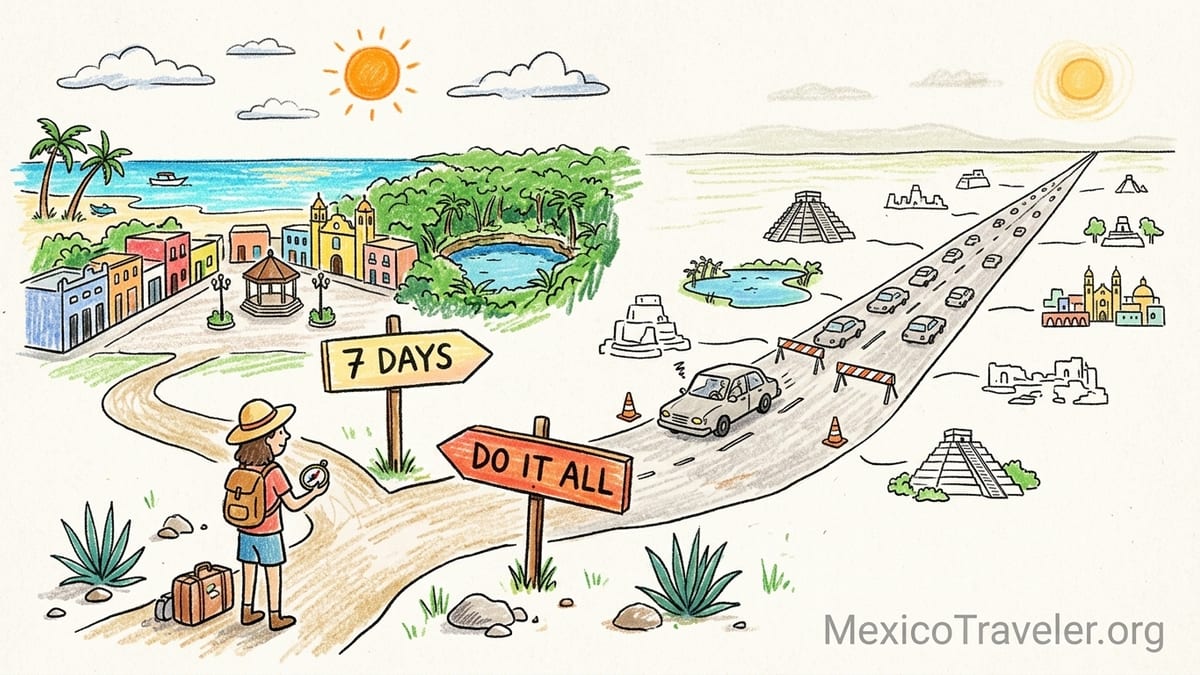
Why You Should Not Try To “Do It All” In Seven Days
On a map, the Yucatán Peninsula looks compact: flat terrain, straight highways and apparently short distances between major stops. In reality, trying to squeeze every big name into one week quickly turns into a blur of packing, check-outs and highway time. A popular wish list might include Cancún, Tulum, Bacalar, Calakmul, Campeche, Mérida, Uxmal, Chichén Itzá, Valladolid and several cenotes. On paper that seems plausible. On the ground, it can mean four to six hours of driving on multiple days, with the car parked more often at gas stations and toll booths than at the beach or ruins.
Local drivers and recent visitors often report that itineraries chaining Cancún, Holbox, Valladolid, Mérida, Uxmal, Bacalar and multiple islands in a single week leave them feeling they only saw highways and hotel lobbies. Several travelers posting their nine or ten day plans that loop the entire peninsula have been told by residents that they will spend a “good portion” of the trip in the car. When you add in time for fuel stops, topes (speed bumps) and occasional construction, a theoretical three-hour leg can easily stretch to four hours door to door.
The point of this guide is to prioritize depth over box-ticking. The 7-day route focuses on the central cultural heartland plus a taste of the Caribbean. The 10-day expansion adds either the Puuc Route and Campeche or the southern lagoon of Bacalar. The 14-day circuit goes deep into the jungle interior around Calakmul and then returns along more of Quintana Roo’s coast. All three options leave room for slow meals, cenote swims and evenings where you are not repacking a suitcase yet again.
Instead of promising that you can see everything, the itineraries below help you choose which type of Yucatán trip you want: culture heavy, beach focused or a balanced loop, with realistic daily distances and costs.
Key Practicalities: Driving, Costs and Where To Start
The peninsula is genuinely driver friendly. Main roads such as Federal Highway 180 and toll Highway 180D between Cancún, Valladolid and Mérida are paved, signposted and largely flat. Typical distances are modest: Cancún to Valladolid is about 160 kilometers with 2 to 2.5 hours of driving on the toll road, Valladolid to Chichén Itzá is around 45 kilometers in about 40 minutes, and Mérida to Uxmal is around 80 kilometers in 1.5 hours via the interior road. The only significantly slower legs are those toward the jungle interior near Calakmul, where the road between Bacalar or Chetumal and Xpujil takes roughly 3.5 to 4 hours for about 250 kilometers because of curves, villages and topes.
Fuel prices in Mexico as of late 2026 tend to hover near the equivalent of about 1.30 to 1.40 US dollars per liter for regular gasoline, depending on exchange rate and station. A compact rental car that averages roughly 14 to 16 kilometers per liter will therefore cost somewhere near 0.09 to 0.10 US dollars per kilometer in fuel. For a 1,000 kilometer loop, that is around 90 to 100 US dollars in gasoline, excluding any tolls. Tolls on the main 180D route are significant. In 2025, the two toll plazas between Mérida and Cancún together added up to around 645 Mexican pesos, with the Valladolid to Cancún section alone costing about 408 pesos; travelers should expect similar or slightly higher levels in 2026 and budget around 35 to 45 US dollars in total tolls if driving the full Mérida to Cancún toll highway in one direction.
Rental car base prices at Cancún International Airport often look low in search results but increase once mandatory liability insurance is included. In the past year, many reputable international brands at Cancún airport have quoted compact cars in the range of roughly 35 to 60 US dollars per day once you add the required insurance and taxes, with seasonal spikes around Christmas and Easter. Local travelers also report that booking direct with a major company and carefully confirming that the quote includes Mexican liability insurance avoids surprises at the counter.
Choosing where to start depends on your priorities. Cancún offers the most frequent international flights, usually lower airfares from North America and Europe, and the largest pool of rental cars, which helps with availability. It is also the easiest launch point if you want your road trip to end with time on the Caribbean coast or on an island such as Isla Mujeres or Cozumel. Mérida has a smaller but growing roster of direct flights, a calmer city arrival experience and quicker access to the cultural heartland around Uxmal, Izamal and the Puuc Route. For itineraries that emphasize archaeology and colonial cities over beaches, flying into Mérida and looping back there can shorten your overall driving time.
Route 1: Seven Days – Valladolid, Chichén Itzá, Mérida and a Caribbean Finish
The 7-day route is designed around two main bases plus brief transitions, which keeps daily driving to two or three hours. It works equally well starting from Cancún or Mérida. Distances below assume a clockwise loop starting and ending in Cancún, but you can invert the order without changing the character of the trip.
Day 1 is arrival in Cancún, pick up of the rental car at the airport and a 2 to 2.5 hour drive of roughly 160 kilometers on the 180D toll road to Valladolid. An early afternoon arrival allows a sunset stroll around Valladolid’s central plaza and a swim in a nearby cenote such as Cenote Zaci or Cenote Oxman. Typical midrange hotels on or near the plaza often price around 70 to 120 US dollars per night for a double room, while simple guesthouses and posadas can be found in the 35 to 60 US dollar range.
Day 2 is devoted to Chichén Itzá and surrounding cenotes. The drive from Valladolid to Chichén Itzá is roughly 45 kilometers and around 40 minutes on the free highway. Many travelers leave before 7:00 to arrive near opening time, both for cooler temperatures and to avoid the largest tour-bus crowds from Cancún and the Riviera Maya. Entrance fees have risen in recent years and now sit in the range of roughly 30 to 35 US dollars per foreign visitor, split between federal and state charges, with additional costs for parking. Nearby cenotes like Ik Kil, Saamal or X’cajum typically charge about 8 to 12 US dollars per person. After a full day of ruins and swimming, driving back to Valladolid keeps things relaxed.
Day 3 runs Valladolid to Mérida, with optional stops in Izamal or at cenotes along the way. The distance is roughly 160 kilometers and about 2.5 to 3 hours of driving, depending on whether you use the toll road. Mérida offers a wider range of accommodations, from budget hostels near the center at about 15 to 25 US dollars per bed, through midrange boutique hotels around 70 to 150 US dollars per room, up to restored mansions on Paseo de Montejo that can cost several hundred dollars per night. Evening in Mérida is well spent enjoying street food and watching live music around Plaza Grande or Santa Lucía.
Day 4 focuses on Mérida itself, with no long-distance driving. You might take a short 20-kilometer drive out to Dzibilchaltún, a compact but atmospheric Maya site with a cenote, or head to the coast at Progreso, about 45 minutes away, then return to Mérida for the night. This day is where the itinerary feels spacious rather than rushed and is exactly what often disappears when travelers try to pack in Bacalar or Campeche within one week.
Day 5 is your archaeology or nature day from Mérida. One option is a loop to Uxmal on the Puuc Route, about 80 kilometers and 1.5 hours each way. Uxmal’s entrance fee for foreign visitors is now similar to or slightly higher than Chichén Itzá, so budgeting around 35 to 40 US dollars per person for entry and parking is prudent. Another option is a day trip to the Celestún biosphere reserve on the Gulf coast, about 100 kilometers and two hours away, for boat tours among mangroves and flamingos that often cost around 25 to 35 US dollars per person when booked on the spot in shared boats.
Day 6 runs Mérida to the Caribbean coast, typically Valladolid and then on to Tulum, Playa del Carmen or Puerto Morelos. Mérida to Tulum via the interior route through Valladolid and Coba is around 325 kilometers and roughly 4.5 to 5 hours without long stops. Mérida to Playa del Carmen via the toll roads is about 290 kilometers and 3.5 to 4 hours, plus rest breaks. If you prefer a lighter day, drive only as far as Valladolid or Playa del Carmen and leave Tulum for another trip. Overnight on the Caribbean coast will cost more than in the interior, with simple hotels in Tulum town often starting around 60 to 90 US dollars per double room and beachfront stays usually well into three figures.
Day 7 is a final morning on the beach, cenote snorkeling in the jungle outside Tulum or Akumal, and the drive back to Cancún Airport. Tulum to Cancún via the coastal highway is about 130 kilometers and 2 to 2.5 hours, though traffic around Playa del Carmen and north of Puerto Morelos can prolong that. This seven-day loop is already full. Trying to cram in Bacalar or Campeche as overnight stops would push several days over five or six hours of driving and leave most stops as brief photo pauses rather than genuine experiences.
Route 2: Ten Days – Adding Either Campeche or Bacalar
With ten days you can sensibly add one additional region to the week-long itinerary, either the Puuc Route and Campeche on the Gulf coast or Bacalar and the southern Caribbean lagoon. Adding both in only three extra days usually makes the route feel pressured again, especially if you also want multiple beach days at the end.
For a culture forward option, extend the seven-day sequence by inserting Campeche between Mérida and your Caribbean stop. From Mérida to Uxmal is about 80 kilometers and 1.5 hours, then from Uxmal to Campeche another 160 kilometers and roughly 2.5 hours along the main road. Spending one or preferably two nights in Campeche allows time to walk the pastel historic center, the sea wall and nearby forts. Midrange hotels along the malecón or within the walled city are often priced between 70 and 130 US dollars per double room. This version of the itinerary might look like: two nights Valladolid, three nights Mérida, two nights Campeche and three nights on the Caribbean coast, with daily driving mostly limited to three to four hours on transfer days.
For a water focused option, use the extra days to reach Bacalar, known for its multi-hued “Lagoon of Seven Colors.” From Valladolid or Mérida, the drive to Bacalar is longer but manageable with an early start. Mérida to Bacalar via Valladolid and the interior road toward Chetumal is roughly 380 to 420 kilometers and about six hours of driving, depending on the route and traffic. Bacalar village has a relaxed, low-rise feel quite different from Cancún or Playa del Carmen. Waterfront guesthouses with direct lagoon access often fall between 100 and 200 US dollars per night for a couple, while simpler town-side hotels cost more in the 50 to 90 US dollar range.
From Bacalar, it is about 250 kilometers and 3.5 to 4 hours to Tulum or around 315 kilometers and roughly 4.5 hours to Playa del Carmen, along Federal Highway 307. That gives you an arc of jungle and lagoon before you rejoin the busier Riviera Maya. A ten-day plan could be structured as two nights Valladolid, three nights Mérida, two nights Bacalar and three nights on the central coast, ensuring at least two full non-driving days on the lagoon and two on the Caribbean.
Whichever expansion you choose, daily driving times remain reasonable. You gain the sense of reaching a new region without resorting to one-night hops. The key is to resist the temptation to insert an extra beach town or island once you have already committed to Campeche or Bacalar. The peninsula will reward you more on a future trip than in a rushed extra stop sliding into an already tight schedule.
Route 3: Fourteen Days – A Full Circuit Via Calakmul and Southern Quintana Roo
With two weeks you can make a much broader circuit that includes Calakmul’s remote jungle pyramids and more of Quintana Roo’s southern coast, while still pacing the trip sensibly. This route works particularly well as a one-way rental from Mérida to Cancún or in reverse, though you can also start and end in the same city with one extra long transfer day.
A balanced clockwise option starting in Mérida might look like this. Days 1 and 2 are spent in Mérida, adjusting to the climate, exploring the historic center and perhaps making a half-day trip to Dzibilchaltún or Progreso. Day 3 is a full-day loop to Uxmal and the Puuc Route, with about three hours of total driving for roughly 160 kilometers.
Day 4 is the longest driving day of the trip, from Mérida to Xpujil or another small town near Calakmul. The distance is roughly 380 to 420 kilometers and at least six hours of driving, often closer to seven once you factor in fuel stops and topes through Campeche’s interior towns. Many recent visitors break this with a lunch stop in Campeche city, then continue on toward Xpujil by late afternoon. Simple hotels and cabanas in Xpujil typically run around 40 to 80 US dollars per night, with air conditioning recommended.
Day 5 is dedicated to Calakmul. The access road from the main highway to the archaeological site is about 60 kilometers of slower jungle driving each way, often taking 1.5 to 2 hours one way. Most travelers arrange a local guide with 4x4 transport from Xpujil, with shared tours commonly quoted in the range of 60 to 100 US dollars per person including entrance, transport and guiding, depending on group size. The reward is climbing towering pyramids that rise above unbroken forest, listening to howler monkeys and seeing very few other visitors compared with Chichén Itzá.
Day 6 runs Xpujil to Bacalar, roughly 250 kilometers and about 3.5 to 4 hours along Federal Highway 186 and then north on 307. One or two full days in Bacalar (days 7 and 8) provide time for lagoon boat tours, paddleboarding or simply relaxing on a lakeside dock. Boat tours sold on the waterfront and through hotels are commonly priced around 25 to 45 US dollars per person for two to four hours, depending on the boat type and route.
From Bacalar, the route continues north through Mahahual or directly to Tulum. Bacalar to Tulum is about 250 kilometers and 3.5 hours, while the detour to Mahahual adds around 100 kilometers and up to two extra hours including the spur road to the coast. Allow at least two or three nights between Tulum and either Akumal or Playa del Carmen for days 9 to 12, so you can alternate between beaches, cenotes and perhaps the Tulum or Coba ruins.
Finally, days 13 and 14 bring you up to Cancún or Isla Mujeres, with the last night either in Cancún’s hotel zone or back in Valladolid if you prefer a quieter colonial finale. Tulum to Valladolid is about 100 kilometers and 1.5 to 2 hours, while Valladolid to Cancún airport via the toll road is again 2 to 2.5 hours. This two-week circuit covers a sizable portion of the peninsula but, by limiting one-night stays, still leaves time for slow evenings and unhurried mornings, which is rarely the case when travelers try to insert Calakmul into a 7-day loop.
Clockwise vs Counterclockwise, One-Way Rentals and Parking
Choosing a direction mostly affects how you balance jet lag, major driving days and your preferred finale. A clockwise loop from Cancún usually heads first to Valladolid and Mérida, then possibly down toward Campeche and Calakmul before swinging up through Bacalar and the Riviera Maya. Counterclockwise, you might begin with Tulum and Bacalar, push inland to Calakmul, then work back through Campeche, Mérida and Valladolid. Many travelers prefer to start with inland culture and finish on the coast, so that long walks around ruins and cities happen before serious beach relaxation. Others want to recover from long flights with immediate sea views. The distances are broadly similar either way.
One-way rentals within the peninsula, for example picking up in Cancún and dropping in Mérida or vice versa, are widely offered by major rental companies. The fees for dropping in another city inside the same region are often lower than cross-country drop-offs but can still add around 50 to 150 US dollars to the total contract, depending on company and season. If your itinerary is strongly one sided, for instance mostly inland with a final week in Mérida, that surcharge may be worth paying to avoid backtracking several hundred kilometers.
Parking is relatively straightforward across the peninsula. In colonial centers like Mérida, Campeche and Valladolid, many hotels offer secure off-street parking included in the room rate or for a small daily fee. Public street parking around plazas is often metered or controlled by informal attendants who help you find a space in exchange for a modest tip. At major archaeological sites such as Chichén Itzá, Uxmal and Tulum, expect to pay a separate parking fee in addition to entrance, usually the equivalent of a few US dollars per vehicle. Coastal towns on the Riviera Maya have tighter parking near beaches, with some commercial lots charging by the hour.
Mobile coverage on the main highways between Cancún, Valladolid, Mérida, Campeche, Bacalar and Tulum is generally solid with major Mexican carriers. Coverage becomes patchier on secondary roads in the interior, especially around Calakmul and rural stretches of Campeche and Quintana Roo. It is wise to download offline maps for the whole peninsula and to keep your fuel tank at least half full before longer stretches of jungle road, where gas stations can be widely spaced.
How the Tren Maya Fits Into a Yucatán Road Trip
The Tren Maya passenger rail line now links key cities across the peninsula, including Cancún, Mérida, Valladolid, Campeche, Tulum and Bacalar, with stations often located slightly outside the urban centers. Sections between Campeche and Cancún began opening from late 2023, with the southern Escárcega to Chetumal corridor following in late 2024. For travelers, this means some long highway legs can be swapped for a train ride, reducing hours behind the wheel and avoiding certain tolls.
For example, you could fly into Cancún, take the train to Valladolid and Mérida, pick up a rental car there for local exploration of Uxmal and smaller inland cenotes, then later return the car and ride another train segment toward Bacalar or Tulum. This kind of hybrid plan works well if you are not comfortable driving on the busiest coastal highway or simply want to rest on longer stretches. Train fares have varied during the opening phase but have generally been competitive with intercity buses, with standard-class tickets between major cities often mentioned in the range of 25 to 60 US dollars depending on distance and service class.
However, the Tren Maya does not fully replace a car for local transfers. The rail route runs on a fixed corridor and stations may lie several kilometers from town centers, beaches or archaeological sites. For instance, reaching Calakmul from the nearest station still requires several hours of road travel. Many cenotes, biosphere reserves and smaller ruins mentioned in these itineraries are not directly on the rail line and remain accessible only by road, whether in a rental car, private transfer or local taxi.
In practice, a mixed road and rail itinerary often works best. You might rely on the train for the long stretch between Cancún and Mérida or between Mérida and Bacalar, then rent a car locally for a few days in each region. This approach can also help travelers uneasy about long-distance driving in a foreign country while still giving them independence for shorter day trips. The key is to check current train timetables and booking systems before you travel, since the schedule and ticketing platforms have evolved during the first years of operation.
Trip Planning for Couples, Families and Archaeology Fans
Couples often prioritize a blend of atmosphere, food and occasional splurge stays. For them, a 10-day version that combines two or three nights in Mérida with a lagoon-front hotel in Bacalar and a final few nights at a quieter stretch of coast such as Akumal or Puerto Morelos can work very well. They may be more willing to pay for boutique hotels, for example a restored mansion in Mérida for around 150 to 250 US dollars per night and a lagoon-front cabana in Bacalar around 150 to 200 US dollars. Driving days of three to four hours are reasonable for two adults sharing the wheel.
Families with young children often benefit from shorter hops and a limited number of base towns. A 7-day plan of two nights in Valladolid, three in Mérida and two on the coast near Tulum or Akumal avoids nightly packing and minimizes long car days. Many family friendly hotels on the peninsula offer pools, breakfast included and free parking, which helps control costs. Attractions such as cenotes near Valladolid, the Mérida Sunday street closures on Paseo de Montejo and smaller ruins like Dzibilchaltún offer more flexible pacing than a strict schedule of back-to-back full-day excursions.
Travelers whose main priority is archaeology more than beaches might dedicate most of a 14-day itinerary to ruins and colonial towns. They could base three nights in Mérida for Uxmal, the Puuc Route and Dzibilchaltún, two nights near Valladolid for Chichén Itzá and Ek’ Balam, two in Campeche for Edzná and the walled city, and three in Xpujil for Calakmul and the Rio Bec sites, leaving only a couple of nights for the Caribbean coast at the end. For this profile, Cancún’s beaches are a bonus rather than the focus, and Mérida is often a more logical arrival point.
At the other end of the spectrum, beach focused travelers sometimes prefer to skip Campeche and Calakmul entirely and concentrate on Valladolid, Mérida, Bacalar and the Riviera Maya. Their road trip becomes essentially a way to stitch together beach and lagoon time with brief inland cultural interludes. This group is often better off starting and ending in Cancún or using the Tulum airport if their flights permit, as that places them immediately on the Caribbean side of the peninsula.
The Takeaway
A successful Yucatán Peninsula road trip is not about how many dots you draw on the map, but how often you can slow down enough to taste cochinita pibil in a market, float in a cool cenote, or listen to a plaza concert in Mérida after dark. In seven days, that usually means choosing a route centered on Valladolid, Chichén Itzá, Mérida and one slice of the Caribbean coast. In ten days, you can either drift farther south to Bacalar or farther west to Campeche without turning the trip into a relay race. With fourteen days, you finally have the time to add Calakmul’s jungle pyramids and more of southern Quintana Roo at a humane pace.
Starting in Cancún maximizes flight options, rental car availability and time at the beach. Starting in Mérida trades some of that convenience for calmer streets on arrival and quicker access to the cultural core of the peninsula. Toll roads save time but add a noticeable cost, fuel remains a significant though manageable expense and the Tren Maya now offers an alternative for some longer segments without replacing the flexibility of a car for local exploration.
Above all, accept that you will not see everything in one trip. Many travelers come back to Yucatán after their first loop, often choosing a different focus the second time, such as the Puuc Route, Calakmul or a deeper exploration of Quintana Roo’s lagoons and reefs. Use the itineraries here as frameworks and adjust them based on what excites you most, keeping daily driving within a realistic range and leaving at least every third day largely free of long transfers.
When you design your road trip that way, the peninsula’s flat roads, reliable services and growing transport options become a platform for discovery rather than a test of endurance, and your memories will revolve less around toll booths and more around jungle dawns, city evenings and the colors of Yucatán’s sky and water.
FAQ
Q1. Is it safe to drive a rental car around the Yucatán Peninsula?
Driving in the Yucatán Peninsula is considered manageable for visitors, with well-paved main roads, clear signage and police checkpoints that are usually routine. The safest experience comes from avoiding night driving on rural stretches, respecting speed limits and topes, keeping valuables out of sight and booking with reputable rental agencies. Interior areas around Calakmul and parts of Campeche involve more isolated roads, so many travelers plan those legs in daylight and share their route and timing with their accommodation.
Q2. How much should I budget per day for a Yucatán road trip?
A realistic midrange budget for two people in 2026 often falls between 180 and 260 US dollars per day, excluding long-haul flights. That might break down as 70 to 130 dollars for accommodation, 40 to 70 dollars for a compact rental car with insurance, 15 to 25 dollars for fuel on driving days, 20 to 40 dollars for entrances and tolls, and 40 to 60 dollars for meals. Budget travelers can trim that by using hostels or simple guesthouses, eating more street food and limiting guided tours, while higher-end trips with boutique hotels and private guides can easily double these estimates.
Q3. Do I need a 4x4 vehicle for these routes?
Most of the itineraries described here can be driven comfortably in a regular compact or midsize car. Highways between Cancún, Valladolid, Mérida, Campeche, Bacalar and Tulum are paved and do not require extra clearance. A 4x4 becomes useful mainly on the access road into Calakmul and on some rougher tracks to remote cenotes or biosphere reserves. Travelers who prefer not to take their rental onto those roads often hire local guides with appropriate vehicles for specific excursions while keeping a standard car for the rest of the trip.
Q4. Can I do this trip without speaking Spanish?
Many people complete Yucatán road trips with only basic Spanish. Staff at rental agencies, larger hotels and major tourist sites usually speak some English, and road signs follow international symbols. However, having at least a few key phrases helps, especially in gas stations, small eateries and rural communities. Downloaded translation apps and offline maps are valuable companions. Learning how to ask for directions, fuel and parking politely can make interactions smoother and often more pleasant.
Q5. Is the Tren Maya a good alternative to the bus or a car?
The Tren Maya offers a comfortable alternative to long-distance buses on certain corridors, particularly between Cancún, Valladolid, Mérida, Campeche, Tulum and Bacalar. It can shorten tiring road days and provide a different perspective on the landscape. However, it does not reach every town or attraction directly, and station locations often require taxis or transfers. For travelers who want maximum flexibility to visit cenotes, smaller ruins and beaches off the main corridor, the train works best as a complement rather than a complete replacement for a rental car.
Q6. When is the best time of year for a Yucatán road trip?
The most comfortable months for driving and sightseeing are generally from December to March, when temperatures and humidity are a bit lower and rain less frequent, although this is also high season with higher prices and more crowds. April and May can be very hot inland around Mérida and Uxmal, while June through October brings more rain and the Atlantic hurricane season, which can affect coastal areas. Many travelers find November and early December or late February and March to be a good compromise between weather, prices and visitor numbers.
Q7. How do entrance fees to ruins and cenotes affect the budget?
Entrance fees form a noticeable but manageable part of the trip cost. Major sites such as Chichén Itzá and Uxmal charge foreign visitors the equivalent of around 30 to 40 US dollars including state and federal components and parking. Smaller ruins like Ek’ Balam or Dzibilchaltún cost less but still add up if you visit several in a short time. Cenote access typically ranges from about 8 to 15 US dollars per person, depending on facilities and whether life jacket rental is included. Over a 10 to 14 day trip, many couples end up spending several hundred dollars on entrances and selected guided tours.
Q8. Are toll roads worth the extra cost?
Toll highways such as 180D between Cancún, Valladolid and Mérida can save significant time compared with the parallel free roads, especially around busier stretches. For instance, Cancún to Mérida on the toll road takes roughly 3.5 hours instead of a longer, village-studded route on the free highway. The trade-off is cost, with the Mérida to Cancún route involving several toll plazas that together come to the equivalent of dozens of US dollars for a round trip. Many drivers choose toll roads for longer transfers and free roads for shorter legs where the time savings are modest.
Q9. What documents do I need for a rental car in Yucatán?
Most rental agencies require a valid driver’s license, a passport, a credit card in the main driver’s name and proof of mandatory Mexican liability insurance, which is often bundled into the rental or added at the counter. An international driving permit is rarely demanded for visitors from North America or Europe if their home license is in Roman script, but some travelers carry one as an extra form of identification. It is also sensible to keep a printed or digital copy of your rental contract and insurance coverage in the car in case of checkpoints or accidents.
Q10. How much should I budget in total for 7, 10 and 14 days?
For two people traveling midrange in 2026, a 7-day Yucatán road trip including accommodation, rental car, fuel, tolls, entrances, a couple of guided tours and meals is commonly in the range of about 1,300 to 1,800 US dollars, depending on hotel category and how many paid activities you add. A 10-day version usually falls between roughly 1,900 and 2,600 dollars, and a 14-day circuit between about 2,600 and 3,600 dollars. Travelers staying in simple guesthouses, using fewer toll roads and cooking some meals can spend less, while those favoring boutique hotels, private guides and waterfront stays will be toward or beyond the upper end of these ranges.