


I had seen the photos of El Castillo surrounded by hundreds of people and selfie sticks, and I knew I did not want that version of Chichén Itzá. So on a warm May morning in 2026, I set an alarm for 5:00 a.m. in Valladolid, pointed my small rental car west in the dark, and tried to reach one of Mexico’s most famous ruins before the first tour buses from Cancún and Mérida rolled in. This is exactly how that early-morning visit unfolded, what it cost, what I would change next time, and why basing myself in Valladolid made all the difference.
Why I Chose Valladolid as My Base
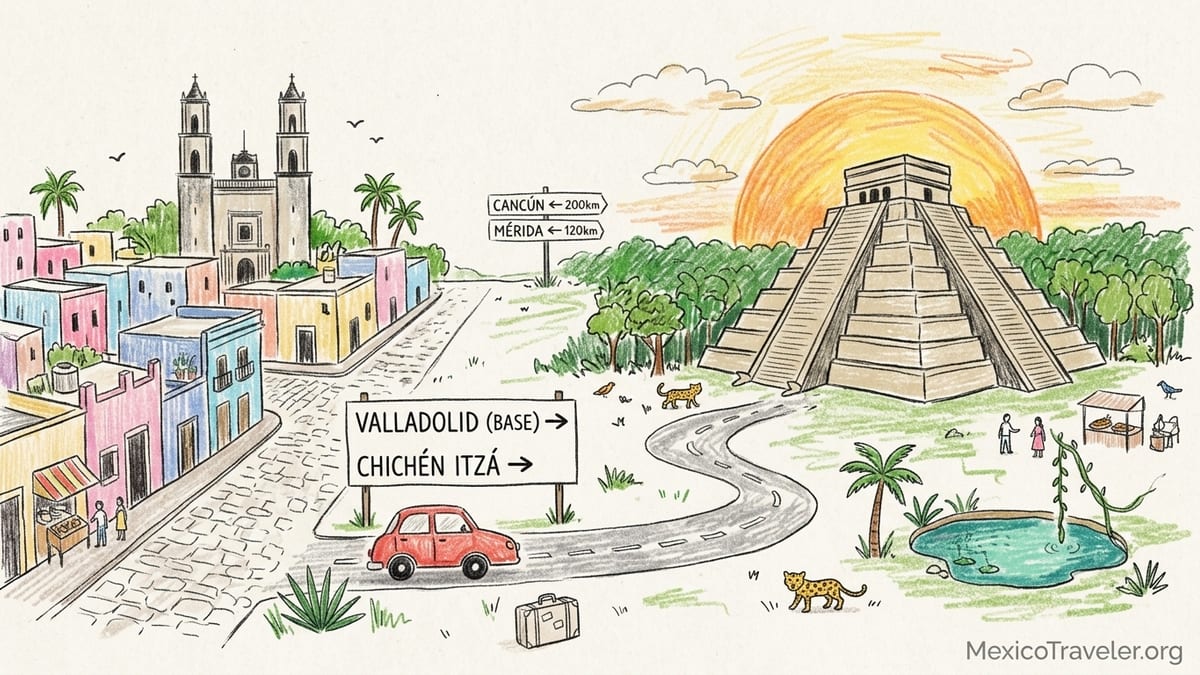
Valladolid is a small, pastel-colored colonial city in eastern Yucatán, roughly 45 kilometers from Chichén Itzá. That distance translates to about a 40- to 45-minute drive along Highway 180, which is short enough to make a dawn start realistic without feeling brutal. By contrast, Cancún is about 200 kilometers away, often three hours by road once you factor in hotel pickups, and Mérida is about 120 kilometers, usually a two-hour drive. Staying in Valladolid the night before was my way of turning Chichén Itzá from a rushed marathon excursion into a half-day trip with room to breathe.
I arrived in Valladolid the previous afternoon and checked into a simple posada a few blocks off the main square, paying around 900 pesos for a fan room with private bathroom. That is typical for the town; Valladolid has everything from 400-peso guesthouses to boutique hotels facing the central park. The key factor was not luxury but location: I wanted somewhere that allowed me to roll out of bed, grab coffee near the plaza, and be on the highway well before sunrise.
Valladolid also felt like a good place to sync into Yucatán time before tackling a major site. I walked around the San Servacio cathedral at dusk, ate cochinita pibil tacos at a stand just off Calle 41, and bought a few liters of water and snacks from an Oxxo convenience store for the next morning. Doing this prep in a small, walkable city was far more pleasant than trying to stock up in Cancún hotel-zone traffic at 5:30 a.m.
Perhaps the biggest advantage of Valladolid, though, was psychological. Knowing that Chichén Itzá was less than an hour away made the early alarm feel manageable. Instead of wondering if a late tour bus pickup or highway traffic would ruin my plan to beat the crowds, I felt in control of the timing from the moment I left my hotel.
The Dawn Departure and Drive to Chichén Itzá
My alarm went off at 5:00 a.m. and by 5:30 I was checked out, coffee in hand, and rolling my small suitcase down the cobblestones to the rental car I had picked up the previous afternoon near Valladolid’s bus station. If you do not want to drive, there are also colectivos and Oriente buses, but those rarely get you to the ruins much before the 8:00 a.m. opening, and they can be slower at that hour. A rental car gave me flexibility to leave when I wanted and later to stop at a cenote on the way back.
Leaving Valladolid in the dark was straightforward. I followed Highway 180 west, a single-carriage road with occasional topes and small villages. At that hour the traffic was mostly local pick-ups and a few long-distance buses. I kept my speed modest because livestock and cyclists without lights are not uncommon in rural Yucatán. The drive took just under 45 minutes, including one brief slowdown behind a truck in a village.
I arrived at the Chichén Itzá parking entrance at about 6:15 a.m., more than an hour before opening. That felt early, but it put me second in line among independent travelers. Over the next 45 minutes a handful of other cars and two small vans arrived, but the big tourist buses from the coast did not show up until closer to 8:30 a.m., long after I was inside the site.
Waiting in the car park turned out to be peaceful rather than boring. The parking attendants arrived around 7:00 a.m., opened the barrier, and began collecting the fee. I paid 120 pesos to park a small car for the day, which is the going rate in 2026 for private vehicles in the official lot. There were shade trees along the far edge of the parking area, and I moved my car there once the gates opened to keep the interior from turning into an oven before I returned.
Tickets, Fees and Getting Through the Gate
Chichén Itzá has a slightly confusing ticket system because the entrance price is split between a federal fee collected by Mexico’s National Institute of Anthropology and History (INAH) and a separate state fee collected by Yucatán. In mid‑2026, the combined cost for international adult visitors worked out to roughly 40 to 45 US dollars when converted from pesos. On the morning of my visit, I paid just under 800 pesos at the Yucatán counter and a little over 100 pesos at the INAH window, for a total close to 900 pesos per person, plus parking.
The process goes like this. Once the main gate opens at 8:00 a.m., you first pass through a small security check where bags are visually inspected. Staff look for prohibited items such as alcohol, weapons, illegal substances, and flammable products. Tripods and bulky camera gear are sometimes questioned, because INAH treats professional photography and videography differently from regular tourist photos. From there you walk into a shaded courtyard with several ticket booths. One line is for the state fee and another for the federal INAH ticket. You need both receipts to enter the archaeological zone.
Because I was among the first to arrive, I was through security and ticket purchase in less than 10 minutes. By 8:15 a.m. I was already walking down the main path toward El Castillo. When I looked back at the entrance around 8:30 a.m., however, I saw the ticket lines thickening with day-trippers. Later in the morning, according to staff I spoke with, queues can stretch back into the courtyard and easily cost visitors 20 to 40 minutes, especially when multiple tour buses arrive at once. Arriving before opening made a clear, practical difference.
One cost decision I made at the gate was about guide services. Just beyond the ticket control, several licensed guides with official badges were waiting and offered their services in Spanish and English. Rates in 2026 often range from about 1,000 to 1,500 pesos for a private two-hour tour for two or three people, with slightly less per person if you join a small group. I chose to hire a guide for the first hour and then explore independently, which allowed me to get solid context near the main monuments without committing my entire morning to a fixed route.
First Light on El Castillo and the Great Plaza
My first view of El Castillo, also known as the Temple of Kukulcán, came just after 8:20 a.m. I walked out of the shady path and into the huge grassy plaza, and the pyramid rose from a light morning mist, almost unoccupied. There were perhaps twenty people spread across the entire space, most of them hugging the perimeter path. For a few quiet minutes, it felt like the world-famous pyramid belonged to a small, scattered group rather than a festival crowd.
Historically, El Castillo is a stepped pyramid likely completed in the Postclassic period and associated with the feathered serpent deity Kukulcán, a Yucatec Maya counterpart of the central Mexican Quetzalcóatl. INAH and UNESCO descriptions explain that it embodies a sophisticated Maya calendar: 91 steps on each of the four sides plus the top platform add up to 365, the number of days in the solar year. During the equinox periods, the sun creates a play of light and shadow along the northern staircase that resembles a serpent descending to the ground.
As of 2026, climbing El Castillo is strictly prohibited. Barriers surround the base, and after repeated high-profile incidents of tourists trying to ascend the steps, authorities have reinforced distance rules and vigilance. Visitors must admire the structure from the ground and are required to respect the cordoned-off zones. To me, seeing the pyramid quietly from the grass in the early light, without crowds pressing against the ropes, felt more respectful and photogenic than any scramble up its steps could have been.
I spent about 40 minutes in the main plaza with my guide, circling El Castillo slowly. We stopped at angles where you can see how the nine terraces stack, how the corner serpent heads frame the stairway, and how the temple at the top aligns visually with other buildings on the site. That deliberate, unhurried walk would have been far more difficult after 10:00 a.m., when the plaza began to fill with hundreds of people and vendors calling out from the edges.
Walking the Great Ball Court and Temple of the Warriors
From the main plaza, we walked northwest to the Great Ball Court, which opens off a broad sacbe, or raised causeway. The scale is what hits you first. At about 168 meters long and 70 meters wide, this is the largest known ball court in Mesoamerica. Standing near one end in the early morning, I could hear my guide’s voice echo clearly off the vertical walls even when he moved far down the field. That acoustic effect is one of the court’s striking features and part of why it feels so theatrical.
INAH’s interpretation panels explain that the Mesoamerican ballgame, known as pitz in Classic Maya, was both sport and ceremony. Teams struck a heavy rubber ball using hips and sometimes forearms, aiming to pass it through stone rings mounted high on the court walls. At Chichén Itzá the relief carvings show richly dressed players and, in some scenes, decapitated figures, which suggests that ritual sacrifice was symbolically or directly linked with the game. How literally that imagery reflects routine practice is still debated by archaeologists, but the association between the ballgame, rulership and cosmology is well documented.
I allotted about 30 minutes for the Great Ball Court. That gave time to walk its length, examine the carvings, and step into the small temple structures at both ends. Even by 9:30 a.m., when we were there, the court remained quieter than the main plaza. The wide layout allowed people to spread out, so it was easy to find stretches of wall to study in relative silence.
From there, we continued south and east toward the Temple of the Warriors and the adjacent forest of columns often called the Group of a Thousand Columns. This complex is impressive because of its density: a broad stepped pyramid fronted by rows upon rows of square limestone columns that once supported a large roofed hall. At the top sits a chacmool statue and a small temple, though access is restricted behind barriers to protect the fragile stone.
The Temple of the Warriors likely served as a major civic-ceremonial center in the Late to Terminal Classic period. Archaeologists see influences from central Mexico in its sculptural style, including warrior figures and feathered serpents, which fits Chichén Itzá’s role as a cosmopolitan power in the region. I spent another 35 to 40 minutes here, weaving through the columns for photographs and pausing in any available shade. By now, around 10:15 a.m., the sun was already fierce and the crowds around El Castillo had thickened noticeably, confirming how valuable those first quiet hours had been.
El Caracol, Heat, Shade and Walking Comfort
After thanking and tipping my guide near the plaza, I continued alone toward the southern part of the site, where El Caracol stands slightly apart from the main clusters of monuments. The walk from the Temple of the Warriors to El Caracol took about 10 minutes along a mostly flat dirt and gravel path, with low scrub and a few broader trees providing intermittent shade. Good walking shoes were essential here. Sandals would have been possible but not as comfortable once small stones started working into the soles.
El Caracol, often called the Observatory, is a round tower on a rectangular platform, with staircases and windows that appear to align with astronomical events. INAH and UNESCO materials describe it as an example of Maya interest in tracking celestial bodies, especially Venus, although exactly how it functioned in daily practice is an active area of research. The spiral interior staircase that gives the structure its name is not accessible to visitors, and like other major buildings, climbing is not allowed. Instead, you view it from a modest distance, appreciating its unusual circular form amidst mostly rectilinear architecture.
By the time I reached El Caracol, around 10:45 a.m., the temperature felt well above 30 degrees Celsius. The relative lack of high, dense tree cover inside the core of the site means that shade is patchy. I found relief under occasional ceiba and other broad-leafed trees along the paths, but large parts of the walk were in full sun. A wide-brimmed hat, sunscreen, and at least two liters of water per person made the difference between a pleasant, if sweaty, visit and the onset of heat exhaustion.
In total, I spent just under three and a half hours inside Chichén Itzá. That included the guided portion near El Castillo and the Great Ball Court, an independent loop past the Temple of the Warriors, El Caracol and several smaller complexes, and short pauses in shade to drink water and regroup. By the time I started walking back toward the entrance just after 11:30 a.m., tour groups were flowing steadily through the paths, and the quiet early ambiance had definitively shifted to something more like a crowded festival.
Guided Tour or Independent Exploration?
One of the most common decisions at Chichén Itzá is whether to hire a guide or wander alone with a guidebook and posted explanations. Having now done both in a single morning, I found that a hybrid approach worked best. During the first hour, my licensed guide walked me around El Castillo, the Great Ball Court and the Temple of the Warriors, anchoring each stop in verifiable archaeological information rather than speculation about human sacrifices or mystical energy.
He drew directly on INAH’s signage and official narratives, explaining, for example, how the ballgame reliefs at Chichén Itzá depict decapitation scenes that signal the ritual importance of the game, without insisting that every match ended in death. He pointed out the alignment of El Castillo’s steps with the solar calendar and described how archaeologists identified construction phases inside the pyramid. That grounding in research-based interpretations kept the stories vivid yet responsible, something that not all informal “guides” or unlicensed hawkers in the region consistently provide.
Exploring independently afterwards had its own strengths. Without a fixed route, I could linger at carvings that interested me or step away from the busiest areas to quieter corners. The signage in Spanish and English around the site is decent and, combined with a pre-downloaded map on my phone, made it easy to navigate. The trade-off was depth. I would not have understood the acoustic design of the Great Ball Court or the architectural influences in the Temple of the Warriors as clearly without that earlier guided explanation.
In terms of cost, hiring a guide at roughly 1,200 pesos for a one- to two-hour private tour added a significant but worthwhile amount to the overall budget, which also included entrance fees and transport. Talking with other visitors later in the parking lot, I heard from one couple who skipped a guide entirely and felt slightly lost in the sheer scale of the site, and from a group that joined a larger 250-peso-per-person tour but struggled to hear the explanations in the growing noise of the late morning crowds. If your budget can stretch to it, I would recommend a licensed guide for at least the first hour, ideally starting right at 8:00 a.m. before the site becomes loud and hot.
Rules, Photography, Prohibited Items and the Museum
Chichén Itzá is heavily visited and carefully regulated, so it is worth understanding what you can and cannot do before you arrive at the gate. Climbing on any structures, including El Castillo, the Temple of the Warriors, and the platforms around the Great Ball Court, is not allowed. Barriers and ropes make this visually obvious, and guards are quick to intervene when visitors attempt to cross them. Recent widely reported incidents of tourists ignoring these rules have only tightened enforcement. Touching carvings or leaning against fragile stone is also discouraged to slow erosion.
Photography for personal use is broadly permitted. Smartphones and regular cameras are fine, and as of 2026 there is no extra fee attached to bringing a standard DSLR or mirrorless camera into the site for non-commercial purposes. However, drones are banned, and professional filming or commercial shoots require prior authorization from INAH. Tripods, monopods and stabilizing rigs fall into a gray zone. On the morning of my visit, staff at the ticket booth explained that a small tripod could be brought in if I purchased a modest permit sticker, which cost a few dozen pesos, but that they reserve the right to restrict the use of larger setups or extensive accessories that might obstruct paths or signal commercial intent.
Bag checks at the entrance target a specific list of prohibited items. Alcohol, weapons, fireworks and other flammables are not allowed. Staff may also refuse entry to visitors carrying oversized banners, commercial signage or costumes, especially during special events, to keep the focus on the heritage site rather than private promotions. Importantly, cigarettes, including electronic versions, are increasingly restricted across many archaeological zones, in line with broader public health rules and fire prevention policies. Bringing a small daypack with water, sunscreen, and a hat is fine, but expect security to open it for inspection.
As for museums, the Gran Museo de Chichén Itzá sits near the site and is designed to showcase artifacts and context that cannot be fully appreciated among the ruins. The museum presents pieces recovered from the Sacred Cenote and other structures, along with multimedia exhibits about Maya cosmology and daily life. Its operating hours can vary, including occasional closures announced by cultural authorities, so it is wise to check at the site entrance or with local tourism offices in Valladolid before planning your day around it. On my visit, the museum was open on a standard daytime schedule, but I chose to focus my limited cool hours in the archaeological zone itself and leave the museum for a future trip.
One surprise element inside Chichén Itzá was the presence of many souvenir vendors along the internal paths. Stalls selling carved jaguars, obsidian-like stones, textiles and other trinkets line large sections of the walkways. While some visitors enjoy browsing them, others, including me, find the constant calls from sellers a distraction from the sense of antiquity. This is another reason an early arrival helps; vendors are still setting up in the first hour or so after opening, and the sales pitches peak later in the morning when the buses arrive.
Pairing the Ruins with Ik Kil or a Quieter Cenote
After leaving the site just after noon, legs dusty and water bottles nearly empty, I drove a few minutes further along the highway to Ik Kil cenote. Ik Kil lies roughly 3 kilometers from Chichén Itzá, close enough that many packaged tours include the two as a combo. In 2026, entry purchased directly at the gate is around 240 pesos per adult, which usually covers access to the cenote, a life jacket and a locker, with more expensive buffet packages adding lunch in the on-site restaurant.
By arriving shortly after midday on a weekday, I hit what local operators acknowledge is the start of the busiest window. There were perhaps a hundred people in and around the water: families in orange life jackets, small groups lining up at the carved stone steps leading down, and couples photographing each other from the upper viewing platforms. Life jackets were included in the entrance price during my visit and were mandatory for swimmers. Facilities were comprehensive, with clean changing rooms, showers, lockers and a large parking lot. It felt efficient and safe, but not particularly tranquil.
Swimming in Ik Kil was still a pleasure after a hot morning among the ruins. The water was cool without being shocking, and looking up from the cylinder of the cenote to the circular patch of sky framed by vines and roots was impressive. Yet the sheer number of people and the frequent whistles from staff directing swimmers reminded me that this is a highly managed, high-volume attraction. After about 45 minutes in the water and another 15 minutes drying off and changing, I felt ready to move on.
If I had the day to plan again purely for myself, I would probably choose a quieter cenote instead of or in addition to Ik Kil. Valladolid is surrounded by them. Places like Cenote X’kekén and Samulá near Dzitnup, or cenotes along the road toward Mérida, tend to be less crowded early in the day and offer a calmer, more cavernous experience. They may have fewer facilities, but still provide lockers, basic bathrooms and optional life jackets for rent. The trade-off is that they require a bit more independent logistics, either by rental car or taxi, whereas Ik Kil fits simply and conveniently onto a Chichén Itzá outing.
Return to Valladolid and What I Would Change Next Time
After leaving Ik Kil around 2:00 p.m., I pointed the car back toward Valladolid. The return drive took under 40 minutes, helped by lighter midday traffic, and I rolled into town at about 2:45 p.m. That timing meant I could check into a fresh hotel room for a shower and late lunch, with the entire late afternoon and evening still free to wander Valladolid’s streets and cenotes on the town’s outskirts.
From hotel door to hotel door, my Chichén Itzá excursion from Valladolid filled roughly nine hours, including the dawn departure, three and a half hours inside the ruins, about an hour and a half at Ik Kil, and driving time. It felt full but not frantic. Compared with the 12- to 14-hour days common on group tours from Cancún, which often start before dawn and get back after dark, this schedule preserved energy and left space for serendipitous wandering.
Looking back, there are a few things I would adjust next time. First, I would bring even more water. I started with two liters and refilled a small bottle at a concession stand near the entrance, but the combination of heat, walking and sun meant I could have easily gone through three or four liters over the course of the visit. Second, I would pack a light, long-sleeved shirt to protect my arms and neck from sun exposure without relying entirely on sunscreen, which needs frequent reapplication when you sweat heavily.
The main strategic change is that I would probably skip Ik Kil on the same day as Chichén Itzá and instead head back to Valladolid sooner, perhaps to visit one of the cenotes closer to town in the late afternoon. There is something appealing about closing the loop by cooling off in a more secluded pool after returning from the ruins, rather than jumping from one busy site to another. I would also consider adding the Gran Museo de Chichén Itzá either the afternoon before or the day after, so that the artifact-rich indoor experience brackets the open-air visit without competing with the prime cool hours of the morning.
The Takeaway
Beating the tour bus crowds at Chichén Itzá is less about clever secrets and more about simple geography and timing. By spending the night in Valladolid, setting a 5:00 a.m. alarm, and being parked outside the site well before opening, I was able to experience the Great Plaza, El Castillo, the Great Ball Court and the Temple of the Warriors in relative quiet and mild morning light. By the time the first large tour groups began flooding in after 9:30 or 10:00 a.m., I had already covered most of the central monuments and was heading toward the quieter southern sector.
In concrete terms, visiting from Valladolid meant a manageable 45-minute pre-dawn drive, about 900 pesos in combined federal and state entrance fees, 120 pesos for parking, and optional guide costs in the 1,000- to 1,500-peso range for a focused one- to two-hour tour. It also meant flexibility to pair the ruins with a cenote stop of my choice and still arrive back in town early enough to enjoy a relaxed late lunch. The physical experience of the visit was defined by strong sun, limited shade, and long periods on uneven paths, which underscored the value of good footwear, a hat and ample water.
Compared with visiting from Cancún or Mérida on a standard group excursion, basing in Valladolid felt genuinely better. It reduced total transit time, gave me control over my schedule, and allowed for a more intimate first impression of one of the world’s best known archaeological sites. While tour buses from the coast provide convenience and bundled pricing, they almost always arrive after opening, when the site is already busy and the heat quickly builds. Valladolid, by contrast, offers a balanced mix of proximity, local charm and logistical ease.
If you are planning your own trip and Chichén Itzá is a priority, consider flipping the usual model. Instead of asking how to squeeze the ruins into a beach holiday, ask how you can center at least one day around them, with Valladolid as your launchpad. From there, an early-morning visit, verified historical context from licensed guides, and a thoughtful choice of cenote or museum will give you a version of Chichén Itzá that feels informed, respectful and, at least for the first few hours, surprisingly peaceful.
FAQ
Q1. What time should I leave Valladolid to arrive at Chichén Itzá before the crowds?
Leaving Valladolid around 5:30 to 6:00 a.m. usually puts you at the parking entrance by 6:15 to 6:45 a.m., comfortably ahead of the 8:00 a.m. opening and well before the first large tour buses from Cancún or Mérida begin arriving after 9:30 a.m.
Q2. How much does it cost to visit Chichén Itzá in 2026, including all fees?
For international adult visitors, expect to pay close to 900 pesos in combined federal and state entrance fees, plus about 120 pesos for parking a private car. Guide services add roughly 1,000 to 1,500 pesos for a private one- to two-hour tour, depending on language and group size.
Q3. Can I climb El Castillo or any other structures at Chichén Itzá?
No. Climbing is prohibited on El Castillo, the Temple of the Warriors and other major structures. Barriers and ropes clearly mark the restricted areas, and guards actively enforce the rules to protect both visitors and the fragile stone architecture.
Q4. Are tripods, drones and professional cameras allowed inside the site?
Drones are not allowed, and professional filming requires prior authorization from INAH. Regular cameras and smartphones are fine for personal use. Small tripods or monopods may be allowed with a low-cost permit sticker purchased at the entrance, but very large rigs can be restricted, so it is best to travel light with camera gear.
Q5. What are the bag and prohibited item rules at the entrance?
Security staff inspect bags and may deny entry to alcohol, weapons, fireworks, flammable products, illegal substances, and large commercial banners or costumes. Small daypacks with water, sunscreen and personal items are allowed, but expect them to be opened for inspection, and note that smoking is increasingly restricted or banned across archaeological zones.
Q6. Is it better to hire a guide at Chichén Itzá or explore independently?
Hiring a licensed guide for at least the first hour gives you solid archaeological context for key areas like El Castillo, the Great Ball Court and the Temple of the Warriors. After that, independent exploration works well for revisiting favorite spots and wandering lesser-known areas at your own pace.
Q7. How much time should I plan to spend inside Chichén Itzá?
Plan on at least three hours inside the archaeological zone if you want to see the main monuments without rushing. Four hours allows time for a short guided tour plus independent wandering, with breaks in what limited shade is available.
Q8. Is pairing Chichén Itzá with Ik Kil cenote worthwhile on the same day?
Yes, if you want a convenient way to cool off and do not mind sharing the water with many other visitors. Ik Kil is only a few minutes’ drive from the ruins and offers lockers, life jackets and full facilities, but it can be very crowded by midday. For a quieter swim, consider cenotes closer to Valladolid instead.
Q9. Is the Gran Museo de Chichén Itzá open and worth visiting?
The Gran Museo de Chichén Itzá near the site showcases artifacts and interpretive exhibits linked to the ruins, and it is a valuable complement to the outdoor visit when open. However, hours and occasional closures can vary, so it is best to confirm current status locally before planning your schedule around it.
Q10. Is it really better to visit from Valladolid than from Cancún or Mérida?
For beating the crowds, yes. Valladolid is only about 45 minutes from the site, which makes a dawn start realistic and puts you at the gate before opening. Tours from Cancún and Mérida often arrive later in the morning, when the sun is harsher and the site is already busy, although they can still suit travelers who prioritize convenience over quiet conditions.