


The Tren Maya has shifted from ambitious mega-project to a real transport option across the Yucatán Peninsula. By late 2026, services link Cancún Airport with Valladolid, Chichén Itzá, Mérida-Teya, Campeche, Bacalar, Tulum and more, and the key corridor between Cancún and Playa del Carmen has reopened with the new Tren Maya Conecta feeder buses. This guide focuses on how the system actually works on the ground in 2026, so you can decide when the train is genuinely useful, how to reach stations from airports and city centers, what it costs compared with ADO buses or rental cars, and how to plan realistic journeys around the peninsula.
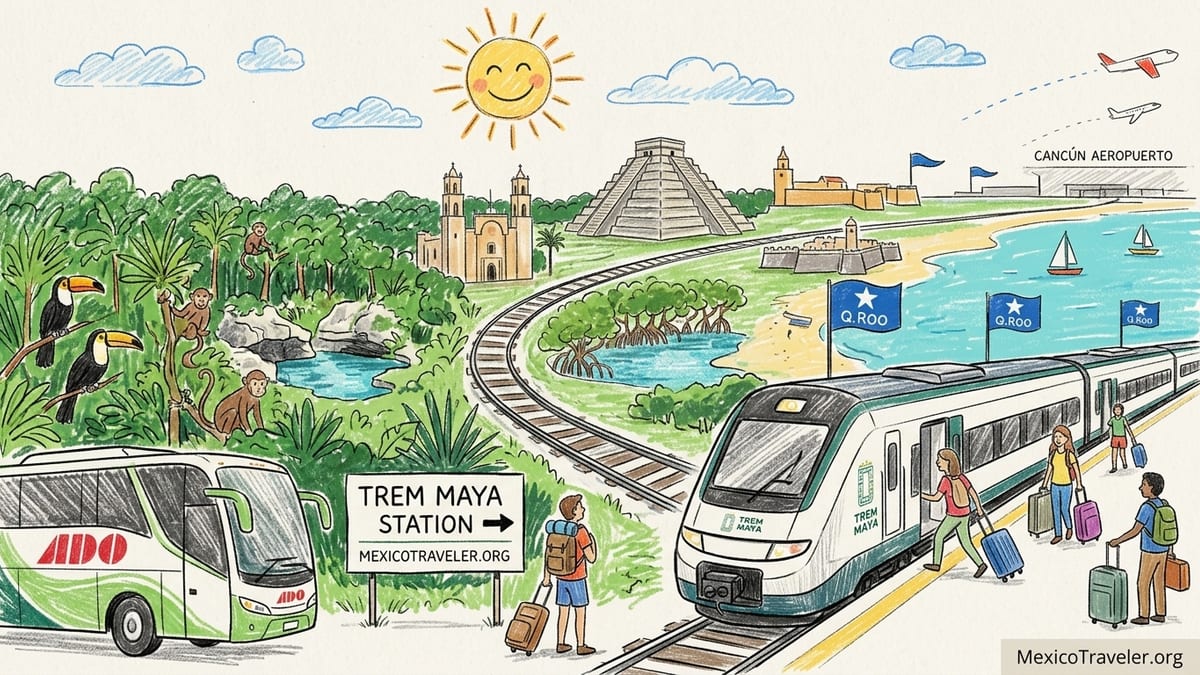
How the Tren Maya network works in 2026
By October 2026, the Tren Maya operates as a mixed tourist and regional system that roughly circles the Yucatán Peninsula. For most visitors the useful arc runs from Cancún Airport down the Caribbean coast to Playa del Carmen and Tulum, then inland to Bacalar and Chetumal, and west toward Campeche and Mérida-Teya before returning through Valladolid and Chichén Itzá to the Caribbean coast. In practice, you will rarely ride the full loop. Instead, think of the Tren Maya as a set of medium-distance links between hubs such as Cancún Aeropuerto, Valladolid, Chichén Itzá, Mérida-Teya, San Francisco de Campeche, Bacalar and Tulum.
The main operational pattern in 2026 combines long-distance trains that run across several states with shorter regional segments. Cancún Aeropuerto acts as a key gateway station, with frequent departures toward Valladolid and Mérida-Teya and at least several departures daily toward Tulum and Bacalar. The relaunch of the Cancún–Playa del Carmen segment on 15 August 2026 restored service on one of the busiest travel corridors in Quintana Roo, with four daily trains and scheduled morning departures in each direction. That link is particularly aimed at people commuting between the Riviera Maya resorts and Cancún but is also useful for travelers continuing farther along the line.
From the northwest, Mérida-Teya station is the main hub for Yucatán state. It connects by rail eastward to Izamal, Chichén Itzá and Valladolid, and westward and southward to Maxcanú, Uxmal area stops and on toward San Francisco de Campeche. Bacalar and Tulum function as southern Quintana Roo gateways, making it possible to travel by train between the Costa Maya and major archaeological sites or on toward Campeche and Mérida without flying. Schedules and service patterns continue to evolve, so it is essential to recheck exact timings on the official Tren Maya channels close to your travel date.
Although marketing often shows sleek maps of a perfect circular route, what you will experience as a traveler is a set of discrete segments with varying frequency and different connection qualities. Some legs, like Cancún Aeropuerto to Valladolid or Mérida-Teya to Campeche, work smoothly as point-to-point journeys. Others, such as Tulum to secondary stations or small communities, may require long taxi or colectivo transfers from the station to your final destination. Understanding where the train is strong and where last-mile transport is weak is the key to planning a stress-free itinerary.
Tickets, passenger categories, luggage and onboard experience
Tren Maya tickets are sold through the official online platform and at station ticket counters. Fares vary based on the route, advance purchase, and passenger category, with discounts available for Mexican residents, seniors and students when booking through official channels. As of late 2026, pricing for long legs such as Cancún Aeropuerto to Mérida-Teya generally sits above an ordinary ADO bus fare but below or roughly comparable to premium ADO GL or Platino classes, while short hops like Cancún Aeropuerto to Valladolid or Cancún to Playa del Carmen are positioned competitively with regional buses and shared shuttles. Exact peso amounts change with periodic revisions, so treat examples as indicative and confirm current prices during booking.
There are several passenger categories that influence price. Standard tourist or turista class is the baseline product and what most foreign visitors will use. Premier or business-style seating, when offered, provides roomier seats and more legroom at a surcharge, mainly on longer-distance services. Mexican citizens and residents with valid ID, INAPAM card holders and certain student groups can access reduced fares according to official policies. Infants under three years may ride without their own seat in some cases, while additional small children require paid tickets at the lowest available fare, under rules set out in the official contract of carriage.
Luggage rules are clearly defined and relatively generous for a rail service. According to the official conditions, each passenger can carry up to three pieces of luggage with a combined weight of around 50 kilograms without extra charge, including one general checked-style bag, one cabin-size suitcase of around 10 kilograms and one personal item such as a backpack or handbag. Dimensions are specified in the terms and conditions and are broadly similar to airline cabin and checked baggage standards. There is no formal checked baggage system as on airlines, so you are responsible for moving and stowing your own bags in overhead racks or dedicated luggage areas inside each car.
On board, the Tren Maya experience sits somewhere between a modern intercity train and a high-end coach. The rolling stock, branded under configurations such as Xiinbal and other variants, offers air conditioning, reclining seats, power outlets at or near the seats on most services, and onboard toilets. Some trains feature a café-bar car where you can buy snacks, soft drinks and, on certain services, branded craft beer and simple hot items. Wi-fi availability can be intermittent and is not guaranteed, so plan on using offline entertainment. Overall comfort is above that of a standard bus, especially on daytime runs where wide windows give broad views of jungle, mangroves and lowland countryside across Campeche, Yucatán and Quintana Roo.
Key stations: from Cancún Airport to Valladolid, Chichén Itzá, Mérida-Teya, Campeche, Bacalar and Tulum
The single most important station for international visitors is Cancún Aeropuerto. The station lies close to the airport complex, and airport signage and shuttle connections have improved steadily since the first trains began running. In practical terms, travelers arriving at Terminals 2, 3 or 4 can follow signs or ask staff for the Tren Maya shuttles that link the terminal curbsides to the station area. Depending on traffic and the terminal, transfer time is usually between 10 and 20 minutes. Since trains do not depart every few minutes, you should factor in immigration, baggage claim, customs and the shuttle transfer when deciding which departure to book, and allow a comfortable buffer of at least two hours between scheduled landing and train departure.
Valladolid station is one of the most useful intermediate stops along the Cancún to Mérida-Teya axis. It lies outside the colonial center, so after you alight you will need a taxi or pre-booked transfer into town. The ride typically takes around 15 to 20 minutes depending on traffic and the exact location of your hotel. Valladolid is the closest major town to Chichén Itzá for many visitors, but there is also a dedicated Chichén Itzá Tren Maya station adjacent to the archaeological complex. From that station, shuttles and local taxis cover the final stretch to the entrance and visitor facilities of the site, making it a realistic day trip by train from Cancún Aeropuerto, Valladolid or Mérida-Teya if schedules line up.
Mérida-Teya is the main rail hub for the Yucatán state capital. It is located outside the traditional historic center, near the eastern edge of the metropolitan area. To reach central Mérida, you currently rely on taxi services, ride-hailing vehicles where available, or the Ie-Tram and bus network. Travel time into the historic center or the Paseo de Montejo hotel zone is around 25 to 40 minutes, depending on traffic and chosen route. On the western side of the loop, San Francisco de Campeche station connects the capital of Campeche state to the network, again via taxis and local buses into the fortified historic core and seafront malecón area.
Farther south, Bacalar and Tulum stations serve some of the peninsula’s most popular beach and lagoon destinations. Both stations are set outside the busiest hotel zones, so short taxi rides are part of almost every journey. From Tulum station, the drive to beachfront hotels along the famous hotel strip or to Tulum town center typically ranges from 15 to 30 minutes. In Bacalar, guesthouses and small hotels cluster along the lagoon shore, generally 10 to 20 minutes by taxi from the rail station. Future expansions of tram and shuttle networks may gradually improve these last-mile links, but in 2026 you should still budget both time and money for station transfers when comparing the train with direct buses or private transfers.
Tren Maya Conecta, station transfers and real last-mile logistics
The weak point of many large-scale rail projects is the gap between stations and where people actually want to go. In response, authorities in Quintana Roo launched Tren Maya Conecta in August 2026, timed with the reopening of the Cancún–Playa del Carmen rail segment. This intermodal service consists of coordinated bus and shuttle routes linking Tren Maya stations with key urban areas and tourist zones in Cancún and Playa del Carmen, including the international airport, downtown terminals and selected hotel districts. It is designed to let workers and visitors ride the train, then continue their journey without relying exclusively on taxis.
Practically, a traveler arriving on a morning train from Playa del Carmen to Cancún can transfer to a Tren Maya Conecta bus that runs toward the airport terminals or downtown Cancún, and from there make their way to the hotel zone or ferry piers to Isla Mujeres. Similarly, trains arriving at Playa del Carmen connect with buses and shuttles that serve neighborhoods and resort zones beyond walking distance of the station. The intermodal fares are set to be affordable for residents and commuters, and are sold separately from the train tickets, although integrated ticketing may evolve over time. Service frequency for the buses aims to reflect the main train arrival and departure banks, reducing waiting times to a tolerable level for most users.
Outside the specific Tren Maya Conecta corridors, last-mile travel remains dominated by regular taxis, app-based ride services where permitted, hotel shuttles and colectivos. At Valladolid, Chichén Itzá, Mérida-Teya, Campeche, Bacalar and Tulum, travelers should expect to find taxi ranks near station exits, though actual vehicle availability varies by time of day and season. For example, after a popular evening departure from Mérida-Teya or a morning arrival at Chichén Itzá, there may be queues for taxis or informal transfers. In quieter periods, you might instead encounter drivers actively soliciting passengers as you leave the platforms.
When comparing costs, it is important to fold these local transfers into your calculation. A ticket from Cancún Aeropuerto to Mérida-Teya that appears cheaper than a premium ADO GL bus may end up more expensive door to door once you add a taxi from Mérida-Teya to your hotel. The same is true for Bacalar and Tulum, where the combination of Tren Maya fare plus two taxi trips sometimes exceeds the price of a direct bus that drops you at a central terminal. On the other hand, for point-to-point trips along the rail corridor, especially between Cancún, Playa del Carmen and Tulum, the combination of a train ride and a short Tren Maya Conecta shuttle can provide a fast, reasonably priced alternative to highway buses clogged in traffic.
Booking, schedules, train types and connections
In 2026, the most reliable way to book Tren Maya tickets is directly through the official digital channels and station ticket offices. Third-party tour operators and agencies bundle rail segments into packages to archaeological sites or multi-day experiences, but for simple one-way or round-trip travel it is safer to buy from the operator to ensure accurate passenger data, easier changes and clear application of official luggage and refund policies. The rail company periodically offers promotional codes and discounts for selected routes and dates, often advertised on its home page and station posters, which can reduce fares by around ten percent or more.
Schedules are dynamic, and adjustments are common as the operator learns where demand is strongest and as infrastructure projects along the route progress. Before committing to nonrefundable hotels or flights based around a rail connection, you should always verify departure times on the official channels in the days leading up to travel. As of late 2026, the Cancún–Playa del Carmen corridor runs four services daily, with at least two departures scheduled in the morning and additional runs later in the day. Long-distance trains linking Cancún Aeropuerto, Valladolid and Mérida-Teya, and services between Mérida-Teya and Campeche, typically run several times per day, though frequencies can be lower on certain days of the week.
Train types are tailored to route profiles. Standard Xiinbal-style sets handle most regular services, with configurations that balance seating capacity and comfort. On a handful of heavily touristic routes, trains may include enhanced café service or upgraded seating sections branded as premium or first. The company’s contract of carriage also sets out policies on changes, cancellations and disruptions, generally allowing modifications subject to fare conditions and, in the case of operator-caused cancellations, full refunds or rebooking options. Insurance coverage against accidents and luggage loss is included in the fare under Mexican regulations.
Planning connections between trains requires conservative timing. Official timetables sometimes show neat cross-platform transfers of less than half an hour between inbound and outbound services at junctions like Valladolid or Mérida-Teya. Given the possibility of minor delays and the time required to disembark, move along the platform and find your next carriage, a buffer of at least one full timetable interval is advisable, especially if a missed train would affect same-day flights or tours. For example, if you intend to ride from Cancún Aeropuerto to Valladolid, then connect onward to Mérida-Teya and finally continue by bus to Campeche in a single day, treat each segment as its own trip and maintain enough slack to absorb disruptions.
Cancún Airport and smaller towns: step-by-step arrival strategies
For travelers arriving at Cancún Airport and heading directly to rail-served cities such as Valladolid, Mérida or Tulum, the most straightforward path is to walk out of customs, locate the Tren Maya or intermodal transport desk and follow guidance toward the station shuttles. Once at the Cancún Aeropuerto station, you can purchase or collect your prebooked ticket, find your assigned car and settle in for the journey. If there is a substantial gap before your departure, small cafés and kiosks around the station provide basic food and drinks, though selection is more limited than inside the terminals.
Suppose you land at noon on an international flight and aim to reach Mérida the same evening by train. Assuming immigration and baggage take around an hour, and the shuttle to the station adds another 20 minutes, you might comfortably target a mid-afternoon departure toward Valladolid or Mérida-Teya. That could put you into Mérida-Teya by early evening, at which point a taxi or bus into central Mérida would deliver you to your hotel before dinner. If, on the other hand, the only feasible northbound train is late in the evening, you should weigh the comfort of waiting at the airport plus a direct ADO bus from the airport terminal against hauling luggage to the rail station for a late-night arrival in Mérida.
Travelers seeking to reach smaller towns that do not have their own station face a different puzzle. In many cases, the most efficient pattern is to use the train to reach the nearest hub, then transfer to a regional bus or colectivo. For example, if your final destination is the pueblo mágico of Izamal and your inbound flight lands at Cancún, you could ride Tren Maya to Valladolid or Mérida-Teya, then transfer to a regional bus onward to Izamal. Similarly, visitors headed to beach villages north of Tulum or inland communities near Bacalar may ride as far as Tulum or Bacalar by train and then transfer to road transport.
If you do not plan to rent a car, it is wise to choose bases with strong onwards transport options. Cities like Mérida, Valladolid, Campeche, Tulum and Bacalar combine Tren Maya access with frequent regional buses and colectivos, making them realistic hubs for exploring nearby cenotes, ruins and beaches by public or shared transport. Very small coastal villages and remote haciendas can still be reached without driving, but expect to rely on more expensive private transfers or multi-stage journeys using taxis and colectivo vans from the nearest rail or bus hub.
Realistic journey comparisons: train vs ADO buses, private transfers and rental cars
To understand when Tren Maya shines and when it does not, it helps to walk through concrete journey comparisons. Consider the classic Cancún to Mérida route. An ADO bus from the Cancún central terminal or directly from the airport typically takes around four to five hours, with fares that range from moderate for standard ADO service to higher for ADO GL or Platino with wider seats and onboard refreshments. Buses depart many times per day, giving enormous schedule flexibility. By rail, the journey involves boarding at Cancún Aeropuerto station, riding to Mérida-Teya and then adding a taxi or bus into central Mérida. Door-to-door travel time can be similar or slightly longer than the bus, depending on how long you wait at each step and where exactly your hotel is located.
In terms of cost, once you add the taxi between Mérida-Teya and the city center, the total amount you pay will often end up similar to or a bit above a premium ADO ticket, especially for solo travelers. What you gain is more legroom, a smoother ride and potentially better scenery. For a couple or family, multiplying train tickets plus multiple taxi seats can tilt the economics back toward the bus, unless you particularly value the rail experience.
On Mérida to Campeche, the balance can be more favorable to Tren Maya. The rail line runs fairly directly between Mérida-Teya and San Francisco de Campeche, and although both stations sit outside the centers, the journey by train tends to be comfortable and reliable, and taxi transfers are relatively short on each end. Buses on this corridor remain frequent and reasonably priced, and they have the advantage of arriving at downtown terminals right in the colonial cores. If you plan to stroll off the bus and check into a hotel within walking distance of the Campeche walls, the bus still has a simplicity advantage. If you prefer a quieter ride and do not mind a short taxi ride at each end, the train can be an appealing alternative.
For Cancún to Valladolid, Tren Maya can be particularly competitive. From Cancún Aeropuerto station, you can board a train and arrive in Valladolid with far fewer intermediate stops than a standard highway bus, and with more room to stretch. Once in Valladolid, you will still need a taxi into town, but the distance and fare are modest. ADO buses from Cancún to Valladolid are numerous and straightforward, departing from Cancún’s main terminals and, in some cases, from the airport. If your international flight arrives late at night or you value being dropped in the heart of Valladolid near guesthouses and restaurants, the bus may still win. On daytime trips, however, many travelers appreciate the train’s comfort enough to accept the brief taxi rides on either end.
When you factor in private transfers and rental cars, the picture changes again. Private vans from Cancún Airport to Mérida, Tulum, Bacalar or even Campeche offer maximum door-to-door convenience at the highest cost, especially for small groups. Rental cars provide unparalleled flexibility, but come with tolls, fuel expenses, parking fees and the stress of driving long distances on unfamiliar roads. For travelers following a classic triangle such as Cancún–Valladolid–Mérida–Campeche and back to Cancún, renting a car still makes sense if you plan to stop at multiple cenotes, side roads and minor ruins along the way. For point-to-point journeys between major hubs, however, Tren Maya and ADO together now cover much of the ground without the need to drive.
The Takeaway
Tren Maya in 2026 is no longer an abstract promise, but it is also not a magic solution for every trip around the Yucatán Peninsula. It works best on routes where stations sit reasonably close to where you want to be, where last-mile services like Tren Maya Conecta or plentiful taxis keep waiting times short, and where you value space and comfort over the absolute lowest fare. The reopening of the Cancún–Playa del Carmen service and the creation of Tren Maya Conecta have made rail a real contender along one of the region’s busiest corridors, particularly for commuters and travelers who prefer to avoid traffic on Federal Highway 307.
For visitors, the sweet spots include journeys such as Cancún Aeropuerto to Valladolid, Cancún Aeropuerto to Mérida-Teya with a well-timed onward taxi into Mérida, and Mérida-Teya to San Francisco de Campeche when you would otherwise book a premium bus. Trips to Bacalar and Tulum can also work well by rail, especially if you are comfortable negotiating taxis at the stations or your hotel offers shuttles. Rail is less compelling when your accommodation sits far from any major hub or when you are staying in small towns without strong public transport links, in which case ADO buses or a rental car remain more practical.
A useful rule of thumb is to start with your door-to-door plan, not the rail map. List your actual legs, including transfers from airport to station, station to city center, city center to hotel and any outings to archaeological sites or beaches. Price and time each option, comparing Tren Maya plus local transfers, direct ADO bus services and, where relevant, car rental or private transfers. In many cases, the train will be the most comfortable and scenic way to cover the long middle distance, but not always the cheapest or simplest. Understanding these trade-offs is the surest way to build an itinerary that matches your budget, time and appetite for adventure.
To summarize the decision points, the following comparison highlights when Tren Maya, buses or rental cars tend to work best for travelers in 2026:
Tren Maya is generally the best choice when you are traveling between major hubs like Cancún Aeropuerto, Valladolid, Chichén Itzá, Mérida-Teya, Campeche, Bacalar and Tulum; when your schedule aligns with published departures; when you value onboard comfort and space; and when station transfers can be handled cheaply via Tren Maya Conecta or short taxi rides. Intercity buses such as ADO are usually simpler when your hotel is close to a downtown bus terminal, when you prioritize frequency and flexibility over extra legroom, or when you are making late-night or very early departures that do not align with rail schedules. Renting a car remains the most practical solution when you want to string together remote beaches, cenotes and small towns that sit far from both stations and bus terminals, when you are traveling as a family or group that will fully use a vehicle’s capacity, or when you simply prefer to keep control of your timetable despite the responsibilities of driving.
Seen in this light, the optimal strategy for many visitors is a hybrid one. Use Tren Maya on one or two key long-distance legs where it offers clear comfort or time advantages, rely on ADO and regional buses where they drop you closer to your door, and consider renting a car only for segments of your trip where independence and access to remote areas are essential.
FAQ
Q1. Is it possible to ride Tren Maya directly from Cancún Airport to Mérida in one day?
Yes, it is generally possible to travel from Cancún Aeropuerto station to Mérida-Teya in a single day, then continue by taxi or bus into central Mérida, as long as your flight arrival time gives you a suitable connection with the current train schedule. You should allow at least two hours between your scheduled flight landing and your chosen departure to account for immigration, baggage and the station shuttle, and always reconfirm the latest departure times shortly before travel.
Q2. Does the Cancún–Playa del Carmen train really save money compared with a bus?
Price differences between the Cancún–Playa del Carmen train and ADO or other highway buses are not huge, and the train is not always cheaper. Where Tren Maya can add value is in comfort and, with Tren Maya Conecta, more predictable connection times between the station, airport and city centers. For budget-focused travelers who do not mind bus seating and highway traffic, regional buses may still be slightly less expensive overall.
Q3. How far are the main Tren Maya stations from city centers?
Most Tren Maya stations are outside historic centers. Mérida-Teya is roughly half an hour from central Mérida by taxi or bus, Valladolid station is around 15 to 20 minutes from the colonial center, and Bacalar and Tulum stations are typically 10 to 30 minutes from most hotels. You should always budget both time and money for these last-mile transfers when comparing options.
Q4. Can I bring large suitcases and sports gear on the Tren Maya?
The luggage allowance is generous, permitting several pieces up to a combined weight close to 50 kilograms per passenger, within specified size limits. Standard large checked suitcases and carry-on bags are acceptable. Oversized sports equipment may be allowed if it fits within the dimensional guidelines and you can handle it yourself, but for anything unusual it is sensible to confirm acceptance with the operator before travel.
Q5. How do Tren Maya fares compare with ADO bus tickets on longer routes?
On longer routes such as Cancún Aeropuerto to Mérida-Teya or Mérida-Teya to Campeche, Tren Maya fares often fall in the same general range as premium ADO GL or Platino bus tickets, and above standard ADO fares. Once you add the cost of taxis between stations and city centers, the total outlay for a single traveler can be similar or slightly higher than a direct premium bus, while couples or families may find that rail plus multiple taxis costs more than bus alternatives.
Q6. Is Tren Maya a good way to visit Chichén Itzá?
Yes, the combination of the dedicated Chichén Itzá station and short shuttle or taxi transfers to the archaeological site makes Tren Maya a practical way to visit, especially from hubs like Cancún Aeropuerto, Valladolid or Mérida-Teya. The main limitation is schedule rigidity: you must time your visit around the trains, whereas buses and private tours may offer more departure options.
Q7. How early should I arrive at a Tren Maya station before departure?
Arriving 30 to 45 minutes before departure is usually sufficient at intermediate stations like Valladolid or Bacalar if you already have your ticket. At major hubs such as Cancún Aeropuerto, particularly when connecting from a flight, it is safer to allow more time in case of queues for tickets, security or shuttles. If you need to buy tickets at the station, add extra buffer in high season.
Q8. Are there food and drinks available on board?
Most longer-distance Tren Maya services offer at least basic food and drink options, either through a café-bar car or at-seat trolley service. You can expect snacks, soft drinks and bottled water, with some trains offering simple hot items and branded beverages. For shorter regional runs, the selection may be limited, so many travelers bring water and light snacks purchased at the station.
Q9. Is Tren Maya suitable for travelers with limited mobility?
The rolling stock is designed with accessible spaces and reserved seating areas for passengers with reduced mobility, and stations typically include ramps and elevators. However, the quality and availability of accessible taxis or adapted shuttles for last-mile transfers can vary by city. Travelers who rely on mobility aids should contact the operator in advance and, where possible, arrange accessible ground transport before arrival.
Q10. Should I base my entire Yucatán trip around Tren Maya routes?
It is better to treat Tren Maya as one of several tools for moving around the peninsula rather than the sole organizing principle of your trip. Use it on segments where it clearly matches your route and schedule, combine it with ADO buses for more flexible arrivals and departures, and consider rental cars or private transfers for reaching small towns, remote beaches and cenotes that lie far from both train stations and bus terminals.