


Renting a car in Mexico’s Yucatán Peninsula is one of those decisions that can transform a holiday into an independent road trip or become an expensive, stressful mistake. To sort myth from reality, I rented a car myself for a 10 day loop across the peninsula, tracked every peso I spent, and noted what was easy, what was difficult and when I would not rent again.
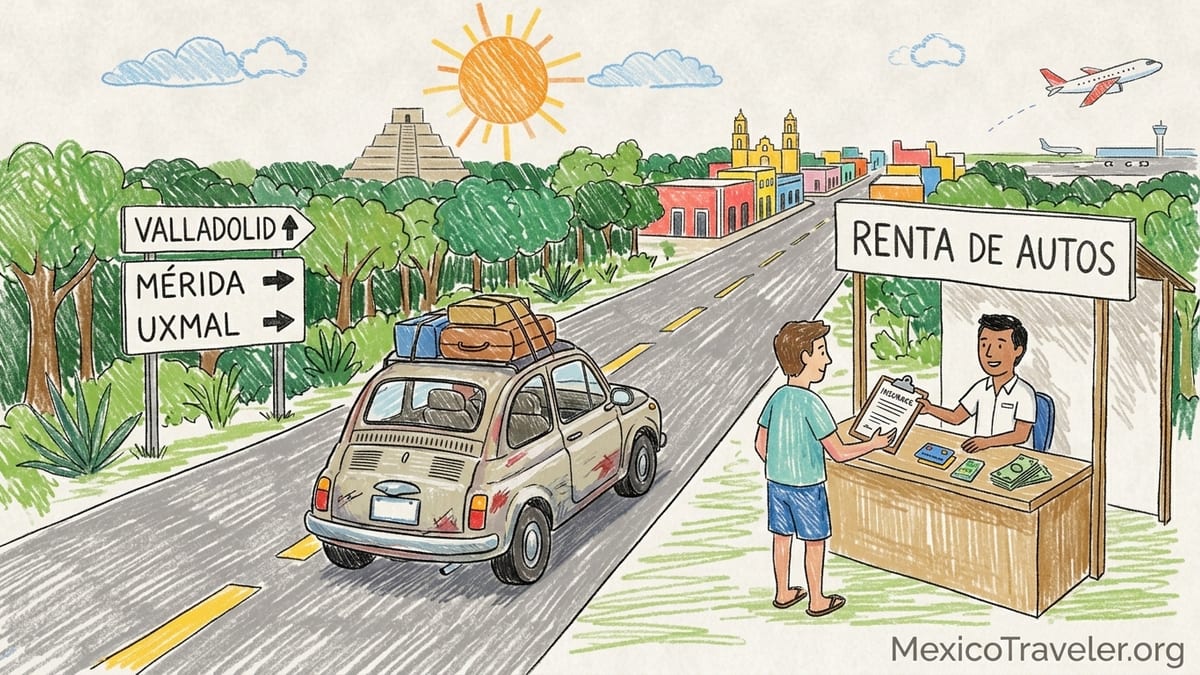
How I Booked My Yucatán Rental and What I Actually Paid
For this trip I booked a compact automatic car online through a major comparison platform that aggregates brands such as Hertz, Avis, Europcar and local Mexican firms. I chose a well known international supplier with a staffed desk at Cancún International Airport, picking up at Terminal 3 and returning to the same location. My rental ran for 10 calendar days in late high season, with pick up in the early afternoon and drop off just before noon.
The advertised base rate on the comparison site was attractive, roughly the equivalent of 18 to 20 US dollars per day for a compact automatic car. That headline price included basic third party liability as required by Mexican law, but did not include collision damage waiver, theft protection, or any reduction of excess. In the booking confirmation, there was a clear note that the final cost in Mexico would depend on local insurance requirements and that a substantial credit card deposit would be blocked at pick up if I declined extra coverage.
At the counter, the rental agent walked me through the real numbers. The mandatory liability coverage was itemized in pesos and worked out to roughly the equivalent of 12 to 15 US dollars per day. A combined collision and theft package that reduced my excess to a manageable level added another 10 to 15 US dollars per day, depending on deductible. By the time all required and strongly recommended insurances were added, my effective daily cost had risen to around 45 to 55 US dollars, including the originally advertised base rate. A refundable security deposit in the low four figures in US dollar terms was pre authorized on my credit card.
I did not encounter hidden fees beyond what was disclosed on the contract, but several optional extras were offered at the desk. These included personal accident insurance, a roadside assistance package, and a daily fee for an electronic toll device that was not necessary for my planned routes. I declined all three after confirming that my travel insurance already included medical coverage for car accidents, and that I was not expecting to use private toll roads beyond the main highway out of Cancún.
Condition of the Car, Collection Process and Insurance Reality
Collection at Cancún airport involved a short shuttle ride from the arrivals area to the rental lot. The process was typical of Mexico: passport, driver’s license, credit card and printed or digital voucher from the booking site. The agent entered my information, repeated the insurance options and asked for my estimated mileage and rough route. There was a polite but noticeable effort to upsell from a compact to a mid size sedan, justified by luggage space and comfort, but the compact was sufficient for two people plus bags and I stuck with it.
The car itself was mechanically sound but well used, with more than 50,000 kilometers on the odometer, light scratches around the bumpers and some minor interior wear. Air conditioning worked properly, which matters more than paintwork in Yucatán’s heat. All four tires had reasonable tread, but I still photographed them along with every ding and scuff on the bodywork. The rental company provided a paper diagram to mark existing damage, and I insisted that even hairline scratches were noted. This added an extra ten minutes but made me more comfortable returning the car later.
Insurance terms were explained in person and printed in Spanish and English on the contract. Mexican federal law requires a certain minimum level of liability coverage, and the base rate technically satisfied that requirement. However, the agent underscored that any serious accident could easily exceed this minimum and that I would be personally responsible for the difference. The collision damage waiver came with an excess of several hundred US dollars. If the car was stolen or declared a total loss, that excess would be the maximum I would pay provided I followed the contract terms, reported incidents promptly and avoided driving under the influence.
The rental company did attempt to sell what I considered unnecessary products, particularly an additional personal accident policy and a glass and tire protection add on that overlapped with the main collision coverage. When I declined, the sales pitch stopped without argument, but I had to initial several fields acknowledging that I was assuming those risks. This is standard practice in the region, and travelers should not interpret it as harassment. It does, however, make it essential to arrive at the counter with a clear idea of what coverage you already have from credit cards or travel insurance and what you are comfortable self insuring.
Where I Drove: Cancún, Valladolid, Mérida, Uxmal and Campeche
Over 10 days I covered a classic central Yucatán loop, driving only roads I will describe here. From Cancún, I took Federal Highway 180D, the main toll road inland, to reach Valladolid. After two nights based near Valladolid’s colonial center and day trips to cenotes on nearby secondary roads, I continued west on the same general corridor toward Mérida, using a mix of toll and non toll sections. From Mérida, I drove south along the highway toward Uxmal and the Puuc Route, then back to Mérida the same evening. The final leg ran from Mérida to Campeche on the Gulf coast, again on the principal intercity highway, before returning by a similar route toward Cancún for the flight home.
This itinerary gave me a blend of fast, limited access toll highway and slower, village lined secondary roads. The toll route out of Cancún was in very good condition, with wide shoulders, clear lane markings and frequent signage. Exits are limited, and there are long stretches of monotony through low jungle, but driving standards were generally calm in daylight. The free parallel highway between Valladolid and Mérida was more variable, with occasional potholes, narrower shoulders and frequent speed bumps at town entrances.
Secondary roads to cenotes and archaeological sites, such as the turnoffs from near Valladolid and the approach to Uxmal, were paved but sometimes patchy. Potholes, abrupt changes in surface and unmarked speed bumps were more common. None of these roads felt unsafe from a security perspective during the day, but I kept speeds modest and avoided night driving outside cities. Parking at each overnight stop was a mix of hotel courtyards, small private lots and street spaces, which allowed me to test how manageable parking really is around historic centers.
In total I logged several hundred kilometers, used multiple gas stations from different brands and navigated with a mix of offline maps and the car’s basic odometer and trip computer. Fuel economy was respectable for a small automatic car, and I never felt range anxiety, since major routes had stations every 50 to 80 kilometers. What mattered more than raw distance was the rhythm of driving days mixed with slower sightseeing days, which made the rental feel like a tool rather than a burden.
Road Quality, Topes, Speed Limits and Driving Experience
Highway quality along the main corridors such as Cancún to Valladolid and Valladolid to Mérida was better than many visitors expect. On the toll segments, lane markings, signage and surface quality were close to what you would find on a modern interstate in the United States, with long sweeping curves and wide shoulders. The principal difference is that enforcement of speed limits is patchier. Posted limits usually sat around 100 to 110 kilometers per hour, but local drivers often moved faster when conditions allowed. I chose to sit near the limit and let faster traffic pass.
Secondary roads and the non toll sections between towns delivered a very different experience. Potholes appeared more frequently, especially after rain, and the infamous topes, or speed bumps, were constant at town and village entrances. Some topes were painted bright yellow and signed in advance, while others were nearly invisible until you were almost on top of them. Over the course of the trip, I learned to assume a tope whenever I saw houses thickening along the roadside and to cut speed early. Hitting one at highway speed would have been unpleasant and possibly damaging.
Navigation with a smartphone using offline maps worked well across the entire route. I downloaded regional maps in advance and pinned key stops like gas stations, cenotes and archaeological sites. Cellular coverage on the main highways was generally good, but there were stretches, especially between Mérida and Campeche, where service dropped to a weak signal. For that reason, I never relied on live rerouting and always glanced at the route before leaving a city. A basic paper map from the rental desk provided additional reassurance, even if I rarely unfolded it.
Daylight driving felt straightforward, while night driving outside cities felt more stressful and less necessary. In rural stretches, oncoming drivers sometimes used high beams for longer than felt comfortable, and the risk of animals or pedestrians near the roadway increased. In colonial centers such as Valladolid and Mérida, narrow one way streets, low lighting and tight corners made parking more challenging after dark. I planned driving days to end by late afternoon when possible, which also aligned better with hotel check in and evening strolls.
Fuel, Tolls, Parking and Unexpected Fees
Fuel costs in Yucatán are relatively transparent, since official prices per liter are regulated and fairly similar between branded stations. Over 10 days of driving, I filled the tank several times, usually from one quarter full back to near full, and spent the equivalent of roughly 80 to 120 US dollars on fuel, depending on exchange rates at the time. I paid in pesos by card or cash inside the station after attendants completed the fill. A common local practice is for attendants to offer windshield cleaning while pumping. Tips for this service and general politeness were small but appreciated.
Tolls on the main highway between Cancún and Valladolid and on to Mérida added a noticeable but manageable cost. Each major toll segment cost the equivalent of several US dollars, and I kept receipts in the car in case I needed to show where I had been. There were no surprise tolls on the secondary roads to Uxmal or on the Mérida to Campeche highway in the stretches I used. Because I declined the rental company’s electronic toll device, I always used cash lanes. Lines were short in daylight, and staff accepted bills and coins without complaint.
Parking varied by city. In Cancún’s hotel zone I did not drive, but around the airport and on the way out, parking at supermarkets and chain restaurants was free and informal. In Valladolid, my guesthouse offered a small courtyard lot included in the room rate, which I used to avoid leaving the car overnight on narrow streets. Mérida’s historic center had more structured options, including several guarded surface lots that charged an hourly or daily rate equivalent to a few US dollars, which felt reasonable for the convenience and security. Campeche, with its fortified core, offered both street parking and small private lots; I used a paid lot close to the walled center to avoid circling on cobblestones.
At return, the rental company inspected the car thoroughly but did not attempt to charge any additional fees. Fuel level was checked against the original full tank, and minor bug splatter and dust from rural roads were ignored as normal use. I had heard reports from other travelers of cleaning fees or claims for existing damage, but in my case, detailed photographs at pickup and a conservative driving style kept the process quick. The preauthorized deposit was released within several business days. The only minor surprise was a small airport concession fee itemized on the final invoice, which had been mentioned in the contract but was easy to overlook among line items at pickup.
Police, Checkpoints and Safety: What Actually Happened
Along my route I encountered several police and National Guard checkpoints, especially on the main highways between Cancún and Valladolid and between Mérida and Campeche. In most cases traffic was simply waved through. On two occasions, officers signaled me to slow down and roll down the window. They asked where I was coming from and where I was headed, took a quick look inside the car and then waved me on without requesting documents. Interactions were polite and brief, conducted in basic Spanish with the occasional word of English.
I did not experience any attempts at bribe solicitation or on the spot fines for fabricated infractions. I carried copies of my passport, rental contract and insurance printout in the glovebox, with originals in a money belt at my waist, but no officer asked to see them. That does not mean scams never occur, only that on this particular trip they did not. Friends who drove different routes at different times have reported mixed experiences, and it is important not to generalize too broadly from a single journey.
To reduce risk, I stuck to daylight driving, avoided excessive speed even when other cars were faster, and used hotel or guarded parking everywhere I slept. I also kept valuables out of sight, locked the car even at gas stations and never left luggage visible on the back seat. In cities, I familiarized myself with one or two main routes into and out of the historic center in advance, which reduced wrong turns onto poorly lit side streets.
Security conditions evolve, and travelers should always check recent advisories from their own government and local news before driving in any new region. Within the corridor I drove, the atmosphere felt generally relaxed, with families at highway rest stops, domestic tourists in cenotes and busloads of visitors at archaeological sites. I never felt targeted as a foreign driver, although I remained aware that a rental car’s plates often differ from local vehicles and can attract more scrutiny.
Is the Cost Worth It Compared with Trains, Buses and Tours?
By the end of the 10 day trip, my total car related spending, including base rental, mandatory liability coverage, chosen collision and theft package, fuel, tolls and parking, was several hundred US dollars. This figure was significantly higher than the advertised base rate alone, but it bought door to door flexibility across multiple towns, rural cenotes and less visited archaeological sites on my own schedule.
To judge value, I compared this with other transport options available in the Yucatán Peninsula. Long distance ADO buses connect Cancún, Valladolid, Mérida and Campeche reliably, and tickets between cities often cost the equivalent of 10 to 30 US dollars per person depending on class and timing. A couple traveling together could move between major cities and some tourist sites by combining these buses with local taxis or small group tours. For a 10 day itinerary focused on city centers and a few headline ruins, total ground transport costs for two on buses and taxis could come in below the cost of a rental car with full insurance, especially if they avoid peak dates.
The new Tren Maya project has begun operating on several segments, linking Cancún and other hubs with parts of the peninsula. While not all sections were fully integrated along my exact route at the time of travel, the presence of a rail alternative will increasingly allow travelers to move between major cities by train and then rely on tours or taxis for day trips. Point to point rail fares, where available, are expected to be broadly competitive with bus prices for standard class.
Guided day tours from Cancún, Playa del Carmen or Mérida to major sites like Chichén Itzá or Uxmal typically cost in the range of dozens to low hundreds of US dollars per person, depending on group size and inclusions such as lunch and cenote stops. For a solo traveler or a couple wanting only two or three such excursions, total costs may undercut a full week of car rental. On the other hand, a family of four taking multiple tours could quickly surpass the cost of a single rental car shared between them, even after adding fuel and parking.
When I added everything, the car was not the cheapest option for two people who might have been content with only city centers and a handful of organized excursions. It became better value when I counted the number of small detours, sunset cenote swims and quiet roadside taco stops we enjoyed on our own timetable. The question of whether it is worth it depends less on strict arithmetic and more on how intensely you plan to explore areas beyond the city cores and how much you value independence.
The Takeaway: Who Should Rent a Car in Yucatán and Who Should Not
Looking back on this particular journey, I would absolutely rent a car again for a similar loop that includes Valladolid, Mérida, Uxmal and Campeche, provided I was traveling with at least one other adult to share navigation and driving. The combination of well maintained main highways, manageable distances between cities and the sheer number of rural cenotes and small archaeological sites rewards travelers who can stop spontaneously. The rental gave us control over departure times, the freedom to linger where we liked and the ability to avoid the most crowded tour schedules.
For couples who enjoy road trips at home and are comfortable driving in new countries, a rental car in Yucatán can be worth the additional cost over buses or occasional tours, especially on a 7 to 10 day itinerary. The key is to budget realistically for insurance and fuel, to accept that the true daily cost will likely be two or three times the headline rate, and to plan routes that make use of the flexibility you are paying for. If your idea of a perfect trip involves impromptu cenote swims, late departures and detours for roadside fruit stands, driving yourself amplifies those moments.
Families can also benefit, particularly those with young children or teenagers who prefer flexible meal and rest stops to fixed tour schedules. Splitting the fixed costs of a car between three or four people often makes it competitive with multiple tour tickets. However, parents should factor in the added stress of topes, navigation and parking in busy centers. Booking accommodations with guaranteed secure parking in Mérida and Valladolid removes much of that worry.
For solo travelers, or visitors planning to spend most of their time in just one or two major cities such as Cancún, Playa del Carmen or Mérida, I would be more cautious about recommending a car. If your plans revolve around beaches, walkable historic centers and a handful of classic ruins that are well served by buses and tours, the savings and reduced stress of not driving may outweigh the benefits of independence. I would not rent again for an itinerary limited to Cancún and Playa del Carmen with perhaps a single visit to Chichén Itzá; in that case, transfers, buses and organized excursions would be simpler and likely cheaper.
FAQ
Q1. Is it safe to drive a rental car in the Yucatán Peninsula?
Driving the main highways and well traveled routes between cities like Cancún, Valladolid, Mérida and Campeche felt generally safe in daylight on my trip. I passed several official checkpoints without issues, avoided night driving in rural areas and used guarded or hotel parking. Conditions can change, so travelers should always check current advisories and local news before setting out.
Q2. How much did your 10 day car rental in Yucatán really cost?
When I combined the advertised base rate, mandatory liability insurance, additional collision and theft coverage, fuel, tolls and parking, the total came to several hundred US dollars for 10 days. This was roughly two to three times the headline rental price shown online but reflected the real cost of driving independently between Cancún, Valladolid, Mérida, Uxmal and Campeche.
Q3. Did the rental company try to sell you unnecessary insurance or extras?
At the counter, staff offered extra policies such as personal accident coverage, glass and tire protection and a roadside assistance package on top of the main liability and collision products. After confirming that my travel insurance and chosen coverage were sufficient, I declined these add ons. The staff asked me to initial several fields acknowledging the refusal but did not pressure me further.
Q4. What were the roads like between Cancún, Valladolid, Mérida, Uxmal and Campeche?
The main toll highway out of Cancún was in very good condition, similar to a modern interstate. The non toll stretches and secondary roads near Valladolid and Uxmal had more potholes and frequent speed bumps. The Mérida to Campeche route offered a mix of solid pavement and occasional rough patches, but the entire loop was manageable at reasonable speeds in a compact car.
Q5. How did you handle navigation and mobile coverage while driving?
I downloaded offline maps to my phone before arrival and pinned key stops like gas stations, cenotes and hotels. On the main highways I usually had mobile data, but some stretches between cities had weaker signals. Planning routes in advance and keeping a basic paper map from the rental desk as backup made navigation straightforward even when reception dropped.
Q6. Were you stopped by police or at checkpoints during your trip?
Yes, I encountered several checkpoints along the main highways. In most cases I was waved through. On two occasions officers asked where I was coming from and going, glanced inside the car and let me proceed. They never requested documents, and I did not experience any demands for money or on the spot fines. That said, travelers should carry identification, rental contracts and insurance papers in case they are asked.
Q7. Is renting a car cheaper than using buses, Tren Maya or tours?
For my two person trip, renting a car for 10 days was more expensive than combining long distance buses with occasional taxis and small group tours focused on major cities and headline ruins. The car became better value when I considered the number of side trips and rural stops that would have been difficult by public transport. For families or groups of three or four, shared car costs can compete more directly with multiple tour tickets.
Q8. Do you recommend renting a car for first time visitors to Yucatán?
I recommend renting a car for first time visitors who already feel comfortable driving abroad and want to explore beyond the main resort areas. If your itinerary includes colonial cities like Valladolid and Mérida, multiple cenotes and sites such as Uxmal, a car gives valuable flexibility. If you prefer structured days, do not enjoy driving, or plan to stay mostly in Cancún or Playa del Carmen, organized tours and buses might suit you better.
Q9. What should travelers check before accepting a rental car at Cancún airport?
Before driving away, inspect the car’s exterior and interior closely, note every scratch and dent on the damage form and take time-stamped photos, including of the tires and windshield. Confirm the fuel level, test air conditioning, headlights and indicators, and read the insurance section of the contract carefully. Ask about roadside assistance numbers, procedures after an accident and the exact fuel policy, then keep copies of documents in the glovebox.
Q10. Would you personally rent a car again for a similar Yucatán itinerary?
Yes, for a 7 to 10 day loop that includes Cancún airport, Valladolid, Mérida, Uxmal and Campeche, I would rent again, especially traveling as a couple or family. The freedom to set my own timetable, visit lesser known cenotes and stop in small towns outweighed the higher true cost and the extra responsibility of driving. I would not rent for a short city or resort stay focused on only one or two major attractions.