


After years of Yucatán day trips, I finally did what many travelers debate but few test properly. On one recent circuit I booked at least two nights each in Mérida and Valladolid, stayed within walking distance of their historic centers, kept my receipts and compared what the experience is actually like once the day-trippers go home. What follows is not a broad Yucatán primer but a focused, side by side look at where it is easier to sleep, eat, park, walk and plan routes for ruins, beaches and cenotes, and which city ultimately felt like the better base.
How I Structured the Stay and What I Paid
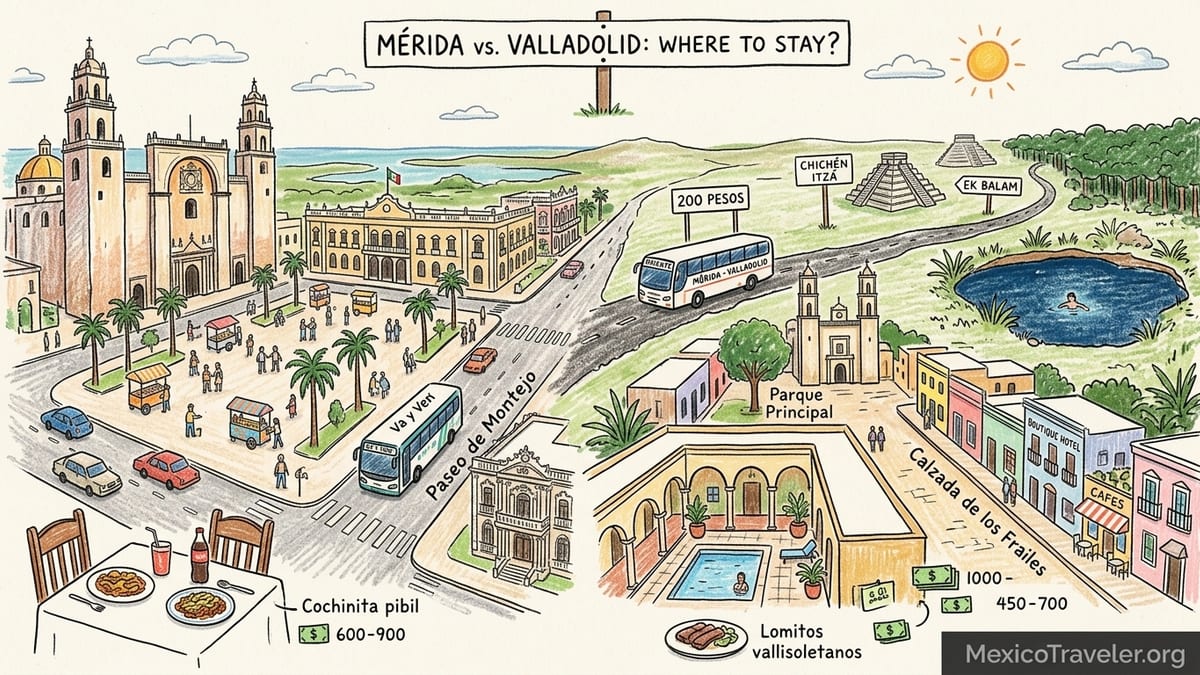
To make the comparison fair, I based myself in the historic cores of both cities and chose midrange hotels with similar ratings and amenities. In Mérida I booked a classic hotel one block off Plaza Grande in late March 2025, with air conditioning, a plunge pool and on site parking. The nightly rate worked out around 2,000 to 2,300 Mexican pesos including taxes for a double room, which was consistent with price ranges I saw for comparable three star properties in Mérida Centro at the time, often listed between 1,800 and 2,500 pesos per night for dates outside Christmas and Easter. I stayed three nights here, enough to see how mornings, afternoons and evenings really felt.
In Valladolid, a few weeks later, I chose a colonial style property just off Parque Principal Francisco Cantón Rosado and an easy stroll from Calzada de los Frailes. Rooms were simpler and the pool smaller, but the property was also highly rated and had air conditioning and secure courtyard parking. For two nights in April 2025 the nightly rate came in nearer 1,000 to 1,200 pesos for a similar double room, in line with other central Valladolid stays that frequently appear between 900 and 1,300 pesos per night for standard rooms of this category. Because I booked both sets of dates within the same season and looked at flexible rates first, the price difference was real rather than a quirk of timing.
For transport between the two cities I used an Oriente second class bus from Mérida’s main terminal to Valladolid’s station. When I checked schedules around that time, early morning departures often showed journey times of about three and a half hours with ticket prices listed around 200 pesos per person. That fare became a useful benchmark when I compared the cost of staying longer in each place versus treating one or the other as a long day trip.
I also tracked everyday spending. Restaurant dinners for two in Mérida’s Centro, with a starter to share, two main courses and soft drinks or a couple of beers, regularly reached 600 to 900 pesos in nicer dining rooms around Plaza Grande or on the quieter streets leading to Paseo de Montejo. In Valladolid, on or near Calzada de los Frailes or the main square, similar meals more often landed in the 450 to 700 peso range for comparable quality and setting. Over several nights that gap quietly added up.
Staying in Mérida: Plaza Grande, Paseo de Montejo and Real City Scale
Merida’s historic core around Plaza Grande delivers the classic big city Yucatán experience. The plaza itself, framed by the cathedral and the governor’s palace, feels busy and civic in the day and almost theatrical by night when families, vendors and occasional musicians share the space. From my hotel near the square, I could walk to museums, cafes and most of my chosen restaurants in under ten minutes. That compact radius made the first twenty four hours feel easy, especially without a car.
Once you start exploring beyond Plaza Grande, Mérida’s scale shows. The elegant mansions of Paseo de Montejo lie about twenty to twenty five minutes’ walk from the central square, depending on your pace and the heat. I tried this walk several times. In the early morning it was pleasant, with filtered light on the facades and locals heading to work. By mid afternoon, especially between March and May when daytime highs often climb above 35 degrees Celsius, the route grew punishing. I quickly understood why many visitors rely on rideshare services or city buses rather than trying to do everything on foot.
The reward for making it to Paseo de Montejo is a grand avenue of historic henequen era mansions, some converted into banks and museums, others adapted as restaurants or hotels. One of the better known modern hotels along this corridor has published average nightly rates around 80 to 90 US dollars before tax for a standard double room in recent tourism catalogs, a reminder that Mérida’s more upmarket area can cost significantly more than simple colonial stays in the core. If you stay closer to Paseo rather than Plaza Grande, you gain a quieter, leafier neighborhood but lose some of the immediate proximity to the central market and cathedral area.
Mérida provides a varied set of museums and cultural stops within Centro. I spent time in the Museo Fernando García Ponce Macay right off Plaza Grande, admired temporary exhibits at the Palacio de la Música a short walk away and visited a couple of smaller private galleries. Several of these institutions are either free or charge modest entry fees that do not alter the budget drastically, but they do reward a multi night stay because you can break sightseeing into manageable chunks rather than trying to rush between them.
Merida by Car: Parking, Traffic and After Dark Comfort
Driving in Mérida affected my impressions of both comfort and convenience. The city’s wider metropolitan area spreads significantly beyond Centro, and even within the grid of the historic core, narrow one way streets and a high volume of local traffic make navigation more demanding than in Valladolid. I timed rush hour trips that took more than twice as long as the same routes at 10 a.m. or mid afternoon. This mattered in practice when I tried to return a rental car before exploring the Plaza Grande area on foot or when I attempted to drive out to the periferico ring road during local commute times.
Hotel parking in Mérida Centro is often paid and sometimes limited. My three star property offered secure on site parking that was included in the room rate but required leaving the keys with the receptionist so staff could shuffle cars in the narrow courtyard. Other travelers I met at breakfast mentioned paying 150 to 250 pesos per day to use independent garages when their historic buildings lacked space. If you are road tripping and expect stress free parking directly outside your room, Mérida demands more compromise than Valladolid.
Once the car was parked for the evening, the city’s size became an asset. Walking around Plaza Grande, down Calle 60 and into adjacent streets after dark felt busy but safe on the nights I stayed. Police presence around the square was visible, and most streets between my hotel and the plaza remained active until at least 10 or 11 p.m. thanks to cafes, heladerías and late dinners. The atmosphere was urban rather than sleepy, more comparable to a small national capital than a resort town. That sense of life helped any lingering nervousness fade, particularly on nights when I was returning from dinner around 10 p.m.
The main drawback was noise rather than security. Traffic echoes, live music from nearby bars and deliveries starting early in the morning meant that a central Merida hotel rarely felt as quiet as my Valladolid stay. Choosing interior courtyard rooms helped, but this is one of the trade offs that come with a larger, more active city.
Food, Markets and Nightlife: Merida’s Variety vs Valladolid’s Intimacy
For food focused travelers, Mérida has a clear advantage in variety. Around Plaza Grande and along the streets that connect it to Paseo de Montejo, it is easy to find everything from traditional Yucatecan dishes such as cochinita pibil, sopa de lima and papadzules to contemporary Mexican menus aimed at a more international crowd. I had one lunch at a long running market stall inside the main municipal market for under 150 pesos for a hearty plate and drink, and another dinner at a smart restaurant on a leafy side street that passed 800 pesos for two courses and drinks. Both felt worthwhile, and there were many places in between.
Traditional Yucatecan flavors appear not only in formal dining rooms but also at nighttime food stands and simple loncherías. On Sunday evening I joined families eating marquesitas and elotes on the streets around Plaza Grande, the air filled with music from a nearby bandstand. The sheer number of choices makes it easier to adjust to different budgets and cravings. If one restaurant felt too polished or crowded, a similar alternative was usually a couple of blocks away.
Nightlife in Mérida Centro is lively without tipping into the club scene of coastal resorts. Many restaurants spill into courtyards and terraces, several bars offer live music, and on certain evenings the city hosts traditional music or dance performances on or near the Plaza Grande. With three nights in the city I experienced quiet midweek dinners and more animated weekend evenings. Importantly, the presence of locals enjoying the same streets and plazas added to a feeling of authenticity that can be missing in beach towns where almost everyone after dark is a visitor.
Valladolid felt gentler and more limited by comparison, but that brought its own charm. Around the main square and along Calzada de los Frailes, I counted far fewer restaurants and bars than in central Mérida, and peak season reservations mattered more. On my first night an early arrival allowed me to walk into a courtyard restaurant off Calzada de los Frailes and enjoy a leisurely dinner for around 500 pesos for two, including a regional main dish and drinks. On the second night, arriving closer to 8:30 p.m., several of the most atmospheric spots were already full, and waiting lists pushed estimated seating past 9:30 p.m. In high travel months this constraint would be even sharper.
Valladolid on Foot: Calzada de los Frailes, Cenotes and Evenings
Valladolid’s strength lies in its compact, walkable center. From my hotel just off the main square, I could reach Calzada de los Frailes on foot in about ten minutes at a relaxed pace. The pedestrian friendly stretch of this street, with pastel houses, boutique hotels and small cafes, delivered a pretty and instagram friendly backdrop without feeling entirely overtaken by tourism. The late afternoon light was especially flattering, and because distances were short I never felt forced to choose between walking comfort and sightseeing.
Even in the heat of the day, moving between the square, Calzada de los Frailes and the nearby cenote Zací was manageable. The cenote, located only a few blocks from the main plaza, exemplified one of Valladolid’s practical advantages. Access to a refreshing swim sat almost inside the city you were staying in, rather than at the end of a longer drive. In practice that meant I could visit in the quieter morning period, return to shower at my hotel, and be back out for lunch within a short window.
After dark, Valladolid felt calm but not empty. The main square around the cathedral remained active until around 10 p.m. with families and vendors, though noticeably less crowded than Mérida’s Plaza Grande. Streets one or two blocks away grew very quiet, with fewer open businesses to provide natural foot traffic. Walking between my hotel and dinner on Calzada de los Frailes felt fine, with street lighting and other visitors nearby, but the ambience was more small town than city, which some travelers will find relaxing and others perhaps too subdued.
Because fewer cars circulate in the core, noise levels were lower than in Mérida, and my hotel room facing an internal courtyard remained peaceful late into the night. If surface tranquility ranks above nightlife in your priorities, two or three nights in Valladolid can feel remarkably restorative after long days at ruins and cenotes.
Access to Ruins, Cenotes, Beaches and Biosphere Reserves
One of the main reasons travelers debate Mérida versus Valladolid is access to major sites. From Mérida, the classic day trip triangle consists of Uxmal and the Puuc Route, the coast at Progreso and the flamingo rich wetlands around Celestún. When I visited Uxmal, I drove from Mérida in roughly an hour and a quarter along Federal Highway 261, arriving soon after opening. Entrance fees at Uxmal have risen in recent years and are split between a federal archaeological charge and a Yucatán state fee. Around early 2024 combined entrance for foreign visitors was being quoted in the range of a little over 550 pesos per person, and several recent travelers reported paying a similar total when parking, federal and state fees were added together at the gate.
From Mérida, Progreso is about 45 minutes to an hour by car along the highway, and frequent buses and the Va y Ven public transport system connect the city with the port town and its malecón. This makes Mérida attractive for travelers who want to mix cultural days with casual beach time without sitting in a resort. Day tours to Celestún, meanwhile, usually quote transfer times of 90 minutes to two hours one way, making it a comfortable full day trip. For all of these excursions, Mérida’s large tour market yields multiple options, from small group minivans to big coach tours, and a dense supply of rental car agencies.
Valladolid sits closer to headline Mayan sites and some of the peninsula’s best known cenotes. By road it is roughly forty to forty five minutes from Chichén Itzá, depending on whether you use the toll road or the free road, and a similar drive to Ek Balam to the north. This proximity translates directly into shorter days and easier dawn starts. On my visit to Chichén Itzá from Valladolid, I could leave the hotel after a quick early breakfast and still arrive close to opening time, while day trippers from the coast were just boarding buses. The return to Valladolid in the early afternoon allowed time for a nap and a cenote swim, something that would have been far more tiring from Mérida.
Cenote access from Valladolid is exceptional. Within fifteen to thirty minutes’ drive you can reach cenotes such as X’keken and Samulá near the village of Dzitnup, or Suytun with its famous light beam effect. Some travelers visit these by taxi or guided tour, while others rent a car in Valladolid for a couple of days to explore more independently. Fuel and entry fees add up, but the convenience of being so close to multiple swimming spots cannot be overstated in the Yucatán heat. The balance of my own days there shifted naturally toward mornings at ruins, early afternoon swims and quiet evenings on Calzada de los Frailes.
What Valladolid lacks compared with Mérida is direct access to the sea and coastal wetlands. If you want both cenotes and beaches, you might find yourself splitting time between Valladolid and a Caribbean coastal town rather than Valladolid and Mérida. If your focus is primarily on cenotes and Mayan archaeology, however, Valladolid wins on location.
Day Trip Impressions vs Staying Overnight
Comparing my overnight stays with earlier day trips highlighted an important truth: both cities feel very different once the tour buses leave. On a previous visit to Mérida as a day trip from the coast, I arrived mid morning, wandered Plaza Grande, had a long lunch and left by late afternoon with an impression of a hot, stately but slightly sleepy city. Staying three nights changed that completely. I saw the way the plaza filled after dusk, how locals reclaimed streets that tour groups never touched, and how evenings along Paseo de Montejo carried a subtle energy with cafes and wine bars opening their doors.
Valladolid also benefits from an overnight stay, perhaps even more. On day trips tied to Chichén Itzá, many travelers spend only an hour or two around the main square at midday. The heat is punishing, parking around the core feels competitive and some of the more atmospheric restaurants and cafes are closed between lunch and dinner service. My two night visit showed me another rhythm. In the early morning, the square is quiet, with market bound locals and only a few tourists heading to the bus station. Calzada de los Frailes at sunset feels entirely different from its midday self, with warm light on the facades and a relaxed pre dinner stroll atmosphere that you can only enjoy if you are not rushing back to a coast bound bus.
There is also a psychological effect. When a place is your base rather than a stop, you pay more attention to practical things: how easy it is to buy fruit or water, whether the local market feels accessible to visitors, how secure you feel walking back from dinner, whether the room stays quiet enough to sleep well. In that sense, Mérida behaved like a small, well organized city with clear big city pros and cons, while Valladolid felt like a handsome but more limited town that comes into its own precisely because you slow down there.
If you are planning your first Yucatán trip and wondering whether you can “do” Mérida or Valladolid as day trips from somewhere else, this experience convinced me that both deserve at least two nights, with Valladolid in particular gaining far more depth in the evening than on a rushed midday stop.
Drawbacks and Who Each City Suits Best
No base is perfect, and being honest about drawbacks helps set expectations. Mérida’s most obvious challenge is the heat combined with its spread out attractions. Walking long distances between Plaza Grande, Paseo de Montejo and various museums in the early afternoon can be draining, and while taxis and rideshare services are plentiful, constant short rides add unplanned costs. Traffic and parking add a layer of stress for those driving, and central hotels are often noisier than their online photos suggest. If your ideal holiday involves quiet evenings, very short walks and easy on street parking, Mérida may feel more intense than you want.
Valladolid’s drawbacks sit at the opposite end of the spectrum. The town’s dining and nightlife selection is noticeably smaller, especially once you step beyond the streets directly around the main square and Calzada de los Frailes. In low season some places close one or more days a week, narrowing choices even further. If you are staying more than three or four nights and care about varied restaurants and bars, you might begin to feel confined. There are also fewer substantial museums, and on rainy afternoons the lack of indoor attractions becomes apparent.
In terms of cost, Valladolid was consistently cheaper for midrange accommodation and dinners of similar quality. However, if you rely entirely on taxis or tours to reach cenotes and ruins, some of the savings on lodging can be absorbed by transport costs, especially if you make multiple excursions. Mérida’s city buses and tour infrastructure make some outings cheaper per person, particularly for solo travelers joining group tours to Uxmal or Celestún, but these same tours can also feel more regimented than hiring a taxi in Valladolid to visit a pair of cenotes at your own pace.
Comfort after dark was high in both places from my perspective, but the flavor differed. Mérida felt like a mid sized Latin American city, animated and well lit in the core, with a sense that there was always somewhere else to go for a drink or dessert. Valladolid felt safe but quieter, with a clearer line between a few busy tourist streets and very tranquil residential blocks. Choosing between them comes down to whether you prefer a softer, small town atmosphere or the energy and choice that come with a proper city.
The Takeaway: How I Would Split Five Nights
After staying multiple nights in both Mérida and Valladolid and running the numbers on hotel and restaurant receipts, I would choose my base according to trip priorities. For a first Yucatán visit where you want a bit of everything and do not yet know what you will like best, I would lean slightly toward Mérida as the main base. It offers a strong mix of museums, traditional Yucatecan food, city life and relatively convenient access to beach days in Progreso and cultural excursions to Uxmal, all supported by a wide choice of midrange and boutique hotels. Three or four nights allow you to find your rhythm without feeling rushed.
For a romantic break, however, Valladolid has the edge. Its compact scale, lower evening noise, pretty pastel streets around Calzada de los Frailes and easy strolls from historic center hotels to candlelit courtyards made it feel more intimate. Two or three nights there, especially if you build days around early starts at ruins and leisurely afternoons in cenotes, create a slower, more contemplative mood than busy Mérida streets can offer.
If your trip is food focused and you want to dive deep into Yucatecan cuisine with plenty of choice, Mérida clearly wins. From busy markets and simple tortillerías to modern restaurants that reinterpret local ingredients, the city delivers more variety in a relatively small radius. You could easily spend four or five nights and still have new places to try each evening, whereas in Valladolid you might run through most of the top options in three nights, particularly in low season.
For a trip that prioritizes cenotes and Mayan archaeology above all else, I would base myself in Valladolid. Its proximity to Chichén Itzá and Ek Balam, along with the cluster of photogenic and swimmable cenotes within short driving distance, means you can spend more time on site and less in transit. In practical terms, that translates into earlier quiet hours at ruins, cooler swims and the freedom to return to your hotel in time for an unhurried evening rather than arriving back exhausted just as dinner service starts.
If I had five nights to divide between the two cities, knowing what I know now, I would recommend three nights in Mérida and two nights in Valladolid for most first time visitors. Three nights in Mérida give you a full day for Uxmal and the Puuc region or Celestún, another for the city itself, and some flexibility for an afternoon in Progreso or extra museum time. Two nights in Valladolid allow a dawn or early morning at Chichén Itzá, a half day at nearby cenotes and, if energy allows, either Ek Balam or further cenote exploration before you continue toward the coast or back to Mérida. Travelers who care little about beaches and city size and a lot about quiet evenings and ruins might flip that ratio to two nights in Mérida and three in Valladolid, but for a balanced introduction, 3 plus 2 felt like the sweet spot.
FAQ
Q1. Is Mérida or Valladolid cheaper for midrange hotels?
Based on my receipts from spring 2025, Valladolid’s central midrange hotels were often 30 to 40 percent cheaper per night than comparable properties around Mérida’s Plaza Grande or near Paseo de Montejo, with similar comfort but fewer on site amenities.
Q2. Which city is better if I will not have a rental car?
If you rely entirely on public transport and tours, Mérida offers more options, especially for reaching Uxmal, Progreso and Celestún. However, Valladolid works very well without a car for visiting Chichén Itzá, Ek Balam and nearby cenotes, since distances are short and taxis are used to these routes.
Q3. How many nights should I stay in each city on a one week Yucatán trip?
For a balanced week that includes some coastal time, I suggest three nights in Mérida, two in Valladolid and two on the coast. If you are skipping the beach, four in Mérida and three in Valladolid or the reverse can work depending on whether you prefer city energy or smaller town calm.
Q4. Is parking easier in Mérida or Valladolid?
Parking in Valladolid’s center was simpler and less stressful, with several hotels offering courtyard parking and lighter traffic. In Mérida, narrow one way streets, busier traffic and limited spaces mean you should prioritize hotels that clearly list secure on site parking or be ready to pay for nearby garages.
Q5. Which base is better for visiting Chichén Itzá and Ek Balam?
Valladolid is the better base for both sites. Driving times are roughly forty minutes to Chichén Itzá and a similar distance to Ek Balam, which makes early starts and midday returns for a rest or cenote swim very manageable compared with setting out from Mérida.
Q6. Which base is better for visiting Uxmal and the Puuc route?
Mérida is the logical base for Uxmal and the Puuc region. The drive to Uxmal is about an hour and a quarter from the city, there are multiple organized day tours, and you can combine the ruins with stops at smaller sites or a chocolate museum without very long days.
Q7. How do restaurant prices compare between the two cities?
In my experience, dinners for two in Mérida’s Centro at midrange restaurants commonly cost around 600 to 900 pesos, while in Valladolid, similar quality meals near the main square or Calzada de los Frailes usually fell closer to 450 to 700 pesos.
Q8. Which city feels safer to walk around at night?
Both cities felt comfortable to walk in after dark in and around their central squares and main restaurant streets. Mérida had more people out late and a more urban feel, while Valladolid was quieter but still felt safe along the main square and Calzada de los Frailes, with very tranquil residential streets just beyond.
Q9. Is it worth staying overnight instead of doing day trips to these cities?
Yes. Staying at least two nights in each city transforms the experience, giving you evening time on the plazas, quieter early mornings, and the chance to see how the places function once day trippers have gone, which is very different from a rushed midday visit.
Q10. For cenotes and Mayan ruins, should I choose Mérida or Valladolid?
If your priority is maximizing time at cenotes and ruins like Chichén Itzá and Ek Balam, choose Valladolid as your main base. Mérida is better if you want to combine one or two major archaeological outings with city museums, varied dining and potential day trips to the coast.