


Some archaeological sites are easy decisions. Chichén Itzá and Uxmal sit near major highways, ringed by hotels and tour buses. Calakmul is the opposite. Reached only after hours of driving into dense jungle on the southern edge of Campeche, this once-mighty Maya capital demands time, planning and a real tolerance for heat, insects and potholes. After basing myself in Xpujil and completing the full journey into the Calakmul Biosphere Reserve, the central question remained simple: was it actually worth the effort?
Setting the Scene: A Capital Hidden in the Forest
Calakmul is not a minor outpost. Archaeologists have identified several thousand structures here, and during the Classic period it was the seat of the powerful Snake Kingdom that rivalled Tikal for dominance over the lowland Maya world. Today the ruins sit inside the vast Calakmul Biosphere Reserve in southern Campeche, close to the Guatemalan border. There is no town at the site itself, no beach resort, and no quick detour from a major highway. Visiting still feels like entering a different, slower world governed as much by jungle rhythms as by modern timetables.
That context shapes every decision about whether to go. Unlike day trips to Chichén Itzá from Cancún or Mérida, Calakmul requires at least one night, often two, in or around Xpujil or in smaller roadside lodges such as those near the village of Conhuas. The site’s remoteness is part of the allure. It also explains why many travelers with ten days on the Yucatán Peninsula never quite make it here, even if they circle Calakmul optimistically on their first draft itineraries.
The Mexican authorities have slowly layered infrastructure around this isolation. The Tren Maya now has a Calakmul station and a visitor center project is advancing, but as of late 2026 the core experience still feels wild and low-key. Services at the ruin entrance remain basic. The road in is long and narrow. Mobile signal is patchy. The surrounding forest remains one of Mexico’s most important tropical reserves, home to tapir, monkeys and the occasional jaguar sighting for the very lucky.
All of which sounds wonderfully romantic in a guidebook. The reality begins in Xpujil, usually the most practical base for independent travelers.
Basing in Xpujil: Nights, Noise and Necessary Logistics
Xpujil is not a destination town in its own right. It is a functional service hub on Highway 186 with a clutch of low-rise hotels, budget guesthouses, a few simple restaurants and an Oxxo convenience store or two. For Calakmul, however, its location matters more than its charm. The highway turnoff to the reserve lies roughly an hour west by car, and from that junction it is still close to 60 kilometers of forest road to the archaeological zone. Staying farther away, in Bacalar, Campeche City or Palenque, turns the visit into a very long day and compresses your time at the ruins.
My own stay in Xpujil matched reports from other recent travelers: accommodations are basic but adequate, with air conditioning that works hard against sticky night heat, intermittent hot water and a simple breakfast if you arrange it. Prices for a clean en-suite room with AC in 2026 generally run in the range of modest Mexican highway hotels rather than resort rates, and booking at least the first night in advance is sensible in high season. The town feels sleepy by early evening, and locals will tell you that traffic and services drop sharply after dark along regional roads, which is not a time you want to be weaving between potholes.
Eating options are limited but workable if expectations are calibrated. Small loncherías near the highway serve tacos, eggs and coffee suitable for a pre-dawn start. There are no sophisticated cafes opening at 5 a.m., so arranging snacks and water the previous day is part of the routine. This is also when you fill your fuel tank. There is fuel in and near Xpujil, but there are no gas stations within the Calakmul access road, and slow driving through the reserve means more time idling than highway statistics suggest. Starting with a full tank is less about fear and more about avoiding needless stress.
Some travelers opt to stay even closer, in the simple jungle lodges near Conhuas a few kilometers from the turnoff. These shave perhaps 45 minutes from the morning drive and immerse you more fully in the sounds of the forest at night, but they also reduce dining choices and increase the need to bring supplies. From Xpujil, in contrast, you can at least count on a proper sit-down dinner before setting an early alarm.
The Long Road In: Timings, Checkpoints and Real Driving Conditions
The journey from Xpujil to the main Calakmul plaza takes longer than many maps imply. From town to the signed turnoff on Highway 186 is roughly an hour in current conditions, partly due to a growing patchwork of deep potholes on sections of the highway reported by drivers in 2025 and 2026. These can be serious enough to require sudden swerving or slow crawling, which stretches distance into time. It is tempting to plan the drive with optimistic averages. Doing so almost guarantees frustration.
At the junction, a paved but narrower road leads south into the Calakmul Biosphere Reserve. After about 20 kilometers there is a checkpoint for the reserve itself. Here you pay the conservation fee charged by the protected area authority, collected per person and linked to federal fee schedules. Recent information indicates that in 2026 this fee for foreign visitors is in the low to mid 200 pesos range per person, with discounts for Mexican residents, students and teachers, and exemptions for young children and seniors with appropriate ID. Exact totals can change with federal updates, so it remains wise to bring enough cash and confirm the current figure in Xpujil before setting off.
Beyond this point, the feeling of entering serious forest deepens. The road continues for several dozen kilometers, its condition varying from smooth to fractured with lateral cracks and small sinkholes. Speed bumps are rare, but wildlife is not, so sharp eyes are essential. There is usually at least one additional payment point closer to the archaeological entrance, where the site admission is collected by the cultural heritage authority according to national tariff tables. In 2026, the published entrance cost for foreign adults sits in the low 200 pesos range, with a lower rate for Mexican nationals and residents, plus typical exemptions for students, teachers, minors and seniors on designated days or with official identification.
Because fees are split between conservation and archaeology, you do not pay one neat sum at a single window. The upside is that the money is earmarked for both heritage and habitat. The downside is that you will stop, pay and collect tickets or receipts more than once. Card payment should not be assumed. Cash in small denominations remains the safest option, and it avoids complications if card readers lose signal.
From the highway turnoff to the parking lot, realistic driving times sit between 1 hour 45 minutes and a full 2 hours in 2026 for a cautious driver, making the total from Xpujil to the ruins around 2.5 to 3 hours. This matches what visitors who left Bacalar at dawn and stopped in Xpujil as a midpoint have reported in recent months. Leaving town around 5:30 a.m. places you in the forest road near sunrise, at the reserve gate in time for its morning opening window, and at the ruins not long after the archaeological site opens, with cooler temperatures and more active wildlife.
Guides, Organized Transfers and the Question of Safety
Independent travelers face a fundamental choice at Xpujil: rent a car and drive themselves, or arrange a guided excursion that includes transport. As of late 2026, there is no regular public bus service onto the Calakmul access road or directly to the ruins. Occasional colectivos may serve nearby villages, but not on a schedule or route that accommodates a day visit to the site. That leaves self-driving, private transfers and tours as the realistic options.
Self-driving appeals for its flexibility, especially if you also want to visit nearby Rio Bec sites like Becán and Chicanná. Car rental hubs in Chetumal, Campeche City and Mérida feed many vehicles into the region, and several agencies will let you drop back in a different city. The trade-off is that you take full responsibility for navigation, time management and dealing with any roadside issues in a fairly isolated environment. Roadside assistance is limited once you leave the highway, and mobile reception along the forest road into Calakmul remains patchy at best. Some stretches have no signal at all, depending on your carrier.
Organized day tours and private guides operate from Xpujil, Bacalar and occasionally from farther afield. These typically include round-trip transport, guidance at the ruins and help with permits and fees. Prices vary with group size and origin point, but starting from Xpujil keeps costs more contained than a long haul from Caribbean resort towns. For many travelers, the value of a guide here is less about navigation and more about context. Calakmul’s plazas are not lined with large interpretive panels, and bilingual signage on-site remains limited. A good guide can anchor the climb up a pyramid in a larger story of dynastic alliances and wars rather than just being another impressive view.
On safety, the region requires up-to-date judgment more than alarm. Travelers and guides in 2025 and 2026 have reported feeling safe on daytime drives between Bacalar, Xpujil and Calakmul, though some also note that residents along certain highways prefer to be off the road at night due to isolated incidents and concerns about traffic and crime. Check current local advice in Xpujil when you arrive, avoid after-dark driving on rural stretches, and keep valuables discreet. The road through the reserve itself is quiet, populated mainly by other visitors, researchers and staff heading to camps and checkpoints.
Arriving in the Deep Forest: What the Site Actually Feels Like
The parking area at Calakmul is modest: a gravel clearing with space for cars and vans, basic toilets and a small kiosk selling drinks and snacks. It feels closer to a trailhead than a major tourist hub. From here, a shaded path leads gradually toward the monumental core. Almost immediately the soundscape shifts to bird calls, insect buzz and the sporadic crash of howler monkeys announcing their presence in the canopy.
The first structures you encounter are not the tallest pyramids but low mounds and smaller platforms partially reclaimed from jungle growth. This gentle reveal contrasts with more theatrical sites where the main pyramid rises beside the parking lot. At Calakmul, there is a sense of moving inward, each plaza unfolding beyond the previous one. The central plaza eventually opens into view ringed by major structures, including the great pyramids often referred to as Structures I and II.
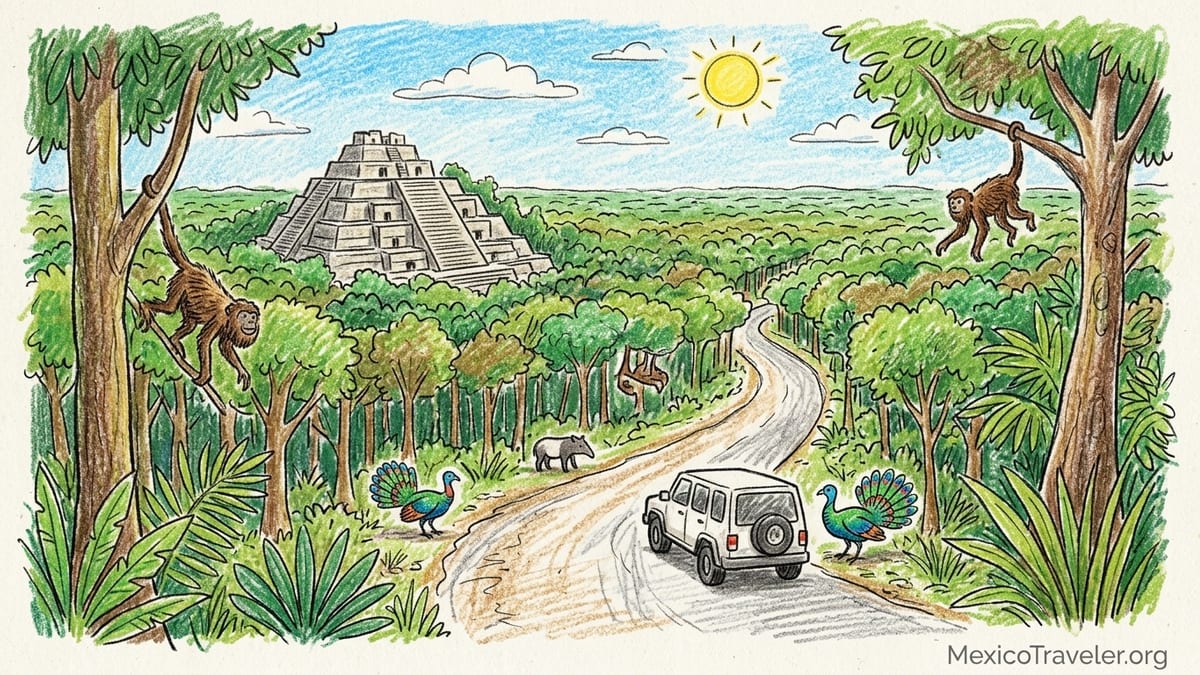
Wildlife is not guaranteed, but the probability of sightings is higher than at most large ruins in Mexico because of the surrounding reserve. Ocellated turkeys sometimes patrol between trees with iridescent feathers catching slanting light. Spider and howler monkeys swing and crash through the canopy, occasionally stopping to stare back at the human visitors. Serious birders visit primarily for species like toucans, motmots and trogons. Seeing a large mammal such as a tapir or a cat is rare but not unheard of, especially for those staying overnight at research camps deeper in the reserve. Even without marquee encounters, the sensation of walking an ancient Maya capital while wrapped in living tropical forest is Calakmul’s defining emotional reward.
The atmosphere also reflects the relative lack of crowds. Visitor numbers remain low compared with marquee destinations on the Riviera Maya or near Mérida. It is still possible, particularly on weekday mornings outside Mexican holiday periods, to sit on a massive staircase and listen to leaves fall without hearing another group. For travelers who equate ruins with lines and souvenir vendors, this solitude is a revelation. For others, the quiet can feel slightly unsettling, especially if they are more comfortable where there are lots of other people and visible staff.
Climbing Rules, Physical Effort and Summer Heat
One of the key questions for travelers in 2026 is what can still be climbed at Calakmul. Across Mexico, the authorities have restricted access to many famous pyramids over the past decade to preserve fragile stone and prevent accidents. As of the most recent reports from visitors and guides, several major structures at Calakmul, including at least one of the tallest pyramids, remain open to climbing within posted safety guidelines. However, access policies continue to evolve. On any given day, local staff may cordon off individual staircases due to rain-slicked steps, conservation work or staffing levels.
It is therefore important to understand the physical demands rather than fixating on one specific summit. Even without climbing every accessible pyramid, exploring Calakmul means walking several kilometers on uneven, occasionally root-tangled paths and ascending multiple steep staircases with uneven risers. There are few handrails. Steps are narrow and high. For anyone with knee problems, vertigo or limited fitness, some sections may be uncomfortable or out of reach. In the hot season, which dominates much of the year, heat and humidity amplify every exertion.
Shade helps. Most routes between plazas pass under dense canopy, and early starts mean cooler air and more manageable sun angles. Still, daytime highs in the dry season can push into the mid 30s Celsius, with humidity clinging even in the so-called cooler months. Carrying at least two liters of water per person for a full morning or midday visit is realistic, and hats, light clothing and plenty of insect repellent move from optional to essential. There are no air-conditioned on-site cafes where you can regroup between climbs.
This combination of heat, exertion and minimalist infrastructure means that families with very young children or travelers unaccustomed to hiking in the tropics should consider realistically whether a full Calakmul circuit suits them. Turning back early is always possible, but the central pyramids lie far enough from the parking area that even reaching them and returning requires a baseline level of stamina.
Understanding the Ruins: Interpretation, Context and Comparisons
Visually, Calakmul’s core contrasts with the crisp, clean lines and heavily restored facades of Chichén Itzá or Uxmal. Many buildings retain a partially collapsed, forest-softened look, with trees still gripping platform edges and roots braided through masonry. This is not due to neglect so much as a deliberate choice to balance conservation with a sense of discovery. Major pyramids and key palaces are stabilized, staircases cleared, and emblematic features like masks and friezes preserved, but much of the urban fabric remains lightly touched by excavation.
In historical terms, however, Calakmul’s importance rivals or surpasses better-known sites. It functioned as the capital of a powerful polity that orchestrated alliances and wars across what is now Mexico, Guatemala and Belize. Its “Snake” emblem glyph appears in inscriptions at distant cities that once owed allegiance or paid tribute. Standing atop its great pyramid and looking across a sea of canopy, with only faint hints of other structures poking through, it is easier to imagine a network of jungle-cloaked cities than in the manicured lawns of Uxmal.
On the ground, interpretation for visitors has improved incrementally but still lags behind Yucatán’s flagship sites. Some explanatory signs in Spanish and English stand at major plazas and next to a few key structures. They offer brief summaries of dates, functions and architectural phases. However, there is no large on-site museum at the ruin entrance. An introductory room and small exhibition space linked to the broader Calakmul visitor system exists nearer to the highway and Tren Maya access point, but many independent visitors still arrive directly at the ruins parking lot with only basic printed maps.
This reality underscores the value of reading up in advance or hiring a guide if you care about political history, cosmology and daily life in the ancient city. Without that context, many travelers still find Calakmul powerful for its atmosphere and scale but may struggle to connect specific buildings with their original functions in the way they can at Chichén Itzá, where ballcourts, temples and observatories are clearly labeled and widely described in popular media.
Costs, Heat, Bugs and the Real Trade-offs
By the time you drive back into Xpujil after a full Calakmul day, the cost of the outing is measured in more than pesos. On the financial side, you will likely have paid separate conservation and archaeology entrance fees per person, plus fuel for at least 180 to 220 kilometers of driving from Xpujil and back, plus any guide charges or tour costs. Even without itemizing exact figures that may shift year to year, this places Calakmul firmly at the serious-day-trip end of a budget, especially for families or small groups.
Then there is the cost in time and energy. A typical schedule from Xpujil involves leaving around 5:30 or 6:00 a.m., driving two and a half hours to the ruins, spending three to five hours walking, climbing and resting on-site, then returning to town mid to late afternoon for a late lunch and recovery. That is a 9 to 11 hour day in often intense conditions. Travelers who include additional stops at roadside lookouts, research camps or small nearby ruins within the reserve will stretch that even further.
Heat is a constant companion rather than a background detail, particularly between March and June and again in September and October. Air is thick with humidity, and any breeze at summit viewpoints feels like a reward earned step by step. Mosquitoes and other biting insects fluctuate with recent rainfall and time of day, but they are present enough to warrant long sleeves or repellent, especially in shady pauses. Ticks are a possibility in tall grass, and ants can sting along some paths if you step unwittingly on their routes.
For some travelers, these factors combine into an authentic sense of adventure and connection. For others they cross an invisible line from “rewarding challenge” into “exhausting ordeal.” Those who thrive in well-serviced environments with cafes, frequent benches, audio guides and clear sightlines to the parking lot may find Calakmul’s minimalism and climate draining rather than inspiring. It is important to be honest with yourself about which category you belong to before committing a scarce vacation day here.
Who Gets the Most from Calakmul: Archaeology, Wildlife and Families
Archaeology enthusiasts with at least a moderate level of fitness are Calakmul’s natural audience. If you already know names like Tikal, Palenque, Copán and Caracol and can situate them roughly on a map, standing atop Calakmul’s largest pyramid and scanning the forest horizon will resonate deeply. The site’s combination of scale, relative solitude and continued ability to climb key structures (subject to current rules) offers a kind of engagement that heavily restricted or crowded sites cannot match.
Wildlife lovers and birders also find significant rewards here. Even casual visitors notice troops of monkeys and the flamboyant presence of ocellated turkeys, while those with binoculars and patience can log a full list of forest species along the access road, in clearings and at the ruins themselves. Adding an extra night in Xpujil or a lodge near the reserve to devote one morning to ruins and another to dedicated wildlife observation often proves a wise choice for this group.
Photographers, especially those drawn to atmospheric rather than postcard-perfect shots, tend to fall in love with Calakmul. Mist in the canopy at dawn, slanting rays through buttress roots, high contrast between carved stone and green foliage, and distant pyramids peeking over the treeline combine into a compelling palette. A sturdy camera bag and willingness to protect gear from sweat and the occasional shower are essential, as are spare batteries and memory cards in a place with no camera shop nearby.
Families with young children deserve special mention. For teens interested in history or nature, Calakmul can be transformative, giving scale to classroom tales of Maya civilization and biodiversity. For younger kids under ten, however, the long drive, heat, minimal facilities and steep, rail-less staircases present serious challenges. Parents will spend a great deal of bandwidth managing water, shade and safety on climbs. If your main priority is easy, visually impressive ruins where kids can bail out early to a shaded café, sites like Tulum, Coba, Chichén Itzá or even nearby Becán may be kinder choices.
Adding Becán and the Río Bec Sites: Making a Regional Stay Worthwhile
One of the strongest arguments for including Calakmul in a ten or fourteen day Yucatán itinerary is that it rarely stands alone. The stretch of Highway 186 around Xpujil anchors the so-called Río Bec route, a cluster of smaller but architecturally distinctive Maya sites that can be visited from the same base. Becán, Chicanná, Xpuhil and Balamkú all lie within an hour’s drive of town and operate with more modest entrance fees than Calakmul itself, reflecting lower maintenance needs and shorter access roads.
Becán in particular offers a compelling complement. Its concentric moats and tall, climbable structures (subject to current local restrictions) deliver sweeping views with only a short walk from the parking area. Chicanná, meanwhile, showcases intricate zoomorphic facades close to ground level, which can be appreciated even by visitors who do not want to climb. Xpuhil, on the edge of town, features evocative tower-like temples that illustrate the Río Bec architectural style’s fondness for dramatic vertical elements.
Staying at least two nights in Xpujil or nearby lodges allows you to dedicate one full day to Calakmul and another to these surrounding sites without turning each outing into a forced march. This transforms the region from a single exhausting excursion into an integrated experience of Maya diversity. It also spreads the fixed cost of reaching this relatively remote corner of Campeche across several rewarding visits rather than loading it all onto one intense day.
For travelers who remain uncertain about the physical demands of Calakmul itself, spending a day at Becán and Chicanná first can act as a reality check. If climbing their pyramids in warming late-morning sun already feels too much, you have valuable information about whether the deeper, longer and hotter Calakmul journey will be enjoyable or simply endured.
The Takeaway
After the long drive in and out, the layers of entrance fees and the sweat-soaked shirt from climbing stone staircases, was Calakmul worth it? For me, unequivocally, yes. The combination of political significance, sheer urban scale, continued ability to physically ascend major structures and the enveloping presence of living forest created one of the most memorable days I have had at any archaeological site in Mexico. The fact that I could sit alone on a massive pyramid and hear only monkeys and wind, rather than the chatter of tour groups and hawkers, felt priceless.
Yet that answer does not apply to everyone. If your ideal ruins visit is a quick, air-conditioned bus ride followed by an hour of photos and a cold drink, Calakmul will likely frustrate more than delight. The logistic load is real, the infrastructure intentionally minimal, and the climate unforgiving for those who are not prepared. Families with young children, travelers with mobility issues, and those who feel anxious far from crowds and services may be better served by combining more accessible sites like Uxmal, Edzná, Becán and Chichén Itzá instead.
For a ten day Yucatán itinerary focused on beaches, cenotes and a sampling of ruins, Calakmul is a major detour that demands at least two nights away from the coasts or colonial cities. For a fourteen day route that already includes inland time and a strong interest in Maya history or wildlife, building in a Xpujil base with Calakmul plus a Río Bec day often becomes the highlight of the entire trip. In my own planning for a return to the region, Calakmul would absolutely earn that investment of time again.
If you are the kind of traveler who reads site plans for fun, pauses to identify birds and does not mind ending a day tired and dusty in exchange for genuine remoteness and depth, then the long jungle journey to Calakmul is not just worth it. It is essential.
FAQ
Q1. How long does it really take to reach Calakmul from Xpujil?
From central Xpujil to the highway turnoff takes about an hour in current conditions, and from the turnoff to the ruins parking lot usually takes 1 hour 45 minutes to 2 hours of careful driving, so most visitors should plan on a total of 2.5 to 3 hours each way.
Q2. Do I need a 4x4 vehicle to visit Calakmul?
No, in dry conditions a regular sedan is usually sufficient, because the access road is paved, but deep potholes and occasional surface damage require attentive, slow driving, and after heavy rains local advice should be checked before setting out.
Q3. Can I climb the pyramids at Calakmul in 2026?
As of recent visitor reports in 2025 and 2026, at least one of the tallest pyramids and several other structures remain open to climbing, although specific staircases or platforms may be temporarily closed by staff for safety or conservation reasons on a given day, so access is never guaranteed in advance.
Q4. How much cash should I bring for entrance fees?
Because fees are split between the biosphere reserve and the archaeological site and occasional community charges, foreign adults should expect combined entry costs in the low to mid hundreds of pesos per person in 2026, with discounts for Mexican residents, students, teachers and some age groups, and it is safest to carry enough cash in small bills to cover slightly higher totals in case of recent adjustments or card machine failures.
Q5. Is it safe to visit Calakmul independently?
Daytime visits by independent travelers remain common, and most recent accounts describe feeling safe on the route, but conditions in Campeche can change, so it is sensible to drive only in daylight, seek up-to-date advice from your accommodation in Xpujil, keep valuables out of sight and consider hiring a local guide if you are unfamiliar with rural Mexican roads.
Q6. What is the best time of year and day to visit?
Cooler months from roughly November to February are generally more comfortable for hiking and climbing, and within any season arriving as close as possible to the site’s morning opening time offers lower temperatures, more active wildlife and a better chance of enjoying plazas and viewpoints with very few other visitors.
Q7. Are there food and drink options at the ruins?
At the parking area you may find a small kiosk selling basic snacks and cold drinks, but there is no full restaurant or guaranteed food service, so most visitors bring their own water, fruit and sandwiches from Xpujil or nearby lodges and plan to eat a larger meal back in town.
Q8. Is Calakmul suitable for young children or older travelers?
Healthy older travelers who are comfortable walking several kilometers on uneven paths and managing steep stairs can enjoy the site at a gentle pace, while families with very young children may find the long drive, heat and lack of railings on pyramid staircases challenging, so many parents opt instead for shorter visits to nearby sites like Becán or Chicanná.
Q9. Can I reach Calakmul by public transport or Tren Maya alone?
Even though the Tren Maya includes a Calakmul-area station and there are buses along Highway 186, there is currently no regular public transport that runs all the way along the reserve access road to the ruins, so visitors arriving by bus or train still need to arrange a tour, taxi or private transfer from Xpujil or the visitor center to complete the journey.
Q10. Should I combine Calakmul with other Río Bec sites?
Yes, most travelers get more value from the long trip by staying at least two nights around Xpujil and pairing one full Calakmul day with another day visiting nearby Río Bec sites such as Becán, Chicanná, Xpuhil or Balamkú, which provide impressive architecture, easier logistics and a broader picture of the region’s Maya heritage.