


On paper, Río Lagartos and Las Coloradas sound like one seamless experience: a boat ride through a wildlife reserve full of flamingos, followed by dreamy photos at neon-pink lakes. In reality, they are two very different outings that just happen to share a map pin. I traveled to the northern coast of Yucatán to see both on the same day, joining an authorized wildlife boat tour in Río Lagartos and then visiting the pink salt ponds at Las Coloradas, taking careful notes on costs, access rules, photo conditions and what this combo really offers travelers who care about nature and photography.
Setting the Scene on the Northern Yucatán Coast
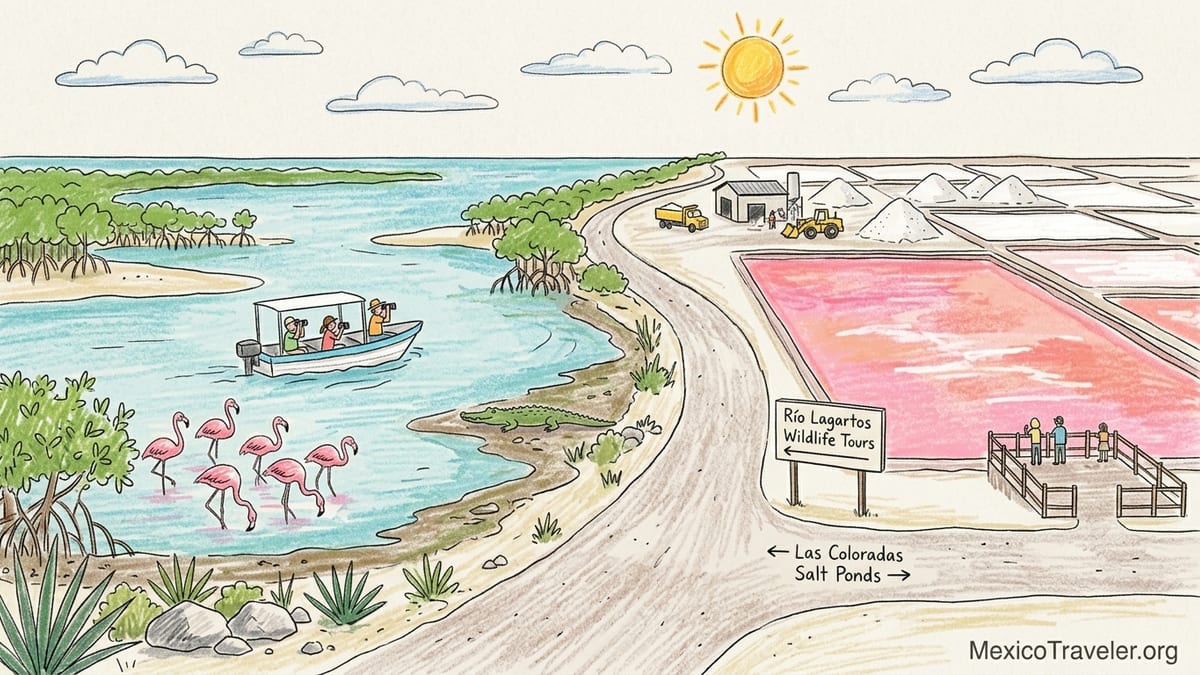
Río Lagartos sits on the edge of the Ría Lagartos Biosphere Reserve, a protected wetland on the northern coast of Yucatán where mangrove channels, shallow lagoons and salt marshes form a long, narrow estuary parallel to the Gulf of Mexico. Flamingos feed here, crocodiles lie along the banks, and fishing skiffs double as wildlife boats for visitors. About 12 kilometers east along the same narrow spit of land is Las Coloradas, a salt company town beside bright evaporation ponds that went viral as the “pink lakes of Mexico.” On social media the two are often blended into one experience, but on the ground they are separated by a paved road, industry gates and very different expectations.
Driving from Mérida, I left before dawn for the roughly 3-hour journey of about 220 kilometers across the interior. The last stretch passes small villages and stretches of scrub, then suddenly opens onto a waterfront lined with modest guesthouses in Río Lagartos. Fishermen were already unloading the morning catch as I arrived at the malecón, and a row of fiberglass lanchas with sun canopies bobbed at the piers, waiting for their first passengers. This is where virtually all authorized wildlife tours depart, under a municipal regulation that requires registered boats and local guides to operate inside the reserve.
My aim was to treat the day the way many independent travelers do from Mérida or Valladolid: one focused wildlife boat tour, lunch in town, then a drive to Las Coloradas in the hottest hours for a short but concentrated photography stop. The structure of the day matters because light and wind conditions affect both flamingo sightings and the color of the salt ponds, and because the long drive makes time and money feel higher-stakes than a casual coastal detour.
Most travelers will encounter Río Lagartos and Las Coloradas through packaged full-day excursions out of Cancún, Playa del Carmen or Mérida, where the logistics are bundled and the trade-offs less visible. By going independently, staying overnight in Río Lagartos and meeting guides at the dock, I could directly compare what each part of the day actually delivered, and where expectations around flamingos and pink water often diverge from reality.
On the Water in Río Lagartos: Logistics, Costs and What You Actually See
At the western end of the malecón, near the Ría Maya dock, I checked in with a local operator that specializes in birdwatching and photography tours rather than simple boat rides. Authorized private wildlife excursions in Río Lagartos in late 2025 and 2026 were typically priced in the range of about 3,000 to 4,000 Mexican pesos per boat for 1 to 2 people for a 2.5 to 3-hour tour, rising as you add participants and opt for longer itineraries. One well-known outfitter, for example, listed a private “nature lovers” tour at about 3,500 pesos for 1 to 2 guests, including an English-speaking naturalist guide, shaded boat, shared binoculars, lifejackets and drinking water. Group departures arranged on the waterfront were often cheaper per person, but with less control over route and timing.
Departure times are arranged around light and wind more than fixed timetables. Around sunrise and late afternoon, the air is cooler and wind on the estuary is softer, which matters both for comfort and for spotting birds in the mangroves. I chose a 7:00 a.m. departure that put us on the water shortly after first light. Tours typically leave directly from the main waterfront docks, and my guide emphasized that only registered local boats with permits are allowed into certain channels of the reserve, a point the municipal tourism regulations reinforce. It is worth asking to see the operator’s registration at booking, not only for conservation reasons but also because enforcement of speed limits and distance rules around nesting areas relies on guides who know the regulations.
Our boat was a 7-meter fiberglass lancha with a sunshade roof and padded bench seats, registered for up to 6 guests plus captain and guide. On this morning we were only two passengers, which is ideal for photographers. Over the course of three hours we saw a mixed lineup of wildlife: several flocks of American flamingos feeding in the shallow lagoons, reddish egrets and great blue herons stalking the banks, white ibises, black-necked stilts, ospreys on posts, and a couple of sizeable crocodiles lying half-submerged near a mangrove edge. We did not approach the flamingos closely; instead, the captain cut the motor and drifted at a distance that kept the birds relaxed while we used binoculars and telephoto lenses.
Binocular availability varies, but specialized wildlife operators often provide at least one or two good-quality shared pairs per boat and sometimes small laminated bird checklists. On my tour, each passenger was offered binoculars, and the guide actively pointed out behavior such as flamingos stirring up the mud with their feet to feed, or herons taking advantage of the disturbance. The difference between this and a generic sightseeing ride was noticeable: rather than racing from one “spot” to another, we slowed in small inlets, listened for bird calls and talked through the mangrove ecology that supports the larger flocks farther inside the reserve.
Flamingo Seasonality, Expectations and Guide Quality
Flamingos are the star of Río Lagartos marketing, but they are not a staged attraction. They are wild birds whose numbers along any given stretch of lagoon change with season, food availability and wind. Guides in town commonly mention that the highest concentrations near Río Lagartos tend to occur roughly from late winter into early summer when water levels and salinity are favorable, but even within that period daily sightings fluctuate. In my case, visiting in the dry season, we saw several medium-size groups, perhaps a few dozen birds each, feeding and flying low across the lagoon in tight V formations.
A good guide will frame this realistically before you step into the boat. Mine explained that some days he sees large, dense rafts of hundreds of flamingos at specific feeding grounds, while on others wind conditions or recent disturbance push the birds deeper into the reserve where it is neither ethical nor permitted to chase them. He carried a small field guide to local birds, flipped it open to show us other species we might value equally, and reminded us that by regulations boats must keep a minimum distance and avoid surrounding a flock. Hearing this on the dock filtered my expectations toward a birding outing rather than a guaranteed selfie with a wall of pink birds behind me.
Guide quality in Río Lagartos varies, as in any popular reserve, but there is a clear cohort of dedicated nature guides who have built reputations over years of working with birdwatchers and photographers. Signs of a professional operator included clear communication of included services and prices in advance, having functioning safety gear, speaking candidly about the likelihood of flamingo sightings at that time of year, and being willing to adjust the route when we expressed interest in certain species. Less specialized boatmen along the waterfront offered shorter, cheaper rides that prioritized getting quickly to a distant view of the pink industrial ponds or to a beach for a swim rather than lingering in narrow mangrove channels where shy birds hide.
The main lesson from the morning was that a wildlife-oriented traveler will be happier if they book with an operator that explicitly markets birding or nature photography, even if the price per boat is a bit higher. The per-person cost can still be modest if two to four people share a private boat, and the payoff comes in unhurried time with binoculars in hand instead of racing to tick off “flamingos” and “pink lakes” in a single blur.
From Biosphere Reserve to Industrial Salt Ponds: Visiting Las Coloradas
After returning to the dock around 10:30 a.m., we ate an early seafood lunch in town, then drove the 20 minutes along the narrow coastal road to Las Coloradas. It is important to understand that Las Coloradas is not another section of the biosphere reserve in the recreational sense. It is a working salt operation, with large evaporation ponds run by a private company near a small worker town. Visitor access is organized through a limited set of official viewpoints and guided circuits created in recent years in response to increasing tourist pressure and environmental rules.
Approaching from Río Lagartos, we passed signs and a few informal pullouts before reaching the clearly signed official visitor area, which doubled as a modest “parque turístico” entrance. Guards and staff directed visitors to a small parking area and ticket booth, where they explained the current options. In 2026, the basic access package for foreigners typically involved a modest admission fee in the low hundreds of pesos per person for a short guided visit to viewpoints over the pink ponds, with the possibility to upgrade to longer circuits by bicycle or vehicle along certain causeways inside the saltworks. Exact prices were posted at the booth and could change with fuel, maintenance and company policy, so I relied on the on-site board rather than older blog posts.
Our choice was a simple guided circuit of roughly 45 minutes on foot and by shuttle vehicle that stopped at two main viewpoints. The guide made it clear from the outset that entering the water, touching the ponds or flying drones was prohibited. This aligned with tightened rules introduced several years earlier, which banned swimming or wading in the pink lakes for both safety and contamination reasons. Visitors were instructed to stay behind ropes or marked lines at each viewpoint and to follow the group so that staff could monitor compliance. Photography was permitted, but strictly from designated platforms or along a specific section of the dike road.
Time at Las Coloradas is therefore structured and relatively short for most independent visitors. Common advice from operators is to plan 45 minutes to 1.5 hours from arrival to departure, unless you book a more extensive cycling or vehicle tour inside the saltworks. There was no café or substantial shade at the viewpoints during my visit, only a few small structures and umbrellas, which meant that the sun and reflected glare from the water quickly became intense. Most travelers around us seemed content with under an hour, taking their photographs and then retreating to air-conditioned vehicles.
Why the Pink Lakes Do Not Always Look Pink
The viral images of Las Coloradas often show electric pink water under a cobalt sky, but that level of saturation is the exception rather than the rule. The color of the ponds is influenced by a cluster of factors: microorganisms and brine shrimp that thrive at certain salinity levels, the depth of the water at different stages of evaporation, suspended minerals, the angle of the sun, and how strongly the sky and surrounding clouds reflect on the surface. Even subtle changes in weather conditions across a single day can change what you see through the camera.
On the day of my visit, the sky was lightly overcast during the early afternoon, with a thin veil of high cloud. At the first viewpoint the water had a muted, milky rose tone, beautiful but not the neon pink that many visitors seemed to expect. As the sun emerged and climbed higher, the color deepened slightly, especially when seen from a low angle with the horizon minimized, but remained more salmon than hot pink. The guide explained that after heavy rain or on cooler days the ponds can appear paler, and that the most saturated colors often occur when the brine is at a specific stage in the evaporation cycle combined with bright, direct sunlight.
Seasonally, the dry months on the northern Yucatán coast often provide more clear-sky days that favor stronger colors, but this is not a guarantee. Nor is there a single “perfect hour.” Early afternoon can enhance brightness when the sun is high, while late afternoon can produce warmer tones during golden hour but may also introduce longer shadows and more reflection from nearby clouds. Based on my experience and conversations with guides, the safest mindset is to treat the pink ponds as an industrial landscape whose beauty is a bonus, not a guaranteed natural spectacle that can be scheduled to the minute.
For photography, longer focal lengths compress the perspective and allow you to fill the frame with textured water while cropping out the industrial infrastructure. At wider angles, more context enters the composition: mounds of white salt, yellow railings, trucks moving slowly along the berms. Used thoughtfully, this can produce strong documentary images that show the human manipulation behind the color rather than pretending the lakes are untouched natural lagoons.
Flamingos vs Pink Lakes: Two Separate Experiences
A recurring source of confusion among travelers is the assumption that flamingo sightings and the pink lakes are part of the same attraction. In practice, flamingos in this region are best and most ethically observed inside the Ría Lagartos Biosphere Reserve from authorized boats, while the pink lakes at Las Coloradas are part of an industrial salt complex with tightly controlled access. You might see a few flamingos flying over or feeding in nearby natural lagoons from the road to Las Coloradas, but you are unlikely to have a meaningful wildlife encounter while standing at the fenced viewpoints above the salt ponds.
From a wildlife perspective, the boat tour feels alive and unpredictable. Flamingos shift position, lift their wings, shuffle and feed. Herons move in and out of mangrove shadows, and crocodiles occasionally slide silently into the water as your boat drifts past at low speed. There is sound: wind across the water, the calls of gulls and waders, the low rumble of the boat engine when repositioning. You are participating in a living ecosystem, even as a temporary visitor. Photography in this context is about timing, patience and accepting distance. Long lenses help, but even with modest gear, framing a small group of flamingos against the wider lagoon conveys a sense of place.
At Las Coloradas, in contrast, the subject is static color and geometry. The main actors are salt, brine and light, not birds. While you may spot occasional silhouettes of distant flamingos over neighboring natural lagoons, the guided routes through the industrial ponds do not allow you to wander freely along all the dikes, and wildlife viewing is not the goal. Photography here is largely about composition and abstraction: capturing the contrast between pink water and white salt edges, or the repeating patterns of rectangular ponds. The human element is prominent, from safety signage and fences to the shapes of loaders and pipes in the background.
Conflating the two can leave travelers disappointed when they arrive expecting a single, fully wild “pink flamingo lake” experience. Understanding that Río Lagartos is the wildlife and Las Coloradas is the industrial color helps set expectations and plan time. Many full-day tours from the Riviera Maya combine a short Las Coloradas stop with a more substantial boat ride from Río Lagartos or nearby docks, but the balance can tilt heavily toward quick photo-ops if the itinerary is crowded. Independent travelers with their own vehicle or a private driver have more control over this balance, and in my experience that flexibility significantly affects overall satisfaction.
Practical Realities: Sun, Insects, Food and the Long Drive
Spending a full day between Río Lagartos and Las Coloradas involves long exposure to Yucatán’s coastal elements. On the boat, even with a canopy, sun reflects off the water and wind can mask how quickly you are burning. By mid-morning on my tour, several guests on other boats were already red across the shoulders. Long sleeves, a broad-brimmed hat that will not blow off, high-SPF sunscreen and sunglasses are essential, and a buff or light scarf helps against wind and incidental spray. Insects were moderate at sunrise near the mangroves, with some mosquitoes and sandflies when we paused close to shore. A combination of long clothing and repellent minimized discomfort, but anyone highly sensitive should be prepared.
On land, Las Coloradas was hotter and more exposed than the boat. The pale salt and shallow water act as mirrors, amplifying glare. There was almost no natural shade at the viewpoints, and the small man-made structures did not fully protect from the midday sun when the guided groups gathered for explanations. Water was not included in our basic ticket, so we were glad to have bottles from Río Lagartos with us. It is feasible to find basic food in Las Coloradas town, but the wider choice of seafood restaurants and small eateries is in Río Lagartos, which is why many visitors prefer to eat there before or after the salt ponds rather than relying on limited options at the industrial site.
From Mérida or Valladolid, the drive time frames the entire experience. From Mérida, a return trip plus activities can easily exceed 10 to 12 hours, especially if you join a combined tour that also squeezes in a cenote or colonial town stop. From Valladolid, the drive is shorter, roughly two hours each way depending on traffic and road conditions. In my case, having a car and an overnight stay in Río Lagartos transformed the day into a slower experience. I could choose an early-morning boat trip, rest at the hotel, then head to Las Coloradas in the afternoon without watching the clock in the same way that a same-day return to Mérida would require.
Whether the long drive is justified depends on what you value. Travelers primarily interested in wildlife and quieter coastal villages often feel that Río Lagartos alone warrants a night or two, especially if they want to combine a flamingo-focused boat tour with additional outings such as night bioluminescence excursions, fishing with local skippers or a visit to nearby San Felipe. For those whose main goal is a few dramatic photos of pink water, the equation is less favorable, particularly when one considers that the color is unpredictable and the time on-site relatively short.
Packaged Excursions vs Staying Overnight in Río Lagartos
Packaged excursions to Río Lagartos and Las Coloradas from Mérida, Cancún or Playa del Carmen bundle the long drive, boat ride, Las Coloradas entry and sometimes lunch into a single per-person price. Recent offerings have sat roughly in the range of about 1,800 to 2,800 pesos per adult from Mérida or higher from the Riviera Maya, depending on group size, vehicle quality and inclusions. These tours appeal to travelers who do not want to rent a car or navigate rural roads, and who are comfortable with a set schedule. You are picked up early, spend several hours in transit, join a group boat tour, stop for a short Las Coloradas visit and return exhausted but logistically satisfied.
The trade-off is flexibility and depth. Group tours often run mid-morning boat departures when bus arrivals dictate the schedule, which can mean stronger wind, harsher light and more boats clustered in similar zones of the reserve. Time at Río Lagartos’ waterfront for chatting with guides, watching fishermen or tasting local seafood is constrained. At Las Coloradas, large groups cycle through viewpoints on a tight timetable, with minimal ability to wait for a cloud to pass or to experiment with different compositions in softer light. For many travelers, this is acceptable. For photographers and wildlife enthusiasts, however, the lack of control over departure time, tour operator choice and on-site duration can be frustrating.
Staying overnight in Río Lagartos shifts those trade-offs. A simple local guesthouse and private wildlife tour, split between two people, can cost a similar total to a higher-end day trip from Mérida, but with a different value proposition. By waking up already in town, you can book the first boat of the morning for calm conditions, enjoy a nap or leisurely lunch afterward, then decide whether to see Las Coloradas the same afternoon or the next day depending on forecast and fatigue. In the evening, the malecón is quiet, and you can walk as the last light fades over the mangroves, a very different atmosphere from stepping off a bus and turning immediately back inland.
For travelers on a strict schedule or without Spanish, a reputable packaged excursion remains a practical option. The key is to read recent reviews that mention boat group sizes, actual time spent on the water and at Las Coloradas, and how honestly guides communicate about flamingo and color conditions. For those willing to put in a bit more planning, however, an overnight stay unlocks a more measured, less rushed experience that aligns better with the slow rhythms of the reserve.
The Takeaway
By the end of my day, two impressions stood out. The morning on the boat in Río Lagartos felt like entering a living, breathing ecosystem where I was a quiet observer of wildlife behavior shaped by tides, light and wind. The flamingos were not as densely packed as in the postcards, but they were undeniably wild, moving with purpose through their habitat. The guide’s explanations, the shared binoculars and the unhurried pace elevated the experience beyond simple sightseeing. I left the dock with memory cards full of imperfect but satisfying images that told a story of place rather than a single staged moment.
The afternoon at Las Coloradas, while visually striking, felt more controlled and detached. The pink water was lovely but subtler than the images that first drew worldwide attention to the site. Security lines, clear rules against touching the water, strict view lines and the hum of salt-industry equipment framed the visit as an industrial tour with strong photographic possibilities instead of the dreamy natural lagoon many imagine. Within that frame, it was still enjoyable, particularly for those curious about salt production or drawn to minimal, color-blocked compositions, but it could not compete emotionally with watching wild flamingos lift off in a rustle of wings over the biosphere.
If I had to choose only one element to repeat, it would be the early-morning wildlife boat tour from Río Lagartos. For a traveler oriented toward birds, photography and quieter nature experiences, the biosphere reserve deserves clear priority over the pink ponds. Las Coloradas can be a worthwhile add-on, especially when you are already in the area and understand its industrial context and limits, but it should not be treated as the main event. Those planning trips from Mérida, Valladolid or the Riviera Maya would do well to design their day around the water and the birds first, with the pink lakes as an optional, photogenic footnote rather than the core reason to make the journey north.
FAQ
Q1. How much does a wildlife boat tour in Río Lagartos cost?
In 2025 and 2026, authorized private wildlife-focused boat tours generally range around 3,000 to 4,000 Mexican pesos per boat for about 2.5 to 3 hours for 1 to 2 people, with the total increasing slightly as more participants join or if you request longer routes. Prices for walk-up group tours on the malecón can be lower per person but offer less flexibility.
Q2. How long do the boat tours last and how many people share a boat?
Standard nature-oriented tours last around 2.5 to 3 hours. Many operators use boats that can seat 6 passengers plus crew, but serious photography tours often cap groups at 2 to 4 guests per boat so everyone has space to move and shoot.
Q3. Will I definitely see flamingos on a Río Lagartos boat tour?
No operator can guarantee flamingos. Sightings are influenced by season, water levels, food availability and wind. In the drier months, chances are usually good to see at least some groups, but flock size and distance vary day to day, and ethical guides keep a respectful distance rather than pursuing birds aggressively.
Q4. Are binoculars and good guides easy to find in Río Lagartos?
Several established operators in Río Lagartos specialize in birdwatching and photography and include shared binoculars, bird checklists and trained naturalist guides. Cheaper generic boat rides may not provide gear or detailed interpretation, so it is worth choosing a company that clearly advertises wildlife guiding rather than just transport.
Q5. How much does it cost to visit Las Coloradas pink lakes?
Access is managed through an official visitor area with posted prices that can change with company policy and maintenance costs. As of 2026, foreigners typically pay a modest admission fee in the low hundreds of pesos per person for a short guided visit to designated viewpoints, with optional higher-priced circuits by bicycle or vehicle available on site.
Q6. Can I swim in or touch the pink water at Las Coloradas?
No. Swimming, wading and touching the water are prohibited for safety and environmental reasons. Visitors must stay behind barriers or within marked areas, and staff monitor compliance. Older photos of people standing in the water reflect past practices that are no longer allowed.
Q7. How long should I plan to spend at Las Coloradas?
For most visitors, 45 minutes to 1.5 hours is enough to join a guided circuit, visit a couple of viewpoints and take photos. Longer visits are mainly for those who book extended bicycle or vehicle routes within the salt complex.
Q8. When is the best time of day to see the pink color of the lakes?
Bright, sunny conditions matter more than a specific hour. Early afternoon often produces strong brightness, while late afternoon can deliver warm tones and softer light. Cloud cover, recent rain and the stage of the evaporation cycle also affect how saturated the color appears, so there is no guaranteed “perfect” time.
Q9. Is the long drive from Mérida or Valladolid worth it?
For travelers focused on wildlife and quieter coastal life, a night or two in Río Lagartos with at least one dedicated morning boat tour usually justifies the journey. For those interested only in quick pink-lake photos, the long round trip can feel disproportionate given the short, regulated visit at Las Coloradas and the variability of the water’s color.
Q10. Should I book a package tour or stay overnight and plan independently?
Package tours bundle transport and logistics, which suits travelers short on time or uncomfortable driving. Staying overnight in Río Lagartos, however, gives you control over departure times, operator choice and how long you linger at both the reserve and Las Coloradas. Wildlife and photography enthusiasts generally gain more value from the flexibility of an overnight stay than from a packed single-day excursion.