


Driving south from Mérida just after sunrise, the traffic and pastel streets of the city gave way to low jungle and limestone hills. An hour later, I pulled into the parking lot at Uxmal, one of the great Maya cities of the Puuc region. I had visited Chichén Itzá a few days earlier, shoulder to shoulder with hundreds of visitors. Uxmal immediately felt different: quieter, more compact, and dominated by one of the most astonishing pyramids in Mexico. Here is what I discovered spending a full day around Uxmal, including precise costs, access rules, architecture details and whether it is worth a night away from Mérida.
Getting to Uxmal from Mérida and First Impressions
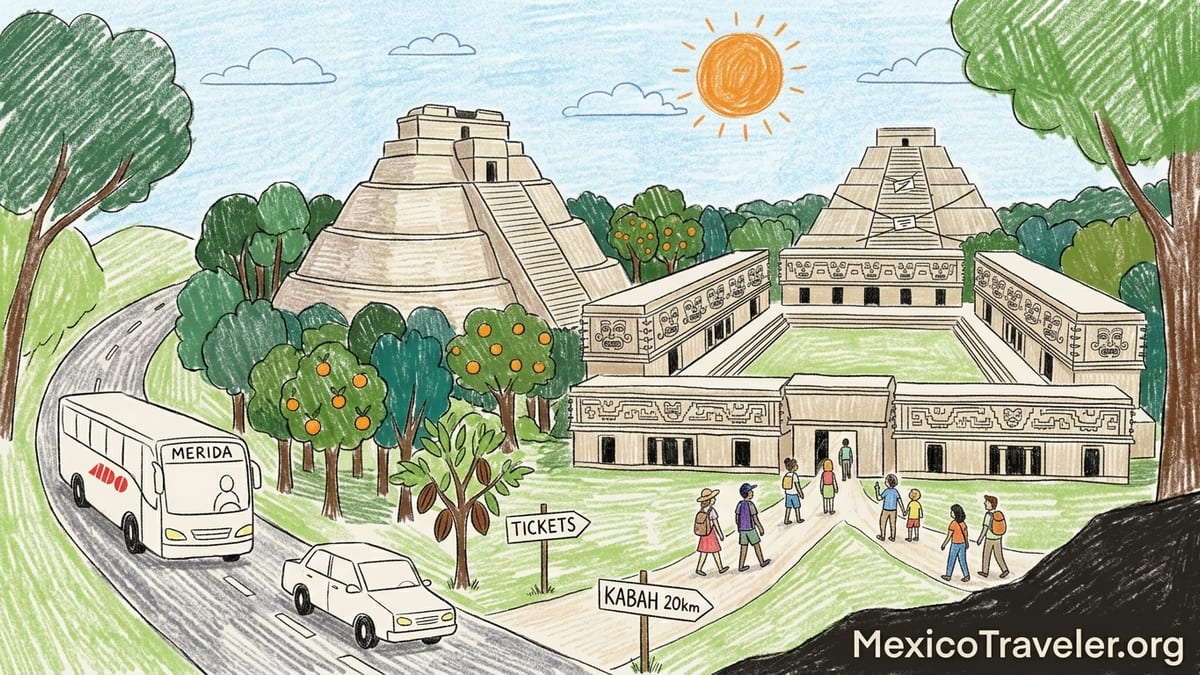
I based myself in Mérida’s Centro and left around 7:00 a.m. to reach Uxmal close to opening time. By private car, the drive took just under 1 hour and 15 minutes following Highway 261 south through Muna. Travelers without a car usually get to Uxmal either on an ADO or Oriente bus from Mérida’s TAME or second-class bus station, or on a small-group tour that combines Uxmal and nearby sites. On the day of my visit, the first public buses were timed to reach the ruins a little after opening, which is fine if you do not mind a few more people in your photos.
Arriving early matters less at Uxmal than at Chichén Itzá, but it still shaped my first impressions. As I walked from the parking area toward the entrance, the soundscape was mostly birds and the occasional guide touting services, not the constant chatter and market calls I had just experienced at Chichén. The jungle feels closer here. You do not emerge onto a vast grassy plaza. Instead, the first thing you see is stone rising above orange trees and palms.
From Mérida, a realistic budget for the trip by rental car is the daily rental cost plus fuel for roughly 160 kilometers round trip. Gas for the route cost me the equivalent of about 300 to 350 Mexican pesos at current prices. ADO and Oriente bus tickets vary, but expect to pay a moderate fare for the round trip. Organized tours that include transportation, a guide, and sometimes lunch generally run several times the independent cost but can simplify logistics for first-time visitors.
Right at the gate, there are basic services that help structure your day. I found bathrooms, a small cluster of shops and a restaurant before entering the archaeological zone. This is where you make your key decisions: whether to hire a guide, whether to see the nearby Choco-Story museum, and how long you can realistically stay before heading back toward Mérida or a nearby hotel.
Tickets, Current Admission Costs and Site Access
Like other major archaeological sites in Yucatán, Uxmal uses a two-part ticket system: a federal fee managed by Mexico’s National Institute of Anthropology and History (INAH), and a state fee collected by the Yucatán government. Separate sources indicate that for 2026, foreign adult admission to flagship sites such as Chichén Itzá is 697 pesos with a unified “boleto único” ticket, while Mexican nationals and Yucatán residents pay significantly less. Comparable posts and local reporting show that Uxmal’s combined ticket for foreign visitors is lower than Chichén’s, but still a meaningful expense per person. Exact amounts at Uxmal have changed several times in recent years, so at the gate I confirmed prices posted at the ticket window and paid in pesos by card.
Because these fees are updated periodically, especially at the start of a calendar year, I recommend travelers verify current amounts with official tourism channels or directly at the Mérida tourist information office shortly before their visit. What has been consistent is that admission covers access to the main archaeological zone. The small on-site museum, which displays carved stone, ceramics and site history, may be included or carry a symbolic extra charge depending on current policy. On my visit, entrance to the museum was included on the same ticket and it was open during core site hours, which generally run during daylight, with last entry in the late afternoon.
In addition to admission, there is a parking fee for vehicles at the official lot in front of the entrance. This is payable in cash and is usually a modest fixed rate per car. I kept my parking receipt handy, as attendants may ask to see it when drivers leave later in the day. If you arrive by bus, you simply walk up from the road and do not pay for parking.
It is important to know that, following safety and conservation decisions similar to those at Chichén Itzá and other sites, climbing of Uxmal’s major structures was not allowed at the time of my visit. Signs and ropes clearly indicated restricted stairs and platforms. Guides I spoke with confirmed that this has been the reality for several years. Some older guidebooks still describe climbing the Great Pyramid or sections of the Governor’s Palace platform, but you should plan your visit assuming that you will admire the buildings from designated paths and low viewing areas only.
Meeting the Pyramid of the Magician Up Close
Uxmal announces itself with one building: the Pyramid of the Magician. As you pass through the entrance gate and begin along the main path, the structure appears suddenly on your right, rising at an unusual oval angle. Unlike the more symmetrical El Castillo at Chichén Itzá, this pyramid seems to twist subtly as it rises, the result of multiple construction phases layered over earlier temples.
I stopped as soon as it came into view. Even after seeing several Maya cities in Yucatán, the Pyramid of the Magician feels surprising. The staircases are steep, and decorative elements such as masks of the rain deity Chaac and intricate latticework peek out between layers of stone. Because visitors can no longer climb the steps, you experience the pyramid as an imposing backdrop rather than a lookout point. I walked the perimeter, following a roped route that lets you see the base from different angles and appreciate how the structure anchors the surrounding plazas.
From the base, you notice details that easily disappear in photos. The corners of the pyramid soften into rounded edges instead of sharp right angles. At certain points, you can see the remnants of earlier temple facades peeking from under later surfaces. Conservation teams have patched cracks and stabilized areas affected by age and weather, which also explains why access to the upper levels is now restricted.
Emotionally, the effect is different from standing before El Castillo at Chichén Itzá. There, the monument exists in a broad open square, surrounded by vendors and continuous groups. At Uxmal, I shared my first minutes with fewer than twenty other visitors. I could hear the wind move across the stone and, occasionally, the call of birds from the low jungle beyond. It did not make Uxmal a “better” site than Chichén, but it did allow a slower, more reflective first encounter.
Inside the Nunnery Quadrangle and Governor’s Palace
Leaving the Pyramid of the Magician, I took the path that leads toward one of Uxmal’s masterpieces: the Nunnery Quadrangle. The name comes from a colonial-era comparison to a convent, but the complex is thought by archaeologists to have served administrative and possibly elite residential functions. Architecturally, it is a textbook example of Puuc style, with four elongated buildings enclosing a central courtyard.
Walking through its main gateway, I felt surrounded by an almost continuous frieze of carved stone. The lower walls are plain, composed of well-cut blocks, while the upper sections erupt in intricate geometric mosaics, Chaac masks, and stylized lattice patterns. This vertical contrast is fundamental to Puuc architecture: stability and simplicity at the bottom, exuberant decoration above. From ground level, I could move around the full square, examining panels that depict serpents, stepped fret designs, and long-nosed Chaac figures with stacked profiles of the rain god’s face.
Higher terraces and roofs that some visitors once climbed were closed off behind low barriers. Still, I found plenty to see from the courtyard and the accessible thresholds of doorways. In several chambers, bats and swallows had claimed the dark interiors, adding another layer of life to the ruins. A guide pointed out areas where original stucco would once have covered the stone, reminding me that these buildings were originally painted, probably in reds and creams, rather than the bare limestone we see today.
Farther along the main path, the Governor’s Palace occupies a broad artificial terrace. The building itself is long and low, with one of the finest decorative friezes in the Maya world. From the base of the terrace, visitors can walk up a central ramp to the platform, which on my visit remained open, although access directly onto the palace roof was restricted. The view from the terrace lets you look back toward the Pyramid of the Magician and out over the surrounding Puuc hills. Up close, the façade is a dense field of mosaics: repeated Chaac masks, diamond patterns and stylized birds and serpents. Even after an hour of looking at decoration elsewhere in the site, this façade is almost overwhelming in detail.
What Makes Puuc Architecture Distinctive
Uxmal sits at the heart of the Puuc region, a hilly zone of northern Yucatán that also includes Kabah, Sayil and Labná. Archaeologists use “Puuc” to describe both this geography and a particular architectural style that reached its peak in the Late Classic period. Seeing Uxmal in person, the characteristics that define Puuc buildings quickly become clear.
First, construction depends on well-cut veneer stones laid over a concrete core. This allowed Maya builders to create smooth wall faces and precise right angles. Up close, the joints at Uxmal are exact, with barely any gaps. Second, architects divided façades into a plain lower zone and an upper decorative zone. At the Nunnery Quadrangle, for example, the first meter or so of wall is bare, while the upper band carries an intricate visual program of geometric mosaics, lattice patterns, stepped frets, serpents and Chaac masks.
Chaac imagery is everywhere, which makes sense given the Puuc region’s reliance on rain-fed agriculture. Unlike lowland Maya regions with rivers and lakes, this karst landscape lacks surface water. The Maya stored rain in natural sinkholes known as cenotes and in artificial cisterns called chultunes. In a place where a failed rainy season could be catastrophic, the long-nosed rain deity became central to religion and art. At Uxmal, you can stand in front of building corners where multiple Chaac masks stack vertically, each with a curling stone nose projecting from the wall. These were not just decoration but active invocations of rain and fertility.
Finally, Puuc sites often feature long palace-like buildings rather than only freestanding pyramids. At Uxmal, these range from the North Building of the Nunnery Quadrangle to the Governor’s Palace and the House of the Doves. Walking between them feels more like moving through an ancient urban neighborhood than simply circling one central pyramid. For travelers already familiar with Chichén Itzá’s grand plazas and single towering pyramid, this web of elongated structures and intricate decoration offers a different way into Maya architecture.
Paths, Restrictions, Shade and Photography Opportunities
Uxmal’s internal circulation is straightforward. A main loop connects the Pyramid of the Magician, Nunnery Quadrangle, ballcourt, Governor’s Palace, Great Pyramid and outlying groups. Walking this circuit at a relaxed pace, stopping for photos and short rests, took me around three hours. Adding the on-site museum and more time examining details at the major buildings stretched my total visit to roughly four hours inside the archaeological zone.
The paths are a mix of packed earth, stone and short grassy stretches. There are some uneven surfaces and a few inclines, especially up to the Governor’s Palace terrace and toward the Great Pyramid, so comfortable closed shoes are important. Official signs indicated that climbing the main pyramids and most tall staircases was prohibited, primarily for safety and conservation. Smaller low platforms and a few short flights of stairs remained open, offering minor viewpoint changes without real risk.
In terms of shade, Uxmal offers more tree cover than Chichén Itzá but still exposes visitors to strong sun, especially between late morning and mid-afternoon. Some sections of the path pass under canopy, while larger plazas are open. I was grateful for a hat, sunscreen and water purchased before entering. Within the zone, formal rest areas are limited, but there are a few benches near major nodes like the entrance and the Governor’s Palace. Informally, low walls and stones functioned as quick rest spots as long as they were outside roped-off archaeological areas.
For photography, early arrival paid off. At opening time, light was soft and the Pyramid of the Magician’s eastern flank was gently illuminated. By mid-morning, the Nunnery Quadrangle was bright enough to capture details along the upper friezes without harsh contrast. Crowds remained modest even by late morning compared to Chichén Itzá. I was able to take multiple wide shots of the Governor’s Palace and ballcourt without other visitors dominating the frame. Tripods are generally restricted at Mexican archaeological zones unless you obtain special permits, so I worked handheld with a standard zoom lens and found plenty of room to step back for wider compositions.
Guided vs Self-Guided: How to Explore Uxmal
At the entrance, several licensed guides waited near the ticket booths, offering tours in Spanish and English. Quoted prices varied by language and duration, with private tours for small groups costing a significant supplement over the base admission fee. A typical guided visit covers the site’s history, cosmology, architectural symbolism and current conservation efforts in two to three hours, focusing on the Pyramid of the Magician, Nunnery Quadrangle, ballcourt and Governor’s Palace.
For my visit, I decided on a hybrid approach. I spent the first hour self-guided, simply walking the main loop, reading the official interpretive signs and orienting myself. These panels, provided by INAH, gave basic chronological context and some explanations of Puuc style. Then, back near the Nunnery Quadrangle, I joined a small English-language tour, negotiating a price with the guide for a ninety-minute overview focused on the major architectural groups.
This combination worked well. Self-guided time let me move at my own pace, linger on details I found compelling and take photos without feeling I was holding up a group. The guided segment, on the other hand, fleshed out the role of Chaac imagery, the urban layout of Uxmal and its likely political relationship with other Puuc cities. The guide also pointed out things I would have missed, such as traces of red pigment in sheltered carvings and the alignment of doorways for astronomical events.
Compared with a fully guided visit at Chichén Itzá, where guides are almost a necessity to navigate both logistics and dense storytelling, Uxmal is more forgiving for independent visitors. The site is compact enough that you will not get lost, signage is clear, and the number of vendors and distractions within the archaeological zone is minimal. For budget travelers, exploring entirely on your own, perhaps with a reputable guidebook or offline resource, is a reasonable choice. For travelers deeply interested in Maya history or architecture, setting aside funds for at least a short guided segment at Uxmal can significantly enrich the experience.
Site Museum, Kabah and Choco-Story: Building a Full-Day Excursion
Near the entrance to the archaeological zone, a small site museum adds context to what you see among the ruins. On my visit it was open during the same daytime window as the rest of Uxmal. Inside, I found carved panels, ceramic vessels, architectural fragments and explanatory texts about Puuc history and excavation work at Uxmal. Because entry was included in my ticket, I considered it a worthwhile thirty to forty minute stop, especially in the middle of the day when the sun was highest.
Just across the road from the main parking area sits Choco-Story Uxmal, a privately operated chocolate and Maya culture museum set in a garden environment. Separate from the archaeological zone, it charges its own admission, which is an additional cost on top of Uxmal tickets. While prices can change, visitors should expect to pay a noticeable but not extravagant amount per person. The visit typically includes exhibits on cacao cultivation and history, small tastings and a short presentation about traditional use of chocolate in Mesoamerica. For families or travelers interested in food history, building in an extra hour here can round out the day; for those mainly focused on archaeology, it is optional.
Kabah, another Puuc site about a twenty to thirty minute drive south along the same highway, offers an especially complementary experience. It is smaller and receives fewer visitors than Uxmal, but it features one of the most striking façades in the region, the so-called Codz Poop or Palace of the Masks, where dozens of Chaac faces form an almost continuous mask wall. Admission to Kabah carries a separate INAH fee that is lower than Uxmal’s, and there is basic parking beside the highway. There may or may not be state-level charges depending on current policies, so travelers should bring sufficient cash.
In financial terms, adding Kabah and Choco-Story to a day at Uxmal converts the outing from a single-site visit to a full-day Puuc circuit. With current patterns, a foreign traveler can reasonably expect to pay one main admission at Uxmal, a smaller second fee at Kabah and a private museum ticket for Choco-Story, plus fuel or bus/tour costs. While I cannot quote exact figures that remain valid long-term, in practice my combined entrance expenses for all three experiences were substantially less than a single day’s combined admissions and extras at Chichén Itzá, yet they filled an entire day of travel.
Comparing Uxmal with Chichén Itzá Without the Hype
It is tempting to declare that Uxmal is “better” than Chichén Itzá simply because it has fewer crowds. My experience, after visiting both during the same week, was more nuanced. Chichén Itzá, a UNESCO World Heritage Site and one of the so-called New Seven Wonders of the World, remains extraordinary for its scale and the variety of its monuments. The main pyramid, El Castillo, the Sacred Cenote, the enormous Great Ballcourt and the Temple of the Warriors collectively tell a story about power, cosmology and contact with central Mexico that no serious traveler should ignore.
However, the reality on the ground at Chichén Itzá today includes dense lines of souvenir vendors along many paths, heavy foot traffic, and a constant soundtrack of whistles and sales pitches. On my visit there, even after arriving at opening, the main plaza filled quickly, and by midday it was difficult to find any quiet vantage point. Photography required patience and sometimes creative angles to avoid crowds. Official rules also prohibited climbing major structures, so you experience the site laterally, similar to Uxmal.
At Uxmal, the experience is more intimate. There are vendors outside the entrance and a few kiosks near the gate, but once inside the archaeological zone, commerce largely recedes. Paths feel more like walks in an overgrown city than in a marketplace. At several points, I found myself alone for a few minutes between groups, able to listen, think and imagine the city in its heyday. That said, Uxmal does not have a feature equivalent to Chichén Itzá’s Sacred Cenote or its enormous ballcourt, and visitors who prioritize monumental scale may still find Chichén more visually impactful.
In architectural terms, Chichén Itzá presents a blend of Puuc and Toltec styles, with warrior columns and feathered serpent motifs that reflect influences from central Mexico. Uxmal, by contrast, is one of the clearest expressions of mature Puuc architecture. If you are particularly interested in the evolution of Maya building styles and the role of Chaac in the Puuc hills, Uxmal may resonate more deeply. In my case, Chichén Itzá impressed me with its monumentalism and global significance, while Uxmal moved me with its detail, atmosphere and the sensation of walking through a city tied closely to its landscape.
The Takeaway
After a full day centered on Uxmal, with a side trip to Kabah and a brief stop at the on-site museum, I felt I had experienced one of the most coherently preserved Maya cities in Yucatán. The combination of the Pyramid of the Magician’s powerful form, the intricacy of the Nunnery Quadrangle and Governor’s Palace, and the pervasive presence of Chaac imagery created a strong sense of place distinct from Chichén Itzá.
Whether Uxmal deserves an overnight stay or works best as a day trip from Mérida depends on your priorities and pace. For many travelers, a long day trip is entirely feasible. Leaving Mérida in the early morning, spending four to five hours between the ruins and the museum, optionally adding Choco-Story or Kabah, and returning before dinner is realistic by car or organized tour. This approach keeps lodging simple and allows you to enjoy Mérida’s restaurants and evening scene.
Staying overnight near Uxmal, however, offers two advantages. First, you can arrive at the ruins right at opening without an early drive, and rest at a nearby hotel during the midday heat before visiting a second Puuc site in the afternoon. Second, the countryside around Uxmal is quiet, and a night there changes the emotional tone of the visit. Several hotels and hacienda-style properties sit within a short drive of the entrance, often with pools that are welcome after hours in the sun. If I were to return, I would likely spend one night near Uxmal to slow the pace, visit Kabah and perhaps another Puuc site without rushing back to Mérida.
On a future trip, I would adjust two things. First, I would allocate dedicated time with a specialist guide, perhaps an archaeologist or long-time local expert, focusing only on the Nunnery Quadrangle and Governor’s Palace to delve deeper into iconography and cosmology. Second, I would schedule my visit to avoid the hottest season, opting for the drier and slightly cooler months from late November through February, when walking between groups and sitting to observe details is more comfortable. Regardless of season, though, Uxmal remains a rewarding complement to Chichén Itzá, not because it is emptier, but because it tells a different chapter of the Maya story in stone.
FAQ
Q1. How much does it cost to visit Uxmal in 2026?
Admission at Uxmal combines a federal INAH fee with a Yucatán state fee for foreign visitors, with total prices adjusted periodically. For 2026, public information shows that flagship sites such as Chichén Itzá charge 697 pesos for foreign adults with a unified ticket, and Uxmal’s combined ticket is somewhat lower. Because specific amounts change, travelers should confirm the exact current price at official tourism offices or the ticket booth shortly before their visit.
Q2. Can you still climb the pyramids at Uxmal?
No. For safety and conservation reasons, climbing the major structures at Uxmal, including the Pyramid of the Magician and the Great Pyramid, was not permitted at the time of my visit. Ropes, railings and signs clearly mark restricted areas. Visitors can still access certain terraces and low platforms, such as the terrace in front of the Governor’s Palace, but should plan on appreciating the architecture from designated ground-level paths.
Q3. How long should I plan to spend at Uxmal?
A focused visit that covers the Pyramid of the Magician, Nunnery Quadrangle, ballcourt, Governor’s Palace and on-site museum typically takes three to four hours at a comfortable pace. Adding time for photography, rest breaks and more detailed examination of Puuc decoration can extend this to five hours. If you also visit Kabah or the Choco-Story museum on the same day, expect to spend a full day in the area.
Q4. Is Uxmal suitable as a day trip from Mérida without a car?
Yes. Buses from Mérida toward Uxmal and the Puuc region, as well as organized day tours, make it feasible to visit without renting a car. Independent travelers can take an early bus from Mérida, spend several hours at the ruins and return in the afternoon. Organized tours usually include round-trip transportation, a guided visit and sometimes lunch, at a higher overall cost but with simplified logistics.
Q5. How crowded is Uxmal compared to Chichén Itzá?
Uxmal currently receives fewer visitors than Chichén Itzá, so paths and plazas tend to feel less congested. On my visit, even mid-morning allowed for relatively uncrowded photos and occasional quiet moments alone between groups. That said, Uxmal still attracts tour buses and independent travelers, especially in high season, so you will not have the site entirely to yourself. The difference lies more in atmosphere and noise than in absolute visitor numbers.
Q6. What should I wear and bring for a visit to Uxmal?
Because much of the site is exposed to sun and temperatures are often high, lightweight clothing, a wide-brimmed hat, sunscreen and comfortable closed shoes are essential. Bringing a refillable water bottle and some snacks or light food will make the visit more comfortable, although there are basic services near the entrance. Tripods usually require special permission at Mexican archaeological sites, so most visitors rely on handheld cameras or phones.
Q7. Is the Uxmal site museum included in the ticket?
During my visit, entrance to the small on-site museum was included in the same ticket used for the archaeological zone. Policies can change, and occasionally museums are closed for maintenance or conservation. It is wise to check posted information at the entrance or ask staff whether the museum is open and included on the day you arrive, then schedule 30 to 40 minutes for a walkthrough.
Q8. Is it worth visiting Kabah on the same day as Uxmal?
For travelers interested in Maya architecture and with access to a car or organized Puuc tour, Kabah is a rewarding addition to a day centered on Uxmal. The drive is short, and the site’s Codz Poop façade, covered in stacked Chaac masks, offers a memorable complement to Uxmal’s decoration. Admission at Kabah involves a smaller INAH fee than Uxmal, so the additional cost is modest relative to the overall trip budget.
Q9. What is Choco-Story Uxmal, and should I include it?
Choco-Story Uxmal is a private museum and garden complex opposite the archaeological site entrance, focused on cacao, chocolate and aspects of Maya culture. It charges a separate ticket from the ruins. If you enjoy food history, ethnobotany or family-friendly experiences with tastings and short presentations, it can be a pleasant one-hour stop. If your main goal is archaeology and you are short on time, you may prefer to allocate your hours entirely to Uxmal and, if possible, Kabah.
Q10. Should I stay overnight near Uxmal or just return to Mérida?
Most visitors treat Uxmal as a day trip from Mérida, which works well if you are comfortable with an early departure and a full day out. Staying overnight near Uxmal, however, can make the visit more relaxed, allowing you to be at the gate at opening time without a long drive and to explore additional Puuc sites without rushing. If I returned, I would likely spend one night near Uxmal to slow down the pace, especially during cooler months when evening and early-morning walks in the countryside are most pleasant.