


In March 2026, I spent twelve days driving across Mexico’s Yucatán Peninsula, moving between Mérida, Valladolid, Campeche, Cancún, Playa del Carmen and Tulum in a compact rental car. I logged nearly 1,000 kilometers on federal highways and local roads, walked colonial centers after dark, used ATMs, took taxis, and visited busy beaches and quieter archaeological sites. This article is not an attempt to declare the peninsula “safe” or “unsafe” in a single word. Instead, it is a detailed account of what I actually saw and did, what felt comfortable, what required extra caution, and how that lines up with current travel advisories and local resources in late 2026.
When I Went, Where I Drove, and Why That Matters
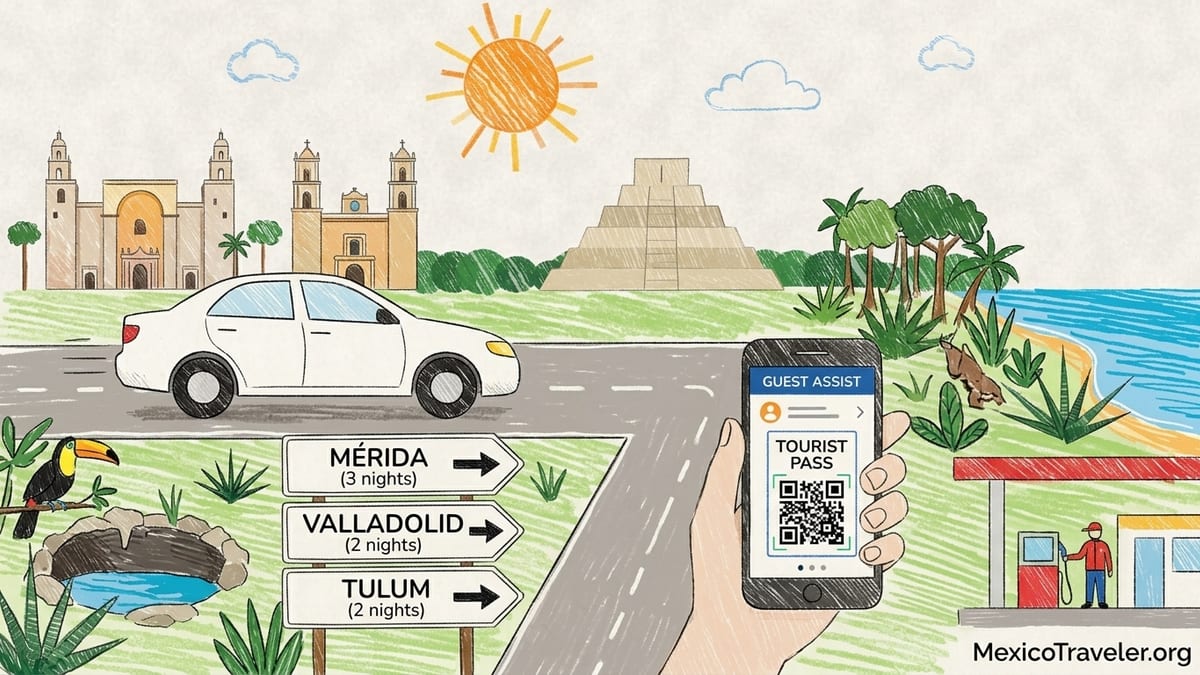
My trip ran from March 4 to March 16, 2026, at the tail end of high season. I flew into Mérida, picked up a mid-range rental sedan from a well-known international agency at Mérida’s small airport, and returned the same car eleven days later at Cancún International Airport. My loop touched six main destinations: three nights in Mérida, two in Valladolid, two in Campeche, one in Cancún’s hotel zone, two in Playa del Carmen and two in Tulum’s beach area. In between I visited Chichén Itzá, Uxmal, Ek Balam, several cenotes around Valladolid and Tulum, and a handful of small roadside towns for fuel and snacks.
This matters because safety conditions on the Yucatán Peninsula are not uniform. Official guidance from the United States in May 2026 advised travelers to exercise increased caution in Mexico overall, but noted no specific restrictions on U.S. government employees in Yucatán state, while highlighting higher crime concerns in Quintana Roo, which covers Cancún, Playa del Carmen and Tulum. My route crossed both states plus Campeche, so I paid close attention to how the “feel” on the ground shifted from a sleepy colonial evening in Mérida to a congested nightclub strip in Tulum.
The car itself was standard for the region: white compact sedan with Quintana Roo plates, no obvious tourist branding, manual locks and a basic alarm. Daily rate at the time, including the legally required third-party liability insurance, hovered around what you might pay for a similar car in a mid-range U.S. city. I declined extras like GPS and instead used an offline map app on my phone, since mobile coverage on some secondary roads between Valladolid and Ek Balam, and between Uxmal and Campeche, dropped to a single bar or disappeared entirely.
I approached the trip with the same mindset I would bring to a big city in my own country. That meant reading the latest official advisories before departure, noting the non-emergency number for local tourist assistance, installing the Guest Assist app used in Quintana Roo, and setting a few simple personal rules: no spontaneous bar-hopping, avoid driving late at night, limit visible valuables in the car, and keep someone at home informed of my daily movements.
Mérida, Valladolid and Campeche: Colonial Calm with Everyday Street Sense
Mérida was my first stop and, in many ways, the place where I felt most at ease. I based myself near the historic center, a ten-minute walk from the main plaza. Over three nights, I walked to dinner around 8 or 9 p.m., joined crowds listening to live music in the square and strolled along Paseo de Montejo in the early evening. Street lighting was decent, families with small children stayed out late, and there was an obvious but not intimidating police presence around the cathedral and government buildings.
There were still moments to pay attention. On one evening walk back from dinner, a teenager on a bike approached a solo older tourist ahead of me and tried half-heartedly to sell souvenirs. The teen drifted closer to the man’s shoulder bag than I liked. The visitor simply stepped to the side, kept moving and the teen peeled away. It never rose to the level of aggression, but it was a reminder that crowds and distraction can create opportunities for petty theft, even in a city that generally feels low-key and community oriented.
Valladolid felt similar in many ways, though smaller and darker in the side streets once you left the main square and Calzada de los Frailes. I left the car in a paid lot overnight, costing less than a simple restaurant meal for one, mainly to avoid having it on an unlit residential street. During the day I drove out to cenotes within a 30 to 40 minute radius and to Ek Balam. Armed guards at some cenote parking areas checked tickets and, in one case, casually watched over a gravel lot with half a dozen rental cars. I saw no sign of break-ins and returned each time to find my car untouched, but I also made a point to leave nothing more valuable than a sun hat in view.
Campeche, on the Gulf side, was perhaps the quietest stop of all. The walled historic center in the evening felt more like a sleepy coastal town than a major tourist hub. Police trucks occasionally idled along the malecón, and I saw small groups of officers chatting near the main square. I walked back to my guesthouse after dinner at about 10 p.m. without incident, passing local teenagers on benches and a handful of other visitors with cameras around their necks. It would be easy to take that comfortable feeling and extrapolate it to say “Yucatán is completely safe.” That would not be accurate. What felt safe to me was a specific combination of place, time, behavior and crowd.
Cancún, Playa del Carmen and Tulum: More Tourism, More Noise, More Variables
The character changed abruptly when I reached Quintana Roo’s Caribbean coast. After the relative calm of Campeche, the drive into Cancún’s hotel zone felt almost jarring: multi-lane traffic, flashing billboards, resort entrances every few hundred meters and clusters of nightclubs advertising open bars. Here, there was little doubt that tourism money and nightlife dominated, and with that came a thicker layer of things to watch for.
I stayed one night in Cancún and did not go clubbing or venture far beyond the main hotel strip and nearby public beach. Even within that limited radius, I saw more police and National Guard patrols than anywhere else on the trip, including trucks parked near beach entrances and officers on foot around a busy shopping center. This visibility may have been partly reassurance, but it also signaled that local authorities consider the area sensitive. News reports earlier in 2026 had described coordinated law-enforcement operations in Quintana Roo and occasional cartel-linked incidents that affected public roads or businesses, although not typically targeting tourists themselves.
Playa del Carmen, where I spent two nights just north of the most intense part of Fifth Avenue, felt somewhere between Mérida’s laid-back evenings and Cancún’s club strip. During the day the pedestrian area was mostly families and couples moving between cafés, pharmacies and beach clubs. After 10 p.m., the mix shifted toward partygoers, bar promoters and a few visibly intoxicated tourists. I kept my walking radius small, stuck to streets with plenty of lighting and people, and chose restaurants that allowed me to keep my bag on my lap or in sight rather than hanging off the back of a chair next to the sidewalk.
Tulum was the place that demanded the most conscious planning. I stayed in a modest hotel along the beach road, which meant you needed either a bicycle, taxi or rental car to move between beach, town and the archaeological zone. Traffic police were visible along the strip, and I had one interaction at a roadside checkpoint where an officer asked for my license and rental contract, looked them over and waved me through in under a minute. Other travelers I spoke to at breakfast mentioned being pulled over at night in Tulum for seatbelt or speed checks and feeling that the line between legitimate enforcement and attempts to solicit bribes could blur. None of those stories involved threats or violence, but they were enough to reinforce my decision to be off the road before 9 p.m.
Driving Between Cities: Federal Highways, Checkpoints and Parking Lots
Most of my driving was on daylight runs of two to four hours between cities, using the main federal highways that connect Mérida, Valladolid, Cancún and Campeche. These roads were, in physical terms, better than many rural routes I have driven in other countries: paved, with clear lane markings, periodic fuel stations and convenience stores. I did not encounter any roadblocks that felt like improvised or unofficial operations. Official checkpoints were marked in advance and staffed by uniformed police or National Guard in clearly marked vehicles.
My closest brush with discomfort came not on a highway but pulling into a busy gas station outside Valladolid. An attendant waved me toward a pump, and as I stepped out of the car a man wearing no uniform approached from the opposite direction, offering to “watch” my car and luggage while I paid. He was not aggressive, but he stood close enough to make refusal awkward. I declined politely, locked the car myself, took my small backpack with me and made eye contact with the uniformed station staff. The man shrugged and wandered off toward another vehicle. It was a reminder that situations around cars and bags can change quickly, especially at busy stops where tourists tend to relax their focus.
Parking in city centers was generally straightforward. In Mérida and Campeche I paid for indoor or gated lots during the day and overnight, and the cost remained reasonable. In Valladolid and Tulum, where small hotels often rely on street parking, I always chose well-lit stretches and avoided leaving anything visible on the seats. I never used steering wheel locks or extra devices, and I did not return to find any signs of tampering, but that is no guarantee. Vehicle theft and break-ins are reported periodically across Mexico, including in tourist areas, even if I did not witness any personally on this trip.
Between Cancún and Tulum, the main coastal highway carried a mix of private cars, resort shuttles, freight trucks and colectivos. The road felt busy but not chaotic when I drove it in mid-afternoon. I would not have felt comfortable driving that same stretch after midnight, partially due to fatigue and reduced visibility, and partially because late-night hours tend to coincide with nightlife-related disturbances and more intoxicated drivers.
Everyday Risks: ATMs, Taxis, Crowds and Isolated Sites
Regardless of destination, I approached everyday travel tasks with the same basic pattern: reduce cash handling in the open, use official services when possible, and avoid mixing alcohol with complicated logistics. This was especially relevant at ATMs and when arranging taxis or ride services in Quintana Roo.
I withdrew pesos three times during the trip. Once at an indoor ATM inside a bank branch in Mérida’s center, once in a supermarket complex in Valladolid and once at a mall-style development in Playa del Carmen. I skipped a freestanding ATM on Tulum’s beach road after noticing a handwritten sign taped nearby and a small group of people loitering within a few steps of the keypad. It might have been harmless. It might also have been an easy opportunity for card skimming or shoulder-surfing. Using indoor machines during business hours added a layer of controlled access that felt worthwhile.
Taxis were most common for me in Cancún, Playa del Carmen and Tulum, especially at night when I did not want to move the car or look for parking near busy bars. In Cancún and Playa del Carmen I relied on the official taxi queues outside hotels and major malls, where dispatchers kept a handwritten log of license plates and destinations. Drivers quoted fares in pesos and, when asked, were willing to give an approximate conversion to U.S. dollars, but I always paid in local currency to avoid disputes. In Tulum, where taxis line the beach road and sometimes negotiate aggressively, I settled the price before opening the door and avoided any driver who seemed evasive about showing an ID card or plate number.
Isolated archaeological sites and cenotes posed a different sort of calculation. Uxmal, for example, felt very quiet in the late afternoon, with only a handful of visitors and a few vendors still packing up stalls. The parking lot there had a couple of security staff and good visibility from the entrance. At a much smaller cenote down a narrow lane, the lot was a simple clearing in the trees with no staff visible once you passed the ticket booth. I limited my time there, swam, took my valuables to the water’s edge in a small dry bag and chose a parking spot close to the exit. The risk I worried about most in these spots was not violent crime but simple theft of bags from cars or unattended towels.
Official Advisories, Guest Assist and Local Emergency Resources
Before I left, I read the most recent Mexico country guidance from my own government, which in late May 2026 listed the country at an overall “exercise increased caution” level, largely due to crime and kidnapping risks in certain regions. Yucatán state, which includes Mérida and Valladolid, was described as having no special restrictions for official travel. Quintana Roo and Campeche were noted as places where travelers should remain alert, particularly in areas associated with nightlife or organized crime. I kept those distinctions in mind, not as a reason to avoid particular cities, but as a reminder that the risks I might encounter in central Mérida were not the same as those near a Cancún nightclub at 2 a.m.
In Quintana Roo, I installed the Guest Assist app, an official tool from the state tourism authorities that connects visitors to a 24-hour call center, provides access to emergency numbers like 911 and 089 for anonymous reports, and lists consulates, hospitals and legal assistance. The app had been recently updated, with a redesigned interface and information packs on hurricanes, health measures and tourist services. It also allowed me to store copies of my passport and insurance information in a simple wallet section, which I considered an extra backup if my physical documents were ever lost or stolen.
Driving in Quintana Roo in 2026 also meant being aware of the Tourist Mobility Pass, a digital pass linked to Guest Assist for visitors who rent cars. Local information campaigns explain that the pass helps authorities quickly identify tourists at checkpoints and is meant to reduce misunderstandings on the road. I registered my rental details in the app and stored the QR code on my phone. At one daylight checkpoint south of Playa del Carmen, an officer glanced at the pass on my screen along with my rental agreement and waved me onward without delay.
For general emergencies anywhere on the peninsula, the universal 911 number was widely advertised on road signs and in hotel lobbies. Most better-known hotels also posted contact details for private medical clinics and, in Quintana Roo, for the state tourism call center. I never had to use these services personally, but speaking with hotel reception staff in Mérida and Playa del Carmen confirmed that they had recent experience helping guests with everything from lost passports to minor injuries and, occasionally, police reports for missing phones or wallets.
Separating What I Saw, What Is Documented and What Is Rumor
Talking to other travelers on a terrace in Valladolid or over breakfast in Tulum, the conversation inevitably turned to safety. One Canadian couple recounted an uncomfortable interaction with highway police near Tulum, where they felt pressured to pay an on-the-spot “fine” in cash for a supposed speed violation. A family from the United States mentioned how news alerts earlier in 2026 about vehicle fires and security operations in Quintana Roo almost led them to cancel their trip, although by the time they arrived their resort and transfer company reported operations as normal.
None of these stories can be independently verified from a café conversation, and they should not be confused with official statistics. At the same time, they reflect patterns that are consistent with both local and international reporting: tourists in Quintana Roo are overwhelmingly not targeted for violent crime, but they can encounter corruption, opportunistic theft or find themselves uncomfortably close to incidents that stem from organized crime disputes. On my own trip, I did not witness armed confrontations, obvious cartel presence or overt harassment. The closest I came to any tension was that gas station encounter and a few overly persistent beach vendors in Playa del Carmen who did not want to take a polite “no” for an answer.
This gap between feeling safe and knowing that higher-level risks exist in the background is important. Standing under the yellow arches of Valladolid’s convent at sunset, listening to children play and street vendors hand out snacks, it would have been easy to forget that the state sits within a country grappling with complex security challenges. In Cancún’s hotel zone, surrounded by security cameras, resort guards and police trucks, I felt watched but not threatened. The visible security presence may reduce some types of crime while reminding you that authorities consider the area worth guarding.
Official crime figures for Mexican states, where available, can highlight whether homicides or robberies are trending up or down over a given year, but they do not tell you whether your specific walk from a restaurant to a guesthouse at 9:30 p.m. will be uneventful. My own experiences should be read in that same limited light: a sample of one traveler’s movements over twelve days, influenced by my choices of neighborhood, budget, activities and risk tolerance.
How Risk Really Varied Across the Peninsula for Me
If I rank the places I visited by where I personally felt most comfortable, Mérida comes first. The combination of a lived-in historic center, visible families on the streets at night, reliable lighting and the calm tone of interactions with locals made it easy to relax, even as I kept the usual eye on my bag and surroundings. Valladolid and Campeche followed closely, especially during the day and early evening, where the main adjustments were about traffic and avoiding the odd pothole rather than concerns about crime.
Playa del Carmen, Cancún and Tulum felt more complex. During daylight hours on the main beach and shopping streets, I was primarily concerned with typical tourist issues: pickpocketing in crowds, bag theft on the sand, overpaying for tours or being steered toward overpriced bars. At night, especially on or near the densest nightlife strips, I added a different layer: avoiding arguments, steering clear of visibly intoxicated people and not lingering outside clubs where small disputes could escalate unpredictably.
One practical example came in Tulum when a group of promoters approached me on the street, offering heavily discounted entry to a late-night party, payable in cash on the spot with an unmarked wristband. The offer may have been legitimate. It also involved handing over cash to strangers without a clear business name, then traveling down a dark road to a venue I did not know. I declined without drama and chose a quiet restaurant instead. That kind of small decision, repeated over a trip, probably did more to shape my experience than any single piece of news or statistic.
It would be a mistake to describe the peninsula as either “perfectly safe for everyone” or “too dangerous to consider.” A more accurate summary is that risk feels layered and localized. Caution that might be excessive for a late afternoon stroll along Mérida’s Paseo de Montejo, such as avoiding all side streets, may be entirely appropriate near certain bars in Tulum at 1 a.m. Recognizing those differences was the single most useful mental adjustment I made.
The Takeaway
Looking back on my March 2026 road trip, I am struck by how ordinary most days felt. I woke up, walked to a café, drove a few hours on sun-bleached highways, climbed pyramids, swam in limestone pools, watched evening light fall on pastel facades and fell asleep to the hum of ceiling fans. Not once did I feel an immediate threat to my physical safety. That does not mean the Yucatán Peninsula is without risk, or that every traveler, on every route, at every hour, will share my experience.
The places where I felt most comfortable were Mérida, Valladolid and Campeche, especially during the day and early evening. These cities combined visible local life with manageable tourism, modest traffic and a tone on the streets that encouraged lingering rather than rushing from door to door. Quintana Roo’s resorts and beaches, particularly in Cancún, Playa del Carmen and Tulum, were beautiful but required more deliberate planning. I adjusted by driving only in daylight, using secure parking, withdrawing cash from indoor ATMs, favoring official taxi stands, installing the Guest Assist app, registering for the Tourist Mobility Pass when renting a car in Quintana Roo, and giving a wide berth to any offer that involved cash, nightlife and vague details.
If I returned tomorrow with friends or family, I would make similar choices. I would still drive between cities, but I would again avoid highway travel after dark. I would still walk Mérida’s center at night, but I would not promise an anxious first-time visitor that every back street is safe. I would still visit Playa del Carmen and Tulum’s beaches, but I would double-check current advisories before booking, use hotel-arranged transfers from the airport, and treat late-night clubbing as a higher-risk activity than a quiet drink at a restaurant terrace. Above all, I would keep in mind that no destination is completely safe and that small, consistent precautions are what allowed my own trip across the Yucatán Peninsula to remain memorable for its cenotes and plazas rather than its problems.
FAQ
Q1. Is it safe to drive between cities like Mérida, Valladolid, Campeche, Cancún, Playa del Carmen and Tulum?
On my March 2026 trip, daytime driving on the main federal highways between these cities felt mostly routine, with official checkpoints and regular fuel stops. I avoided night driving, used well-known rental agencies with proper insurance, registered for the Tourist Mobility Pass in Quintana Roo and kept valuables out of sight. That combination kept road travel comfortable for me, but conditions can change, so checking current advisories before you go is important.
Q2. Which city on the Yucatán Peninsula felt safest to walk around at night?
For me, Mérida felt the most comfortable after dark, followed closely by Valladolid and Campeche. I stayed near the historic centers, where there were families in the plazas, decent lighting and a calm pace. I still stuck to main streets, avoided walking alone very late and kept my bag in front of me. Other travelers’ risk tolerance may differ, but those were the places where evening walks felt most relaxed.
Q3. How worried should I be about crime in Cancún, Playa del Carmen and Tulum?
In these Quintana Roo resorts I treated safety as a matter of managing specific risks rather than avoiding the destinations outright. During the day I focused on typical tourist concerns such as pickpocketing and bag theft. At night, especially near nightlife areas, I became more cautious about intoxicated crowds, petty theft and the possibility of being close to incidents linked to organized crime. I relied on hotel-arranged taxis or transfers, stayed in well-lit areas and avoided late-night bar-hopping.
Q4. Did you encounter police or military checkpoints while driving, and were they a problem?
Yes, I passed several official checkpoints staffed by police or National Guard, particularly in Quintana Roo. In my case, officers asked for my license and rental documents, sometimes glanced at my Tourist Mobility Pass, and sent me on my way within a minute or two. I did not experience aggressive questioning or requests for cash. Other travelers have reported uncomfortable encounters, so having documents in order, remaining polite and driving during the day helped things stay uneventful for me.
Q5. How did you handle ATMs and paying for things safely?
I stuck to ATMs inside banks, supermarkets or shopping centers and avoided freestanding machines on the street or along Tulum’s beach road. I withdrew larger amounts less often, shielded the keypad, and used pesos for taxis, small shops and restaurants. When paying by card, I checked that the terminal looked intact and kept the card in sight. This approach reduced the chances of card skimming or theft, at least based on my own experience.
Q6. Is it safe to visit cenotes and archaeological sites on your own by car?
On my trip, visiting Chichén Itzá, Uxmal, Ek Balam and several cenotes by car felt manageable with basic precautions. I arrived during regular opening hours, parked in official lots, took small valuables with me in a waterproof bag and did not leave electronics visible in the car. At smaller or more isolated sites, I limited my time and parked as close to supervised areas as possible. I never encountered threats, but I treated these places as environments where unattended belongings could be tempting targets.
Q7. What is the Guest Assist app and should I use it?
Guest Assist is an official Quintana Roo tourism app that connects visitors to a 24-hour call center, emergency numbers, consular contacts, hospitals and legal support within the Mexican Caribbean. In 2026 it also included a digital wallet for storing copies of documents and access to the Tourist Mobility Pass for rental cars. I installed it before driving into Quintana Roo and found it reassuring to know there was a dedicated tourist assistance line if something went wrong.
Q8. How does safety in central Mérida compare with nightlife in Quintana Roo?
Central Mérida felt like a lived-in city where tourism blended with local life, and my main concerns were ordinary ones such as pickpocketing or crossing busy streets. Nightlife areas in Cancún, Playa del Carmen and Tulum felt more volatile, especially after midnight, with heavier drinking, louder disputes and more visible security forces. I treated the former as places to stroll and linger, and the latter as zones where short visits and careful planning made more sense.
Q9. Would you take children or first-time international travelers on a similar trip?
Yes, with adjustments. I would still visit Mérida, Valladolid and some cenotes, and I would probably base the Quintana Roo portion at a reputable resort or family-oriented hotel with arranged airport transfers. I would plan driving segments for daylight hours, choose indoor ATMs, avoid packed nightlife zones and build in quiet evenings instead of late clubbing. I would also share emergency contacts, install Guest Assist for adults in the group and agree on simple meeting points in busy places.
Q10. Can I assume the entire Yucatán Peninsula has the same safety level?
No. That is one of the most common and misleading assumptions. My experience, backed by official advisories, showed that risk varies between states, cities, neighborhoods and activities. A calm evening in Mérida’s historic center does not tell you much about conditions near a Tulum nightclub at 2 a.m., and vice versa. Treat each stop as its own environment, update yourself on current guidance and adapt your plans instead of relying on blanket labels for the whole peninsula.