


Valladolid has quietly become my favorite cenote base in the Yucatán. Within a 30-minute drive I swam in dark cave pools pierced by a single sunbeam, open-air blue bowls ringed by jungle, and semi-open sinkholes right in the middle of town. On this last trip in October 2026, I focused on a tight cluster of cenotes around Valladolid itself, not the Riviera Maya. I swam at Cenote Suytun, Cenote Zací, Cenote Oxman, Cenote Xkeken, Cenote Samulá and Cenote X'Canche by Ek Balam, and I planned my days around the water rather than the photos. This is how they actually felt in the water, which ones I would happily return to, and how to plan a geographically coherent cenote day from Valladolid today.
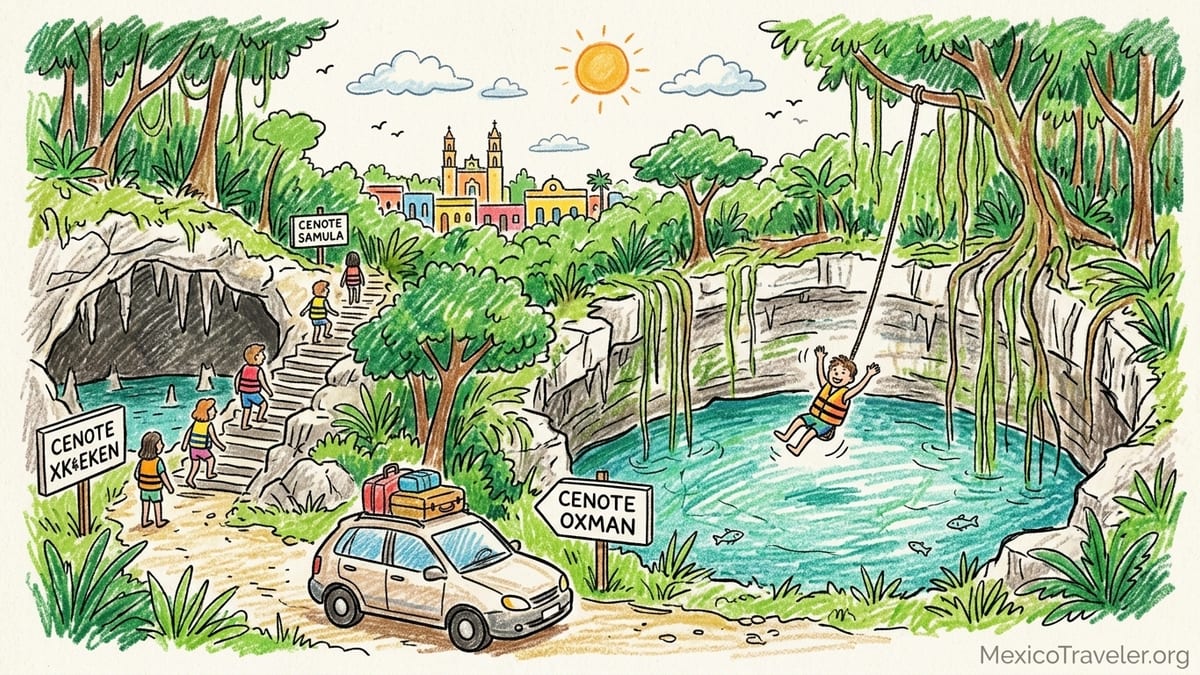
How Cenotes Around Valladolid Work in 2026
Base yourself in Valladolid and most of the classic inland cenotes fall into a neat 5 to 35 minute driving radius. They sit along the roads to Mérida and Tizimín or clustered around small Maya communities like Dzitnup. During my October 2026 visit, every cenote in this article was open with regular hours, though most had increased prices compared with pre-2024 guides. In practice, that meant I was paying roughly 60 to 70 Mexican pesos at the lower end for municipal-style cenotes like Zací, around 200 to 250 pesos for more developed private sites like Suytun and Oxman, and roughly 170 pesos and up for community cenotes such as X'Canche.
Operationally, Valladolid cenotes now share a few common rules. Life jackets are mandatory at the main tourist complexes, including Suytun and the twin Dzitnup cenotes Xkeken and Samulá, and the cost is usually bundled into a combined entrance ticket that runs around 200 to 230 pesos for both Dzitnup caves for adults in 2026. At Oxman and several community cenotes, jackets are included in or rented on top of the entrance fee, so I always kept small bills in pesos for lockers, jackets and tips. Showering before entering the water is enforced at Suytun and X'Canche and requested almost everywhere else to protect the fragile freshwater systems.
From a swimming perspective, the key distinction in the Valladolid area is between closed cave cenotes like Suytun and Xkeken, semi-open caverns such as Samulá and Zací, and fully open, steep-sided pools like Oxman and X'Canche. The cave cenotes tend to be darker, cooler and echoey, with dramatic stalactites and short, steep staircases that can feel slippery when wet. The open cenotes trade some of that drama for sunlight, hanging roots and warmer water but often have higher platforms that matter if you travel with kids or anyone uneasy with heights. I tried to swim long enough at each place to get past the initial shock of the water and see how comfortable it actually felt.
Logistics are straightforward if you self-drive. I rented a compact car in Valladolid, left town after breakfast around 8:30 or 9:00, and comfortably fit two cenotes and a slow lunch into each day. Distances on paper look tiny, but topes and village traffic slow things down. By contrast, organized tours that I saw advertised in Valladolid in late 2026 typically bundled one cenote with Chichén Itzá or Ek Balam, with hotel pickup from the Riviera Maya, and gave guests 60 to 90 minutes in the water. If cenote time is your priority rather than ruins, a rental car or colectivo-plus-taxi combo from Valladolid still offers much more flexibility.
Cenote Suytun: Famous Light Beam, Surprising Swim
Cenote Suytun, 8 kilometers east of Valladolid, is the cenote you see all over Instagram. As of October 2026, it was very much open, privately run and charging around 200 to 250 pesos per adult depending on whether you bought online or at the gate. The ticket includes a mandatory life jacket, basic changing rooms, cold showers and access to the main cave. Lockers were an extra small fee, published as about 30 pesos, and I paid cash in pesos at the entrance.
I arrived just after 11:00 in the morning on a clear day to catch the famous vertical sunbeam that falls through the ceiling onto the stone platform. Staff manage a queue on a staircase that spirals down to the cave and out onto the narrow cement walkway to the circular platform. Around midday, they were giving each person roughly a minute alone in the center before blowing a whistle and waving through the next group. Tripods and drones were prohibited inside, and a staff member checked that we all wore our life jackets over our swimsuits, even those who insisted they were strong swimmers.
The reality behind the social media image is that Suytun is darker, shallower and more crowded than most still photos suggest. The water around the platform is only a couple of meters deep in many parts, and the cave walls hug close around you, so you never feel like you are in a big, open swimming space. On my visit the water was clear enough to see my legs and the stone floor, but visibility was much more limited than at Oxman or X'Canche. The stone walkway can be slick with drips from above, and the narrow stairs from the surface to the cave require attention, especially if you carry a bag or walk in flip flops.
As a swimming experience, Suytun felt more like a theatrical set than a place where I wanted to float for an hour. Between waiting for my turn on the platform, watching the beam drift across the circle, and swimming a slow loop along the rope that marks the allowed area, I spent about an hour and fifteen minutes on site. If you come in the late afternoon when the direct beam has gone, the chamber is serene and the crowds thin, but you also lose the signature effect. I would still return to Suytun with first-time visitors who care about photography, but for sheer swimming pleasure I now pair it with either Oxman or X'Canche later in the same day.
Cenote Zací: A Semi-Open Bowl in the Heart of Town
Cenote Zací is the easiest cenote I swam on this trip. It sits a few blocks from Valladolid's central plaza, behind the municipal market. After a long closure for renovations that began in 2021, the cenote had fully reopened by 2024 and remained open with posted hours of roughly 9:00 or 10:00 until late afternoon when I visited in 2026. I walked from my guesthouse near the cathedral and bought a ticket at the new-looking entrance booth for a fee that fell into the 50 to 150 peso range locals quoted for current municipal prices.
Unlike the enclosed caves at Dzitnup, Zací is a broad semi-open pit. Roughly half of the ceiling has collapsed, so one side feels like a cave with rock overhangs and hanging roots, and the other is open to the sky. Stone terraces and a restaurant sit at the rim, then a series of staircases zigzag down to the water. On the shaded side the walls drop almost vertically, and a few locals and confident visitors jumped from marked ledges several meters above the surface. The posted depth is around 30 to 40 meters in the middle, deep enough that the water shifts to an inky blue and you cannot see the bottom.
For swimming, the combination of cool water, semi-open light and easy walk-up location made Zací a pleasant surprise. I visited in late afternoon after a hot day wandering Valladolid, rented a mandatory life jacket at the water level kiosk, and slipped into a roped-off swimming zone where I could still see loose stones on the ledges below. The visibility was good near the edges, though darker toward the center, and schools of small fish bumped curiously against my legs. The steps are uneven and slightly damp, but I did not find them as slippery as the polished stairs at Suytun or Samulá. I spent about an hour, including a quick rinse in the simple changing area and a cold drink at the rim restaurant, and would happily drop back in again on any future visit just for the convenience.
If you travel with children or anyone unsure on steep stairs, Zací is easier than some cave cenotes but still deserves care. There are handrails most of the way, and the semi-open design means you never feel closed in, yet some cliff-jump spots are very high and best left to confident swimmers. As it sits inside the city grid, I found it ideal as a warm-up swim on arrival day or as a last dip before an evening bus out of Valladolid.
Dzitnup's Twin Cave Cenotes: Xkeken and Samulá
Seven kilometers south of Valladolid, the village of Dzitnup shelters two of the area's most striking cave cenotes, Xkeken and Samulá, reached by the same visitor complex and ticket booth. In October 2026, signage at the official entrance and a bilingual visitor guide listed opening hours from 8:00 to 17:00 daily, with last entry at around 16:00. A single adult ticket covering both cenotes cost in the neighborhood of 200 to 230 pesos and explicitly included a life jacket, which staff considered mandatory in the water.
Xkeken is the darker of the two. You enter through a narrow rock opening and climb down steep, carved stone steps into a wide underground chamber. The ceiling is low in places and crowded with stalactites, and the only natural light trickles through a small hole high above one edge of the pool. The water stays around 24 to 25 degrees Celsius all year, cool but not shocking after a hot Yucatán day. When I visited mid-morning, the artificial lamps that ring the chamber had been switched on, casting a bluish glow across the water, and the visibility was excellent. I could clearly see other swimmers' legs and the central rocky outcrop several meters below the surface.
Samulá, a short walk away across the same complex, feels airier despite also being mostly enclosed. You descend another flight of stairs, this time into a taller dome where a wide opening in the roof sends down a beam of daylight and a curtain of tree roots that almost touch the water. Here too life jackets were controlled tightly by attendants, and they encouraged everyone to stay within a marked swim zone away from the roots. I arrived close to midday to watch the sunlight hit the center of the pool in a bright circle for about half an hour. The water visibility was a little lower than Xkeken on my visit, perhaps because of heavier use, but still clear enough for relaxed floating.
From a swimmer's point of view, I found Xkeken the more atmospheric and Samulá the more photogenic. The stairs down to both are steep and can be slick; I watched a few visitors in wet flip flops hesitate or cling to the rail. Inside, the cavern floors are partly wet rock, partly added concrete, with shallow puddles, so water shoes or sandals with grip help. I allocated around two hours in total for both, which felt comfortable: half an hour in each pool, time to shower and change in the basic facilities near the entrance, and a quick snack from one of the small community stands before catching a taxi back to town. If you only choose one, ask the ticket seller or a driver which is seeing fewer tour buses that morning, then start there.
Cenote Oxman: A Classic Open Cylinder With a Rope Swing
Cenote Oxman sits on the grounds of Hacienda San Lorenzo Oxman, about a 10 to 15 minute drive southwest of Valladolid. In 2026, the hacienda operated as a day-use complex with a cenote, swimming pool and restaurant. Entrance pricing was tiered: one option around 150 to 200 pesos for cenote-only access and another closer to 250 pesos that included a restaurant credit or access to the pool and loungers. I chose the midrange option that gave me cenote access plus a modest food credit, paid at the hacienda desk and walked past the courtyard to the cenote stairway.
Oxman is an almost perfectly round open pit with vertical limestone walls draped in vines. Looking down from the rim, it resembles a deep turquoise well, with the water some 20 to 25 meters below. A spiral staircase carved into the rock wall leads down to a concrete platform on one side at water level. Here staff handed out life jackets, included in the cenote fee, and watched over a sturdy rope swing anchored high overhead. Strong swimmers alternated between launching themselves from the swing and jumping from marked ledges on the walls, while others floated in the main pool or clung to the perimeter.
In the water, Oxman felt like one of the most enjoyable swims of the trip. The depth drops off quickly from the ledge, and while exact figures vary, local guides tend to quote a water column of several tens of meters. Visibility was excellent when I visited late morning. Shafts of sunlight filtered down along the hanging roots, illuminating suspended bubbles and tiny fish, and when I floated in the center and looked up I saw a green circle of trees far above. Despite its popularity, the size of the bowl and the relative simplicity of the layout meant it never felt chaotic. It was easy to find a quiet corner to tread water or practice gentle freediving within the permitted area.
The trade-off with Oxman is access. The staircase, while solid, involves a sustained series of steps that some visitors with knee or balance issues may find tiring on the climb back up. Surfaces are damp, and the final platform can be crowded when a new group arrives. There are decent changing rooms and toilets up at the hacienda, and the ability to break up cenote time with a relaxed lunch or a quick swim in the surface pool made the whole complex feel like a well-rounded stop. I spent just under two hours at Oxman and left feeling both exhilarated and genuinely refreshed.
Cenote X'Canche at Ek Balam: Jungle Surprise After the Ruins
North of Valladolid, the archaeological site of Ek Balam pairs naturally with Cenote X'Canche, an open cenote run as a community project about 1.5 to 2 kilometers from the ruins entrance along a flat jungle path. In mid-2026, published information at the site and recent traveler reports described a combined ticket structure: one option bundled the archaeological site and cenote, while another allowed you to pay the cenote fee separately at a small booth near the trail. Simple day tickets for X'Canche alone were around 170 pesos when bought on site in June 2026, and some guided tours quoted a slightly higher combined price that wrapped in bicycle or tricycle transfers to the water.
I visited Ek Balam in the morning, climbed the main Acropolis pyramid, then followed the shaded path to X'Canche just before midday. At the cenote entrance I paid my separate fee, picked up a life jacket, and used basic but clean changing rooms and cold-water showers. Staff asked everyone to rinse before entering the water and pointed out the no-sunscreen rule. From there a series of wooden stairs and small platforms stepped down the side of a large, roughly circular pit, though the feeling was more natural than at Oxman, with less concrete and more rock and wood.
In the water, X'Canche surprised me in the best way. The cenote is open to the sky, surrounded by jungle, and the water felt slightly warmer than in the cave cenotes yet cooler than most hotel pools. There was enough depth in the center that local teenagers were jumping from mid-level platforms, and a basic rope swing added to the fun. At the same time, a series of lower platforms closer to water level made entry easy for cautious swimmers. Even at lunchtime, when a few small tour groups arrived from Valladolid, the area never felt packed, perhaps because many visitors spent more time at the ruins than in the water.
From an accessibility standpoint, X'Canche sits in the middle of the pack. The wooden stairs can flex a little underfoot and feel more rustic than the stone steps at Oxman or Suytun, but there are railings, and the vertical distance from rim to water is broken up by several intermediate landings. I met families who took a pedal-powered tricycle taxi along the path from the ruins car park rather than walking the full 2 kilometers, a helpful option in midday heat. I allowed around an hour and a half between my arrival at the cenote and the moment I was dressed again and walking back toward the ruins entrance.
Car vs Tour: How I Actually Got Between Cenotes
Over several days in Valladolid I experienced cenotes by rental car and observed how organized tours used them as brief cool-down stops. For this trip I rented a compact car directly in Valladolid, which in 2026 cost me roughly what one full-day cenote and ruins tour from the Riviera Maya would have for a single person. The freedom to leave at 8:30, adjust my route based on weather and crowds, and stay longer when a cenote felt particularly good in the water made a tangible difference.
On my Dzitnup day, for example, I left Valladolid around 8:15, reached the Xkeken and Samulá complex by taxi-like driving time of 15 minutes, and was in the first wave down the cave stairs at opening. Tour buses did not begin to roll in from Chichén Itzá and Cancún until closer to 11:00. That early arrival meant I floated in Xkeken with maybe a dozen other swimmers instead of dozens, and I left just as the echo of whistles and loud voices began to rise. The same logic applied at Suytun, where independent drivers timed their visits either for early morning without the full beam or for just before the main light window, while big tours tended to arrive tightly around midday.
Organized cenote tours that I saw advertised on posters and brochures in 2026 typically originated in Cancún, Tulum or Playa del Carmen and listed Valladolid or a cenote near it as a secondary stop. Common pairings included Chichén Itzá plus a buffet lunch and one cenote, or Ek Balam, Valladolid center and a cenote such as Hubiku on the road back toward the Caribbean. These tours almost always included transportation, a guide at the ruins, lunch and entrance to a single cenote, with fixed time slots of an hour or less in the water. They made sense for visitors based on the coast with limited days.
If you plan to base in Valladolid itself and your main goal is to swim, the car gives you more nuance. You can combine Zací plus Oxman for an open-water day, or pair Suytun with Dzitnup's caves for an underground contrast, all while keeping driving under 30 minutes between any two stops. That said, driving also means dealing with informal ticket sellers and roadblock scammers near major ruin sites like Ek Balam and Chichén Itzá. On this trip I saw cones in the road and men in reflective vests trying to wave cars into private lots or to sell "official" combo tickets that did not match the prices posted at the actual entrances. I simply slowed, stayed in my lane, and continued to the signed public car parks where the real ticket booths sit.
Which Cenotes I Would Return To, and Which Were Less Fun
After swimming all of these cenotes within a few days, patterns emerged. The cenote that surprised me most positively as a swimmer was X'Canche at Ek Balam. On paper it looked like an add-on to the archaeological site, but in person the combination of jungle setting, flexible access with both low and higher platforms, clear water and moderate crowd levels made it one of the best all-around swims. I left feeling like I had discovered a place I would happily recommend both to confident swimmers and to families who want an open cenote without theme-park vibes.
Oxman came a close second for pure joy. Its almost circular shape, dramatic hanging roots and reliable rope swing created that classic cenote feeling you imagine when you first plan a Yucatán trip. The depth and clarity made it fun for longer, more relaxed swims, not just quick dips. The fact that the hacienda offers food, drinks and a sunny surface pool extended the stop into a full afternoon choice, which would be ideal for travelers who like to anchor the day in one scenic spot.
On the other hand, the cenote I found most visually striking but least enjoyable for extended swimming was Suytun. The cave architecture is extraordinary, and standing on the stone platform while a shaft of light hits your shoulders lives up to the iconic photos when the weather cooperates. In my actual experience, though, the relatively shallow water, strict platform rotations, heavy crowds during the light-beam window and narrower swimming zone meant I never really relaxed into the water the way I did at Oxman, Zací or X'Canche. I still think Suytun merits a visit once, particularly if you are already based in Valladolid, but I would not choose it as my only swim of the day.
The Dzitnup caves sit somewhere in the middle. Xkeken delivered from a cave-lover's perspective, with cool, crystal clear water and dramatic stalactites, but the steep, damp stairs and echoing noise once groups arrived made me appreciate having my own car to time an early visit. Samulá was arguably the prettiest to photograph, with its roof opening and tangle of roots, yet I enjoyed the actual swimming slightly less because the water felt busier and the main swim area more hemmed in when a few tour groups entered together. Still, combined they form one of the most distinctive cenote stops near Valladolid and remain worth carving out a morning for.
If You Only Have Half a Day: My Shortlist
With all of these first-hand swims in mind, if I returned to Valladolid with only half a day for cenotes, I would choose two. For my own tastes as a confident swimmer who likes natural-feeling settings, I would pair Cenote Oxman and Cenote X'Canche. Oxman would anchor the morning or afternoon with an open, deep cylinder perfect for floating, rope swings and sun, while X'Canche would bring in a slightly wilder, more community-run jungle bowl with easier entry points and fewer crowds, especially if I visited outside peak hours for the ruins.
For families with younger children or nervous swimmers, I would lean toward a Zací plus X'Canche combination. Zací lets you walk from Valladolid's center at almost any time of day, swim in a semi-open environment where one adult can sit on the steps while another takes a quick dip, and leave whenever attention spans shorten. X'Canche, approached at a gentle pace from Ek Balam with the option of a tricycle taxi instead of a full walk, offers a second, more natural-feeling open cenote where kids can enter from low platforms and stay close to the edges without dealing with tight cave ceilings.
Photographers who want the iconic beam shot should still allocate a slot to Suytun, ideally arriving before 11:00 on a clear day to secure a position in the cave before the tight light window that runs roughly from late morning to early afternoon. I would then pair Suytun with either Xkeken or Samulá in Dzitnup for a contrasting style of cave pool, accepting that the focus of that half day will be more on visuals and cave ambiance than on long surface swims. For strong, confident swimmers who care less about photos and more about depth and water clarity, Oxman and X'Canche remain my top inland picks.
FAQ
Q1. Are these cenotes definitely open as of late 2026?
All the cenotes described here were open and operating when I visited around October 2026, and their hours and prices matched information posted on site or in updated local guides from mid to late 2026. Because individual cenotes sometimes close temporarily for heavy rain, maintenance or community events, it is still wise to confirm with your accommodation in Valladolid the day before you go, especially if you plan to visit a less-developed community cenote.
Q2. How much should I budget for entrance fees and extras near Valladolid?
On my recent trip, I typically spent the equivalent of 200 to 250 pesos per person for private or highly developed cenotes such as Suytun and Oxman, 200 to 230 pesos for the combined ticket to Xkeken and Samulá at Dzitnup, and around 170 pesos for X'Canche when bought separately from the Ek Balam ruins. Municipal cenotes like Zací were noticeably cheaper, in a 50 to 150 peso range. On top of that, I usually paid 30 to 50 pesos for a locker where they were available and sometimes a similar amount for parking at haciendas or ruins.
Q3. Are life jackets really mandatory, and can I bring my own?
At the main tourist-focused cenotes around Valladolid, life jackets were required for everyone entering the water, regardless of swimming ability. This was clearly enforced at Suytun, Xkeken, Samulá and X'Canche, and jackets were either included in the entrance fee or rented cheaply at the water's edge. Some visitors did bring their own coastguard-approved vests, but staff still inspected them and occasionally preferred you to use their jackets. Only at a few more relaxed spots, and for short photo moments on ledges, did I see anyone allowed in the water without one.
Q4. What is the difference between cave, semi-open and open cenotes when you are actually swimming?
Cave cenotes like Suytun and Xkeken are almost entirely enclosed, with the water sitting inside a dome or cavern and very limited natural light. They feel cooler, echo more, and can seem intense to anyone with claustrophobia but offer dramatic stalactites and extremely calm water. Semi-open cenotes such as Samulá and Zací are partly roofed and partly open to the sky, so you get a mix of shade and sun plus striking rays of light. Fully open cenotes like Oxman and X'Canche are basically vertical-sided natural pools in the jungle, bright and airy, often deeper overall, and better suited to longer, more relaxed swims.
Q5. How deep are the cenotes around Valladolid, and is the water clear?
Depths vary widely and are not always precisely measured, but many of the larger cenotes near Valladolid reach several tens of meters at their deepest points, especially open pits such as Oxman and Zací. Even the shallower cave cenotes typically drop off quickly from the entry ledges. Water clarity is generally good to excellent, particularly early in the day before crowds stir up sediment. In Oxman and X'Canche I could see well down into the blue-green water, while in the darker caves I could at least see other swimmers and nearby rock formations clearly.
Q6. Are the stairs and access paths difficult or dangerous?
Access is a key consideration. At cave cenotes, especially Suytun, Xkeken and Samulá, you descend short but steep staircases carved into rock or built from concrete, which can become slippery when wet. There are handrails, yet people with knee or balance issues should take their time. Open cenotes like Oxman and X'Canche use a combination of wooden and stone stairs with railings and intermediate platforms, but the total height can be significant. Zací, being in town, felt comparatively gentle, with several terraces and broad steps, though it still requires care near the water's edge and jump platforms.
Q7. How long should I plan to spend at each cenote?
On my trip, one to two hours per cenote felt comfortable. I usually spent around 60 to 75 minutes at Zací and Suytun, including changing time and a few photos, and closer to 90 minutes to two hours at Oxman and X'Canche, where the open layout encourages longer swims and lounging. At Dzitnup, I allocated about two hours for Xkeken and Samulá combined, which gave me time to swim in both, rinse off and buy a snack before returning to Valladolid.
Q8. Is it better to visit on an organized tour or rent a car from Valladolid?
If you are already based in Valladolid and want to focus on cenotes rather than major ruins, I found renting a car for a day or two gave me much more freedom. I could arrive early at Dzitnup before tour buses, adjust my timing at Suytun around the weather and the sunbeam, and leave any cenote that suddenly felt too crowded. Organized tours from the Riviera Maya or Mérida are efficient ways to combine ruins and a single cenote but usually offer only one swim stop and a fixed schedule. Their value lies more in transportation and guiding at archaeological sites than in cenote time itself.
Q9. What should I bring for a cenote day near Valladolid?
For a full cenote day, I carried a swimsuit worn under light clothes, a quick-dry towel, water shoes or sandals with good grip, a refillable water bottle, and small notes in pesos for lockers, parking and snacks. I skipped regular sunscreen before swimming because most cenotes prohibit it, relying instead on sun shirts and hats on the surface. A dry bag or at least a plastic pouch for my phone helped on stairs and platforms where spray and drips are constant. Where photography was a priority, I brought a wide-angle lens, but I left tripods and drones at my hotel because many cenotes either restrict or completely ban them.
Q10. Which two cenotes are best if I only have half a day?
If you have only half a day and are a confident swimmer who enjoys depth and open skies, my top pairing is Oxman and X'Canche, with a brief stop at Ek Balam's ruins if you can stretch the schedule. If you are traveling with children or simply want to stay closer to town, consider spending your limited time between Zací in central Valladolid and one of the Dzitnup caves, Xkeken or Samulá, reached by a short taxi ride. Photographers who care more about iconic images than long swims might instead focus that half day on Suytun and Samulá, timing their visit around the midday light.