


The Yucatán Peninsula has so many Mayan archaeological sites that most travelers cannot see them all in one trip. With entrance fees, long drives and limited vacation days, choosing between Chichén Itzá, Uxmal, Ek Balam, Cobá, Calakmul and lesser-known ruins such as Kabah, Edzná or Becán becomes a practical decision as much as a romantic one. This guide compares the major sites using current information on access, costs, walking distances and visitor experience so you can decide where your time and money are best spent.
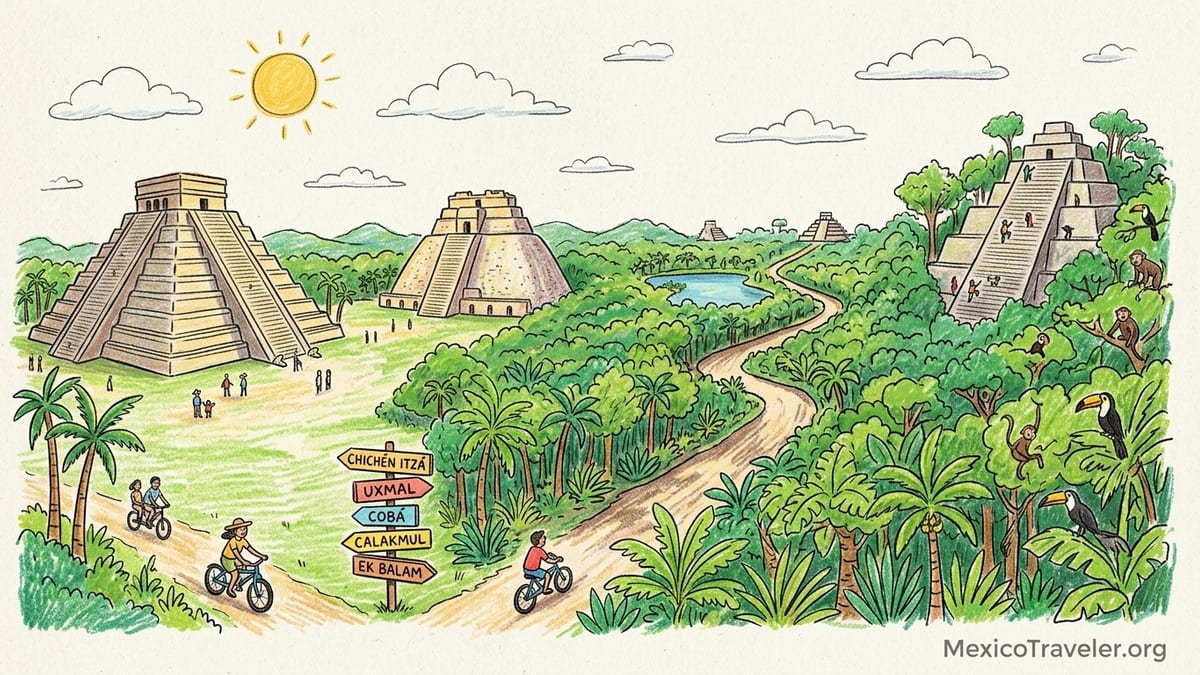
How the Major Yucatán Sites Compare
Each of the peninsula’s flagship sites offers a distinct combination of history, architecture and landscape. Chichén Itzá is the international icon, a UNESCO World Heritage Site and one of the so‑called New Seven Wonders, famous for its restored pyramid El Castillo and large-scale ceremonial architecture. Uxmal showcases the most refined Puuc-style palaces in the region, with intricate stone mosaics and rounded corners unlike the stepped profiles at Chichén. Ek Balam draws visitors who want to see exceptionally well-preserved stucco sculpture and to climb a tall pyramid with jungle views. Cobá spreads through low forest and around lagoons, with long shaded paths that once connected to distant cities by raised white causeways. Calakmul lies inside a vast biosphere reserve, combining a remote archaeological core with towering pyramids emerging from untouched tropical forest. Kabah, Edzná and Becán appeal to travelers who want quieter ruins with strong character and fewer tour buses.
Distances and access points shape how you experience each site. Chichén Itzá and Ek Balam are logical from Valladolid and Cancún or the Riviera Maya. Uxmal and Kabah are within the Puuc region south of Mérida. Cobá pairs naturally with Tulum and the central Riviera. Calakmul, Edzná and Becán belong more to the Campeche and southern Campeche road network and often justify at least one overnight stay nearby. When planning a route, think concretely in drive times: two to three hours each way for Calakmul from Xpujil or Chicanná, about two hours from Mérida to Uxmal, 45 minutes from Valladolid to Chichén Itzá and about half an hour further to Ek Balam. Those hours behind the wheel matter as much as the site itself.
Another important practical difference lies in how Mexico structures admission charges. At many Yucatán sites, visitors pay two separate fees: a federal ticket collected by the National Institute of Anthropology and History (INAH) and a state-level cultural or conservation fee, sometimes handled by agencies in Yucatán or Campeche. At Chichén Itzá, for example, the foreign-adult entrance price in late September 2026 is quoted as 697 Mexican pesos on combined INAH and state-rate notices, sold as a single dated ticket for international visitors. At other sites, such as Calakmul, travelers report paying a separate INAH archaeological charge plus additional roadway, ejido and protected-area fees collected along the access road, which together raise the real-world total significantly compared with the listed archaeological tariff alone.
Finally, the on-the-ground experience differs in comfort and services. Chichén Itzá is hot, exposed and busy, with relatively little shade in the core plazas but a short, flat walk from the gate. Uxmal offers more shade and gentler slopes but includes stair-climbing if you explore the Nunnery Quadrangle and Governor’s Palace. Ek Balam, Cobá and Calakmul all require more walking along forested paths, with a mixture of sun and shade and dirt surfaces unsuitable for standard wheelchairs in some sectors. Smaller sites such as Kabah or Becán have limited services but trade that for quietness: it is still possible, on some weekdays, to share a pyramid with only a handful of people.
Chichén Itzá: Monumental Icon and Costly but Efficient Visit
Chichén Itzá sits roughly midway between Mérida and Cancún, a straightforward trip on the toll highway or by organized tour. It can be visited as a long half-day excursion from Cancún, Playa del Carmen or Tulum, or as a short day trip from Valladolid. The site typically opens around 8:00 in the morning and closes in the late afternoon. In 2026, travelers consistently report a combined foreign-adult entrance price of 697 pesos, covering both the INAH archaeological ticket and the Yucatán state cultural levy sold together at the gate or through official ticketing portals. Children, Mexican nationals and residents, and holders of certain credentials may pay reduced rates, but foreign adults without concessions should plan on this figure and bring cash, since card terminals can occasionally be offline.
The site layout favors visitors with limited time. From the entrance, a wide, mostly flat path leads to El Castillo in roughly five to ten minutes at a normal walking pace. Most of the major monuments cluster in a compact core: the main pyramid, the Temple of the Warriors, the Group of a Thousand Columns and the Great Ball Court all lie within another few minutes’ walk of one another across open lawns. There is little meaningful shade in this central area. Sun hats, sunscreen and water are essential, especially from February through May when midday temperatures and humidity are highest. The terrain is technically accessible for visitors with limited mobility because surfaces are generally compacted and there are only gentle undulations, yet heat and lack of shade can still make the visit exhausting.
In recent years, climbing has been prohibited on the major pyramids at Chichén Itzá, including El Castillo and the Temple of the Warriors. This policy reflects conservation priorities and crowd management rather than temporary restrictions, and travelers should not plan to ascend any primary temple structures. You can, however, view intricate reliefs in situ, such as the feathered serpent heads at the base of El Castillo or the carved panels along the ball court. To reach the Sacred Cenote, expect an additional walk of about ten to fifteen minutes each way along a relatively flat path with some uneven patches. Market-style vendor stalls line many of the paths inside the site, which some visitors find atmospheric and others consider distracting.
Guided tour options around Chichén Itzá are extensive. At the gate, licensed local guides offer standard group tours of around 90 minutes, typically priced per group or per person depending on negotiation and language. Several companies sell private archaeologist-led experiences where a specialist with academic training interprets the architecture beyond the usual legends about human sacrifice and equinox serpents, sometimes with early-entry access that lets you enter right at opening to avoid crowds. Many Riviera Maya agencies market combined Chichén Itzá and cenote packages, usually pairing the ruins with a swim at a managed sinkhole and sometimes with a buffet lunch and short stop in Valladolid. While these packages offer good value and simplify logistics, they can feel rushed; independent travelers who rent a car often prefer to visit the ruins first, then choose a cenote on their own schedule on the way back.
Uxmal and the Puuc Region: Elaborate Palaces and Quieter Courtyards
Uxmal lies about 80 kilometers south of Mérida, along a well-paved highway through the Puuc hills. The site is renowned for its Puuc-style architecture, which features smooth lower wall zones topped with dense mosaic friezes of cut stone depicting masks, lattice patterns and geometric borders. The Pyramid of the Magician, with its unusual elliptical base and steep profile, greets visitors almost immediately after entering. Beyond it, the Nunnery Quadrangle presents some of the finest palace facades in the Maya world, where human and serpent motifs repeat in a precise stone tapestry. The experience here is architectural rather than sculptural; you spend more time contemplating long horizontal facades and doorways than individual colossal statues.
Uxmal typically maintains opening hours similar to other major INAH zones, generally from 8:00 in the morning until approximately 5:00 in the afternoon. Entry costs are structured with a federal INAH charge plus a separate Yucatán state fee collected at or shortly after the gate. Recent travel reports suggest that foreign adults pay a combined sum that is somewhat lower than Chichén Itzá but still significant, although exact totals can vary when state tariffs are updated. Confirming the latest figure through your hotel in Mérida or a local agency shortly before travel is prudent, especially if you are budgeting closely for a family group.
Walking distances inside Uxmal are moderate. From the entrance to the Pyramid of the Magician is only a few minutes on a broad path, and the main clusters, including the Nunnery Quadrangle, the Governor’s Palace and the Great Pyramid, can all be explored within two to three hours at an unhurried pace. The site provides more shade than Chichén Itzá thanks to trees around plazas and the slightly hillier terrain, and the stone surfaces are generally firm. Some staircases remain climbable, though access rules can change; visitors should expect that not every structure is open for ascent, and that any permitted climbs involve steep, uneven steps without handrails. For those with mobility challenges, simply viewing the principal facades from courtyard level still offers a rewarding sense of Puuc artistry.
Uxmal pairs well with lesser-known nearby sites such as Kabah, Sayil and Labná, all reachable by road from Mérida or Uxmal itself. These are quieter and usually cheaper than Uxmal, often with only basic ticket booths and minimal services beyond simple restrooms and small vendor stands. Kabah, for instance, is celebrated for its so-called Codz Poop or Palace of the Masks, whose facade is covered in repeating long-nosed masks. Because these Puuc sites see fewer visitors than Chichén Itzá, they are attractive to photographers and enthusiasts who prefer time alone with the architecture. From Mérida, many travelers either rent a car for a self-guided loop or join a small-group Puuc Route tour that visits two or three sites in a single day, sacrificing depth at each stop for variety.
Ek Balam and Cobá: Sculpture, Forest Paths and Cenote Combinations
Ek Balam lies about 30 kilometers north of Valladolid and can easily be visited in a half day from there, or as a stop between Cancún or Playa del Carmen and the colonial city. The site is compact but vertically impressive. Its main Acropolis rises above the forest canopy, and climbing remains permitted here as of mid 2026, making it popular with travelers who regret not being able to ascend El Castillo at Chichén Itzá. Halfway up the Acropolis you reach a terrace with some of the peninsula’s most remarkable stucco work, including a gaping earth-monster facade surrounded by seated figures and intricate reliefs. These sculptures are protected under palapa-style roofs, which also provide welcome shade while you observe the details.
Entry fees at Ek Balam combine an INAH museum-style ticket with a Yucatán state charge collected at a separate booth or integrated into a single payment, depending on current local practice. Recent independent guides updated in September 2026 describe a federal fee in the low 200-peso range plus an additional state contribution, with total costs for foreign adults ending somewhere between Chichén Itzá and Uxmal. The archaeological zone keeps standard daytime hours, and there is paid parking near the entrance. Immediately outside the zone, a separate community-run cenote offers swimming for an additional charge, making Ek Balam a convenient ruins-and-cenote pairing if you have your own vehicle.
Cobá sits inland from Tulum, reached via a main road that cuts through flat forest. For years it was known for the ability to climb Nohoch Mul, one of the tallest pyramids in the northern lowlands. Access rules here have evolved, and by the mid 2020s some travelers reported that climbing opportunities were curtailed or restricted, partly for safety and conservation reasons. Even without climbing, Cobá offers a different experience from other sites because the ruins are spread out along a network of sacbeob, the raised limestone causeways that once linked Maya cities. From the main entrance, you can walk or hire simple pedal tricycles with drivers to reach more distant groups deep in the trees.
Cobá’s paths are mostly shaded, which makes it more pleasant in the middle of the day than Chichén Itzá, though humidity can still be high. Surfaces are dirt and stone, not ideal for wheelchairs but manageable for most visitors with sturdy footwear. Admission consists primarily of the INAH archaeological ticket and potentially a municipal or community-level parking fee outside the site. Several cenotes lie within a short drive, and many Tulum-based excursion companies sell Cobá-plus-cenote or Cobá-plus-Tulum Ruins day trips. From Tulum pueblo, independent travelers with rental cars can leave after breakfast, explore Cobá until early afternoon, then cool off in a cenote on the return drive. Compared with the full-day commitment that Chichén Itzá often requires, Cobá can feel like a gentler outing that still offers an authentic sense of forest and ancient causeways.
Calakmul, Edzná and Becán: Remote Landscapes and Overnight Logistics
Calakmul occupies a very different geographic and logistical category from the northern Yucatán sites. Located deep within a biosphere reserve in Campeche state, it requires first reaching the town of Xpujil or similar small settlements along Federal Highway 186, then driving roughly 60 kilometers along a narrower access road that cuts into the forest. Conservation authorities note early opening times on the protected-area access road, but most travelers experience the archaeological core as an essentially daytime visit because of the combined drive in, several hours on-site and the drive back out. Recent practical guides updated in mid 2026 describe a realistic total visiting budget that includes the INAH archaeological ticket plus separate roadway and conservation levies, together pushing the overall cost for foreign adults toward several hundred pesos once all payments are counted.
The payoff is immersion in a landscape that feels almost entirely removed from the busy resort corridors. Calakmul’s monumental core includes multiple large pyramids rising above the canopy, with broad views across unbroken forest when the air is clear. Some structures can still be climbed, though policies can evolve as conservation priorities shift. Trails between groups involve moderate walking over uneven surfaces with minimal constructed shade. Wildlife sightings are common: visitors frequently report hearing or spotting howler monkeys, toucans and occasionally even deer along the paths. Because of the long day and hot, humid conditions, this is not an ideal first archaeological site for those unused to tropical travel; it rewards travelers who already know they enjoy ruins and are willing to focus a couple of days of their itinerary around a single remote destination.
Nearby Edzná and Becán provide somewhat easier remote experiences. Edzná lies closer to the city of Campeche and can be visited as a long half-day trip by car or on a guided excursion. Its main plaza features an impressive five-level pyramid rising from a raised platform, with surrounding buildings that show both Petén- and Puuc-influenced features. Becán, located in the Río Bec region not far from Xpujil, is famous for its surrounding moat-like ditch and tall, slender towers on some of its buildings. Both sites generally maintain standard daytime opening hours under INAH supervision. Entry fees are usually lower than for the big Yucatán and Quintana Roo names, consisting primarily of the federal archaeological ticket and modest local charges.
Because distances are long and public transport limited, Calakmul and Becán almost always require at least one overnight stop. Most travelers choose simple eco-lodges or motels near Xpujil, Chicanná or other small highway towns, then depart for Calakmul at dawn to maximize cooler temperatures and wildlife activity. From the city of Campeche, Edzná can work as a day trip, but combining it with Calakmul in a single day is unrealistic for most visitors. If your main base is Mérida, Cancún or Tulum and you do not wish to change hotels, then Calakmul, Edzná and Becán are better saved for a future visit; reaching them involves essentially a mini-road trip through southern Campeche rather than an easy add-on.
Access from Mérida, Valladolid, Cancún, Tulum and Campeche
From Mérida, the most straightforward major sites are Uxmal and the Puuc region, plus Chichén Itzá via the toll highway. Uxmal is about an hour and a half by car and is served by occasional buses, though schedules change and returning the same day by public transport can involve some waiting. Many Mérida-based agencies sell day tours that stop at Uxmal and one or two smaller Puuc sites, or combine Uxmal with a nearby cenote or a hacienda visit. Chichén Itzá from Mérida is another easy, mostly straight highway drive of roughly two hours, making that site a viable day trip without necessarily using Valladolid as a base. For first-time visitors who do not want to rent a car, Mérida offers some of the peninsula’s best selection of organized small-group and private archaeological excursions.
Valladolid is the closest base for Chichén Itzá and Ek Balam. Shared vans, buses and taxis cover the short run to Chichén Itzá, but having your own car or booking a round-trip transfer gives you more control over arrival time. Many independent travelers now choose to visit Chichén Itzá at opening from Valladolid to beat the bulk of tour buses coming from Cancún and Playa del Carmen, then continue to a cenote or to Ek Balam in the afternoon. Ek Balam itself is so close to Valladolid that a half day is sufficient, especially if you combine the ruins with a swim in the nearby cenote complex before returning to town for a late lunch or early dinner around the main square.
Cancún and the Riviera Maya primarily feed visitors to Chichén Itzá, Cobá and Tulum’s coastal ruins. Standard tour packages from Cancún or Playa del Carmen to Chichén Itzá often last twelve hours or more once hotel pickups, highway travel, guided visits, lunch stops and cenote swims are included. Self-driving in a rental car cuts that door-to-door time and allows for an earlier arrival at the ruins at the cost of doing your own navigation and parking. Cobá lies closer, usually under two hours’ drive from central Riviera resort areas, which makes it attractive for travelers who want to see substantial ruins without devoting a full day. Public transport options exist but are less convenient for same-day return schedules, so most visitors rely on organized excursions or rental cars.
From Tulum, Cobá is the natural day-trip choice. The road is simple and largely straight, and combined cenote visits are plentiful right off the highway. Chichén Itzá is still feasible from Tulum, though it requires an earlier start and a tolerance for several hours of driving each way, particularly if you prefer not to use toll highways. Ek Balam and Valladolid are a longer reach but can form part of a multi-night loop that also includes Chichén Itzá. Campeche city, on the other side of the peninsula, offers access to Edzná in a single day and can serve as a launch point for longer circuits to Xpujil and Calakmul if you are comfortable with several hours on secondary highways. In all cases, travelers should factor in fuel availability, daylight hours and their own comfort with rural night driving when planning archaeological excursions by rental car.
Costs, Fees, Tours and On-Site Comfort
Budgeting for Mayan ruins in the Yucatán Peninsula involves more than just the headline ticket price. At sites in Yucatán state, foreign visitors now routinely pay several hundred pesos per person, due to the combination of a federal INAH charge and a separate cultural or tourism levy imposed by the state government. At Chichén Itzá, the foreign-adult price currently stands near 697 pesos, which can feel steep for families or repeat visitors. Ek Balam and Uxmal are somewhat lower but still substantial once state contributions are included. By contrast, many Campeche sites such as Edzná or Becán and some Quintana Roo locations like Cobá tend to remain closer to the lower hundreds of pesos for foreign visitors when only the INAH ticket and modest local fees are counted, though overall costs for Calakmul rise as multiple agencies collect entrance and road-use charges.
Guided-tour availability is strongest at Chichén Itzá, Uxmal, Cobá and Tulum, where you can simply walk up to the entrance and hire a licensed guide without pre-booking. Fees vary by group size and language, with English and additional European languages often commanding higher prices than Spanish. A typical real-world example at Chichén Itzá might be a family of four paying the entrance tickets plus a negotiated private on-site guide fee that roughly matches or exceeds a single adult ticket. Private archaeologist-led tours are more specialized; these are usually arranged through local agencies or independent experts based in Mérida, Valladolid or Cancún and may involve hotel pickup, transport, entrance fees and extended explanations tailored to your interests.
Combined ruin-and-cenote packages are most common around Chichén Itzá, Ek Balam and Cobá. For instance, operators from Cancún might sell a full-day trip that includes transport, a guided visit to Chichén Itzá, buffet lunch at a countryside restaurant and a swim in a managed cenote on the way back, sometimes with a brief stop in Valladolid’s main square. Another common product from Tulum is Cobá plus two or three nearby cenotes, with bicycle or tricycle hire inside the ruins included. These packages provide predictability in costs and logistics, which many first-time visitors appreciate, but they rarely allow the time a serious archaeology enthusiast wants to linger over carvings or quiet corners of a site.
On-site comfort varies in ways that can significantly affect your day. Chichén Itzá has extensive vending areas, food stalls and souvenir stands plus clean restrooms and large parking lots, but almost no shade inside the main ceremonial precinct. Uxmal has decent facilities and a slightly more relaxed feel, with gardens and trees softening the experience. Ek Balam, Cobá and the smaller Puuc and Campeche sites have limited food options at or near the entrance; you will generally find basic snacks and water rather than full meals, so carrying your own supplies or planning to eat back in town is wise. Cobá and Calakmul offer the best shade along forested paths, yet they can be very humid. Travelers with limited mobility or heat sensitivity may find a focused visit to Uxmal or Chichén Itzá, close to the entrance and with easy exits to air-conditioned vehicles, more manageable than extended hikes at Ek Balam, Cobá or Calakmul.
Which Sites Are Best for First-Timers and Enthusiasts
For a first-time traveler to the Yucatán Peninsula trying to balance time, money and variety, three archaeological sites stand out as particularly worthwhile. Chichén Itzá earns its place for its global significance, monumental scale and relative efficiency: you can see the principal structures in two to three hours, and it is well served by tours from all the main resort and city hubs. Uxmal complements Chichén Itzá by showing a different architectural language in a more relaxed setting, with exquisite Puuc-style palaces that many visitors remember as the aesthetic highlight of their trip. Cobá rounds out the trio by offering shaded forest paths, glimpses of sacbeob and an atmosphere that bridges the gap between heavily restored showpiece sites and more overgrown ruins.
Travelers who prioritize photography and atmosphere might trade Cobá for Ek Balam, especially if staying in Valladolid. Ek Balam’s sculpted facades and climbable Acropolis deliver striking views and intimate encounters with ancient stucco. Those who are more interested in off-the-beaten-path experiences than in marquee names may instead craft a trio of Uxmal, Kabah and Becán or Edzná, building a route that emphasizes quiet exploration over crowds. In each case, consider not only what you will see, but how you will feel walking between structures in the mid-day heat, how long you will sit in vehicles to reach them and what degree of services you prefer at the entrance and along the way.
Archaeology enthusiasts with a rental car gain the freedom to design more ambitious circuits. A practical several-day loop for a dedicated traveler might begin in Mérida with a full day at Uxmal and Kabah, continue to Valladolid for Chichén Itzá and Ek Balam, then head south through the interior toward Tulum for Cobá and coastal ruins before finishing in Campeche with Edzná. Those with more time and tolerance for long drives can push into southern Campeche to spend a couple of nights near Xpujil, using one full day for Calakmul. This sort of itinerary makes the most sense for travelers already comfortable driving in Mexico, willing to manage varying road conditions and prepared to book small-town lodging where English may be less widely spoken.
If you prefer to avoid renting a car, focusing on a smaller number of easily accessed sites will deliver a better experience. Based in Cancún or the Riviera Maya, a realistic archaeological menu might consist of an organized Chichén Itzá and cenote day, a shorter Cobá and cenote outing from Tulum, and perhaps a half-day at Tulum’s coastal ruins. From Mérida, concentrate on Uxmal and Chichén Itzá with reputable local guides, adding Kabah or other Puuc sites only if your schedule and budget comfortably allow it. Remember that each site represents hours of walking and exposure; building rest days with beaches, cenotes or shaded city plazas between major ruin excursions helps prevent fatigue and makes each visit feel special rather than one more hot climb of stone steps.
The Takeaway
Choosing the “best” Mayan ruins in the Yucatán Peninsula is less about an objective ranking and more about aligning your expectations, budget and travel style with what each site genuinely offers. Chichén Itzá supplies grandeur, efficient access and a sense of ticking off a world-famous wonder, at the cost of higher entrance fees and crowds. Uxmal gives you refined architecture and a calmer environment within easy reach of a major city. Ek Balam and Cobá bring forest paths, more intimate encounters with sculpture and the possibility of combining ruins with nearby cenotes in a single relaxed day. Calakmul, Edzná and Becán reward patience and long drives with remote landscapes and far fewer visitors.
For most first-time visitors, especially those based in Mérida or the Riviera Maya without a rental car, Chichén Itzá, Uxmal and Cobá together provide an excellent introduction to the region’s archaeological heritage and a balanced mix of monuments, plazas and forest. Travelers with a rental car and a strong interest in archaeology can confidently add Ek Balam and at least one quieter site such as Kabah, Edzná or Becán, and, if time and stamina allow, plan a dedicated overnight detour to Calakmul. By understanding the concrete realities of distances, fees, heat and walking conditions, you can choose a handful of ruins that will feel memorable rather than overwhelming, and leave the peninsula with a deeper appreciation for the diversity of the ancient Maya world.
FAQ
Q1. Can I still climb pyramids at Mayan ruins in the Yucatán Peninsula?
Climbing is prohibited at headline structures like El Castillo in Chichén Itzá, but as of late 2026 some pyramids at sites such as Ek Balam, Uxmal and Calakmul remain climbable, subject to on-the-day safety and conservation decisions by site staff.
Q2. How much should I budget for entrance fees at Chichén Itzá?
Foreign adults should currently plan on paying a combined archaeological and state fee close to 697 pesos per person, with additional costs for parking, guiding and optional cenote visits purchased separately.
Q3. Which Mayan ruins are easiest to visit without renting a car?
Chichén Itzá, Uxmal, Cobá and Tulum’s coastal ruins are all well served by organized tours and, to varying degrees, by public transport, making them realistic options for travelers who prefer not to drive.
Q4. Are the major archaeological sites suitable for travelers with limited mobility?
Chichén Itzá and parts of Uxmal offer relatively flat, compacted paths close to the entrance, which can work for some visitors with limited mobility, but forested sites like Cobá, Ek Balam and Calakmul involve uneven dirt paths that can be challenging.
Q5. Do I need to book a guided tour in advance?
You can usually hire a licensed guide on arrival at popular sites such as Chichén Itzá, Uxmal and Cobá; advance booking is mainly necessary for private archaeologist-led tours or full-day packages that include transport and meals.
Q6. What is the best base city for visiting multiple ruins in a short trip?
Mérida works well for Uxmal, Puuc sites and Chichén Itzá, while Valladolid is ideal for Chichén Itzá and Ek Balam; Cancún or the Riviera Maya are convenient for Chichén Itzá, Cobá and Tulum’s ruins.
Q7. Is Calakmul worth the long trip from the main resort areas?
Calakmul is very rewarding for archaeology enthusiasts and nature lovers willing to invest at least one or two nights near Xpujil, but it is a demanding detour for casual visitors focused on beaches and short excursions.
Q8. How should I handle the heat when visiting ruins?
Plan early-morning arrivals, wear light clothing, bring a wide-brimmed hat, high-SPF sunscreen and plenty of water, and build rest days between major ruin outings, especially in the hot season from March to May.
Q9. Are combined ruin-and-cenote tours good value?
Combined tours often represent good overall value when they include transport, entrance fees and lunch, though they can feel rushed; independent travelers who rent a car gain more flexibility but must manage their own logistics.
Q10. Which three sites should a first-time visitor prioritize?
Most first-time visitors will get the best overall experience by focusing on Chichén Itzá for its iconic status, Uxmal for its Puuc-style palaces and Cobá for its shaded forest setting and long Maya causeways.