


If you are planning a trip to the Riviera Maya in 2026, you will almost certainly run into the same problem I did: glossy brochures and hotel concierges pushing three big names, Xcaret, Xel-Há and Xplor, all expensive, all promising a “must-do” day. Most travelers can only justify one or two of these parks. So I went to all three in October 2026, paid real online prices, sat in the same transfer buses, queued for food and lockers, and tracked what I actually did with my time. This is a frank, value-for-money comparison based on those visits and on prices that were live and bookable as of October 20, 2026.
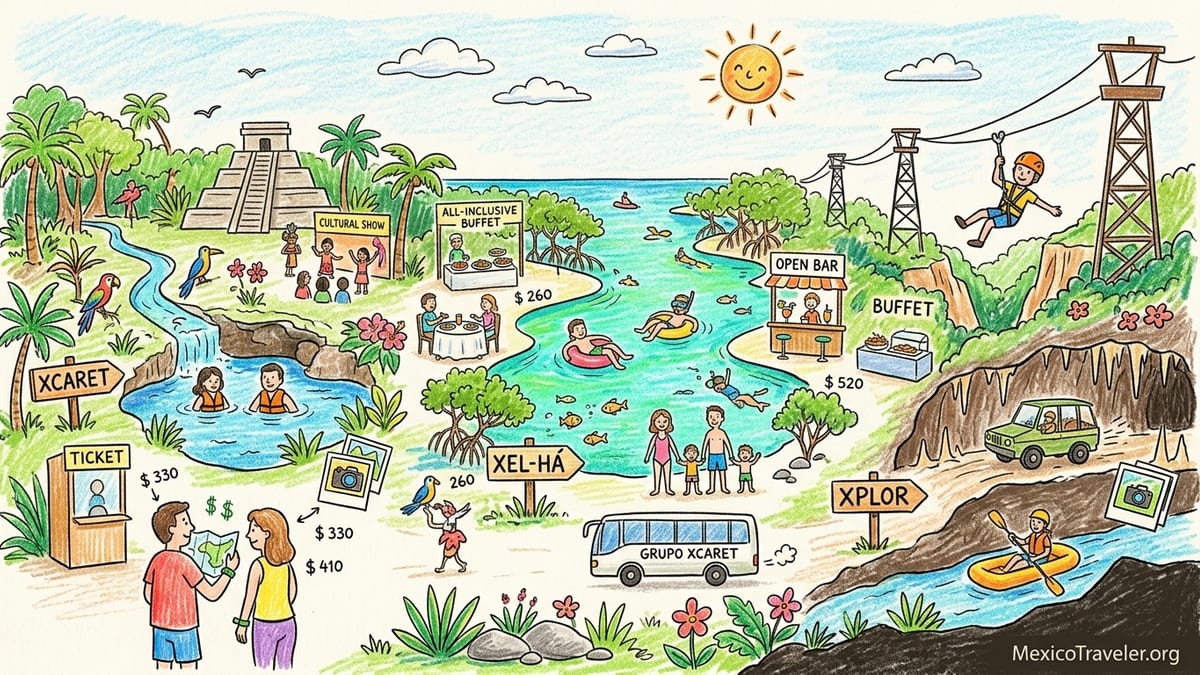
How I Tested the Three Parks and What I Paid in 2026
To make a fair comparison, I visited Xcaret, Xel-Há and Xplor within the same week in October 2026, staying in Playa del Carmen and booking directly through Grupo Xcaret’s official online system. That kept exchange rates, weather, and crowd levels broadly comparable and let me track what a typical visitor would actually spend. All costs below are in US dollars, using the prices shown in Mexican pesos on the official sites on October 20, 2026, then rounded to the nearest dollar for clarity.
For Xcaret I booked the Xcaret Plus admission because the basic ticket does not include food or lockers and that makes a big difference to the final bill. On the day I checked (October 20, 2026), the regular same-week Xcaret Plus price was trending around the mid 160s per adult when not using early purchase promotions, with children roughly a quarter cheaper. Booking at least seven days in advance online typically reduced that by about 10 percent, and 21 days by around 15 percent, but for this comparison I use the non-promotional window as that is how many last-minute travelers actually book.
For Xel-Há I booked the standard all-inclusive day admission, which includes buffets, open bar with domestic alcohol, non-motorized snorkeling equipment, towels and lockers. On the same October 2026 date, that came out around the low 130s per adult when not applying advance-purchase discounts, again with children somewhat cheaper. Xplor’s daytime adventure ticket, including buffet lunch, snacks, non-alcoholic drinks and a locker for two people, was pricing in the mid 150s per adult before any early booking reductions. Transportation from Playa del Carmen, when added directly from the parks, was clustering close to 35 to 40 dollars per adult round trip depending on the specific pickup and date.
For each park day I tracked when the pickup bus arrived, how long check-in and locker logistics actually took, time spent queuing for main activities, and how many core experiences we realistically fit into eight to nine hours on site. I went with one other adult and also tracked how a hypothetical family of four with two school-age children would fare in terms of costs and practicalities like height limits and stamina.
What Your Day Really Costs in 2026: Two Adults vs a Family
Because list prices do not tell the whole story, I built two sample budgets using the live price ranges from October 2026. The first is for two adults staying in Playa del Carmen, booking within a week of the visit and adding official bus transportation. The second assumes a family with two children aged between 6 and 11, again adding bus transfers and sticking to what most families actually buy: at least one set of photos and perhaps one paid upgrade.
For Xcaret Plus, two adults paid roughly 330 dollars in admission plus about 80 dollars in transport for a total near 410 dollars for the day. A family of four, assuming the common child discount that runs around 25 percent off the adult rate for kids aged 5 to 11, landed close to 640 dollars with transportation included. That covered park access, one buffet meal with soft drinks, snorkel equipment and a shared locker but not extras like swimming with dolphins, underwater “Sea Trek” walks, spa treatments or photo packages.
At Xel-Há, the same two adults paid around 260 to 270 dollars in admission and just under 80 dollars for transportation, bringing the total to roughly 340 to 350 dollars. A family of four ended up at about 540 to 560 dollars, which included unlimited buffets, open bar, snorkeling gear, life vests, inner tubes, towels and lockers. Once inside, it was very realistic to spend nothing more than an optional tip and perhaps a specialty coffee or branded souvenir. From a pure budget perspective, Xel-Há delivered the smallest gap between what the brochure suggests and what you actually pay.
Xplor sat in the middle. Two adults paid in the region of 310 to 320 dollars in admission plus transport, and a family of four about 520 to 540 dollars. While the official site encourages buying 7 or 21 days in advance for discounts, many visitors tied to fixed flight schedules and resort packages book closer to the date, so the comparison here focuses on the walk-up online rates visible in mid October 2026. Across all three parks, the largest hidden costs for non-resort guests were the one-off photo packages, which families often buy once they see cameras on zip-lines or in the rivers. Those bundles varied, but a typical full-day multi-park image package for a family of four could easily add 80 to 140 dollars if purchased once you were already onsite rather than pre-booked with a discount.
Time on Activities vs Time in Queues
In terms of sheer activity time, Xplor won. During our 9 a.m. to 5 p.m. visit, we spent close to five and a half hours actually doing things: riding amphibious vehicles, paddling, swimming in the stalactite river and, most notably, tackling both zip-line circuits. Queues were heaviest at the opening of each loop of zip-lines, but even then, most waits ranged from 20 to 35 minutes for the first tower, then flowed continuously tower-to-tower. Staff loaded harnesses efficiently and gave repeated safety checks, which meant lines moved steadily even when large tour groups arrived.
Xel-Há delivered about five hours of water-based activity time during an 8:30 a.m. to 5 p.m. day, but there was more soft downtime: leisurely river floating, snorkeling, and breaks at bars and buffets. The check-in and locker process took slightly longer because so many guests arrive on large buses at the same time and must sort wristbands that track open-bar eligibility. Queues for the main scenic lighthouse slide built up in bursts; we waited just under 40 minutes during mid-morning, which felt long compared with the near-zero waits at some of the secondary ziplines and bike routes along the mangroves.
Xcaret, by contrast, felt like the place where we lost the most time to walking and decision overload. The park is sprawling and themed like an eco-archaeological complex with animals, cultural shows, underground rivers and swimming coves spread across a large footprint. With a day running roughly from 8:30 a.m. check-in until the night show after 7 p.m., we still only managed one full underground river, two short swims or snorkel stops, one major cultural show in the afternoon and the famous nighttime Mexico Spectacular. Moving between animal exhibits, chapels, cemeteries, small shows and food areas involved a lot of backtracking through shaded paths and underground corridors. Actual “in the water or in a show seat” time felt closer to four hours, with the rest spent in transit or hesitating over maps and signposts.
Queues at Xcaret were moderate for the underground rivers at peak heat hours (20 to 30 minutes) and longer for paid extras like Sea Trek or dolphin swims, which can take a full hour block out of your schedule once you factor in check-in, briefings and post-activity showers. Because the headline night show starts at a fixed time in the arena, significant crowds funnel through the food areas beforehand, and we waited almost 25 minutes to be seated at the buffet with our Plus wristbands.
Food, Drinks and Whether Xel-Há’s All-Inclusive Model Really Pays Off
One of the most important value questions is how much the included food actually changes what you spend. Xel-Há clearly came out on top for carefree eating and drinking. The standard ticket included multiple buffet restaurants and snack bars as well as an open bar with domestic alcohol and mixed drinks. In practical terms that meant breakfast as soon as we arrived, a long lunch, afternoon snacks and several rounds of drinks, all for no extra charge beyond the entrance ticket. For travelers who would otherwise buy cocktails at their resort or in town, this bundled value is significant, especially on hot days when people naturally drink more.
Xplor’s model landed in the middle. There is one main buffet restaurant and at least two snack and juice stations with cookies and fruit, all included in the admission. No alcohol is served inside Xplor for safety reasons, which some visitors appreciate and others might miss. The buffet itself was robust: a mix of grilled meats, salads, pasta, Mexican specialties and desserts. Because there is only one main meal location, there are peak times when a short line builds up, but turnover was fast. For two adults who eat a substantial lunch and graze on snacks between zip-line circuits, this inclusion significantly reduces the need to buy food elsewhere that day.
At Xcaret, the picture is more complicated. Food is not included in the basic ticket, which is the product often highlighted in headline pricing by outside tour resellers. To avoid paying for every plate, we chose the Xcaret Plus option that bundles one buffet meal and a drink along with a shared locker and snorkel equipment. The catch is that the park is full of enticing eateries: a la carte restaurants, quick-service stands and multiple buffets. Even with Plus, it is easy to buy extra snacks, ice creams and additional drinks as you move around. Independent reviews and recent visitor reports in 2026 describe buffet prices landing in the ballpark of 35 to 45 dollars per adult for walk-up purchase and simple burger or taco plates around the mid-teens. With that in mind, the Plus upgrade made financial sense for our adult pair, but for light eaters or those who plan to leave before the night show, the included meal does not always translate into savings.
From a pure value standpoint, Xel-Há’s all-inclusive food and bar materially improved its cost-per-hour-enjoyed compared with Xcaret Plus. It removed the friction of tracking what every drink or plate might cost and allowed families to feed picky children without worrying about waste. Xplor’s inclusion of a generous buffet and snacks kept it competitive for adults and teens focused on adventure, but Xcaret’s partial inclusion model felt like the least straightforward deal once we added impulse purchases during a ten-hour day.
Water Quality, Safety and Crowd Management
All three parks are operated by the same company, and that shows in consistency of safety briefings, life jacket policies and visible lifeguard coverage. At each park, staff made repeated announcements about using only biodegradable sunscreen, wearing mandatory flotation in certain areas and respecting zip-line weight and height restrictions. Equipment like helmets, harnesses, life vests and paddles looked well maintained, and we saw frequent cleaning and rotation throughout the day.
Water quality varied more by setting than by park. Xel-Há is built around a natural inlet where freshwater from underground rivers mixes with the sea, creating slightly cloudy but appealing blue-green water with plenty of small fish. Visibility for snorkeling was good enough to see schools of fish, but this is not the crystal-clear, coral-filled experience of a dedicated offshore reef tour. There were some patches of suspended sediment after large groups kicked through shallow zones, but staff encouraged people to spread out, and the inlet is large enough that it rarely felt cramped.
Xcaret’s underground rivers were exceptionally clear, cool and clean, with filtered water flowing through limestone tunnels. The open-air lagoon and beaches near the coast sometimes showed a mild presence of floating seaweed, particularly on days when the wider Riviera Maya coastline was affected, but crews worked steadily on raking and removal. The park’s size helped distribute visitors, so even when some areas felt busy, there were always quieter coves or shaded pools a few minutes’ walk away.
At Xplor, all water experiences are within controlled underground or semi-underground environments, which kept clarity high. The stalactite river was illuminated enough to feel safe but dark enough to feel adventurous. Because Xplor limits capacity and focuses on a smaller number of high-intensity activities, crowd management felt tight and organized. Staff staggered departures on vehicles and zip-lines, so queues were visible but rarely chaotic. In contrast, Xcaret’s crowd flow sometimes felt confused near show entrances and at key crossroads, with multiple paths merging and signage competing with souvenir stalls. Xel-Há, with its simpler “follow the river” layout, struck a better balance between open space and crowd control.
How Each Park Fits Different Travelers: Culture, Snorkeling, Adventure and Families
If your primary interest is Mexican culture, Xcaret is the clear winner despite its higher total cost and sprawling layout. The evening show alone, with pre-Hispanic ball games, regional dances and live music, spans roughly two hours and would justify a standalone ticket in many destinations. Throughout the day you can wander into small chapels, see traditional cemeteries, watch horse-riding displays and catch shorter folkloric presentations. None of that exists at Xel-Há or Xplor, which focus more on nature and adventure than on history and performance.
For snorkeling, neither park replaces a dedicated small-boat reef tour, but Xel-Há makes casual snorkelers happiest. The all-inclusive gear, multiple access points to the inlet and long river float mean you can pop in and out of the water several times without tracking rental times or worrying about losing masks. We saw plentiful fish near the floating bridges and rock outcrops, and the mix of deeper and shallow areas suited both confident swimmers and nervous kids wearing life vests. Xcaret has some snorkeling options in coves and the main inlet, but the water felt busier with boats and structures, and many visitors prioritized the underground rivers or shows instead.
For high-adrenaline adventure, Xplor is in a different league. The twin zip-line circuits, one of which features the tallest lines in the Riviera Maya region, the amphibious vehicle tracks and underground river routes deliver a concentrated hit of thrills. For visitors who enjoy heights, speed and challenging themselves physically, Xplor justified its ticket price far more clearly than the other parks. However, if you are uncomfortable with heights or have little interest in zip-lines, your usable menu of activities at Xplor shrinks quickly. In that case, paying a premium for a park designed around aerial circuits and cave adventures can feel wasteful compared with Xel-Há’s gentler all-inclusive water day.
Families with differently aged children need to think carefully. At Xel-Há, younger kids can spend hours in shallow coves, children’s water play areas and on small zip-lines that drop into the water, while teens tackle the lighthouse slide, cliff jumps and bike routes. Parents can regroup easily at a buffet or bar every few hours. At Xcaret, the zoo-style exhibits and cultural shows appeal across generations, but the distances between them mean a lot of walking for small legs, and strollers are common. At Xplor, many of the flagship activities have minimum age or height requirements and involve long climbs up zip-line towers or through caves, which can exhaust younger children and some grandparents.
What Each Park Does Poorly (And Why I Would Still Go Back)
Xcaret’s biggest weakness is its scale relative to a single day ticket. Most visitors will not come close to doing everything, yet the marketing makes it feel like you should try. That creates a subtle pressure to rush between zones instead of slowing down. If you only have one day and you arrive with a list of “must-do” items from online videos, you may leave frustrated at how much you missed. Signage, while present, can be confusing in the underground corridors, and it is easy to spend chunks of time simply figuring out where you are. On the positive side, that same breadth is also Xcaret’s strength for repeat visitors or guests staying at the associated all-inclusive hotels who can dip in multiple times.
Xel-Há’s weak spot is variety of activities beyond the core water circuit. Once you have floated the river, climbed the scenic lighthouse once or twice, and done a few small jumps or ziplines into the water, many of the remaining hours are about repetition: more snorkeling, more floating, more eating and drinking. That is wonderful for travelers seeking a “lazy but active” day and for groups who like to socialize over long buffet sessions, but thrill-seekers may find the day blurs together. The open bar is a selling point but can also lead to clusters of loud, inebriated guests in some seating areas later in the afternoon, which might not suit families with young children.
Xplor’s downside revolves around its core design: it assumes you want to push yourself. Visitors with fear of heights or limited mobility will quickly run out of comfortable options. The park is also physically demanding, with repeated climbs up tower staircases while wearing a helmet and harness, uneven cave floors and long swims or paddle stretches that require some baseline fitness. For those guests, the price feels steep for the limited set of activities they will truly enjoy. Additionally, because so much of Xplor happens in caves and shaded areas, you do not get the open Caribbean views that many people imagine when they picture a day out in the Riviera Maya.
Across all three, a shared weakness is the hard sell of extras like dolphin encounters and photo packages, which are heavily promoted from the booking pages to in-park signage. While these can be memorable, they also add significant costs and, in the case of captive dolphin programs, raise ethical concerns that some travelers now actively avoid. The best strategy is to decide before you arrive whether you intend to purchase these add-ons and budget accordingly, instead of making impulse decisions in the heat and excitement of the moment.
Best Park by Category: Culture, Couples, Families and “Only One Park” Budgets
For culture and sense of place, Xcaret is the park that most deeply answers the question “Where am I?” rather than simply “What can I do?” Between the evening spectacular, the replicated pre-Hispanic ball game, chapels, rural Mexican village areas and traditional cemeteries, it offers a curated overview of Mexican traditions that neither Xel-Há nor Xplor attempt. Travelers who value understanding the country as much as playing in its water will find Xcaret’s premium price easier to justify, especially if they can arrive early and stay through the evening show.
For snorkeling and relaxed water time, Xel-Há stands out. Its natural inlet, long gentle river float and multiple ladders and docks invite you to drift, stop and re-enter the water all day. Because everything from snorkel gear to drinks is included, couples and groups can treat it as an all-day beach club with built-in activities. For travelers who dislike heights or intense speed but love to swim, bob on inner tubes and sample buffets between dips, Xel-Há offers the highest “relaxed fun per dollar” of the three.
For high adventure and teens or adults who want to test themselves, Xplor is the obvious pick. The back-to-back zip-line circuits, amphibious vehicles and cave rivers deliver a day that feels like a compact adventure tour rather than a theme park. Couples who enjoy shared adrenaline experiences will likely find Xplor the most memorable, especially if they schedule it early in the trip when they are rested. However, if even one member of a couple is uncomfortable with heights, the shared value drops considerably because so much of the park revolves around those towers.
For families with a wide age spread, Xel-Há offers the easiest compromise. Younger kids have safe shallow areas and playground-style water zones, confident swimmers can roam the inlet with life vests, and adults can take turns tackling the taller slides and small cliff jumps. The included food and drinks also reduce friction around mealtimes and picky appetites. Xcaret comes second for families who prioritize cultural learning and do not mind a long day with lots of walking. Xplor suits families with older children and teens who are tall and brave enough for all the circuits and where at least one parent is equally excited about adventure.
If you can only afford one park and want a well-rounded “Mexico in a day” experience, Xcaret remains my recommendation, provided you budget for Xcaret Plus with food and take a realistic approach to how much you can see. If your budget is tighter and you are more excited by water play than by shows and animals, Xel-Há gives you a full, indulgent day for less money, with fewer surprises at the cash register. And if you want a once-in-a-trip adrenaline highlight and are unafraid of heights, Xplor is the park that feels most like a bucket-list activity, even if it is not for everyone.
The Takeaway
After visiting all three parks under similar conditions in October 2026 and tracking both money and minutes, my personal ranking for value for money is Xel-Há first, Xplor second and Xcaret third, with an important caveat. That order only holds if your main goal is fun and relaxation rather than cultural immersion. Xel-Há’s fully inclusive model, easy layout, long snorkel and float routes, and the ability to eat and drink all day without opening your wallet create a stress-free experience that aligns closely with what many Riviera Maya visitors want from a vacation day.
Xplor takes second place because of how much actual activity time you get for your ticket if you like adventure. The included buffet and snacks help offset the mid-range price, and the tight organization means you spend more time flying, paddling and driving than waiting. For couples and groups who are all on the same adrenaline wavelength, it may even outrank Xel-Há in perceived value, especially if bought with early-bird discounts.
Xcaret, although last in this specific value ranking, is still the most uniquely Mexican of the three and the one I would recommend to first-time visitors who care about culture, music and history. Its weaknesses lie in its size, partial inclusion model and the reality that most people cannot do it justice in one day, not in the quality of what it offers. For travelers who stay at one of the Xcaret-branded hotels and can visit multiple times without paying separate day tickets, Xcaret becomes a very different, and much stronger, value proposition.
If your budget allows only one park, ask yourself two questions. First, “Do I want a chill all-inclusive water day, a culture-and-show day, or a pure adventure day?” Second, “How comfortable am I with heights and physical exertion?” Answer “water” and “I prefer to keep things easy” and Xel-Há is your park. Answer “culture” and Xcaret earns your pesos. Answer “adventure” and “I love heights” and Xplor is worth the splurge. None of the three is cheap, but with clear priorities and the right expectations, each can feel like money well spent.
FAQ
Q1. Can I really enjoy Xcaret in just one day?
It is possible to have a good day at Xcaret in one visit, but the park is so large that you will only sample a fraction of its activities. If you want to see an underground river, some animal exhibits and the main evening show, plan a very long day, choose a few priorities, and accept that you will not “do it all.”
Q2. Which park is best if I am afraid of heights?
If heights make you uncomfortable, Xel-Há is usually the best fit because you can spend the whole day in or near the water and skip the taller slides. Xcaret also works if you focus on rivers, beaches and shows. Xplor, by contrast, is built around tall zip-line towers and elevated platforms, so fear of heights can severely limit its value.
Q3. Are the included meals at Xel-Há and Xplor enough for a full day?
Yes, in practice the included buffets and snack stations at Xel-Há and Xplor are more than enough for a full day for most visitors. At Xel-Há you can have breakfast, lunch and afternoon snacks, with an open bar for drinks. At Xplor there is a hearty buffet and several snack and juice stations, although no alcohol is served.
Q4. How early should I book to get better prices?
The official parks promote discounts for buying at least seven days in advance, and a larger discount for purchases made 21 days or more before your visit. If your travel dates are fixed, booking three weeks ahead usually secures noticeably lower prices than waiting until you arrive in the Riviera Maya.
Q5. Do I need to pay extra for lockers at the parks?
At Xel-Há and Xplor, standard lockers are included with your admission. At Xcaret, basic tickets do not include lockers, but the Xcaret Plus option bundles a locker, snorkel gear and one buffet meal. If you buy only the basic ticket, you should budget extra for locker rental.
Q6. Which park is better for small children under eight?
Xel-Há generally suits younger children best because it has gentle shallow areas, small slides and playground-style water zones, plus plenty of shade and easy access to food. Xcaret can work if you are prepared for a lot of walking and plan naps around showtimes. Xplor is better suited to older children and teens who meet the height and weight limits for the main activities.
Q7. Are there good vegetarian or gluten-free options?
All three parks offer buffet stations with salads, fruits and some vegetarian hot dishes, and staff are accustomed to guests asking about gluten and allergies. The widest food variety is usually found at Xcaret and Xel-Há because they have multiple restaurants. If you have strict dietary needs, visit buffets early and speak directly with staff about ingredients.
Q8. Is it worth buying the official photo packages?
The photo systems capture excellent images on zip-lines and in water activities, and many families like having a full gallery from the day. However, these packages add a significant cost on top of tickets. They can be worth it if you are a group or family of four or more and plan to do many activities together, but solo travelers and couples may prefer to buy only a few individual prints or rely on their own waterproof cameras.
Q9. Can I bring my own snorkel gear or life jacket?
You can bring your own snorkel mask and fins to all three parks, although you must still follow their safety rules and use life vests where required. Life jackets are provided and mandatory in many water areas, particularly in underground rivers and deeper zones. Bringing your own good-fitting mask can improve comfort, especially for long sessions at Xel-Há.
Q10. If I am staying at an Xcaret-branded hotel, does this change the value?
Yes. Guests at the Xcaret all-inclusive hotels often have park access bundled into their room rate, sometimes with transport included. In that case, you are not comparing three separate expensive day tickets but rather choosing where to spend your included park days. Under those conditions, Xcaret’s size and Xplor’s intensity become assets, because you can spread your visits over several days without paying extra admission each time.