


When I first planned to snorkel with sea turtles in Akumal, I thought it would be as simple as showing up with a mask and swimming out from the sand. Standing under the white Akumal arch on a humid October morning, surrounded by a small army of tour sellers insisting I needed them, I realized how much the rules have changed. Akumal Bay is now a tightly regulated turtle habitat, and the difference between a respectful, legal encounter and an exploitative one starts long before you put your face in the water.
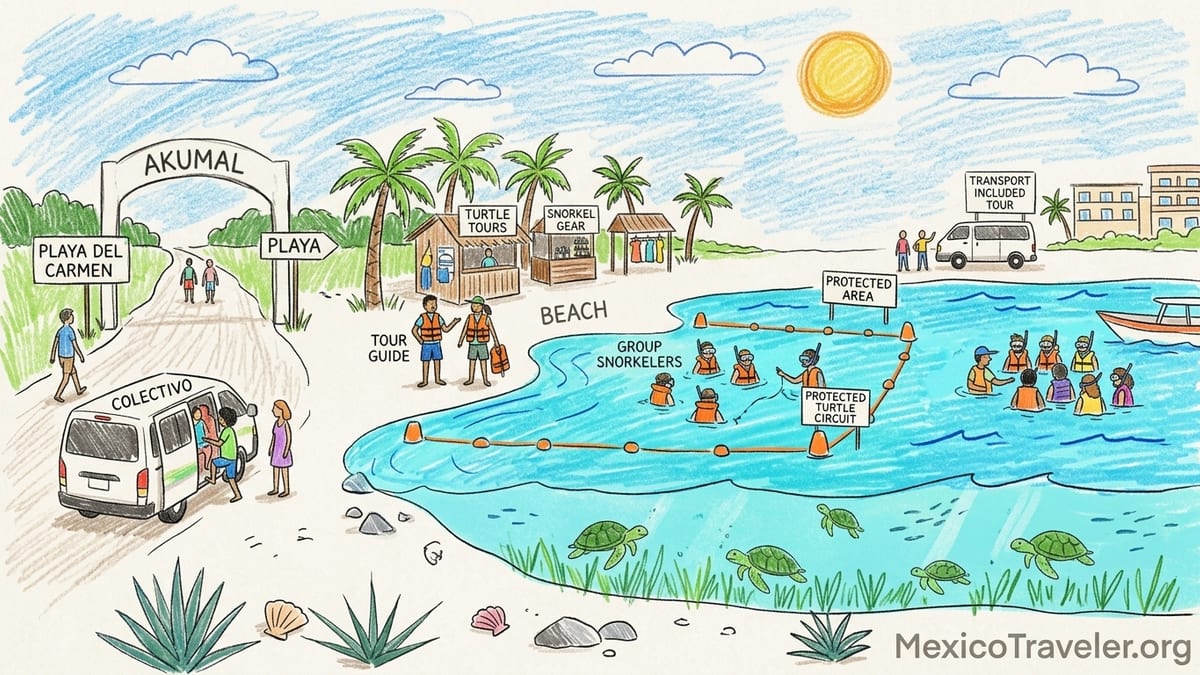
Arriving From Playa del Carmen and Reaching the Beach
I based myself in Playa del Carmen and did the classic day trip down the Riviera Maya highway to Akumal, about 30 to 35 minutes south by road. To keep the logistics realistic for most travelers, I tested the same options visitors actually use: a local colectivo one way and a tour that included hotel pickup on another day.
On my first visit I walked to the colectivo stop near the highway in Playa, flagged down a southbound van marked “Tulum,” and told the driver “Akumal.” The fare in October 2026 was 50 pesos in cash from central Playa to the Akumal highway stop. From there it was a five to seven minute walk along the side road toward the sea, past taco stands and small convenience shops, until the concrete arch announcing “Akumal” framed the palm trees and bright strip of sand beyond.
Right after the arch I passed a small booth collecting a beach access and conservation fee. I paid 120 pesos and received a paper wristband that allowed me to walk through to the public section of Akumal Bay and use the bathrooms and showers inside the concession area. This fee did not include snorkeling gear, a guide or entry into the regulated turtle snorkeling circuit. It simply allowed me to cross private property to reach the sand and basic facilities.
Once I stepped onto the beach proper, the water was the clear turquoise every Riviera Maya brochure promises, but what struck me more was the activity on shore. To my left, all inclusive resorts lined the curve of the bay. Ahead, a cluster of beachfront kiosks advertised “Turtle Snorkel Tour,” “Official Guide,” and “Protected Area Access” on hand painted signs and printed banners. This was where the real decision making began.
Talking With Tour Sellers and Understanding Real Prices
Within seconds of reaching the sand, two men wearing laminated badges approached and told me that independent snorkeling was now “prohibited” and that I needed a tour if I wanted to enter the sea at all. This did not match what I had read from local conservation groups, so I declined politely and walked further down the beach toward the central section where the boats and more formal kiosks operate.
At the first kiosk connected to a long established local dive shop, the offer was clear and better structured. For 800 pesos per person, roughly 45 US dollars on the day of my visit, they included a life jacket, mask, snorkel, fins, locker, and a guided group snorkel of around 45 minutes inside the designated turtle observation circuit. The staff explained that their guides appear on the state tourism registry, carry insurance, and follow the bay’s management plan that caps group sizes and routes.
To cross check, I asked at a second stand a little closer to the pier. Their price was 900 pesos for a similar package but they immediately dropped it to 800 when I mentioned what the neighbor was charging. Both quoted departures every 30 to 40 minutes in small groups capped at 6 to 8 snorkelers per guide, depending on how many people had signed in.
The most aggressive sales pitches came from men standing closer to the arch and parking area, some without fixed kiosks, quoting prices between 1,000 and 1,200 pesos and insisting every other operation was “not licensed” or “full for the day.” Several travelers I spoke with later in Playa described being told that the public beach itself required a separate “tourist tax” far higher than what I had paid. Those stories matched recent warnings from visitors about turtle tour scams on Akumal beach, so I stuck with the operators that had clear signage, visible gear storage and a functioning credit card terminal instead of cash only demands.
Gear, Briefing and Entering the Protected Snorkeling Circuit
For my first in water session I chose the locally arranged guide option at 800 pesos. After paying at the kiosk, I received a numbered token and was directed to a shaded gear area where staff handed out life jackets, masks and snorkels. Everyone in the group was required to wear a floatation device, not only for safety but to keep us from standing on the seagrass beds that feed the turtles. The jackets were the open front style that you can tighten under the arms, which made it easier to float without feeling constricted.
The guide gathered our group of seven under a palm before we entered the water. He began with the rules that Mexican environmental and maritime authorities have put in place for Akumal’s turtle habitat. We were to maintain at least three to four meters of distance from any turtle, never chase or surround them, and avoid positioning ourselves directly above a turtle when it surfaced to breathe. Touching, grabbing shells or blocking their path is not only harmful but can lead to removal from the bay and high federal fines. We could not dive down, even for a few seconds, and fins were to stay clear of the seagrass.
He also explained the difference between the public swimming zone and the protected snorkeling circuit where we would be going. Near shore, between the beach and the first line of buoys, anyone with beach access can swim and float. Beyond that lies a clearly marked corridor reserved for licensed turtle tours, with defined entry and exit points. Guides must keep their groups within authorized lanes, away from boat channels and nesting areas, and there are daily limits on how many people can enter during each time block, especially in turtle feeding hotspots.
We entered the water at one of the official access points beside a string of orange buoys. The depth dropped quickly from knee deep sandy bottom to chest deep seagrass meadow. Visually, the bay here has two main textures under the surface: lighter patches of sand and darker, denser swathes of turtle grass waving slowly with the current. The guide led the group in a loose single file, stopping every few minutes to scan for the unmistakable oval silhouette of a turtle head among the shadows.
Visibility, Turtle Encounters and What the Swim Actually Felt Like
On the day of my locally arranged tour, the sea was relatively calm, with only small wind ripples disturbing the surface. Underwater visibility was around 10 to 12 meters. Close to shore the water had a slight milkiness from stirred up sand, but out over the deeper grass beds it cleared into a rich turquoise with enough clarity to see the blades of seagrass swaying below.
Our guide found the first turtle about 15 minutes into the swim. He raised his arm and quietly called “tortuga” so the group could gather at a respectful distance. The green turtle was medium sized, grazing with unhurried bites from the grass, unbothered by our presence as long as we stayed in a loose semicircle several meters away. Every few minutes it rose toward the surface, took a quick breath, then descended to continue feeding. We watched for about eight minutes, the guide checking that no one edged too close or tried to dive.
In total, during the 45 to 50 minutes we were on the water that morning, we observed three individual turtles along the circuit. One swam just below us for a brief moment before veering off toward a deeper patch; another stayed in place long enough for the whole group to take a good look. Along the way we also saw schools of sergeant majors and blue tangs, plus a stingray partially buried in the sand. It was not an endless parade of turtles, but it felt like an authentic encounter with wild animals moving on their own schedule.
It is important to say that even inside the protected circuit, turtle sightings are never guaranteed. Water clarity changes with weather and currents, and turtles can shift feeding spots from day to day. The best a reputable operator can do is increase your chances by knowing where turtles have been grazing recently and by staying in touch with other guides on the bay. Anyone promising “100 percent guaranteed turtles” or offering a refund if you see none is overselling a wild encounter that will always involve some luck.
How Crowded Is Akumal and What About Photography?
Akumal once had a reputation for feeling like a snorkeling highway, but current management measures have thinned the crowds in the water compared with the stories from years past. On my guided circuit, our small group overlapped with two other tour groups at a distance, but we were never in a chaotic cluster. When we met another guide near a turtle, both groups spread out into wider arcs so the animal was never hemmed in.
From the surface it still looked busy along the shore: beachgoers in the public swim zone, kayaks closer to the resort front, and occasional small boats heading to and from the reef line. Yet inside the regulated lanes our guide kept us focused and moving. The feeling was more like a supervised field trip than a free for all. That said, if you are sensitive to seeing other people in the water at all, Akumal is not a secret cove. It is a shared bay with resort guests, day trippers and organized tours all using the same general space.
Before we set off, the guide covered photography rules. Handheld action cameras and waterproof phones were allowed as long as we did not chase turtles for a close up or dive down to shoot from below. Large housings with strobes or bright video lights were discouraged, partly to reduce stress on the animals and partly for safety in busier sections of the circuit. The priority, he emphasized, was to keep arms and fins still when a turtle approached or changed direction, not to get the most dramatic framing.
In practice, I found this guidance helpful. The most satisfying images I captured came when I floated quietly and let a turtle swim across the edge of the frame, rather than trying to line it up perfectly. There were also long stretches when I did not film at all, choosing instead to simply watch the turtle’s grazing pattern and the way its shell and head moved through filtered sunbeams. It was a reminder that successful wildlife encounters are as much about observation as documentation.
Comparing a Beach Arranged Guide and a Transport Included Tour
To see how the experience changed with a hotel pickup package, I returned to Akumal later that week with a Playa del Carmen based operator that sells a sea turtle snorkeling tour with round trip transport. The advertised price at the time of booking was 120 to 140 US dollars per person, depending on hotel location and group size. This included highway transport, entrance fees, snorkel gear, a licensed guide in Akumal and a brief stop at a nearby cenote on the way back.
The van collected guests from several hotels in Playa, which added some time to the start of the day but removed all decisions about colectivos, highway crossings and walking routes. When we reached Akumal, the tour company staff handled the conservation fee and beach access wristbands, then walked us directly to their partner operator on the sand. From the guest perspective this bundled approach was much smoother, especially for first time visitors or families anxious about local logistics.
Once in the water, though, the core of the experience was nearly identical to my locally arranged tour. We followed the same type of circuit, wore the same style of life jackets, and spent roughly 45 minutes snorkeling above the seagrass meadows under the supervision of a licensed bay guide. On that day we spotted two turtles and a larger stingray, with visibility slightly reduced after an overnight wind shift.
The main differences were convenience and overall time commitment. The transport included option stretched into a half day excursion of about five hours door to door once the cenote stop and hotel rounds were added. The locally organized tour required me to manage my own transport but let me decide exactly when to arrive, how long to stay on the beach afterward, and which nearby taco stand to choose for lunch. For confident independent travelers already staying in Playa del Carmen or Tulum, arranging a guide on the beach can save money and give more flexibility. For those who prefer one booking that covers everything, the higher cost of a package can feel justified by the simplicity.
Can You Snorkel With Turtles in Akumal Without a Tour?
The question every visitor seems to ask is whether you can snorkel with turtles in Akumal without joining a tour. The answer, based on current practice and the management of the bay, depends on what exactly you want to do and where you plan to swim.
As of late 2026, you can still access the public zone of Akumal Bay independently once you have paid the beach and conservation fee or walked in via a hotel or restaurant that faces the water. In this area near shore, you are free to swim, float, and use your own mask and snorkel, as long as you follow general safety and environmental guidelines. You might occasionally see a turtle cruising through shallower water outside the main circuit, especially early in the morning or later in the afternoon when the bay is quieter.
However, the core turtle feeding grounds in front of the main bay, where the seagrass is thickest and turtle sightings are most consistent, are now managed as a controlled snorkeling circuit. Entry into this area is restricted to licensed guides and authorized tour groups. Independent swimmers are not allowed to simply cross the buoy lines and wander through these feeding meadows on their own. This shift came after years of unregulated tourism that put stress on the turtles and damaged the grass beds they rely on.
In other words, while you can still snorkel freely in parts of Akumal Bay, the highest probability turtle encounters in the central protected zone require you to be accompanied by an authorized guide. Old blog posts that describe just walking in with your own mask and heading straight to the turtles without supervision no longer reflect the way Akumal is being managed. If your goal is specifically to snorkel alongside feeding turtles while staying on the right side of local rules, booking a licensed guide is now the responsible route.
Learning to Respect Wildlife in a Popular Bay
What struck me most during my time in Akumal was how quickly the atmosphere changed when people shifted from a “checklist” mindset to a respect based one. At the start of each briefing, there were always a few guests who joked about how close they wanted to get for a selfie. By the end of the swim, after watching a turtle hesitate or alter its line when someone drifted a little too near, those same snorkelers were the ones tapping others on the shoulder and signaling them to give the animal more space.
Akumal’s rules about not touching turtles, not diving down, and not crowding them are not arbitrary. Sea turtles expend energy every time they have to change course or surface more frequently due to disturbance. Repeated stress in feeding areas can push them away from the best grass beds or make them burn more energy than they can easily replace. Add in the risk of fin kicks uprooting seagrass and the damage is not just to a single individual, but to the habitat as a whole.
Snorkeling with a guide who clearly cares about the bay made these ecological connections obvious. Ours pointed out bare sandy patches where heavy visitor traffic had damaged the seagrass in the past, as well as newer growth where restrictions and better enforcement have allowed the meadow to recover. He also explained that local operators are increasingly being evaluated not only on guest satisfaction but on their adherence to conservation protocols that aim to keep Akumal a viable turtle foraging ground for years to come.
For me, the lasting lesson was that a “successful” turtle encounter in Akumal is not measured by how close you get or how many times a shell fills your camera frame. It is measured by whether those same turtles continue to return to the bay season after season, grazing calmly in the same grass beds long after your mask has cleared and your vacation has ended.
The Takeaway
After visiting Akumal twice and testing both a beach arranged guide and a transport included tour, I would personally book with a reputable local operator on the sand again. Paying around 800 pesos for a small group guided snorkel, plus the separate beach access fee and my own inexpensive colectivo transport from Playa del Carmen, gave me a high quality in water experience and the freedom to shape the rest of my day.
If I were traveling with young children, older relatives or anyone nervous about logistics, I would seriously consider the more expensive package that wraps hotel pickup, bay access and a cenote visit into one reservation. The in water portion will feel similar, but the stress of moving a multi generational group along the highway in local buses disappears, and that peace of mind counts for something.
Whichever route you choose, there are a few ways to avoid misleading sellers and unsupported access claims. Do not pay anyone near the highway or the arch who insists you must join their tour just to step onto the sand. Walk all the way to the beach, pay the official access or conservation fee where required, and then compare prices at clearly marked kiosks that display gear and staff in uniform. Ask whether their guides are authorized for the turtle circuit and how many people they put in each group.
Most of all, arrive with realistic expectations. You are entering a living habitat, not an aquarium, and the rules exist to protect animals that have made Akumal their home long before tourism found it. If you can accept that turtle sightings are never guaranteed, that you will float at the surface rather than dive to the bottom, and that giving wildlife space matters more than any photograph, then snorkeling with sea turtles in Akumal can still feel like one of the Riviera Maya’s most memorable experiences.
FAQ
Q1. Can I still bring my own snorkel gear to Akumal Bay?
You can bring your own mask, snorkel and fins and use them in the public swimming zone once you have beach access, but entry into the controlled turtle circuit still requires joining a guided tour with an authorized operator.
Q2. How much does a turtle snorkeling tour in Akumal cost right now?
On the beach in late 2026 I was consistently quoted around 800 to 900 pesos per person for a small group guided snorkel with gear, while transport included packages from Playa del Carmen or Cancun typically start near 120 US dollars and go up from there.
Q3. How long are you actually in the water with a guided tour?
Both my locally arranged tour and my transport included package kept us in the water for roughly 45 to 50 minutes inside the turtle observation circuit, not counting the time spent on shore for check in and briefing.
Q4. Is it possible to see turtles without going into the protected circuit?
It is occasionally possible to spot a turtle passing through the shallower areas or near resort fronts, especially at quieter times of day, but the most reliable feeding grounds with higher chances of encounters are inside the regulated circuit that you can only enter with a licensed guide.
Q5. Do I have to wear a life jacket during the tour?
Life jackets are required on the guided turtle snorkeling routes to prevent people from standing on the seagrass beds and to keep groups floating calmly at the surface, even if you are a strong swimmer.
Q6. Are children allowed on Akumal turtle snorkeling tours?
Many operators accept children, often from around six to eight years old depending on swimming ability, but will sometimes require younger kids to ride on a float or stay especially close to the guide for safety.
Q7. What is the best time of day to snorkel with turtles in Akumal?
Morning departures usually offer calmer seas, slightly better visibility and fewer crowds than midday, though weather and sea conditions on a given day can still affect what you see.
Q8. Can I use an underwater camera or GoPro during the tour?
Handheld action cameras and waterproof phones are generally allowed, but guides ask you not to dive down, chase turtles for footage or use bright artificial lights that could disturb wildlife.
Q9. How do I know if a tour operator is legitimate?
Look for fixed kiosks or dive shops on the beach with clear signage, visible safety gear, staff wearing identifiable uniforms and transparent pricing, and avoid unmarked sellers near the highway or arch who pressure you to pay before you even reach the sand.
Q10. Would you recommend booking in advance or waiting to choose on the beach?
If you are visiting in a busy holiday period or traveling with a group, reserving in advance offers peace of mind, but outside peak dates many visitors have a good experience walking to the beach, paying the official access fee and then selecting a reputable guide on the spot after comparing a few options.