


I arrived at the Tulum archaeological zone just after sunrise on an October 2026 weekday, determined to finally untangle the new reality of visiting one of Mexico’s most famous Mayan ruins. Between shifting entrance fees, the still-evolving Parque del Jaguar and conflicting reports about beach access, it has become surprisingly hard to know what a visit really looks like in practice. What follows is a ground-level account of the experience, based on an actual visit, cross-checked with current official information and on-site conversations with staff, guides and fellow travelers.
Getting to Tulum: Transport, Parking and the First Surprise
For this visit I based myself in downtown Tulum, a few kilometers from the coast. To recreate the choices most visitors face, I first rode a colectivo along Federal Highway 307, then repeated the journey later by rental car. From downtown, colectivos toward Playa del Carmen or Cancún will drop you on the highway near the signed turnoff for Parque del Jaguar and the ruins. You tell the driver “Parque del Jaguar” and they let you off near the main access road, from where it is roughly a 10 to 15 minute walk along a paved approach to the official control point. The ride from the town center cost 30 to 35 pesos per person on my October visit, and locals confirmed that this is in line with current 2026 fares.
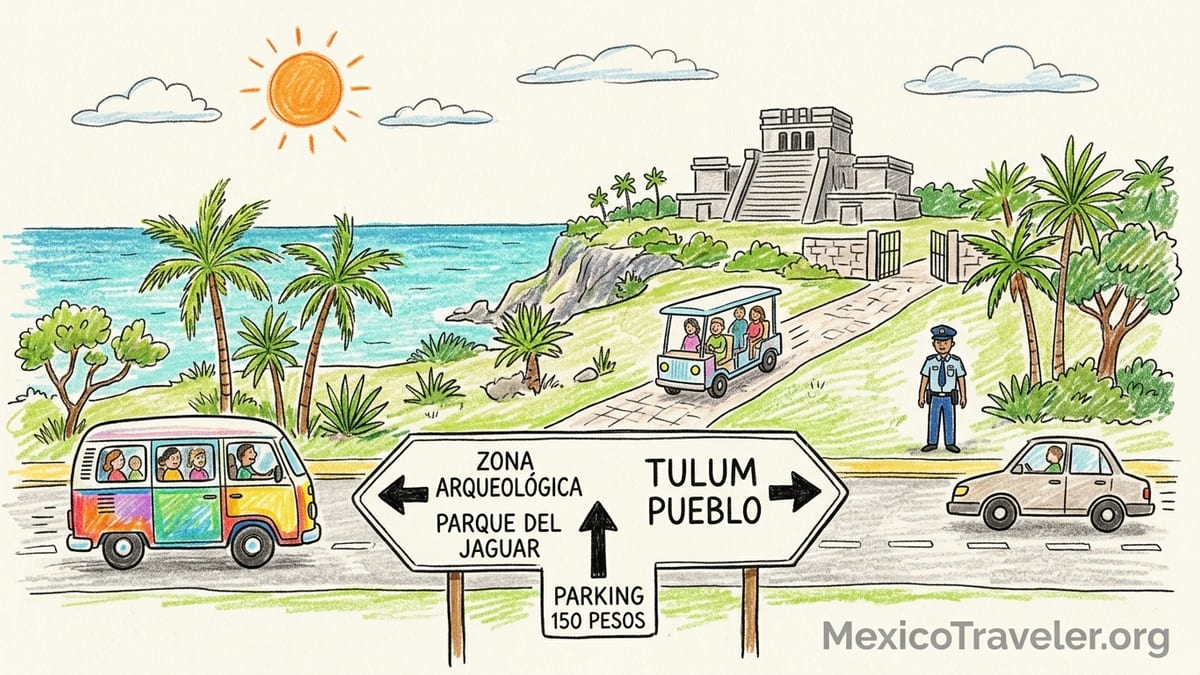
Arriving by car is more straightforward but adds a new layer of decisions. Driving from Tulum town you follow signs for “Zona Arqueológica” and “Parque del Jaguar.” Immediately before the main controlled entrance there is a retorno and an access road leading to a large paid parking area. Travelers I spoke with who had visited earlier in 2026 described a mix of informal and official lots, but on my visit there was one clearly signed “official” lot charging 150 pesos for the day, which matched what several other drivers reported paying. There was also free curbside parking further back along the access road, but these spaces filled quickly and came with the usual uncertainty about security and potential towing.
The first surprise came even before I reached the ticket window. The entire archaeological zone now sits functionally inside the broader Parque del Jaguar and the Tulum National Park, so every visitor must pass through a single controlled access point. In the past, blogs often mentioned a cluttered strip of souvenir stalls and “parking scams” far from the ruins. That gauntlet has largely been pushed back. There are still touts on the highway trying to wave you into private lots and sell combined packages, but once you commit to the official access road it feels more orderly, with uniformed staff directing vehicles and pedestrians toward the main entrance plaza.
Unpacking the Fees: What I Actually Paid in October 2026
Because prices and structures have changed repeatedly in the last few years, I approached the ticket area expecting confusion. Instead I found a relatively clear, two-step system. First, there is the access to Parque del Jaguar and the protected coastal strip managed by environmental authorities. According to recent government announcements in mid-2026, access to the park itself has been reduced and, for Mexican nationals, made free in an effort to restore public beach access and encourage responsible visitation. On the ground, signage confirmed that Mexican citizens with valid ID did not pay for the park gate on the day of my visit. As a foreign visitor, I was directed straight to the combined ticket windows where both park and ruin entries are handled.
My total outlay for entrance occurred in distinct steps and receipts. At the first window I paid the federal archaeological fee set by Mexico’s heritage agency. This was listed at 265 pesos for foreign adults and 80 pesos for Mexican nationals, reflecting a 2026 reduction from earlier, higher rates that had sparked controversy among travelers. I requested and received a printed ticket clearly labeled for “Zona Arqueológica de Tulum,” with the date and the amount. At a neighboring window, foreign visitors who were not part of groups were issued a second receipt covering the environmental and park management charge, which staff described as the contribution for use of the access road, shuttles and protected coastal infrastructure. In my case this added approximately 150 pesos, with a receipt that referenced Parque del Jaguar and Tulum National Park.
In total, my out-of-pocket cost to stand inside the ruins came to just over 400 pesos, not counting parking. This is noticeably less than what some travelers reported paying in late 2024 and 2025, when combined fees could exceed 600 pesos for foreigners, but still high compared with other Mexican archaeological sites. I saw multiple signs noting that residents of Tulum municipality receive a full exemption from certain fees when they show appropriate ID, part of a broader policy to keep local access free. Students, teachers and seniors with Mexican credentials also benefited from discounts or free entry on some days. The important point for international visitors is that you should expect at least two separate receipts and should insist on them. If someone tries to charge a flat cash amount without tickets, you are likely dealing with an unofficial intermediary.
Passing the Gate: Shuttles, Walking Distances and the Role of Parque del Jaguar
After buying tickets, you pass through a security checkpoint where bags are visually inspected and, in some cases, briefly opened. Prohibited items listed on signage included large coolers, alcohol, drones, tripods and bulky professional camera gear without prior permits. Security staff also reminded visitors not to touch or climb the structures and to stay on marked paths, citing both safety and the fragility of the ruins. From there, the landscape opens into a broad, mostly flat corridor of scrubby coastal vegetation, part of the protected area that forms the core of Parque del Jaguar.
Most visitors have two options for reaching the archaeological zone itself. You can walk along a paved pedestrian route of roughly 800 meters to 1 kilometer from the control point to the main ruin entrance, or you can hop on small shuttle vehicles circulating along the same corridor. During my visit, these shuttles, essentially oversized golf carts, were operating on a continual loop. Staff explained that their use for the short section between the access plaza and the ruins was currently included in the park fee for both Mexicans and foreigners, as part of the 2026 policy changes. Riders were still encouraged to tip the driver modestly, and several Mexican families did. The ride takes only 3 to 5 minutes, but the ability to avoid walking under direct sun later in the morning is a real benefit, especially for older visitors or anyone with limited mobility.
Walking is perfectly manageable if you arrive early. I chose to walk in on my first loop to better understand the distance and terrain, then ride the shuttle back when the day had grown hotter. The path is well paved, with some scattered shade from low trees but long exposed sections, and a few interpretive panels explaining the coastal ecosystem and the jaguar conservation message of the park. This is where the broader role of Parque del Jaguar becomes clearer. It is not simply a toll gate; it is now the administrative umbrella that unifies the archaeological zone, public beach access points and a necklace of trails, hotels and protected mangrove and dune systems. Guards and rangers from multiple agencies patrol together, and there is a visible effort to keep the area free of litter and unauthorized vendors.
Inside the Archaeological Zone: Crowds, Heat and Limited Shade
The archaeological gate opens at 8:00 a.m., with last entry listed at 3:30 p.m. and closing around 5:00 p.m. According to recent figures, Tulum remains one of Mexico’s most visited ruin sites, which is obvious as soon as mid-morning buses begin to arrive from Playa del Carmen and Cancún. On my weekday October visit, I entered at about 8:10 a.m. along with a small wave of early risers. For roughly the first 45 minutes it was still possible to move through the site in relative quiet, hearing only the surf and the calls of birds in the surrounding vegetation. By 9:30 a.m., however, the central paths had filled with large tour groups and a noticeable queue had formed at the most photogenic viewpoints.
Heat is a decisive factor in how you experience Tulum. The site sits on an exposed limestone bluff directly above the Caribbean, and shade is surprisingly limited once you leave the short tree tunnel at the entrance. There are a few pockets of relief beneath palm trees near the main lawn in front of El Castillo and along the northern path, but much of the circuit runs in full sun. By 10:00 a.m. in October the temperature and humidity combined to create a heavy, almost sauna-like feel, and I saw several visitors retreat early looking pale and overheated. There are basic services such as toilets and small shops back near the main gate, but no serious food options or large shaded rest areas inside the archaeological core itself.
Water availability deserves emphasis. I carried 1.5 liters of water and refilled once from a bottle I had left in a shaded spot near the entrance. While vendors at the access plaza sell bottled drinks before you pass through security, I did not see official water refill stations inside the main circuit on this visit. Guides and guards alike repeatedly urged people to bring their own supply, apply sunscreen and wear hats. Anyone with young children or older relatives should strongly consider an 8:00 a.m. arrival to complete most of the visit before the worst heat and the largest crowds.
El Castillo, Coastal Views and What You Actually See Today
Tulum owes much of its fame to its location. The ruins themselves are modest in scale compared with sites like Chichén Itzá or Cobá, but they sit dramatically on a cliff edge above a turquoise sea. From an archaeological perspective, the settlement functioned as a late Postclassic Maya walled port, active roughly between the thirteenth and sixteenth centuries, controlling trade routes along the coast and inland. You enter through a gap in the defensive wall and the path quickly opens onto a broad grassy area dominated by El Castillo, the so-called “castle,” which is more accurately a temple platform that also seems to have served as a navigational landmark for seafarers approaching the reef.
Visitors today follow a one-way loop on designated paths, with rope barriers keeping you from approaching or climbing the main structures. El Castillo can be admired from several angles but not entered. Its stepped façade, small shrine on top and associated platforms are all clearly visible, and if you pause you can pick out details like the sloping batter of the walls and the remnants of stucco decoration. To the north of El Castillo, the Temple of the Descending God stands out for its unusual iconography of a figure diving headfirst from the heavens, a theme repeated in other structures at the site. Further west, the so-called Temple of the Frescoes, a relatively low building with an interior sanctuary, is important because traces of painted murals survive inside, although these are not accessible to casual visitors and are protected behind glass and walls.
The coastal viewpoints are, for many people, the emotional highlight. A path runs along the edge of the cliff at several points, with wooden railings and small platforms where people cluster for photos. On my visit, the main balcony overlooking El Castillo framed by sea and sky was already crowded by 9:00 a.m., with lines of visitors patiently waiting for a clear shot. The water below was a milky blue that day, churned by moderate surf and streaked with some sargassum mats, the floating seaweed that has increasingly affected Caribbean beaches in recent years. Journalists and environmental groups have documented how heavy sargassum landings can temporarily close the small cove below the ruins to swimming, and several travelers I spoke with had come prepared for the possibility of murky water or restricted access.
Historically, a wooden staircase led from the clifftop down to a pocket beach directly beneath the ruins, which featured in many iconic photos of people swimming below the ancient walls. At various points in the last few years, that staircase and beach access have been closed for erosion control, turtle nesting and safety concerns. During my October 2026 visit, the staircase remained roped off and access to that specific cove was not permitted. Rangers were clear that this could change seasonally, but visitors should not currently plan on swimming below El Castillo as part of their ruin visit. This was one of several instances where old guidebooks and glossy marketing images collided with the much more restricted modern reality.
Guides, Interpretation and How Long a Visit Really Takes
Just outside the archaeological gate a row of licensed guides in beige uniforms offered their services in Spanish, English, French, Italian and occasionally German. Official boards listed approximate prices by group size and language. For a small group of up to five people, quotes on the morning of my visit ranged from 1,000 to 1,400 pesos for a 60 to 75 minute tour. The system appeared more regulated than in the past, with names, license numbers and languages displayed on badges, and staff from the heritage agency informally supervising the area to deter unregistered operators.
To evaluate whether hiring a guide meaningfully changes the experience, I first walked the site alone using only the basic interpretive signs, then circled back later for a guided lap with a small mixed-language group. Without a guide, it is entirely possible to complete the loop in 60 to 90 minutes, including several pauses for photographs and sea views. The panels offer concise information about each major structure and some context about Tulum as a fortified port of the eastern Maya. However, they cannot easily convey subtler elements like astronomical alignments, trade networks or the more complex religious symbolism of the iconography.
With a guide, the ruins came to life in a way that surprised me, even as someone who had read about the site extensively. Our guide pointed out how the orientation of El Castillo aligns with certain solar events and how the small openings functioned as beacons for canoes navigating through gaps in the offshore reef. Near the Temple of the Frescoes, she described the traces of marine deities and underworld symbolism that remain inside, drawing connections to other sites along the coast. She also connected the modern management of Parque del Jaguar and the Tulum National Park to long-term efforts to protect nesting turtles and coastal ecosystems, including the controversial balancing act between tourism infrastructure and conservation.
On balance, I came away convinced that a knowledgeable, licensed guide does materially improve the experience for travelers who are genuinely interested in history and culture, not just a quick photo stop. Budget-conscious visitors who mainly want to see the views can skip a guide without missing core logistics, but anyone curious about the meaning behind the stones should consider joining a small group tour. In terms of time, combining a guided visit with independent wandering and extra stops at viewpoints turned my total on-site presence into roughly two and a half hours, not counting transport to and from town.
Early Arrival, Photography Rules and Managing the Midday Crush
The timing of your visit shapes almost every aspect of the experience. Arriving with the first wave just after 8:00 a.m. granted me a half hour of relative calm, cooler air and softer light for photography. The sun at that hour still sits low enough to rake across the limestone, picking out texture and depth, and the sky tends toward softer blues and pinks before the overhead glare. By contrast, when I looped through again around 11:30 a.m. to cross-check crowd levels, the central lawn felt more like a festival ground. Lines formed not just at the cliff viewpoints but even along simple sections of path where groups waited for their guide to finish explanations.
Photographers should keep in mind both the light and the rules. Small cameras and phones are allowed at no extra cost, and I saw countless visitors shooting with smartphones and compact mirrorless bodies. Tripods, stabilizers and more elaborate setups are considered professional gear and require special permits that are typically arranged in advance; several visitors who tried to set up small travel tripods were politely but firmly asked to pack them away. Drone use anywhere in or over the site is prohibited without a specific authorization, which ordinary tourists will not have. Rangers also asked visitors not to block narrow paths or viewpoints for extended “photo shoots,” and I saw at least one informal wedding-style session curtailed for that reason.
In practical terms, the strongest viewpoints are the main balcony looking back at El Castillo with the sea dropping away behind it; a northern lookout where the wall, smaller temples and the coastline align in a layered composition; and several openings in the vegetation where you can frame the turquoise water against jagged limestone. All of these are small spaces. Early arrival lets you take your time without feeling rushed by a queue at your back, and it also means you spend more of your visit in manageable temperatures. If your only option is a midday slot, consider carrying an umbrella for shade, planning frequent short rests, and perhaps limiting your circuit to the key structures rather than trying to see every angle.
Combining Tulum Ruins with Beaches and Cenotes in One Day
One of the biggest planning questions for visitors staying in Playa del Carmen or even Cancún is whether Tulum deserves a standalone day or can be combined with other experiences. Based on my October visit and current transport realities, a focused half-day at the ruins is entirely feasible, leaving room for a nearby beach or cenote in the afternoon. However, the exact combination depends on your tolerance for heat, crowds and time on the road.
From Playa del Carmen, many travelers join organized excursions that bundle Tulum ruins with a swim in a cenote like Cenote Dos Ojos, Casa Cenote or one of the cenotes closer to Tulum town, plus a brief stop at a beach club. These trips depart early, reach the ruins around opening time, and then continue inland or along the coast. If you travel independently by rental car or ADO bus, you can follow a similar pattern: arrive for the 8:00 a.m. opening, spend two to three hours exploring, then retreat to a cenote where the water is cool and shaded by jungle. During my stay I paired the ruins one day with a mid-afternoon visit to a cenote just off the highway between Tulum and Akumal, reaching it in under 25 minutes of driving.
Beach access near the ruins is in flux as the authorities work to reopen and protect public entrances through Parque del Jaguar. Government statements in 2025 and 2026 highlighted new free public access points inside the park that connect inland visitors to the sand without crossing private hotel grounds. On my visit, guards at the archaeological exit explained that while these beach access points exist within the broader park, they are managed separately from the ruin circuit and their operational status can change with sea conditions, turtle nesting and sargassum levels. In other words, you cannot assume that a morning at the ruins will automatically flow into an afternoon lounging directly on the adjacent beaches. If a beach day is a priority, it is safer to plan it either at a known public access area elsewhere in Tulum or at a beach club, treating the ruins as a distinct, time-bounded outing.
The Takeaway: Expectations vs Reality and Is It Worth a Dedicated Trip?
Going in, I expected Tulum to be a quick, somewhat over-commercialized stop: a photogenic cliff, a handful of small structures and a tangle of pushy vendors and confusing fees. Parts of that stereotype still hold. The ruins are indeed compact, and the entrance sequence now includes multiple agencies, tickets and security steps. Crowds build rapidly after 9:00 a.m., and the combination of intense sun, limited shade and high humidity can make the visit feel physically taxing, especially in the hotter months. Prices, even after 2026 reductions, are not low by Mexican standards, and anyone arriving without clear information can feel overwhelmed by the overlapping roles of Parque del Jaguar, Tulum National Park and the archaeological authorities.
Yet the reality on the ground in October 2026 was more positive and more coherent than I anticipated. The integration of the site into a broader protected area has reduced some of the chaotic roadside commerce that used to dominate first impressions. Signage is clearer, official staff are more visible, and local residents benefit from policies that keep their access free or discounted. Security felt present but not oppressive, focused mainly on safety, conservation and basic order. The ruins themselves, while modest in scale, gain weight and meaning when you understand them as a fortified maritime gateway at the edge of a once-thriving Maya world, guarding sea routes and signaling to canoes threading the reef.
Whether Tulum’s ruins deserve a dedicated trip from Playa del Carmen depends on what you value. If your main interest is dramatic scenery and you are content with a relatively short, surface-level visit, then a combined day that includes Tulum, a cenote and perhaps a lunch stop will feel efficient and satisfying. The archaeological zone can be walked thoroughly in two to three hours, leaving ample time for other activities. On the other hand, if you care deeply about Maya history, coastal ecology and the modern politics of conservation and tourism, Tulum easily justifies a more focused outing. Arrive at opening time, hire a well-regarded licensed guide, linger at the viewpoints and then decompress over lunch in town, reflecting on how this compact walled port fits into the broader story of the Riviera Maya.
Personally, I left with a more nuanced appreciation than I expected. The fees were still higher than at many other sites but clearer and somewhat lower than recent horror stories had led me to believe. The crowds were real but manageable with an early start. The coastal views, even with some sargassum and a closed staircase, were still arresting, especially in the quiet first hour when the sun was low and the sea breeze gentle. Most importantly, the ruins felt less like a backdrop for social media and more like a living node in a complex landscape where ancient trade, colonial history, modern development and environmental urgency meet. For travelers willing to plan carefully, arrive early and bring patience along with sunscreen and water, Tulum’s Mayan ruins remain worthy of a deliberate journey, not just a hurried detour.
FAQ
Q1. How much does it cost to visit the Tulum ruins in late 2026?
For foreign adults, expect to pay a federal archaeological fee of around 265 pesos plus an additional environmental and park-related charge that brings the total to just over 400 pesos, not including parking. Mexican visitors pay a lower archaeological fee, and residents of Tulum municipality can access certain parts of the park for free with valid ID.
Q2. Do I have to pay separately for Parque del Jaguar and the ruins?
In practice you buy access at a combined ticket area near the main entrance. The receipts are separate, one for the archaeological zone and one reflecting park and environmental management, but the payments happen in one sequence at official windows supervised by federal staff.
Q3. How early should I arrive to avoid the worst crowds and heat?
Arriving close to the 8:00 a.m. opening makes a big difference. You gain at least an hour of relatively low visitor numbers, softer light for photos and cooler temperatures before the large tour buses from Playa del Carmen and Cancún begin to arrive.
Q4. Is beach access included with a ticket to the ruins?
Access to the small cove directly below the ruins has been restricted or closed at various times for erosion control, turtle nesting and safety, and during my October 2026 visit the staircase remained closed. While the broader Parque del Jaguar includes public beach access points, their operation is managed separately and can change with sea and weather conditions, so they should not be assumed as a guaranteed part of a ruin visit.
Q5. How long does a typical visit to the Tulum ruins take?
A self-guided circuit with time for photographs and a few pauses at viewpoints usually takes 60 to 90 minutes. Adding a licensed guide and a slower pace at the main structures and coastal lookouts extends the visit to around two to three hours in total.
Q6. Is it worth hiring a guide at the entrance?
For travelers interested in the history, symbolism and wider context of the site, a licensed guide adds considerable value by explaining trade routes, religious iconography, astronomical orientations and modern conservation efforts. Budget-focused visitors who mainly want the views can manage without, but they will experience the ruins in a more superficial way.
Q7. What are the current photography and drone rules?
Phones and small cameras are allowed at no extra charge. Tripods, stabilizers and professional-looking setups require special permits and are often turned away at the gate if brought without prior authorization. Recreational drone use is prohibited inside and above the archaeological zone and surrounding protected area.
Q8. Can I visit Tulum ruins and a cenote or beach in the same day?
Yes. If you reach the ruins for opening time and spend two to three hours on-site, you still have time in the afternoon to swim at a nearby cenote or visit a beach accessed from elsewhere along the coast, especially if you are traveling by rental car or on a structured tour from Playa del Carmen.
Q9. How accessible are the ruins for visitors with limited mobility?
The main approach from the entrance plaza to the archaeological gate is via a paved path or shuttle vehicles, and the interior circuit is mostly flat, though with uneven limestone surfaces and some steps. There is limited formal accessibility infrastructure, so travelers with mobility challenges should plan to use shuttles, bring support aids and allow extra time.
Q10. Is a dedicated trip from Playa del Carmen to Tulum ruins worth it?
If you are mainly seeking a quick photo at a famous viewpoint, you can fold Tulum into a broader multi-stop excursion. If you value understanding the site’s maritime role, its coastal ecology and the current balance between tourism and conservation, then a focused half-day trip from Playa del Carmen dedicated solely to the ruins is very much worthwhile.