


For many visitors to Mexico’s Riviera Maya, the biggest money question comes long before the first margarita: should you book a big, beachfront all-inclusive resort or base yourself in town and pay as you go for food, drinks and excursions? I recently put that decision under a microscope by tracking every peso during a five-night stay at a midrange all-inclusive between Puerto Morelos and Playa del Carmen, then comparing the real daily cost with an equivalent independent setup in central Playa del Carmen. The results were not quite what I expected.
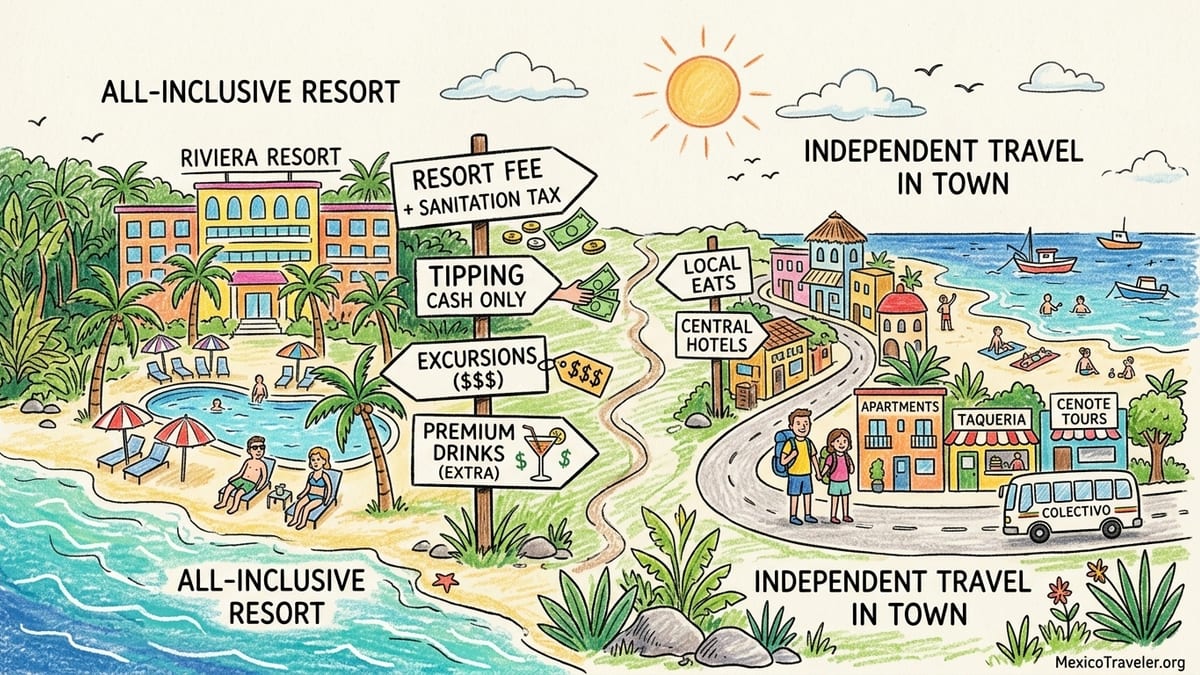
What I Expected to Be Included
Before booking, I assumed the all-inclusive label would mean that almost everything on property was covered: buffet and à la carte dinners, snacks, drinks, kids’ club activities, non-motorized water sports, nightly entertainment and at least basic airport transfers arranged through the tour operator. I also expected taxes and gratuities to be largely baked into the advertised package price, because many Riviera Maya resort brands market their stays as “all taxes and tips included” on booking engines and brochures. In other words, I thought that once my card was charged, only optional excursions and spa treatments would add meaningfully to the final bill.
I also went in thinking that the resort’s isolation would be a minor trade-off. The property I chose sits on the stretch of coast between Puerto Morelos and Playa del Carmen, about a 25 to 30 minute drive from either town. On the map this looked close enough for a few spontaneous evenings in town and day trips to cenotes and the Tulum area. My rough mental math assumed one or two taxi rides, a couple of paid tours and perhaps one splurge meal off property. I did not factor in how often I would want to leave once I saw the excursion prices posted at the resort tour desk.
In terms of food and drink value, I expected that the unlimited aspect would easily beat paying cash in town. Recent price data for Playa del Carmen puts a midrange restaurant meal at about 20 to 25 US dollars per person, with a beer around 4 dollars and cocktails often higher, especially along the touristy 5th Avenue strip. That means a couple eating two restaurant meals per day plus drinks can easily spend 120 dollars or more daily just on food and beverages in town. Against that, an all-inclusive package that seemed to work out to somewhere around 180 to 220 dollars per night per couple felt like a solid deal.
Finally, I anticipated that the room rate would be relatively transparent. I knew Mexico adds a 16 percent federal value-added tax to hotels and a 5 percent state lodging tax in Quintana Roo, which covers Cancun, the Riviera Maya and Tulum. I also knew there was a small environmental sanitation fee per room per night that many hotels in the region now collect at checkout to fund local services. What I underestimated was the way these separate layers, combined with optional but socially expected tipping and transportation, inflate the real daily spend.
What Was Actually Included in My All‑Inclusive Stay
The trip I tracked was a five-night stay for two adults and one school-age child at a large beachfront resort north of Playa del Carmen, booked for early 2026 shoulder season. Through a major package operator, the room was advertised at 269 US dollars per night for a “junior suite garden view,” based on triple occupancy. That headline rate included access to a main buffet, several à la carte restaurants, most bar drinks, kids’ club, evening shows and non-motorized water sports like kayaks and stand-up paddleboards. On paper, this was a classic midrange Riviera Maya all-inclusive product.
Once the booking engine calculated taxes and operator fees, the prepaid accommodation total for five nights came to about 1,670 dollars, including the tour operator’s own service charge. That works out to 334 dollars per night for the room, food and drinks. The package also bundled shared round-trip airport transfers from Cancun International, with the ground transport itemized internally at about 80 dollars round-trip for the family, but effectively hidden within the overall package price rather than charged separately.
On arrival at reception, the first reminder that “all-inclusive” has limits appeared in the form of an environmental sanitation fee and a small hotel charge collected directly by the property. Quintana Roo municipalities currently levy an environmental tax per room per night on hotel stays in Cancun, Puerto Morelos, Playa del Carmen and the Riviera Maya corridor. The resort charged the equivalent of roughly 4 to 5 US dollars per night per room for this fee, plus a modest hotel facility charge. Over five nights, that added just over 30 dollars to my bill, payable in pesos at checkout and not included in the prepaid package.
In terms of food and drink, inclusions were generous but not unlimited in the way I had imagined. House cocktails, local beer, basic spirits and wines by the glass were free-flowing at pool and lobby bars. The main buffet served breakfast, lunch and dinner with enough variety to satisfy most families: made-to-order egg stations, Mexican and international dishes and a dedicated kids’ section. However, two of the resort’s specialty restaurants, including a teppanyaki show table and a “gourmet” seafood venue, carried either a per-person surcharge or were reserved for higher-tier room categories. Premium-brand spirits like top-shelf tequila and some imported gins also showed a surcharge on the bar menu.
Unexpected Expenses That Inflated the Real Daily Cost
When I sat down after the trip and added up each category, the gap between the advertised nightly rate and the real daily cost became clear. The prepaid package of approximately 1,670 dollars covered the core of the stay. To that, I added about 32 dollars in environmental and hotel fees collected at checkout. So the base for “room plus food and drink” rose to around 1,702 dollars, or 340 dollars per night.
Gratuities were the next meaningful layer. Technically, resort brochures and many booking confirmations state that taxes and gratuities are included in the all-inclusive price. In practice, almost every guest I observed tipped bartenders, servers, bell staff and housekeepers in cash. Over five nights, my family handed out the equivalent of about 12 to 18 dollars per day in tips, mostly in 20 to 50 peso notes at bars and restaurants and a bit more on the last day for housekeeping. That added roughly 75 dollars to the week, nudging the nightly cost by another 15 dollars.
Excursions and off-property transportation, however, were where the costs truly escalated. The resort’s on-site tour desk quoted around 120 to 150 dollars per adult for small-group day trips to Tulum ruins and nearby cenotes, slightly discounted for children. Booking two guided excursions for the three of us, including transport, cost just over 600 dollars across the week. On the one afternoon we took a taxi into central Playa del Carmen for dinner and a stroll, the round-trip fare from the resort came in at the equivalent of about 70 dollars. That combined excursions and taxis budget quickly climbed past 670 dollars, adding roughly 134 dollars per night to the all-in cost.
When I folded in a modest amount of optional resort spending, such as a single 50-minute massage at the spa for about 110 dollars before service charge, a 30 dollar cabana rental for one day, a handful of coffee-shop pastries that were not part of the regular buffet, and a small souvenir from the lobby shop, optional extras reached about 220 dollars. Over five nights, those discretionary purchases contributed another 44 dollars per night. By the end of the week, my five-night “269 dollars per night” stay had cost just shy of 2,700 dollars door to door, or about 540 dollars per night for the family.
How That Compared With an Independent Base in Town
To test whether the all-inclusive still represented value, I built a parallel budget for what an equivalent-standard independent stay might have cost in central Playa del Carmen or Puerto Morelos for the same dates. For accommodation, I looked at current late-2026 nightly rates for well-reviewed, family-friendly hotels and aparthotels within walking distance of the beach and restaurants in Playa del Carmen. A modern one-bedroom suite with kitchenette and pool access a few blocks from the beach typically runs between 160 and 220 dollars per night in shoulder season for three guests, including taxes collected by the platform but excluding the municipal environmental fee at check-in.
Adding a similar environmental charge of around 4 dollars per room per night, five nights in a centrally located suite would likely total somewhere in the 850 to 1,150 dollar range for accommodation only. Using a midpoint of around 1,000 dollars, the nightly room-only cost for the family would be roughly 200 dollars. That already represents a savings of about 140 dollars per night compared with the 340 dollars real base cost of the resort once local fees were added but before excursions and tips.
The major question then becomes food and drinks. Recent traveler spending data and local dining guides suggest that an average visitor in Playa del Carmen spends somewhere around 35 to 40 dollars per person per day on food if eating at a mix of casual local spots, taquerias and midrange restaurants. For a couple with one child, that translates to roughly 90 to 120 dollars per day for three people, assuming breakfast pastries or fruit, a simple lunch and a sit-down dinner with non-premium drinks. Over five days, that food budget comes to about 500 to 600 dollars.
Layering that food spend onto the room-only figure gives a rough independent travel cost of 1,500 to 1,600 dollars for five nights in Playa del Carmen, or around 300 to 320 dollars per night. Even if I added a modest bar tab in town, a few gelatos, coffees and the same two guided excursions purchased directly from operators in Playa or online, the total trip might have landed near 2,100 to 2,200 dollars. That is still several hundred dollars less than the final 2,700 dollar tally from the all-inclusive stay, with the key difference that an in-town base would have eliminated the 70 dollar round-trip resort taxi into Playa and likely reduced the per-person cost of excursions booked without resort markups.
Food Variety, Premium Drinks and the Time Cost of Isolation
Beyond raw numbers, there were qualitative trade-offs worth considering. On the positive side, the resort’s buffets and included à la carte options covered enough ground that we never went hungry. There were rotating theme nights, a Mexican station with regional dishes and international comfort food to keep a child happy. However, after the third day, the repetition became noticeable. While core proteins changed, the salads and sides felt similar from night to night, and the dessert selection often repeated. By comparison, eating in town for several evenings would have opened up Playa del Carmen’s much broader restaurant scene, from small taco stands on side streets to Italian, Middle Eastern and contemporary Mexican spots at various price points.
Premium drinks were another area where inclusions did not match my initial expectations. The resort’s standard cocktails were fine but leaned sweet, made with house-brand spirits. If I wanted a well-known tequila label, a top-shelf gin and tonic or bottled craft beer, the menu often showed a surcharge of several dollars per drink added to the room. Over a week, even a few of these upgrades per day could quietly add 100 dollars or more to a bar bill. By contrast, in-town bars on or just off Playa del Carmen’s main drags often price cocktails in the 8 to 12 dollar range and domestic beers closer to 3 to 5 dollars, with the significant advantage of being able to choose exactly where and how much you want to spend.
The biggest non-financial cost turned out to be time. Staying at an isolated resort meant that every off-property activity required advance planning through the tour desk or pre-arranged transport. Joining group excursions involved early morning lobby meetups, long transfer times and fixed schedules. When I calculated it afterward, each organized tour consumed eight to nine hours of the day, including an hour or more in a bus each way. Simply getting to an independent cenote or a beach club in Tulum by taxi or hired driver from the resort would involve 45 to 90 minutes each way, at fares that can approach 80 to 100 dollars per leg during busy times on parts of the Riviera Maya coast.
By contrast, basing in central Playa del Carmen or Puerto Morelos shortens logistics. Many cenote tours, reef snorkel trips and even visits to Tulum and Coba ruins operate from in-town meeting points that are either walkable or a short local taxi ride away. You still pay for those tours, of course, but you spend less of your holiday in transit and have more flexibility to mix organized outings with casual beach time, shopping or evenings in town without worrying about resort gate security or late-night taxi surcharges.
Amenities I Actually Used Versus What I Paid For
When evaluating whether the all-inclusive model was “worth it,” it helped to list which amenities we genuinely used and which remained theoretical perks. Over five days, we made heavy use of the main pools, including a shallow area ideal for children, and the beach loungers. The kids’ club program, which offered supervised activities for several hours per day, proved valuable for a couple of quiet adult lunches by the pool. We attended three of the five nightly shows, which ranged from a lively Mexican dance performance to a family-friendly magic night. The included non-motorized water sports, like kayaks, saw a single 30-minute outing.
On the food side, we ate every breakfast and lunch on property and four of five dinners within the resort, including two a la carte venues that did not carry surcharges. Snack bars near the pool and beach provided burgers, quesadillas and fruit throughout the day. Realistically, the all-inclusive food component delivered three substantial meals and grazing options every day without additional outlay, which would have been costly to replicate in town if we had insisted on a similar quantity of food and drink.
However, several headline amenities factored little into our stay. The spa, though attractive, saw only a single visit for one treatment. The tennis courts and fitness classes went unused. We never tried the separate adults-only pool zone that was technically part of our package, because it was located at the far end of the property from our room, and family logistics made that impractical. The on-site shopping arcade, designed to keep guests spending on logo wear, jewelry and imported snacks, felt more like a trap than a benefit.
When I divided the final cost of the stay by the number of days and considered what we actually used, the math was revealing. Roughly speaking, about half of our 540 dollars per night went to accommodation and core resort operations, including staff and facilities, while the rest effectively prepaid a level of food, drink and entertainment we did not entirely exploit. Had we been the kind of travelers who stayed on property all day, drank cocktails from late morning and joined every activity, the per-use cost of the inclusions would have been far lower. Because we left the resort multiple days for excursions and a dinner in town, we ended up paying both for all-inclusive access and for independent experiences on top.
What I Would Change Next Time
Looking back, the biggest change I would make before booking another Riviera Maya trip is to align the accommodation style much more tightly with the trip’s purpose. If I know I want to spend several days exploring cenotes, ruins and nearby towns, staying in an isolated all-inclusive resort is an expensive choice once taxis and private tours are factored in. The predictable room-and-food cost is attractive, but every day I leave the property I am effectively paying twice for daytime meals and drinks. In that scenario, I would choose a well-located independent hotel or condo in Playa del Carmen or Puerto Morelos and accept the variability in daily dining costs in exchange for more flexibility and lower transport bills.
If I were to book an all-inclusive again for a more resort-focused break, I would pay closer attention to the fine print around taxes, local environmental fees and premium restaurant access. I would confirm in advance whether the property charges an additional hotel or resort fee at check-in, how much the nightly environmental tax is in pesos and which specialty restaurants are genuinely included for all guests versus reserved for club-level or higher room categories. I would also set a dedicated cash envelope for tips, decide on a daily tipping rhythm that feels fair and sustainable, and treat it as part of the real nightly rate rather than an afterthought.
I would also resist the lure of heavily marked-up on-site excursion desks unless the convenience clearly outweighs the cost. From a central base in Playa del Carmen, it is relatively straightforward to join reputable tours or hire transport independently at more competitive rates, particularly for simple day trips to popular sites like Tulum ruins, Coba or nearby cenotes. Similarly, if I chose a resort again, I would likely cap the number of off-property excursions and instead make fuller use of the included water sports, entertainment and relaxation time to get better value out of the prepaid package.
Finally, I would think carefully about the food experience I want from the trip. If trying a wide range of local taquerias, seafood shacks and contemporary Mexican restaurants is a priority, an all-inclusive can feel limiting after a few days, no matter how well executed the buffets are. On the other hand, if the goal is simply to relax by the pool with reliably decent food available without reservations, the resort model can still make sense as long as you walk in with eyes open about the true cost per day.
The Takeaway: Who an All‑Inclusive Riviera Maya Stay Suits Best
After tracking this real-world stay from booking screen to checkout, my conclusion is that Riviera Maya all-inclusive resorts are not inherently a bad deal, but they reward certain traveler types more than others. Once hidden taxes, fees, gratuities, transportation and excursions were added, the true nightly cost of my midrange resort week reached around 540 dollars for a family of three. An equivalent-standard independent setup in Playa del Carmen, using recent price data for accommodation and food, would likely have cost in the 300 to 400 dollars per night range, depending on dining habits and activity choices.
For families with young children who plan to spend most of their time on property, that premium can still be justified. The value of easy pool access, kids’ clubs, snack bars, evening shows and not having to calculate the price of every ice cream or second juice at lunch is hard to quantify. For couples on a honeymoon or special-occasion trip who want a largely stress-free week with predictable costs, an all-inclusive can provide peace of mind, especially when upgraded room categories and adults-only spaces are part of the experience and you intend to make full use of included food and drink.
By contrast, visitors who are most excited about exploring the region’s cenotes, archaeological sites and local food scene may find that an all-inclusive resort, especially one located far from town, locks in a high fixed cost that sits awkwardly alongside the additional money they will inevitably spend off property. Every taxi to town, private driver to Tulum or day trip organized through a resort tour desk adds to the total and erodes the savings of bundling food and drink into the room rate. In those cases, a central base in Playa del Carmen, Puerto Morelos or Tulum Pueblo, combined with a realistic daily food budget, can be both cheaper and more flexible.
Ultimately, the key is to match your booking choice to your real behavior, not your imagined one. If you know you will stay by the pool, order several rounds of drinks, enjoy nightly shows and rarely leave the property, then the all-inclusive math can work in your favor. If you are likely to hop in a taxi every other day and seek out experiences beyond the resort walls, treating the “all” in all-inclusive as a convenience rather than a strict money saver will lead to more honest budgeting and, in the end, a more satisfying trip.
FAQ
Q1. How much do Riviera Maya all‑inclusive resorts really cost per day?
For a midrange Riviera Maya all-inclusive, a realistic total for two adults and one child, after taxes, local environmental fees, tips, airport transfers and a couple of excursions, can easily land between 450 and 600 US dollars per night. The advertised per-night room rate often covers only about two-thirds of that once all on-the-ground spending is counted.
Q2. Are taxes and environmental fees included in all‑inclusive packages?
Most package prices include Mexico’s main hotel taxes collected by the operator, but municipal environmental or sanitation fees in Quintana Roo are very often charged separately at the hotel in pesos, per room per night. These fees are usually modest, often a few dollars per night, but they are rarely obvious at the booking stage, so you should expect to pay them at check-in or checkout.
Q3. Do I still need to tip if gratuities are “included”?
Resort marketing materials frequently state that gratuities are included in the all-inclusive rate, but in practice many guests tip bar staff, servers and housekeepers in cash. While tipping is technically optional, not participating can feel socially awkward. Setting aside a small daily tipping budget, even just a few dollars in local currency notes, is sensible when estimating your real trip cost.
Q4. How do food costs in Playa del Carmen compare with resort dining?
In Playa del Carmen, a typical midrange restaurant meal often costs around 20 to 25 US dollars per person, with beer and cocktails extra. A couple or small family can expect to spend roughly 90 to 120 dollars per day on food if eating at a mix of casual local spots and midrange restaurants. That can come in below the effective per-day food value built into an all-inclusive, but it offers far more variety and flexibility.
Q5. Are premium drinks really extra at all‑inclusive resorts?
Basic house cocktails, local beer and simple mixed drinks are generally included, but many Riviera Maya resorts charge surcharges for top-shelf spirits, branded tequila, imported craft beers or specialty coffee drinks. Those add-on costs can accumulate quickly if you consistently choose premium options, so it is worth checking the bar menu for “included” versus “extra” labels before ordering.
Q6. How much should I budget for excursions from an all‑inclusive resort?
Guided day trips from Riviera Maya resorts to popular attractions like Tulum ruins, Coba or nearby cenotes often run around 100 to 150 dollars per adult, somewhat less for children, including transport and entrance fees. Booking two such excursions for a small family can add several hundred dollars to a one-week trip. For those who plan multiple outings, comparing resort tour-desk prices with independent operators in Playa del Carmen or Puerto Morelos can reduce costs.
Q7. Is it cheaper to stay in Playa del Carmen or Puerto Morelos instead of a resort corridor hotel?
For travelers who plan to eat out and take regular excursions, basing in central Playa del Carmen or Puerto Morelos is often cheaper overall. Midrange hotels and aparthotels in town can cost noticeably less per night than comparable all-inclusive resorts, and you avoid the high taxi fares and private transfer costs associated with isolated properties along the highway.
Q8. How far in advance should I factor in local fees and airport transfers when budgeting?
When comparing options, you should calculate your expected environmental tax per night, check whether the hotel adds a separate resort fee and confirm the cost of airport transfers from Cancun to your chosen area. Adding these items at the planning stage, rather than treating them as surprises on arrival, gives a more accurate picture of how one property compares with another, particularly along the Riviera Maya corridor.
Q9. Are Riviera Maya all‑inclusive resorts good value for families?
For families who intend to spend most days on property, make regular use of kids’ clubs and eat the majority of meals at the resort, all-inclusive packages can represent solid value and simplify money decisions. The more you use pools, activities and included dining, and the less you leave for off-property meals and tours, the better the cost-per-use becomes compared with paying a la carte in town.
Q10. Who is better off skipping all‑inclusive and booking room‑only?
Travelers focused on daily excursions, local food and nightlife in Playa del Carmen, Puerto Morelos or Tulum Pueblo are usually better served by room-only or breakfast-inclusive stays in town. These visitors gain more freedom to choose where and how they spend, avoid repeated long taxi rides from remote resorts and often end up with a lower total bill for the same or higher level of day-to-day experience.