

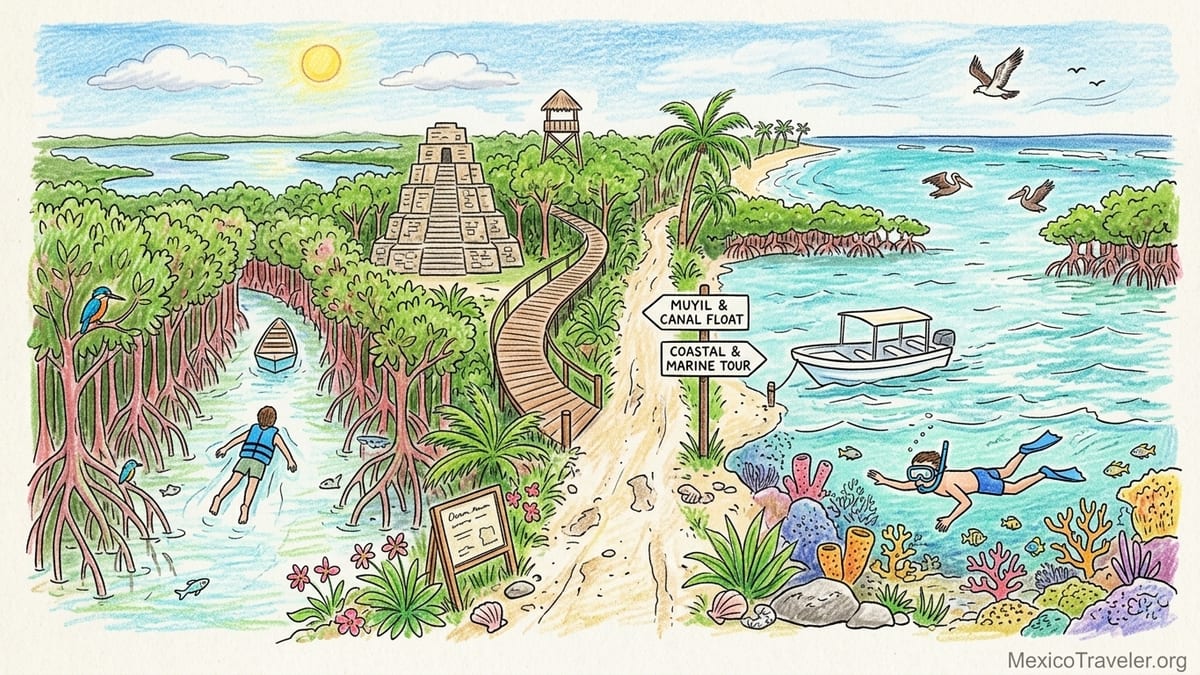
When people in Tulum talk about Sian Ka’an, the conversation usually jumps straight to dolphins, crocodiles and manatees. After spending two full days exploring the reserve on two different authorized tours, what stayed with me was not a checklist of animals but the feeling of moving slowly through a protected landscape where the rules, the logistics and the limits matter as much as the wildlife itself. This guide is based on the specific excursions I completed in 2025, focusing on how you actually get into Sian Ka’an, what the boat time and road conditions really feel like, and what you can realistically expect to see on the Muyil lagoon and canal route versus the longer coastal trip toward Punta Allen.
Choosing an Authorized Sian Ka’an Tour From Tulum
For this article I joined two different excursions departing from Tulum on separate days, both run by authorized local operators. The first was a Muyil lagoon and ancient canal tour with Community Tours Sian Ka’an, a Maya-owned cooperative that has worked inside the biosphere for years and operates under the official management rules set by Mexico’s protected areas agency. This trip focused on the freshwater side of the reserve, combining the Muyil archaeological site, mangrove boardwalk, lagoons and a long canal float. The second was a coastal route branded as a Sian Ka’an marine and lagoon experience from Tulum Area Experiences, which uses licensed boat captains based inside the reserve and complies with the biosphere’s navigation and wildlife-disturbance limits.
I booked both tours directly in advance, then cross-checked details in person in Tulum in early 2025. Prices and inclusions can shift from season to season, but the structure of the day, the access points and the conservation rules tend to remain stable. Rather than promising dramatic encounters with charismatic species, the operators I chose were clear about what they could and could not guarantee in a UNESCO-listed biosphere reserve, which was an important reason I selected them over cheaper, less-transparent options advertised along Tulum’s beach road.
What follows is not a generic overview assembled from brochures. It is a composite of those two full tour days, conversations with guides about current regulations and on-the-ground observations of road conditions, weather, mosquitoes, heat and how the reserve actually feels once you leave Tulum’s hotels behind.
Muyil Lagoon & Canal Float: A Half-Day From the Jungle Side
The Muyil excursion with Community Tours Sian Ka’an started with a hotel pickup from central Tulum at 7:15 a.m. in a white 12-seat van. There were two more pickups at small hotels in the town center, and by 7:40 a.m. we were heading south on Federal Highway 307. The paved drive to Muyil took about 25 minutes, covering the roughly 23 kilometers between Tulum and the secondary access point that the protected-area authorities list for the reserve. The road itself is smooth highway, which makes this one of the gentlest ways to reach Sian Ka’an if you are traveling with children or people sensitive to rough rides.
At the entrance to the Muyil archaeological zone our guide, a local Maya biologist, paid the site fee for the group. In 2025 this was just under 100 pesos per person, paid in cash in Mexican pesos, on top of the separate nature-reserve fee. These official conservation fees support the management of Sian Ka’an and are mandatory regardless of operator. We walked slowly among the compact ruins for about 45 minutes while the guide explained the trade routes that once ran between the inland cities and the coast, setting up the story of the canal we would later float. There were families with small children in the group, and the distances were short enough for them to manage easily.
Behind the main temple, a small gate marked the transition from the archaeological site into the protected jungle of Sian Ka’an. Here an additional conservation contribution was collected, again modest, to maintain the raised wooden boardwalk and mirador tower. The boardwalk itself, built over wetlands and low forest, is atmospheric and at times a little uneven. Boards flexed and creaked underfoot, which mattered for less-confident walkers but added to the sense of being deep in the mangroves. On this stretch we saw termite nests, epiphytes, small lizards and a scattering of birds such as kingfishers and herons that the guide identified, but no large mammals.
Boat Logistics, Weather and the Reality of the Muyil Float
The wooden walkway ended at a tall lookout tower that rose above the canopy. From the top, reached by a steep ladder, the Sian Ka’an lagoons spread out like a sheet of glass punctuated by mangrove islands. The wind was light and the March sky was hazy, which meant softer views for photography but also lower risk of afternoon storms. After the tower it was a short walk to a rustic dock on the edge of the first lagoon, where a set of outboard launch boats operated by licensed local captains waited with life jackets neatly stacked in the bow.
Our tour’s boat had six passenger seats and a sun canopy. Before boarding, the guide checked that everyone had removed sunscreen and insect repellent, since both are restricted inside the reserve’s water bodies unless they are specifically labeled as reef-safe. The boat ride across the first lagoon took about 15 minutes at low speed, with the captain following a designated route. We then entered a narrow man-made channel, the first of two, linking this lagoon to the next. Conservation rules limit the number of boats using the canals at one time, so there were brief pauses at pinch points where we waited for another skiff to pass. This is part of the design that keeps wakes low and erosion in check.
At the far end of the second lagoon the captain nosed up to a small wooden platform and tied off. Here our group stepped out and the guide distributed life vests and basic snorkeling-style belts for those who wanted extra buoyancy. The water was clear and surprisingly cool compared to the air, which hovered in the low thirties Celsius by late morning. The actual float down the Mayan canal took just under 40 minutes, drifting with the gentle current between walls of red mangrove, their roots forming lattices in the pale sand below. Small fish flashed in the shallows and we spotted several more wading birds, but no crocodiles or manatees, animals that are often mentioned in advertisements but are far from guaranteed in this sector of the reserve.
In terms of comfort, most of the group found the float relaxing, though a few people felt a mild chill after so long in the water. There was very little sensation of motion that might trigger seasickness, since the current is smooth and the canal is protected from wind and waves. Where the environment made itself felt was in the heat and humidity. By midday the sun sat high and there is little shade once you are in the boat or the water. A long-sleeve rash guard, hat and water bottle proved more useful than any other piece of gear. Mosquitoes were noticeable on the jungle boardwalk in the early morning shade, less so on the open water where wind kept most of them away.
Costs, Inclusions and Ecological Interpretation on the Muyil Tour
The Community Tours Sian Ka’an package I joined was sold as a small-group Muyil ruins and Sian Ka’an canal experience from Tulum, with a listed duration of about six hours from hotel pickup to drop-off. In early 2025 the price for non-Mexican adults ran a little under 3,000 pesos per person, or roughly 175 US dollars at the exchange rate that season. That price included round-trip transport from Tulum town, guided visit to the ruins, conservation fees, boat time, canal float and a simple cooked lunch at a roadside comedor on the way back. Children paid less, and infants could join without charge, though they obviously did not float the canal.
Equipment-wise, the operator provided mandatory life jackets in several sizes, plus a dry bag that the guide used to carry phones and small cameras for the group. There was no snorkeling gear because the focus was on floating and bird watching rather than reef time. The food was straightforward, with options like grilled chicken, rice, beans and a vegetarian plate. Bottled water and soft drinks were included from the van’s cooler, and we had several short restroom stops, including one at the restaurant where facilities were basic but clean.
What set this tour apart was the depth of ecological explanation. Our guide, who had grown up in a nearby Maya community, did not simply point and name species. He talked about how the mangrove roots stabilize the low-lying coast, how freshwater from the interior pushes out toward the sea, and how the same canals we were floating had once been engineered to move jade, cacao and salt in dugout canoes. When we asked about crocodiles and manatees, he was clear that sightings near Muyil had become less frequent during busy hours and that the tour design avoided active searching or baiting, in line with reserve rules that prohibit disturbing wildlife.
On this particular day, our wildlife list remained modest: several heron and egret species, osprey overhead, small fish among the roots and butterflies along the boardwalk. No large predators surfaced, and no one pretended they had. The value came from the gentle pace and the feeling of floating through a corridor where nature still set the terms.
The Long Coastal Route Toward Punta Allen
The second excursion, the coastal Sian Ka’an route with Tulum Area Experiences, was a very different day. This tour focused on the marine side of the reserve, entering via the narrow Boca Paila peninsula south of Tulum and navigating coastal lagoons and nearshore Caribbean waters. It did not run all the way down to the village of Punta Allen itself, which lies deep inside the reserve at the end of the peninsula, but it followed the same general axis: south from Tulum along a sandy road, then by boat into a chain of shallow bays and mangrove-fringed channels.
Pickup in Tulum pueblo was at 6:30 a.m., a full 45 minutes earlier than the Muyil tour. The reason became obvious once we turned off the pavement at the Sian Ka’an arch at the far end of Tulum’s hotel zone. From this point the road conditions changed dramatically. The single-track sand and limestone road is pocked with potholes, ruts and occasional standing water depending on recent rains. Our minibus, carrying ten guests plus guide and driver, crawled south at an average speed of 15 to 20 kilometers per hour. The drive from the arch to the small dock used by the operator took roughly an hour and a half, plenty of time to understand why independent travelers debate whether to bring a rental car down this route.
Motion-sensitive travelers in the group felt this segment much more than any of the boat time that followed. The constant jolts and side-to-side swaying were manageable but tiring, particularly for families with younger children. It is worth emphasizing that the Muyil approach involves none of this, since it uses the main highway instead of the peninsula track. On the other hand, for visitors intent on seeing the coastal lagoons and, conditions permitting, the barrier reef, this rough road is the price of admission.
At the dock, a simple wooden structure sheltered a cluster of small outboard boats registered with the reserve. Each carried a maximum of six to eight passengers, and our group split between two hulls. The guides again enforced the biosphere’s rule against conventional sunscreen and insect repellent before boarding. Although mosquitoes were mild that morning because of the breeze coming off the sea, the sun was already sharp by 9 a.m. Long clothing and wide-brimmed hats were essential.
Boat Time, Wildlife Expectations and Snorkeling on the Coast
The coastal tour’s navigation time far exceeded that of the Muyil float. Over the course of about four and a half hours on the water, our route stitched together open lagoons, narrow mangrove channels and a brief foray toward the fringing reef, which forms part of the larger Mesoamerican Barrier Reef system. Boat speed varied from slow idle in tighter mangrove sections, to faster runs across wider lagoon reaches where conservation rules still limited wake and approach distances to sandbars favored by birds and, at certain times, marine turtles.
Wildlife on this day centered on birds rather than large marine animals. We saw several species of terns and gulls, brown pelicans resting on posts, osprey hunting overhead and egrets in the mangroves. One sandbar held a small mixed flock of shorebirds. The guides talked about the possibility of spotting dolphins in the deeper channels or turtles near the reef, but they made clear from the beginning that nothing was guaranteed. On our outing no dolphins appeared, and no turtles surfaced near the boat. The crew did not chase any animals or circle repeatedly, a behavior that regulations specifically discourage because it can stress wildlife.
The snorkeling portion, when conditions permitted, took place on a shallow patch of reef inside the reserve boundaries. The sea was moderate that day, with low chop and a steady wind, which was enough to make several guests slightly seasick once they were bobbing in the water looking down at the coral. Time in the water was limited to around 30 minutes, with the boat anchored at one of a set number of designated mooring points. Masks, snorkels and fins were included in the tour price and rinsed between uses, though travelers with their own equipment brought it along. Visibility was respectable, not spectacular, with a mix of hard corals, sponges and reef fish but no large charismatic animals.
Throughout, the guides provided a more general ecological commentary than on the Muyil trip, focusing on the difference between mangrove types, explaining why certain channels were closed to navigation during bird nesting seasons and emphasizing how the same protected area can hold freshwater wetlands, coastal lagoons and coral reef within a relatively small geographic span. They often referred to the biosphere’s zoning plan, which divides the area into strict conservation and more flexible use sectors, but they did not go into as much cultural or historical depth as the Muyil guide had.
Costs, Meals and Comfort on the Coastal Excursion
The coastal Sian Ka’an experience through Tulum Area Experiences was marketed as a full-day tour of about eight to nine hours. The suggested retail price sheet in 2025 listed their Sian Ka’an eco boat tour, run by e-bike or van logistics depending on the season, at just under 200 US dollars per person for international visitors, with lower rates occasionally offered by local hotels. That price included transport from Tulum town, biosphere access fees, boat time, snorkeling gear, a simple boxed breakfast and a sit-down seafood lunch in a small local restaurant on the way back.
Breakfast was modest: coffee, juice and a pastry eaten at the dock before boarding. Lunch, served mid-afternoon, offered grilled fish, rice, salad and tortillas, with a vegetarian option available on request. Portions were generous after several hours in the sun and salt air. Bottled water and soft drinks were available on the boat, and the crew encouraged steady hydration to reduce heat stress and the risk of motion-related headaches.
In terms of physical comfort, this tour demanded more resilience than the Muyil half-day. The combination of the rough access road, longer hours under the sun and open-sea snorkeling meant that by the time we returned to Tulum around 4:30 p.m., most guests looked and felt tired. A few had mild sunburn on the backs of their legs despite long clothing. One guest who was already prone to seasickness spent a portion of the boat time focused on the horizon and skipped snorkeling entirely. Families with younger children coped, but several remarked that they would probably choose the shorter lagoon trip if they were to do it again.
On the plus side, photographers appreciated the variety of landscapes the coastal route delivered. Wide shots of lagoons framed by low mangroves, telephoto views of birds on sandbars and the turquoise line of the outer reef all offered different compositions compared with the enclosed, tunnel-like feeling of the Muyil canal. However, because wildlife viewing is shaped by tide, wind and pure chance, there was no way to guarantee dramatic animal encounters in exchange for the higher price and longer day.
Understanding Conservation Rules and Why Wildlife Is Never Guaranteed
Both tours repeatedly circled back to a single point. Sian Ka’an is not an adventure park or a themed attraction. It is a federally protected biosphere reserve, recognized internationally for its wetlands, mangroves, seagrass beds and tropical forests. As such, everything visitors do is shaped by conservation rules. Boat numbers are limited in key zones. Certain channels are closed during parts of the year to protect nesting birds. Approaching marine mammals too closely is prohibited. Feeding animals is not allowed. Even where you can enter the water, such as the Muyil canal or shallow reef patches, there are restrictions on chemicals and physical contact with vegetation or coral.
These rules exist because, over time, unregulated tourism can erode exactly the ecosystems people come to see. Mangrove roots break down under repeated wake impact, shorebirds abandon disturbed roosts, and large animals shift away from noisy areas. Guides explained that in parts of the reserve where tours once practically guaranteed dolphin or crocodile sightings, animals now behave more unpredictably. With that context, the lack of dramatic wildlife on my particular days felt less like a disappointment and more like a reminder that a healthy protected area allows its residents to appear or vanish on their own terms.
From a practical traveler’s perspective, this means recalibrating expectations. It is reasonable to hope for birds along the Muyil boardwalk, fish in the canal, perhaps turtles or rays from the boat on the coast, and a general sense of immersion in a well-preserved landscape. It is not reasonable to treat any single species as part of the package inclusions, regardless of what glossy posters might imply. The operators I joined were careful to correct that impression. They talked in probabilities and seasons rather than guarantees, and they framed every sighting, from a distant osprey to a school of small fish, as something that happened because the conditions were right, not because the tour had purchased it on our behalf.
If your main goal is to tick specific species off a list, you may leave Sian Ka’an unsatisfied on a quiet day. If, instead, you are open to the rhythms of wind, light and water in a landscape that still functions largely on its own terms, both the Muyil and coastal routes can feel richly rewarding even when the wildlife headline is subtle.
Which Sian Ka’an Experience Fits Different Types of Travelers
Having done both tours back-to-back, the contrasts became clear. The Muyil lagoon and ancient canal float is shorter, gentler and more focused on freshwater wetlands and cultural history. It involves about 45 minutes on the archaeological site, perhaps half an hour on the jungle boardwalk, roughly 45 minutes of slow boat navigation and another 35 to 40 minutes floating in the canal. Transport from Tulum uses paved roads and takes less than half an hour each way. The total outing, including a simple lunch, fits comfortably into a six-hour window, returning you to town by early afternoon.
The coastal route, in contrast, uses minimal archaeology and offers more time on open water. It involves around one and a half hours each way on a rough sand road, three and a half to four and a half hours on a boat moving through lagoons and nearshore sea, and, conditions permitting, about 30 minutes snorkeling over a shallow reef. Lunch is more substantial and the day feels more like a proper expedition, but it also demands more stamina and a higher tolerance for bumps, sun and salt spray.
Costs reflect this difference. As of 2025, small-group Muyil packages from Tulum town generally ranged from the equivalent of 120 to 190 US dollars per person, depending on the operator, group size, and whether meals and archaeological-site fees were bundled or paid separately. Coastal excursions typically started in the 170 to 220 dollar range, partly because of the longer distances, higher fuel consumption, and the extra logistics associated with reef gear and more complex boat management. Do-it-yourself visits to Muyil using public transport and hiring a boat directly at the lagoon can reduce costs substantially, but still require paying the fixed conservation fees set at the ruins ticket office and at the Sian Ka’an trail access.
For nature photographers, the choice often comes down to subject preference. If you are drawn to tranquil compositions of mirror-like lagoons, mangrove roots and human figures drifting quietly through a narrow channel, Muyil is ideal. The controlled pace and limited boat traffic make it easier to plan shots and experiment with angles. If you want a broader sweep of habitats, including wide coastal lagoons, distant reef lines and the chance, however uncertain, of capturing seabirds on sandbars or larger marine life, the coastal route offers more variety, albeit with less predictability and more environmental movement to manage in-camera.
Families with young children, older travelers and anyone prone to motion sickness will generally be happier choosing the Muyil route. The shorter van rides, gentler boat movements and protected canal float are simply less demanding. Independent travelers who value flexibility and lower costs may prefer to reach Muyil on their own by rental car or shared van, visit the ruins and boardwalk at their own pace, then hire a licensed boat at the lagoon docks for the float, using the fixed prices posted at the ticket office as a guide.
The Takeaway
After two days inside Sian Ka’an, the most striking realization was how different the biosphere feels depending on how you enter it. From Muyil, you slip almost imperceptibly from dry forest into wetland, then out across shallow lagoons and into a human-crafted canal that seems to erase time. From the coastal side, you feel every jolt of the access road, every shift of the boat over wind chop, every change in water color as you move from mangrove to reef. In both cases you are traveling along historic routes, yet what you notice most is the present-day tension between access and protection.
If your priority is close contact with quiet water, manageable logistics and the chance to pair archaeology with ecology, I would recommend the Muyil lagoon and canal experience with a Maya-led operator such as Community Tours Sian Ka’an. It is especially well suited to families, first-time visitors to the region and travelers who want to understand how the ancient canal fits into the modern conservation story. Those whose main focus is wildlife photography should also strongly consider this route, since the slow boat movements and extended float offer repeated opportunities for considered shots of birds, mangroves and reflections without the vibration and unpredictability of open sea.
For independent travelers with a high tolerance for rough roads and a desire to see Sian Ka’an’s marine face, the longer coastal excursion with a reputable operator like Tulum Area Experiences can be rewarding, though not in the way glossy posters suggest. Enter with realistic expectations, prepared to spend as much time absorbing lagoon light and mangrove silhouettes as scanning for dolphins or turtles, and the day will feel well spent even if no large animals surface. Visitors who are primarily interested in swimming and snorkeling, rather than cultural context, may enjoy this route, provided they accept that weather and sea state can limit water time.
No matter which tour you choose, remember that every boat wake, every footstep on the boardwalk and every chemical you leave behind in the water has a cumulative impact on a reserve that exists first for its resident species and only secondarily for us. Approach Sian Ka’an as a guest in a living, changing system, and both the quiet Muyil lagoons and the windswept coastal channels will leave a deeper impression than any single animal sighting ever could.
FAQ
Q1. Is it better to visit Sian Ka’an from Muyil or via the coastal road toward Punta Allen?
The choice depends on your priorities. Muyil offers smoother access on paved roads, a shorter day, archaeology and a gentle canal float in freshwater wetlands. The coastal route involves a rough sand road, more time on a boat and the chance, but not the guarantee, of seeing coastal lagoons and reef environments. For most first-time visitors and families, Muyil is the more comfortable and reliable introduction.
Q2. How much does a Sian Ka’an tour from Tulum cost in 2025?
Small-group Muyil tours from Tulum generally range from about 120 to 190 US dollars per person, depending on inclusions and group size. Coastal and near-Punta-Allen style excursions usually fall between roughly 170 and 220 US dollars. Do-it-yourself visits to Muyil with public transport and direct boat hire can be significantly cheaper but still require paying official site and reserve fees.
Q3. Will I definitely see dolphins, manatees or crocodiles on a Sian Ka’an tour?
No operator can honestly guarantee sightings of specific species in Sian Ka’an. Wildlife movements depend on tide, season, time of day and luck. On my own recent tours, we saw a variety of birds, fish and mangrove life but no dolphins, manatees or crocodiles. Conservation rules also limit how closely boats can approach animals, which reduces disturbance but makes encounters less predictable.
Q4. How long is the boat ride and canal float on the Muyil tour?
On a typical Muyil excursion, you can expect about 45 minutes of slow boat navigation across the lagoons and through the connecting channel, followed by roughly 35 to 40 minutes of floating down the ancient Mayan canal in a life vest. The overall outing, including ruins, boardwalk and lunch, usually runs around six hours from Tulum and back.
Q5. How rough is the road on the coastal Sian Ka’an route from Tulum?
South of the stone arch at the end of Tulum’s hotel zone, the track into Sian Ka’an becomes a single-lane sand and limestone road with potholes, ruts and occasional standing water. Vehicles travel slowly and the ride can be jarring for motion-sensitive travelers. The drive from the arch to the dock used by tour operators often takes 60 to 90 minutes each way, which many visitors find more tiring than the boat time itself.
Q6. Are Sian Ka’an tours suitable for children and older travelers?
The Muyil lagoon and canal float is generally appropriate for school-age children and active older travelers, thanks to smooth road access, shorter navigation times and calm water. Children wear life jackets in the canal and can skip the steep lookout tower if they prefer. The coastal route is more demanding because of the rough road, longer hours in the sun and open-sea snorkeling, so it suits families with older children and adults comfortable with more physical effort.
Q7. What should I wear and bring for a Sian Ka’an excursion?
For both routes, wear a swimsuit under lightweight clothing, a long-sleeve rash guard or sun shirt, a wide-brimmed hat and water-friendly sandals. Because conventional sunscreen and insect repellent are restricted in the water, prioritize sun-protective clothing and rehydrate often. A small dry bag, reusable water bottle, and a microfiber towel are useful. For photographers, a telephoto lens is helpful for birds, and a simple waterproof pouch can protect your camera during the canal float.
Q8. How bad are mosquitoes and heat inside the reserve?
Heat and humidity are constant factors, especially from March through September, with midday temperatures often in the low thirties Celsius. Mosquito activity is highest in shaded jungle sections and after rain, such as along the Muyil boardwalk, and lower out on wind-exposed lagoons and the open coast. Light, breathable clothing that covers arms and legs and staying hydrated make a bigger difference to comfort than heavy use of chemical repellents, which are restricted in the water.
Q9. Can I visit Sian Ka’an independently without a tour?
Yes, particularly on the Muyil side. Independent travelers can reach Muyil by rental car or public transport, pay the archaeological-site and conservation fees, walk the boardwalk to the lagoon and then hire a licensed boat for the canal float at fixed prices. Visiting the coastal sector independently is possible but more complicated, because of the rough road, limited facilities and the need to coordinate with authorized boat captains already inside the reserve.
Q10. Which specific Sian Ka’an tour would you recommend for my first visit?
For a first visit focused on nature, culture and manageable logistics, I would recommend a Muyil ruins and Sian Ka’an canal float with an authorized, locally rooted operator such as Community Tours Sian Ka’an. It balances archaeology, ecology and gentle adventure in a single half-day, works well for most ages and fitness levels, and offers a clear introduction to why the biosphere is protected. Travelers who return to the region and want a more demanding day on the water can then add a coastal excursion with a reputable operator that respects the reserve’s conservation rules.