


When I booked a June 2026 escape to Mexico’s Riviera Maya, I imagined turquoise water, soft white sand and long, lazy swims. Instead, I woke up on my first morning in Playa del Carmen to a brown, tangled band of seaweed stretching the length of the beach, a sharp organic odor in the air, and tractors scraping heaped mounds of sargassum off the shore. It did not ruin the trip, but it completely changed it. This is the story of what the seaweed was actually like at different beaches, what I learned from following the forecasts and talking to locals, and what I would plan differently next time.
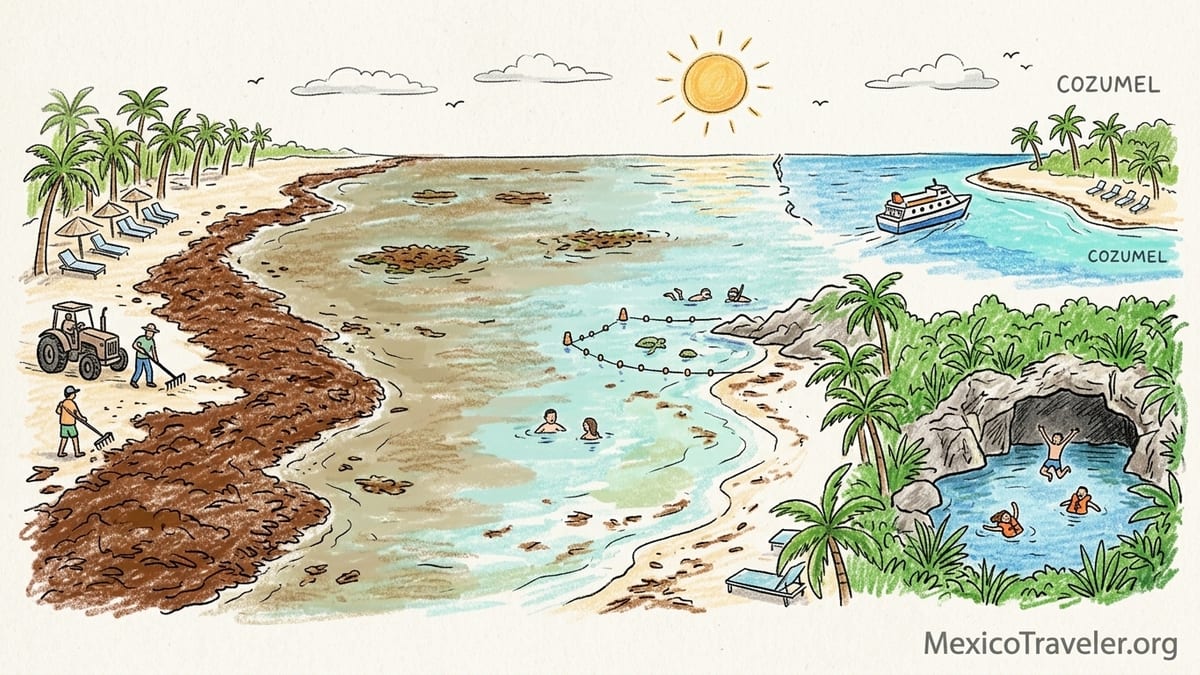
My 2026 Riviera Maya Trip and When the Sargassum Hit
I visited the Riviera Maya from 8 to 16 June 2026, flying into Cancún and staying in three areas along the coast: central Playa del Carmen, Playacar and Akumal. Those dates fell squarely inside the 2026 sargassum season, which local hoteliers told me had started earlier and more intensely than in previous years. Mexican media in late March 2026 were already reporting that authorities expected a stronger season, with Playa del Carmen and Tulum among the hardest hit stretches of coast.
Before traveling, I had checked satellite-based tools that show sargassum rafts approaching the Caribbean, as well as daily beach condition maps produced from local monitoring. In the week before my trip, these maps consistently showed “high” to “extreme” sargassum for central Playa del Carmen, with slightly better scores for Playacar and fluctuating conditions for Akumal. That gave me a general warning, but did not fully prepare me for how different each specific beach would look and smell from one day to the next.
On arrival, the reality was immediately visible from the airport shuttle as we drove south past stretches of brown-tinged water. By the time I checked into my first hotel on the north end of Playa del Carmen, a fresh overnight arrival had left a dark, uneven band of seaweed along the entire visible shoreline. The water, which looks postcard-blue in winter, was a cloudy greenish brown in the first few meters, clearing only slightly farther offshore.
Playa del Carmen vs Playacar: Same Town, Very Different Beaches
My first three nights were in central Playa del Carmen, a small hotel near Calle 38. Over those days, the public beach in front of Mamitas and along to the ferry pier at Parque Fundadores was heavily affected. Early each morning around 6:30 a.m., municipal crews and hotel staff were already at work with rakes, wheelbarrows and occasionally tractors. They managed to clear walking paths and create cleaner patches in front of beach clubs, but by midday fresh strands were washing in, forming a floating line about one to two meters wide in the shallows.
The odor was noticeable but not unbearable on most days. At its worst, in the late afternoon of 9 June after a hot, still day, the decomposing sargassum released a sulfur-like smell strong enough that several people abandoned their loungers and moved back toward the bars and restaurants. Swimming comfort was clearly affected. I waded in up to my waist and had to push through a soft, stringy mat of seaweed on the surface, with pieces brushing against my arms and legs. Visibility in the first meter of water was very poor, and only a handful of people attempted to swim beyond the brown band into clearer water.
Two days later, I moved just ten minutes south by taxi into the gated hotel zone of Playacar. Although it sits practically next door to Playa del Carmen, the beach experience was not the same. The bay in Playacar is slightly more sheltered and has a long, gently curving strand with fewer public access points. The morning of 12 June, there was still a ribbon of sargassum along the shoreline, but hotel crews had already raked it into low piles away from the waterline. The sea itself was much more swimmable: a narrow band of seaweed at the entry, then relatively clear, pale-turquoise water underfoot.
Here, the odor was weaker and mostly noticeable only where piles of older, darker sargassum sat waiting to be collected by tractors. My hotel’s sunbeds near the dune line were usable all day, and I comfortably swam several times without feeling like I was wading through soup. This contrast, between a difficult beach day in central Playa del Carmen and a reasonably pleasant one in Playacar on almost the same dates, was my first clear lesson: you cannot generalize “Riviera Maya is full of sargassum” from one or two crowded beaches.
Akumal: Turtles, Brown Surf and a Narrow Clear Window
For the final part of the trip, I changed hotels again and moved about 40 minutes further south to a small property north of Akumal Bay, staying from 13 to 16 June. Online reports in early June had shown Akumal swinging between “moderate” and “high” sargassum levels. When I arrived, the bay had a visible accumulation of seaweed in the shallows, especially close to the rocky points at either end, but there were still green-turquoise patches where snorkel tours were operating.
On the morning of 14 June, a fresh breeze from the east pushed more sargassum into the bay. Hotel staff set up a floating barrier, a line of buoys intended to catch some of the seaweed before it hit the beach. It helped to keep the inner swimming zone somewhat clearer, but plenty of strands still slipped through and accumulated in knee-deep water. Swimming comfort here depended heavily on personal tolerance. I joined a guided turtle-watching snorkel that day. Beyond the barrier, the water was cloudy and full of suspended particles, and we spent the first ten minutes finning through a soft layer of sargassum fragments. Once we reached slightly deeper water over the sea grass beds, visibility improved just enough to spot turtles, but it was far from the crystal clarity shown in older marketing photos.
Interestingly, the following morning brought a short-lived clear window. Overnight, the wind had shifted slightly and the bay looked significantly better: only a thin brown line at the water’s edge, clearer waist-deep water and almost no smell. By midafternoon, however, fresh arrivals had begun to collect again along the eastern side. That 12-hour gap between forecasts and on-the-sand reality showed me that even within a single bay, daily conditions can oscillate more quickly than any weekly prediction suggests.
Photos, Smells and How Hotels Communicated Conditions
In central Playa del Carmen, my photos from 9 and 10 June show a wide band of dark brown sargassum along the tide line, piles up to knee height in some sections and tractors carving narrow clean paths to the water. In close-up shots, the individual fronds and air bladders of the seaweed are clearly visible, mixed with bits of plastic debris scooped up accidentally. The water itself appears opaque and brownish in the first few meters, with only scattered gaps of blue between floating clumps.
In Playacar, photos two days later show a less dramatic scene: a lighter, uneven strip of seaweed along the sand and clearer water beyond. You can still see patches of sargassum in the shallows, but sunlight penetrates enough to reveal white sand underneath. Photos taken facing downwind also show hotel staff actively raking and loading seaweed into small trucks. The smell is not something the lens can capture, but my notes mention a faint, compost-like odor near the tractor piles and almost no smell at regular sunbed distance.
Hotel communication about conditions varied. The small independent hotel in central Playa del Carmen did not mention sargassum in its pre-arrival emails, although their booking engine included winter photos that did not reflect what I found in June. When I asked the front desk on arrival, the receptionist described the situation as “some seaweed, but they clean every morning,” which I felt understated both the visual impact and the effect on water clarity. In Playacar, by contrast, the resort had a short note on its website FAQ acknowledging that sargassum “may be present between roughly April and September” and that “daily cleaning operations are in place.” At check-in, the staff member candidly added, “This week central Playa is worse than us, but we still have some.”
My Akumal hotel was the most transparent. Their pre-stay email included a brief update on current sea conditions, explaining that “moderate sargassum is present in the bay” and that they were using barriers and manual raking. On site, a small board at the towel hut showed that day’s sea condition with colored magnets for waves, jellyfish and sargassum. That simple, visual system made it much easier to understand what to expect before walking down to the sand.
Forecast Maps vs Shoreline Reality: Why Wind and Currents Matter
During the trip, I checked several monitoring tools each morning over hotel Wi-Fi. One mobile-friendly map compiled daily beach reports for Quintana Roo, labeling individual beaches as “none,” “low,” “moderate,” “high” or “extreme” based on photos, webcams and field observations. Another, operated by Mexican scientific agencies, showed broader satellite-detected sargassum belts moving through the northwestern Caribbean and included a 10-day drift forecast based on winds and currents.
These tools were invaluable for macro-planning. For example, in the days before I moved from Playa del Carmen to Akumal, the daily map consistently showed central Playa del Carmen in the “high” or “extreme” category while Akumal oscillated between “moderate” and “high.” That helped confirm my decision to shift south and set expectations that Akumal would not be sargassum-free, just somewhat less affected overall.
On the shoreline, however, conditions still surprised me. On 11 June, the daily map rated Playacar as “moderate,” which was broadly correct, yet in front of my specific hotel section the amount of seaweed felt closer to “low” because the overnight wind had pushed much of the floating mat slightly down the beach toward another property. Similarly, in Akumal, the satellite forecast did not fully capture the short clear window I experienced on the morning of 15 June. Local currents inside the bay, shaped by the reef and the headlands, temporarily swept the seaweed toward one corner, leaving another section inviting for swimmers.
Wind direction was the single biggest factor I noticed. When the trade winds blew steadily from the east and southeast, fresh sargassum lines built up on exposed mainland beaches, especially those directly facing open water such as central Playa del Carmen and Tulum. After a brief shift in wind direction associated with a passing disturbance, there were hours when the influx slowed or a portion of the beach temporarily cleared. Local guides and lifeguards repeatedly stressed that this is why you cannot assume that “the whole Riviera Maya is bad” or, equally, that any one cove will stay clear all week.
Sargassum vs Official Bathing Water Quality: Two Different Issues
One point of confusion I heard from several travelers around the hotel pools was the idea that “if there is seaweed, the water must be unsafe.” In Mexico, bathing-water quality is monitored separately from sargassum arrival. The national health authority coordinates regular sampling of seawater at popular beaches before peak holiday seasons such as Easter and summer. The main indicator they publish is related to microbial contamination, chiefly enterococci bacteria, and beaches are classified as suitable or not suitable for recreational use based on these measurements.
Sargassum does not automatically mean that the water fails those tests. While decomposing seaweed can contribute to localized changes in water chemistry and can trap debris, the presence or absence of brown algae on the sand is not itself the parameter the laboratories measure. It is entirely possible to have a beach where thick sargassum lines the shore, making swimming unpleasant, while the official microbial readings still rate the water as within acceptable limits.
Conversely, a beach may look visually inviting but fail a bacteriological test after heavy rain or sewage issues. Local environmental certifications and “clean beach” standards in Mexico tend to consider broader criteria, including litter management and infrastructure, alongside water quality test results. None of those programs currently label a beach as unsafe solely because of floating sargassum, though authorities sometimes close small sectors temporarily to remove large accumulations with machinery.
During my June stay, I did not encounter any official closures due to water quality in Playa del Carmen, Playacar or Akumal. Lifeguard flags flew green or yellow primarily based on surf conditions, not seaweed. This distinction matters for trip planning: sargassum is mainly an aesthetic and comfort issue for most visitors, especially those without respiratory sensitivities, whereas bathing-water alerts relate to health risk and are issued through separate channels.
Escaping the Brown Surf: Cozumel and Cenotes as Real Alternatives
Confronted with a murky shoreline in central Playa del Carmen, I tested two popular escape strategies during the trip: a day trip to Cozumel and a swim in a nearby cenote. Neither option is a permanent guarantee against sargassum, but both improved individual days of my holiday significantly.
On 10 June, with Playa del Carmen’s main beach heavily covered and the air noticeably odorous by late morning, I walked to the ferry terminal and took the boat across to Cozumel. The crossing itself passes floating patches of seaweed in the channel, a reminder that the entire region is affected, but once on the island I took a taxi to a beach club on the western shore. There, the geography made an immediate difference. Cozumel sits offshore from the mainland, and many west-facing beaches are sheltered from the prevailing east and southeast trade winds. On that day, the beach where I swam had only a narrow line of sargassum at the water’s edge and almost none in the first several meters of water.
The water was not perfectly clear, as some fine particles still hung in the shallows, but visibility was good enough for comfortable snorkeling over the sand and small patches of sea grass. Importantly, there was no strong odor. Local staff mentioned that earlier in the year, during a strong cold front in February, unusual wind patterns had pushed sargassum onto parts of Cozumel’s western malecon, and the municipal government had deployed crews to clear it, but they stressed that such events are exceptions rather than the norm. Under typical summer trade-wind conditions, they said, the brunt of the seaweed lands on Cozumel’s uninhabited eastern coast, leaving the main tourist beaches on the west comparatively spared.
Two days later, from Akumal, I chose a different escape: a freshwater cenote about 20 minutes inland along the highway. These sinkhole pools connect to the Yucatán Peninsula’s underground aquifer rather than the open sea, which means pelagic sargassum does not wash into them. On a hot, sticky afternoon after a morning of swimming through brownish surf, dropping into a clear, cool cenote with no smell at all felt transformative. Of course, cenotes come with their own considerations, such as entry fees, required life jackets at some sites and the need to shower off sunscreen to protect the delicate ecosystem, but in sargassum-heavy weeks they are an excellent way to salvage a day.
Did changing locations “fix” the trip? Not entirely. I still spent several mornings on beaches that looked nothing like the brochures. However, by being willing to move between mainland resorts and add a Cozumel or cenote day, I turned a potentially disappointing beach vacation into a more varied coastal and inland experience, with acceptable swimming on most days.
Seasonal Planning, Monitoring Tools and What to Ask Before You Book
Looking back, the single biggest thing I would change for a future Riviera Maya visit is timing. Historical patterns and local reports suggest that significant sargassum arrivals along this coast have become common between roughly April and September, with peaks often falling between late spring and mid-summer. That window can expand or contract from year to year, and 2026 was noted locally for an earlier and stronger start. Still, the quieter months for seaweed tend to be in the late autumn and winter, when currents and winds shift and the Atlantic sargassum belt is less intense.
If my priority were long, carefree ocean swims and postcard-clear water, I would now lean toward dates between late November and February, accepting slightly cooler evenings and higher prices around Christmas and New Year. If my schedule only allowed travel in late spring or summer, I would build more flexibility into my plans: stay in a hotel with a large pool, budget for at least one or two cenote visits, and consider a Cozumel day or even a split stay that includes time on the island’s west side.
Before booking any beachfront property, I would also make a point of checking live monitoring resources rather than relying on old marketing photos. Satellite-based systems run by Mexican agencies show where large sargassum masses are in the wider Caribbean and provide 10-day drift forecasts, while beach-level maps compiled from local reports and webcams indicate which specific shores are currently affected. These are not perfect predictive tools, but if they show a solid week of “high” or “extreme” ratings at your chosen beach right before your travel dates, it is worth at least asking the hotel how they are handling it.
When contacting hotels, useful concrete questions include: “What has your beach looked like this week?” “Do you have daily cleaning and at what time?” “Do you use barriers or nets in the water?” “If the beach is not swimmable, what alternative swimming options do guests usually choose?” Pay attention to how specific the answers are. A candid description such as “We have had moderate sargassum this month, but our crew cleans every morning and the water is clear beyond a short band at the entry” is far more helpful than a vague reassurance that “it is natural and not a problem.” I would also look for properties that acknowledge the issue openly in their FAQs or pre-arrival emails rather than ignoring it.
The Takeaway: Should You Avoid Riviera Maya During Sargassum Season?
After a week in June 2026 spent between Playa del Carmen, Playacar, Akumal, Cozumel and an inland cenote, my honest answer is nuanced. If your dream holiday is entirely about Caribbean-blue water and long ocean swims every single day, and your dates are flexible, then yes, it makes sense to avoid the heart of sargassum season on the exposed mainland beaches. A winter or early spring trip will give you a much better chance of finding the Riviera Maya that appears on postcards, especially around central Playa del Carmen and Tulum.
If, however, your travel window falls squarely between April and September and you still want to go, I do not think you need to write off the Riviera Maya entirely. You do need to adjust expectations and plan actively. Choose your exact beach carefully, understanding that Playacar might look very different from the public beaches a short walk away in downtown Playa. Consider splitting your stay between the mainland and Cozumel’s west coast to diversify your chances of clear water. Budget time and money for cenotes and inland activities so that a brown morning surf does not feel like a wasted day.
Most importantly, use the same tools locals now rely on. Watch the satellite alerts and daily beach-condition maps in the weeks and days before your trip. Ask direct questions of your chosen hotel and be ready to change beaches if necessary, even if that means a short taxi ride down the coast. Sargassum has become a regular part of the Caribbean seascape rather than a one-off anomaly, and no destination along this coast can promise permanent freedom from it, including Cozumel.
My own June holiday did not deliver the flawless beach week I had pictured, but it also did not become a write-off. I discovered that a “sargassum season” trip can still be rewarding if you think in terms of a broader coastal region rather than a single resort shoreline. Clear-water days at a sheltered Playacar stretch, an unexpectedly beautiful afternoon on Cozumel’s west side and tranquil swims in a shaded cenote more than compensated for the brown surf in central Playa del Carmen. With that in mind, I would not avoid the Riviera Maya altogether in sargassum season, but I would never again book it blindly without checking the maps and building flexibility into my plans.
FAQ
Q1. When is sargassum season in the Riviera Maya?
There is no fixed official season, but in recent years significant arrivals have often occurred between about April and September, with peaks frequently in late spring and mid-summer. The exact timing and intensity vary from year to year, which is why checking current monitoring tools and recent traveler photos is more useful than relying on averages.
Q2. Which beaches did you personally find most affected on your June 2026 trip?
On my 8 to 16 June 2026 visit, central Playa del Carmen’s public beaches near Mamitas and Parque Fundadores were the most heavily affected, with thick shorelines of sargassum and murky shallows on several days. Akumal Bay saw moderate to heavy arrivals that changed with wind and currents, while Playacar, just south of Playa, generally had less accumulation and clearer swimming water, though still with a visible band of seaweed along the shore.
Q3. Was Cozumel really better than the mainland during your stay?
On the day I visited Cozumel in mid-June 2026, the west-side beach I chose had far less sargassum than Playa del Carmen that same morning. There was only a narrow line at the water’s edge and almost none in the first few meters of water, with no strong odor. Local staff explained that the island’s west coast is usually sheltered from the prevailing trade winds that push sargassum onto the mainland and Cozumel’s exposed east coast. However, they also mentioned rare exceptions during strong cold fronts or unusual wind events.
Q4. How accurate were the sargassum forecast maps for your trip?
The maps were good at showing general trends, such as central Playa del Carmen being harder hit than Playacar or Akumal in that first half of June. They were less precise at predicting hour-by-hour changes on specific stretches of beach. For example, Akumal briefly cleared one morning despite a “high” rating in recent days, and within a few hours new patches had drifted in. I found the forecasts most useful for comparing areas and planning day trips, not for assuming a guaranteed clear beach at a specific hour.
Q5. Does sargassum mean the water is unsafe to swim in?
Not necessarily. In Mexico, bathing-water quality is assessed through microbiological tests that look at bacteria levels, mainly enterococci, and beaches are classified as suitable or not based on those results. Sargassum is not itself the parameter tested in those programs. Thick accumulations can be unpleasant, reduce visibility and sometimes irritate skin or airways in sensitive people, especially near decaying piles, but a beach can have seaweed and still meet official health standards. Conversely, a visually clear beach might temporarily fail a microbial test after heavy rain or sewage issues.
Q6. What should I ask a hotel before booking a summer stay on the Riviera Maya?
Ask very specific, current questions. For example: “What has your beach looked like this week?” “Do you have daily beach cleaning, and at what times?” “Do you use sargassum barriers in the water?” “If there is heavy seaweed, what alternative swimming or sunbathing areas do guests typically use?” You can also ask them to share a photo taken in the last few days. The level of detail and honesty in their answers is often a good indicator of how seriously they manage the issue.
Q7. Are some Riviera Maya beaches always free of sargassum?
No beach along this coast can honestly claim to be permanently free of sargassum. Some locations are less exposed because of geography, such as more sheltered coves or Cozumel’s west side, but unusual wind patterns or storms can still deliver seaweed even there. The safer assumption is that conditions are dynamic and that you should check recent reports and be prepared to change beaches or activities if needed.
Q8. Is it worth changing hotels mid-trip to escape sargassum?
In my case, changing hotels from central Playa del Carmen to Playacar, and later to Akumal, improved my access to swimmable water on several days. The moves did not eliminate sargassum entirely but reduced its impact. Whether it is worth it for you depends on your budget and tolerance for packing and unpacking. For shorter stays, booking a day trip to a relatively clearer beach, Cozumel or a cenote can be a simpler workaround than moving all your luggage.
Q9. Besides the beach, what activities worked well during heavy sargassum days?
Freshwater cenotes were the standout alternative on my trip, since they are fed by underground aquifers rather than the sea and are not affected by pelagic sargassum. I also found that exploring towns, visiting Mayan sites inland, and enjoying resort pools turned “bad beach days” into enjoyable vacation days. Building those options into your plan before you arrive makes it much easier to adapt when the ocean looks uninviting.
Q10. Overall, would you return to the Riviera Maya in sargassum season?
Yes, but with different expectations and planning. I would not go in peak sargassum months if my only goal was postcard-perfect ocean swimming every day. However, if I wanted a mix of culture, cenotes, food and some beach time, I would return in late spring or summer, choose my exact location more carefully, use live monitoring tools, and stay flexible with day trips. My June 2026 experience showed that a sargassum-season holiday can still be worthwhile if you treat the Riviera Maya as a whole region of options rather than banking on a single perfect beach.