


The Riviera Maya is only about 130 kilometers of Caribbean coastline, but choosing the wrong base can quietly reshape your entire holiday. Staying in central Playa del Carmen feels like a walkable city break by the sea. A week in a gated resort near Maroma or Mayakoba becomes a self-contained luxury retreat. Nights in Tulum’s beach zone are all about design hotels, beach clubs and high prices, while Akumal or Puerto Morelos tilt your trip toward reef snorkeling and quieter evenings. Before you commit to nonrefundable hotel rates, it is worth understanding what each area is actually like in 2026, how you will move around, and what that means for your budget and daily rhythm.
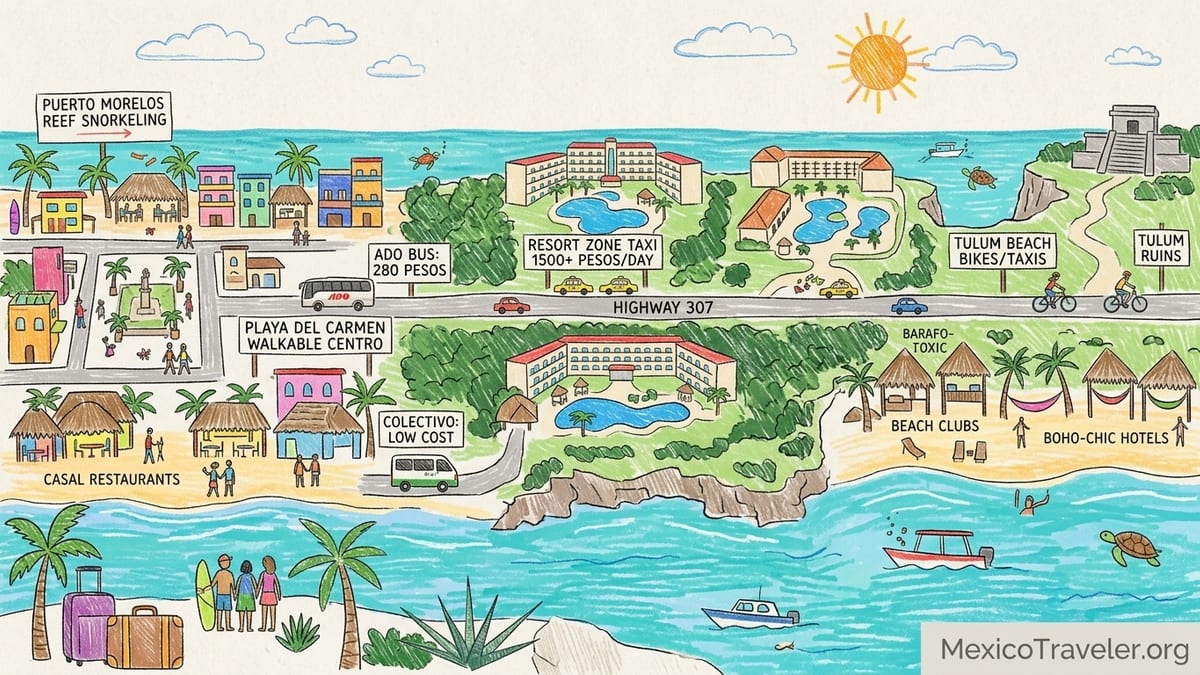
Riviera Maya Layout, Logistics and Costs in 2026
The Riviera Maya officially begins around Puerto Morelos, roughly 30 to 35 kilometers south of Cancún, and runs along Highway 307 past Playa del Carmen, Puerto Aventuras, Xpu-Há, Akumal and down to Tulum. It is a linear corridor, not a single town, and that matters because your base can sit either in a real community or in an isolated resort zone where every restaurant and bar is inside a hotel complex. Driving time from Cancún International Airport to Playa del Carmen is usually about one hour, while Tulum is closer to two hours by road, although a newer airport near Tulum shortens that leg for some travelers.
The main cost trap in 2026 is not just nightly rates but transportation. A prebooked private transfer from Cancún Airport to Playa del Carmen typically runs around 1,200 to 1,800 Mexican pesos per vehicle each way, depending on company and vehicle size. An ADO intercity bus ticket on the same route costs roughly 260 to 280 pesos per person one way and takes about one to one hour fifty, depending on stops. Local taxis between neighborhoods inside Playa del Carmen are commonly in the 50 to 150 peso range, but long coastal hops, such as Playa del Carmen to Tulum or Tulum beach to the ruins, can quickly climb into the hundreds of pesos each direction.
Those transport numbers explain why a cheaper hotel in a distant zone can become more expensive than a central stay once you add in taxis to restaurants, cenotes and excursion pickup points. A couple staying in a lower priced Tulum beach hotel might spend an extra 1,000 to 1,500 pesos every day just moving between beach clubs, town restaurants and tour meeting points. Over a week, that can erase the saving from a modest room rate. By contrast, a slightly higher nightly rate in walkable Playa del Carmen Centro or Puerto Morelos can reduce or eliminate daily taxi use because dining, bars and basic services cluster within a compact area.
When you compare areas, it helps to look beyond marketing language. Each zone has a different profile in walkability, beachfront access, reef snorkeling, nightlife, highway access and resort style. The decision comes down to what you want at your door and how often you are willing to sit in a vehicle. The sections below walk through each major area with concrete examples so you can picture what daily life will actually feel like once you are unpacked.
Puerto Morelos: Reef Town Close to the Airport
Puerto Morelos is the first real stop as you leave Cancún heading south, a small fishing town with a central square, pier and low rise beachfront rather than a high rise strip. It sits beside a protected section of the Mesoamerican Barrier Reef, and boats take snorkelers out to shallow coral gardens where depths are often just a few meters. That proximity means Puerto Morelos works particularly well for travelers who want to snorkel without daylong tours. Local operators run half day reef trips priced to remain competitive in 2026, and the short boat ride keeps more of your time in the water rather than in transit.
Walkability in Puerto Morelos is strong within the seaside zone. The main square, beachfront restaurants, small supermarkets and many guesthouses and boutique hotels fall within an easy stroll. Beachfront all inclusive resorts also line the coast north and south of town, but some of those properties sit several kilometers away from the main square. For instance, staying in a self contained resort north of town often means you will treat Puerto Morelos more as a half day outing by taxi than as a place you walk into for dinner. Travelers who prioritize local dining and an evening paseo tend to choose smaller hotels or rentals near the central plaza.
Accommodation prices here in 2026 usually undercut high profile areas further south. Simple hotels and guesthouses in town can start in the range of roughly 70 to 120 US dollars per night, depending on season, while beachfront all inclusives nearby can range from about 220 dollars upward, with well known brands charging more. Food and drink in town is often a bit cheaper than equivalent options in the Cancún Hotel Zone or Tulum beach, partly because Puerto Morelos still serves local residents as much as visitors.
Being only about 20 minutes from the airport makes Puerto Morelos a convenient base for short trips and for visitors who dislike long transfers. It is also on the main highway and increasingly connected to regional rail, which simplifies day trips south to parks or cenotes. The trade off is that nightlife is low key. Evenings center on casual bars, live music some nights and long dinners rather than clubs or rooftop lounges. For many couples or families, that is the attraction, but travelers wanting to walk between multiple late night venues may prefer Playa del Carmen.
Playa del Carmen Centro and Playacar: Walkable Hub of the Riviera Maya
Playa del Carmen is the Riviera Maya’s urban heart, a real city of several hundred thousand residents with infrastructure, services and a wide range of accommodation. The central grid around Quinta Avenida, or Fifth Avenue, holds blocks of restaurants, bars, small hotels and shops, with beach clubs and public sand just a few minutes’ walk away. For visitors who like to stroll out of the hotel and choose dinner by feel, this is the most practical base in the region, and its central location makes day trips north to Cancún or south to Tulum manageable.
Mid range hotel rooms in central Playa del Carmen typically sit somewhere around 90 to 160 US dollars per night in 2026, with simpler guesthouses and hostels below that and boutique or branded properties above. Rooftop pools, small urban spas and co working spaces are now common amenities. Dining costs in town vary widely, from inexpensive taco stands and fondas to tasting menu restaurants and international chains along Quinta. That mix gives independent travelers and longer stay guests more control over their daily spending than in resort corridors where choices are limited.
Playacar, a gated community immediately south of downtown, collects many of the area’s all inclusives and villa style accommodations along a calmer, wider stretch of beach. It is technically part of Playa del Carmen, and many properties sit within a 10 to 25 minute walk or a short taxi ride of Quinta Avenida. Staying in Playacar can feel like a compromise between resort seclusion and city access. Guests at a beach resort here can still head into town for dinner or nightlife without planning full half day excursions, and excursion operators treat Playacar as part of Playa del Carmen for pickup logistics.
Transport from Playa del Carmen to regional attractions is straightforward. Shared vans known as colectivos run down Highway 307 toward Tulum, stopping near major cenotes and towns, at prices that remain low compared with taxis. ADO buses serve archaeological sites and cities farther inland. For visitors booking several excursions to parks like Xcaret or Xel-Há, or to ruins such as Tulum or Cobá, starting from Playa del Carmen often means shorter pickup routes compared with Cancún or the far south of Tulum. That convenience, plus walkability, is why Playa del Carmen consistently appears at or near the top of recommendations for first time visitors.
Mayakoba and Maroma: High End Resort Enclaves
North of Playa del Carmen, two names recur in luxury discussions: Mayakoba and Maroma. Mayakoba is a master planned enclave of high end resorts threaded by mangrove canals and golf fairways, with brands known for wellness, design and fine dining. Maroma, slightly farther north, fronts one of the region’s celebrated beaches, where soft white sand meets usually calm turquoise water. Both zones feature gated entries, extensive grounds and a resort bubble feeling, by design.
Nightly rates in these enclaves usually start well above mainstream Riviera Maya averages. It is common to see base room categories in the range of 500 US dollars per night and upward in high season, with suites, private pools and villa style accommodations pushing into four figures. Those rates often include higher levels of service, spa facilities and curated on site experiences. For travelers planning to spend most waking hours on property enjoying restaurants, spas, golf and the beach, the value can make sense. The hidden cost appears when guests expect easy off property dining or nightlife. A taxi ride from a resort near Maroma into Playa del Carmen for dinner and back can cost enough that many guests decide to remain within the resort orbit.
Walkability within each complex is usually limited to landscaped paths and internal transport such as golf carts or bicycles, not to neighboring towns. There is typically no strolling out to a casual taco stand or corner café. Snorkeling from shore is possible in some pockets, but many resorts emphasize pool and beach relaxation over active reef access, and organized boat trips to nearby reefs or cenotes are the norm.
From a logistics perspective, these enclaves sit between Cancún and Playa del Carmen, which keeps airport transfer times moderate and makes northbound or southbound excursions feasible. However, guests without rental cars will rely on hotel transport desks or prebooked transfers for most movements beyond the gate. That can add hundreds of dollars to a weeklong stay if you plan multiple off site dinners and tours. Travelers who are mainly seeking a contained luxury retreat are rarely bothered by this, but independent travelers and food focused visitors may feel constrained after a few days.
Puerto Aventuras, Xpu-Há and Akumal: Bays, Marinas and Beach Days
Continuing south past Playa del Carmen, Puerto Aventuras, Xpu-Há and Akumal offer a different rhythm. Puerto Aventuras is a gated marina community with condos, villas, a small commercial center and a golf course. It functions as a quiet residential style enclave where many visitors rent apartments or stay in smaller hotels around the marina and nearby beach. Reviews and local guides describe it as a good fit for travelers who want a low key week of swimming, boating and golf without the crowds and nightlife of Playa del Carmen. The trade off is that dining options within the community are limited compared with a city, and most evenings revolve around a handful of restaurants and bars by the water.
Xpu-Há, just south of Puerto Aventuras, is known for a broad natural beach with several beach clubs and small lodging options tucked into the vegetation. The area remains less developed than town beaches farther north, which appeals to day trippers and laid back visitors. Some accommodations here are rustic cabanas or small hotels set back from the sand. Beach quality is often high, although like the rest of the coast, it can be affected by seasonal sargassum seaweed. Walkability is limited to the immediate beach area; for supermarkets, pharmacies or a variety of restaurants, you will need a vehicle or taxi ride to a larger town.
Akumal, farther south again, curves around bays that are closely associated with sea turtles and sheltered snorkeling. Akumal Bay has been under federal environmental regulations for several years, with rules such as life vest requirements, designated swim zones and limitations on how tours interact with turtles. That framework has helped preserve the attraction but also means that do it yourself snorkeling is more controlled than in the past. Accommodation in and around Akumal ranges from simple guesthouses in the small town area to mid and upper range hotels and villas along the bays.
These three zones are popular bases for visitors who value beach time and in water activities over urban buzz. Families with children often appreciate the calmer water inside bays and the smaller scale of local centers where everything closes earlier. However, staying here without a rental car can feel restrictive, especially for travelers who want to explore multiple cenotes, dine in both Playa del Carmen and Tulum, or visit ruins on different days. Each taxi or private shuttle into larger hubs adds to the effective cost of what might otherwise be an affordable rental or hotel.
Tulum Pueblo and Tulum Beach Zone: Split Personality Destination
Tulum looks close on the map, but its layout surprises many first time visitors. There are effectively two separate zones. Tulum Pueblo, or downtown, sits several kilometers inland along Highway 307, with grid streets, hostels, small hotels, local restaurants and services. The Tulum beach zone, sometimes called the hotel zone, is a long, narrow coastal road lined with boutique hotels, design focused beach clubs and a few larger resorts. There is no practical way to walk between the two unless you are willing to cover several kilometers in hot, humid conditions along a road that is not pedestrian friendly at night.
Costs differ sharply between these zones. Budget and mid range rooms in Tulum Pueblo can be found in the approximate range of 40 to 100 US dollars per night, with more upscale hotels and apartments charging more. In contrast, beachfront or near beach hotels along the Tulum beach road often start around 180 to 400 dollars per night and rise steeply for suites or properties with strong branding and design reputations. On top of room rates, many beach zone venues operate with high price points for food, drinks and beach club access, especially on popular stretches that double as party destinations.
Transportation is the piece many travelers underestimate. Moving between Tulum Pueblo, the beach zone, the ruins and cenotes involves repeated taxi rides or rented bicycles. Cycling is viable in the daytime for some visitors, but the beach road is narrow and unlit in sections, and traffic and dust increase after dark. Taxis between town and the beach can cost enough that a couple shuttling twice daily may spend more than 1,000 pesos on transport in a single day. Over several days, that additional spend can make an inland budget hotel feel far less affordable in practice.
No other Riviera Maya zone matches Tulum beach for concentration of boho chic design hotels and Instagram ready venues. Nightlife here revolves around beach clubs, jungle venues and curated DJ nights rather than mainstream clubs. For travelers whose priority is that specific atmosphere and who accept higher costs and transportation quirks, the beach zone delivers. For others, particularly those booking multiple excursions or traveling with young children, the combination of long transfer times, scattered services and price levels can become tiring over a week.
Cancún as a Nearby Alternative, Not the Same Destination
Because flights usually land in Cancún, many visitors automatically search there first. It is important to recognize that the Cancún Hotel Zone is not part of the Riviera Maya. It is an island like strip shaped by high rise beachfront resorts, malls and wide multilane roads, more akin to a dedicated resort city than to the lower rise, town based rhythm farther south. City buses and taxis move guests up and down the strip, and walking distances between clusters of restaurants or clubs can be long, although sidewalks are present and well lit.
Room rates in the Cancún Hotel Zone in 2026 often run from around 120 to 250 US dollars per night for midrange hotels, with budget options available in downtown Cancún away from the beach and higher prices for luxury properties. Dining costs skew higher in the Hotel Zone than in working Mexican towns, reflecting rent levels and a heavier focus on foreign visitors. For travelers whose priorities are large pools, brand name resorts, quick airport transfers and nightlife centered on clubs and bars, Cancún is a strong candidate base, particularly for short trips of three to four nights.
Where Cancún falls behind the Riviera Maya is distance to many eco parks, cenotes and archaeological sites. Day tours to the Tulum ruins, Cobá or even Riviera Maya parks such as Xcaret involve significant road time. Many tour operators still pick up in the Hotel Zone, but guests often note the long drives in reviews. In contrast, bases like Playa del Carmen or Akumal shorten access to many of the same attractions and spread road time more evenly across the week.
If your main interest is urban comforts with a Caribbean beach and you plan only one or two major day trips, Cancún can compete well. If your dream trip centers on cenote hopping, reef snorkeling in multiple zones, or visiting various small beach towns, you are generally better off choosing a base somewhere along the Riviera Maya corridor instead of commuting south repeatedly from Cancún.
How Distance, Excursions and Trip Length Shape the Best Base
One of the most practical ways to choose a base is to count how many excursions and restaurant districts you realistically plan to include. A traveler flying in for a three night long weekend who mostly wants a nice beach, one snorkel trip and one dinner out can happily stay in a slightly more remote resort area like Mayakoba, Maroma or Puerto Aventuras. The limited number of off site outings keeps taxi and transfer costs manageable, and the resort setting will feel pleasantly self contained.
For a weeklong holiday with several plans off property, such as visiting at least one park like Xcaret or Xel-Há, touring one or two archaeological sites and dining in different towns, a central base reduces friction. Playa del Carmen Centro or Playacar, and to a lesser extent Puerto Morelos or Akumal, put you closer to the middle of the action. Transfers to tours are shorter, pickup windows are narrower, and on some evenings you can simply walk to dinner rather than arranging a vehicle. Over seven nights, those advantages translate into more relaxed days and often a lower overall budget.
Travelers planning multiple early morning excursions should also consider highway access. Properties right on or very near Highway 307 make it easier for tour buses and private drivers to reach you. This is a subtle reason why some resorts in secluded bays involve longer, more complicated pickups. Guests there may be advised to meet at highway entrances, or they may be among the first picked up and last dropped off, which stretches an already long day. In contrast, compact town centers concentrate guests, so tour operators can plan efficient routes.
Distance to restaurants shapes daily life as much as distance to attractions. A beachfront property that sits 20 to 40 minutes by taxi from the nearest town center effectively locks you into on site dining most nights unless you are willing to commit time and money to each outing. Over the course of a week, that pattern can lead to a feeling of repetition and a higher food budget. This is where cheaper nightly rates can mislead. A couple paying 50 dollars less per night than an in town option but spending 40 dollars round trip on taxis every evening plus extra for resort priced drinks may spend more overall than if they had booked a central, slightly pricier hotel.
Decision Guide: Which Area Fits Which Traveler Type
Putting these factors together, a simple decision table emerges. For first time visitors who want a mix of beach, dining variety and easy excursions, Playa del Carmen Centro is often the most forgiving base, with Playacar as a good option for those who prefer resort environments while keeping the city accessible. Puerto Morelos also works well for first timers who care most about a relaxed, small town feel and convenient airport access, especially if nightlife is not a priority.
Families tend to favor Playacar, Puerto Aventuras, Akumal and some resorts near Mayakoba or Maroma, where gated layouts, calmer waters and kid friendly facilities are common. Being a short taxi ride from town in Playacar can be especially useful for families who want a quiet beach by day but easy access to shops and medical services in Playa del Carmen when needed. Akumal’s sheltered bays and focus on snorkeling also appeal to families with water confident children, as long as they are comfortable with modest local infrastructure.
Luxury focused vacations gravitate toward Mayakoba, Maroma and higher end properties scattered near Akumal or in the Tulum beach zone. Couples seeking romance but not necessarily the Tulum party scene often pick Puerto Morelos, Akumal or select adults only resorts near Playa del Carmen or in Playacar. Independent travelers and digital nomads usually feel most at home in Playa del Carmen Centro or Tulum Pueblo, where more affordable apartments, co working spaces and local dining keep long stays manageable.
For beach quality and travelers without rental cars, the answer splits. Some of the best feeling sand and water combinations in recent years have been reported around Xpu-Há, Akumal and Maroma, although sargassum varies by season and wind patterns. Without a car, however, basing in very quiet stretches like Xpu-Há can be inconvenient. In practice, many car free visitors choose central Playa del Carmen, Puerto Morelos or Tulum Pueblo, then visit standout beaches by taxi, colectivo or organized tour. That approach balances walkability, cost control and access to multiple shorelines instead of tying the trip to a single bay.
FAQ
Q1. Is Playa del Carmen or Puerto Morelos better for a first trip to the Riviera Maya?
For a first trip, Playa del Carmen works better if you want lots of restaurants, nightlife and easy access to tours without using taxis every day, while Puerto Morelos suits travelers who prefer a quiet town, reef snorkeling and short airport transfers over urban energy.
Q2. How far in practice is Tulum’s beach zone from Tulum Pueblo?
In real terms, most hotels in Tulum Pueblo sit around four kilometers or more inland from the beach road, which usually means a 10 to 20 minute taxi or bike ride one way, so you should assume you will not be walking casually between town and the beach several times a day.
Q3. Do I need a rental car if I stay in Mayakoba, Maroma or Xpu-Há?
You do not strictly need a rental car because resorts and some small hotels can arrange transfers and taxis, but without your own vehicle you will rely heavily on paid transport for dinners, shopping and day trips, which increases the overall cost of the stay.
Q4. Which area has the best nightlife in the Riviera Maya?
Playa del Carmen has the most concentrated nightlife, with bars, rooftop lounges and clubs in and around Quinta Avenida and Calle 12, while Tulum’s beach zone offers more scattered, high priced beach clubs and jungle parties rather than walkable streets of venues.
Q5. Where should families with young children stay?
Families with younger children often do well in Playacar, Puerto Aventuras or Akumal, where beaches are calmer, many properties are gated and quiet at night, and you are still close enough to reach parks and cenotes without overly long drives.
Q6. Is Cancún part of the Riviera Maya and should I treat it as the same choice?
Cancún is a separate destination north of the Riviera Maya, with a high rise Hotel Zone on a narrow strip; it shares the same airport but feels more like a resort city than the lower rise towns to the south, so you should consider it a different style of base rather than another stop on the same corridor.
Q7. How much should I budget for taxis if I stay in Tulum’s beach area?
Exact fares vary, but couples moving between the beach zone, Tulum Pueblo and nearby attractions most days often find that taxis add the equivalent of tens of US dollars per day to the trip, enough to noticeably affect a weekly budget.
Q8. Which base is best if I am booking several all day excursions?
If you expect to join multiple full day tours to parks and ruins, a central base such as Playa del Carmen or nearby Playacar minimizes time spent in pickups and drop offs, since most operators run route networks that radiate out from the middle of the corridor.
Q9. Are cheaper inland hotels really a good deal once transport is included?
Cheaper inland hotels in places like Tulum Pueblo or the outer parts of Playa del Carmen can save money on nightly rates, but if you then rely on taxis to reach the beach, restaurants and meeting points every day, those savings can shrink or disappear compared with a more central or beachfront stay.
Q10. What is the best area for travelers without a car who want strong beach access?
For car free travelers, central Playa del Carmen, Puerto Morelos and Akumal combine decent beach access with enough local dining and services to walk to most things, while making it reasonably easy to reach other beaches by colectivo, taxi or organized tours when you want variety.