


Deciding between Playa del Carmen and Tulum is not a theoretical exercise if you are about to click “book now” on a hotel. I recently did what many travelers consider and few actually test: I split my trip, sleeping several nights in both Playa del Carmen and Tulum in comparable midrange hotels, tracking what I really spent on rooms, meals, taxis, beach days and nights out. This is a firsthand report on what worked, what disappointed me and, crucially, which place I would personally book again for different types of trips.
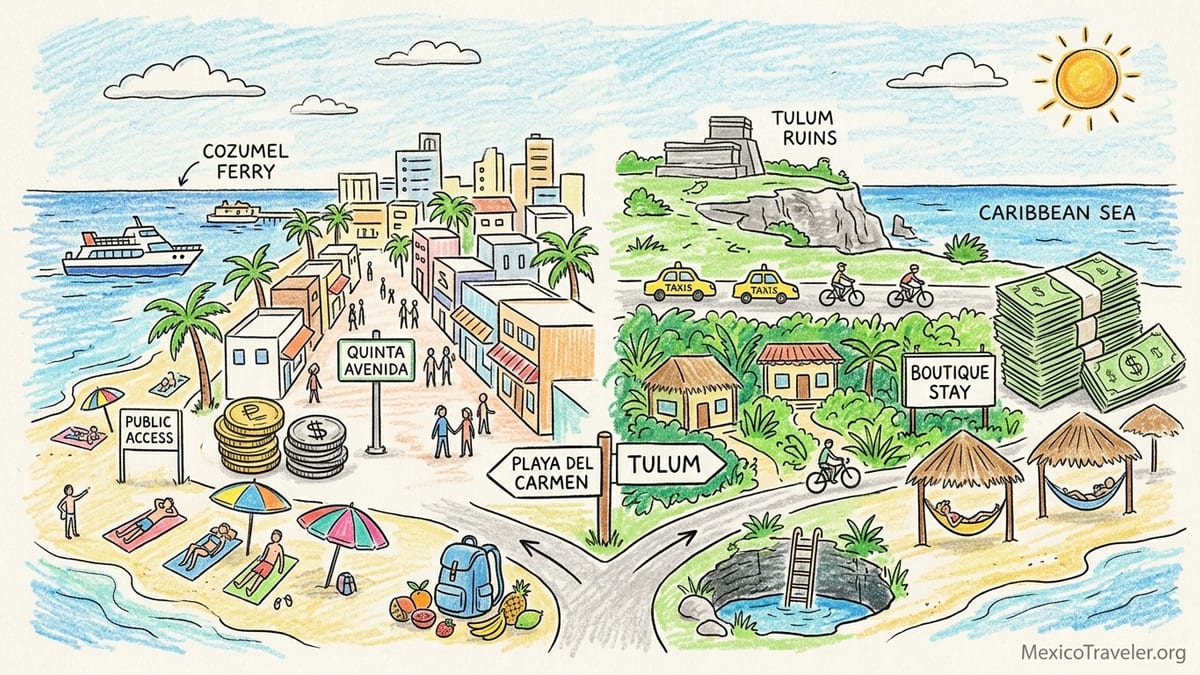
How I Structured My Stay And What I Actually Spent
I based this comparison on real overnights, not day trips. In Playa del Carmen, I stayed near Quinta Avenida (Fifth Avenue) in a modern 3.5 to 4 star hotel with a small rooftop pool, similar to the downtown average that recent hotel data pegs at around 120 to 160 US dollars per night for this category in 2026, depending on dates and demand. In Tulum, I booked a boutique-style property of comparable standard, one stay in the center and one closer to the beach road, where similar hotels commonly range from about 160 to 250 US dollars per night or more. That gap in rates already hints at how costs diverge when you move south.
For a fair comparison, I tracked three and seven night scenarios that many travelers consider. For Playa del Carmen, a realistic three night stay in a solid midrange hotel near Fifth Avenue comes in around 360 to 480 US dollars before tax, while a similar category hotel in Tulum usually starts closer to 500 to 700 US dollars for three nights, rising quickly if you want to be directly on or very close to the beach. Over a full week, the difference became more obvious: Playa del Carmen at roughly 840 to 1,120 US dollars versus Tulum easily running 1,200 to 1,800 US dollars for comparable comfort, especially on popular dates.
Those accommodation figures are only half the story. I also tracked daily spending on food, local transport, beach access and entertainment. In Playa del Carmen my average daily non-hotel spending landed near 60 to 90 US dollars without trying to be especially frugal, thanks to affordable local eateries and walkable distances. In Tulum, the same level of comfort and activities typically pushed me closer to 90 to 140 US dollars per day because of higher restaurant prices and near constant taxi use between the town, beach zone and attractions.
These are not absolute rules. Prices in the Riviera Maya move with season, exchange rates and events, and your own habits matter. But structuring the trip this way made it very clear that Playa del Carmen favors those who want to control their budget without sacrificing location, while Tulum rewards travelers willing to pay more for atmosphere, design and a softer, more dispersed setting.
Playa del Carmen On The Ground: Fifth Avenue, Beaches And Ferries
Playa del Carmen’s strongest advantage during my stay was how compact everyday life felt. Fifth Avenue, a pedestrian strip that runs parallel to the sea for several kilometers, became my anchor. My hotel was a short walk from the northern section near the Cozumel ferry terminal, and from the lobby I could be browsing shops, ordering tacos or buying a coffee within five minutes. This kind of density is rare in the region and it meant I barely needed taxis inside town.
Hotel prices reflected that central convenience. Browsing current rates before booking, I consistently found 3 to 4 star hotels in the downtown zone clustered around 120 to 160 US dollars per night, with basic but well reviewed options dipping under 100 US dollars and beachfront or resort style properties north of town rising higher. Once checked in, I could walk to public beach access points near the Constituyentes pier or slightly north where smaller beach bars offered loungers if I bought a drink. Sargassum seaweed did affect the water on one of my beach days, reminding me that neither Playa del Carmen nor Tulum is guaranteed perfect Caribbean turquoise every single day, but swimming was comfortable on my other visits with gentle waves and a family friendly shoreline.
The Cozumel connection is a major plus for Playa del Carmen. Ferries depart from the Maritime Terminal at the southern end of Fifth Avenue, with companies such as Ultramar and others currently posting standard tourist fares around 320 Mexican pesos one way for adults in their regular class, with frequent sailings from morning into the evening. That translated into roughly 18 to 20 US dollars per person each way at recent exchange rates. Buying tickets and boarding was straightforward enough that a same day Cozumel snorkeling or diving trip felt almost like an urban commute rather than a full excursion mission.
What disappointed me in Playa del Carmen was the sheer commercial intensity of parts of Fifth Avenue. Between roughly Calle 4 and Calle 20, aggressive souvenir shops, loud bars and clubs, and touts pushing tours or timeshares gave some blocks a slightly exhausting edge by late evening. Traffic on the parallel Avenida 10 and 15 also created constant background noise, especially on weekends. If you are a light sleeper, corners close to nightclubs can stay noisy deep into the night, something I would now factor into any future booking by double checking a hotel’s exact cross streets and recent reviews that mention noise.
Tulum’s Boutique Appeal, Ruins And Cenotes, At A Price
Arriving in Tulum after a few nights in Playa del Carmen felt like stepping into another version of the Riviera Maya. Instead of a dense grid and a single pedestrian artery, Tulum is split between Tulum Pueblo (the town), the long beach road and several residential pockets like Aldea Zama. My first stay was in a design focused guesthouse near the town center, a property that fit the common Tulum aesthetic of concrete, wood and lots of jungle landscaping. Nightly rates here often started around 150 to 200 US dollars in 2026 for a double room with air conditioning and a small plunge pool or shared rooftop.
The reason many people pay Tulum’s higher accommodation prices became obvious quickly. Mornings at my town hotel were quiet, with bicycles passing slowly and birds drowning out most traffic noise. A 15 minute taxi or bike ride took me to the Tulum archaeological site, perched on a bluff above the sea. The ruins charge a modest national park entry fee and the coastal views from the clifftop paths were some of the most atmospheric I experienced anywhere on the trip, especially early in the day before larger tours arrived.
Cenotes were another highlight. From Tulum, short taxi or bike rides brought me to freshwater sinkholes such as Gran Cenote or cenotes along the road toward Coba. Entry fees varied, often landing somewhere in the range of 15 to 30 US dollars per person once converted from pesos, with extra charges for activities such as zip lines or life jacket rental. Compared to Playa del Carmen, where accessing cenotes almost always required a longer outing or organized tour, Tulum made independent cenote hopping much easier if you were comfortable arranging your own transport.
The famous Tulum beach club scene, however, came with real trade offs. When I moved to a boutique hotel off the beach road, my nightly rate jumped toward the 250 US dollar level for a space that was beautifully styled but still not directly on the sand. Beach access usually meant choosing a beach club that either charged a cover, a minimum consumption, or both, often equivalent to 40 to 80 US dollars per person for loungers, towels and a credit toward food and drinks. For couples, it was easy to spend well over 150 US dollars on a relaxed beach day when you added a few cocktails and lunch. On top of that, taxis between town, Aldea Zama, beach clubs and cenotes regularly cost more than any ride I took within Playa del Carmen, and late night returns from the beach road were where I saw the sharpest quotes.
Real World Transport: Walking, Taxis, Colectivos And Traffic
For a car free traveler, the difference between Playa del Carmen and Tulum felt stark. In Playa del Carmen, I walked almost everywhere. My hotel’s location near Fifth Avenue meant I could reach restaurants, the beach, small supermarkets, laundry services and even some nightlife within a 10 to 15 minute radius on foot. When I did need wheels, such as coming from the intercity bus station or catching an early morning transfer, taxis hailed from official stands within town generally cost the equivalent of 3 to 7 US dollars for short hops, agreed in pesos before getting in.
Travel between Playa del Carmen and outlying attractions was also manageable without private cars. Shared vans known as colectivos run along Highway 307 between Playa del Carmen and Tulum, stopping at points like Xcaret, Akumal and various cenote turnoffs. Fares are low compared to taxis, often just a few US dollars or less for medium distances, and while the vehicles are basic, they are popular with local workers and budget travelers. For a day trip down to Tulum or up to Cancun, the ADO bus network from Playa del Carmen’s downtown terminals provided air conditioned coaches with assigned seats at prices that felt reasonable for one to two hour journeys.
In Tulum, the lack of similar centralization shaped my daily choices. Distances between my hotel in town and the beach were too far to walk comfortably, especially in the heat, and bicycle rides on busy roads required attention and confidence in traffic. Without a rental car, taxis quickly became non optional, particularly at night. During my stay, quotes for rides between town or Aldea Zama and popular beach clubs or restaurants along the beach road often fell in the range of 15 to 25 US dollars equivalent each way, and late night prices spiked higher according to several other travelers I spoke with and recent online reports. That meant a simple evening out for dinner and drinks by the water could quietly add 30 to 50 US dollars in transport alone.
One area where Playa del Carmen also held a clear advantage was access to the broader Riviera Maya and beyond. The Cozumel ferry terminal sits right at the end of Fifth Avenue, with standard tourist one way fares around 320 pesos on major operators and frequent departures through the day, making it easy to slot an island visit into a flexible itinerary. From Tulum, reaching Cozumel involves backtracking an hour north to Playa del Carmen before even boarding the ferry, which adds cost and time. Likewise, excursions to theme parks near Playa del Carmen, such as eco parks or adventure parks, logically base from Playa, whereas visitors staying in Tulum either face longer transfer times or pay more for private pickups.
Food, Nightlife And Everyday Costs In Each Destination
On the food front, Playa del Carmen offered both highs and lows. Around Fifth Avenue, polished restaurants priced for international visitors served tacos, ceviches and international dishes, with main courses often in the 10 to 20 US dollar range. A cocktail or imported beer could easily add another 8 to 12 US dollars to the bill. However, just a few blocks inland toward Avenida 30, I found local taquerias and fondas where a plate of tacos al pastor or a simple set lunch cost more like 3 to 7 US dollars, and bottled beers were only modestly more. This ability to drop my per meal cost dramatically by walking ten minutes away from the tourist core helped keep my overall Playa del Carmen budget in check.
Tulum’s food scene felt more curated and frequently more expensive. Many of the trendiest restaurants in the beach zone offered outstanding ambiance, creative menus and candlelit settings, but main dishes here commonly ran between 18 and 30 US dollars or more, with tasting menus or signature grills priced higher. Cocktails designed for Instagram, often infused with local fruits and herbs, rarely dipped under 12 to 16 US dollars after service, meaning a couple could spend a substantial amount on a single dinner even before factoring in taxis to and from town. In Tulum Pueblo proper, I did find more modest taco stands, tortillerias and small restaurants with prices somewhat closer to those in Playa del Carmen’s inland streets, but the crowd that gravitates to Tulum often chooses venues where design and concept carry a premium.
Nightlife in Playa del Carmen centers on the blocks around Calle 10, 12 and 14 near the beach, where open air clubs pump music that spills onto the street until the early hours. Cover charges varied, from free entry with the expectation of buying drinks, to modest covers on busier nights. For me, this density of nightlife was both a pro and a con. It was incredibly easy to sample multiple bars in one night and walk home, yet the thrum of music meant that friends who stayed closer to those club streets sometimes struggled with bass vibration in their rooms even after midnight.
Tulum nightlife, especially along the beach road, was more about curated events than mass clubbing. Beach clubs hosted DJ nights, full moon parties or special events, often with ticketed entry or minimum spends. The scene tilted older and more bohemian, with many visitors willing to invest in one or two big nights out rather than bar hop every evening. Personally, I enjoyed one late night at a beach venue where the sound system and setting were excellent, but the combined cost of tickets, drinks and taxi rides made it something I would plan as a splurge rather than a casual outing. Back in Tulum town, evenings were calmer, with a mix of mezcalerias, smaller bars and casual restaurants that wrapped up earlier.
Beaches, Crowds And What Disappointed Me In Both Places
Beach expectations often drive the Playa del Carmen versus Tulum decision, and actually swimming in both helped correct some assumptions. In Playa del Carmen, sections of the beach near the central ferry pier were busy and showed signs of erosion, with narrower strips of sand in some areas. North of the main pier the beach widened slightly, and I had several pleasant swims with a mostly sandy bottom and small waves. However, during one visit the shoreline saw a noticeable arrival of sargassum seaweed, a seasonal and weather dependent issue that can affect much of the Caribbean coast. Cleanup crews worked to clear access points, but it was a reminder that beach conditions are changeable and that Playa del Carmen’s central beaches are very much urban, with piers, boats and constant activity.
Tulum’s beaches, when in good condition, lived up more to the postcard image. The sand felt softer and whiter, and the water near the main beach club strip looked a shade clearer on the calm days I experienced there. Swimming was easy when the sea was gentle, and the lack of large piers or ferries directly offshore kept the views more natural. Yet Tulum was not immune to sargassum either. One afternoon, lines of seaweed washed onto the shore, and several beach clubs focused more on clearing narrow paths to the water than creating pristine wide open stretches. The larger disappointment for me in Tulum was not the beach quality itself, but how increasingly complicated and expensive it could be to simply enjoy it for a few hours.
In Playa del Carmen, despite commercialization, public access to the beach is free and straightforward in multiple spots, and you can bring your own towel and sit near the water without anyone asking you to meet a spending minimum. Beach clubs exist, but they sit alongside open public sections. In Tulum, much of the beachfront directly behind the main access road is controlled by hotels and beach clubs. While there are public access points and stretches of open sand, reaching them without a bike or car sometimes involved walking along narrow, busy roads and negotiating with security staff who were not always eager to direct non guests through. I did find public paths, but it took more pre trip research and willingness to walk.
The crowd dynamics also produced mixed feelings. Playa del Carmen felt overtly touristy in the central core. If your idea of a beach vacation excludes souvenir chains, brand name shops and club promoters, Fifth Avenue might quickly grate on you. At the same time, that mainstream atmosphere meant a broader mix of travelers: families, backpackers, digital nomads and Mexican vacationers all sharing the same streets. Tulum attracted a more curated crowd. Wellness oriented visitors, design lovers and influencers were abundant, especially on the beach strip, and there was sometimes an air of performance in how people dressed and moved around. Neither mix is inherently better, but you should be honest with yourself about which social setting you find more comfortable.
Three Versus Seven Nights: Breaking Down Total Trip Costs
Looking back over my receipts and bookings, the financial picture for three and seven night stays was clear enough that I can outline realistic ballpark totals for two people traveling together, keeping accommodation and day to day spending separate. All figures here assume midrange choices rather than ultra budget hostels or luxury villas.
In Playa del Carmen, a three night stay for two in a centrally located 3.5 to 4 star hotel near Fifth Avenue at current rates typically meant 360 to 480 US dollars in room costs. Over those same three nights, two people eating most meals in a mix of midrange and local restaurants, having some drinks, buying ferry tickets for one Cozumel day trip, and taking a handful of taxis might reasonably spend another 300 to 450 US dollars, depending on how many organized tours they added. That put a realistic three night Playa del Carmen total in the ballpark of 660 to 930 US dollars for two, not counting flights.
Stretching that Playa del Carmen stay to seven nights in the same category of accommodation would increase the room budget to roughly 840 to 1,120 US dollars. Daily spending tends to flatten slightly over longer stays as you learn cheaper spots and do not book paid excursions every day, so a reasonable estimate for two people’s food, local transport, a couple of tours and nightlife over a week might fall in the 600 to 900 US dollar range. Total one week costs for a couple could therefore sit around 1,440 to 2,020 US dollars, with room to go higher if you favor upscale dining and frequent excursions.
In Tulum, three nights in a stylish boutique hotel in town will often start around 500 to 700 US dollars for a double room in 2026, rising further for properties along the beach road, where comparable comfort usually pushes room costs toward 750 to 1,000 US dollars or more for three nights. Non hotel spending for two over three nights, factoring in higher restaurant prices, at least one cenote visit, taxi heavy logistics and perhaps a paid beach club day, could realistically range from 360 to 600 US dollars. That puts a three night Tulum stay for a couple at approximately 860 to 1,600 US dollars, with beach focused stays sitting toward the upper end of that range.
For seven nights in Tulum, the gap widens further. A week in a comfortable boutique hotel in town might cost around 1,200 to 1,600 US dollars, while a week in an equivalent level property near the beach could easily reach 1,800 to well over 2,400 US dollars depending on season. Add 700 to 1,100 US dollars in daily local spending for two over that week, and you are looking at approximately 1,900 to 3,500 US dollars for a couple’s seven night Tulum stay. Neither destination is inherently cheap anymore, but Tulum consistently required a thicker wallet to maintain a similar level of comfort and activity.
My Verdict: Romantic Trips, Families, Car Free Vacations And Excursion Weeks
After living both places for several nights, would I stay again in Playa del Carmen, Tulum, or split my time? The answer depends heavily on the type of trip. For a romantic escape where atmosphere and setting matter more than strict budgeting, I would choose Tulum again, ideally booking a small, characterful hotel either in a quieter part of the beach zone or a leafy street in Aldea Zama with a private plunge pool. The combination of design, softer lighting at night, the ruins at sunrise or early morning, and the ease of reaching cenotes created a more intimate feel than Playa’s busy grid. I would simply go in prepared to pay more for taxis and consider renting bikes for daytime movement.
For a family holiday, especially with younger children, Playa del Carmen is my repeat pick. The ability to walk from a centrally located hotel to child friendly restaurants, ice cream shops, playgrounds, pharmacies and the beach without hiring a taxi every time reduced friction dramatically. Cozumel day trips for snorkeling, easy access to theme parks up and down the coast, and the option to duck back to the hotel quickly if kids got tired all counted in Playa’s favor. I would avoid staying directly on the loudest stretches of Fifth Avenue with children, choosing instead a spot a few blocks inland or toward the quieter northern or southern ends.
If I were planning a car free vacation again, Playa del Carmen would win almost every time. It simply works better on foot. Between the grid layout, frequent colectivos and intercity buses, I never felt trapped. Tulum can be navigated without a car, but doing so demanded a steady stream of taxi negotiations, schedule awareness, and a higher transport budget. Travelers who are comfortable cycling and staying mostly in town rather than on the beach might mitigate this, but I did not find Tulum’s infrastructure as forgiving for those who prefer to walk everywhere.
For a strict budget stay, especially for solo travelers or long term visitors, Playa del Carmen again edges ahead. Not only are accommodation options broader, from hostels to local guesthouses, but it is also easier to eat cheaply by exploring neighborhoods a few blocks away from the main strip. Tulum still offers hostels and budget rooms, particularly in town, yet the rising baseline for food, taxis and beach access makes truly low cost days harder to maintain unless you are very disciplined and willing to skip many of the settings that made Tulum famous in the first place.
The one scenario where Tulum becomes my first choice is an excursion heavy week centered on ruins and cenotes with a strong nature and culture focus. While Playa del Carmen connects well to major parks and Cozumel, Tulum sits closer to inland archaeological sites like Coba and to a concentration of cenotes that can be explored by independent travelers with a rental car or well organized tours. If my priority for a week was to be in the water of different cenotes every day and visit multiple ruins, I would base myself in Tulum town, accept the cost of a few long taxi rides or a rental car, and perhaps add a final night in Playa del Carmen to simplify departure logistics.
The Takeaway
Staying several nights in both Playa del Carmen and Tulum confirmed that neither destination is objectively better. Each rewards a different kind of traveler, budget and trip style. Playa del Carmen is an energetic, highly walkable hub with direct ferry access to Cozumel, strong public transport connections along the Riviera Maya and a deep range of accommodation and dining options. Its downsides are the crowded, commercial feel of Fifth Avenue and the potential for noise if you stay too close to the club district.
Tulum delivers a more diffused, boutique experience, with memorable archaeological ruins on the sea cliffs, easy access to cenotes and a design forward accommodation scene. In exchange, you accept higher prices for hotels, food and especially transport, along with a beach access system that often funnels you toward paid beach clubs rather than truly open public sand. Understanding these trade offs before you book is crucial.
If you are still on the fence, my honest recommendation for many first time visitors who can spare at least seven nights is to split the stay. Start with three or four nights in Playa del Carmen to enjoy the convenience, excursion options and urban energy, then move to Tulum for another three or four nights focused on ruins, cenotes and slower days. That way you can personally test which atmosphere speaks to you more. On my next trip, I will likely repeat that pattern, but with a slightly longer share for Playa del Carmen if I am watching my budget, and for Tulum if the goal is a special occasion getaway where I am willing to spend more for setting.
FAQ
Q1. Is Playa del Carmen or Tulum cheaper overall for a one week stay?
For comparable midrange hotels and similar activity levels, Playa del Carmen is usually noticeably cheaper, both in nightly room rates and in daily costs for food and local transport.
Q2. Which destination is better if I will not rent a car?
Playa del Carmen is better for car free travel because you can walk almost everywhere in town and rely on colectivos and buses for day trips, while Tulum requires far more taxis.
Q3. Where are the beaches better, in Playa del Carmen or Tulum?
Tulum’s beaches often feel wider and more natural, but both places can experience seaweed and changing conditions, so neither guarantees perfect swimming every day.
Q4. How much should I budget per day for food and small expenses?
In Playa del Carmen, many travelers are comfortable on 30 to 60 US dollars per person per day for meals and small purchases; in Tulum, 40 to 80 US dollars is more realistic.
Q5. Is it easy to take the ferry to Cozumel from both Playa del Carmen and Tulum?
From Playa del Carmen it is very easy, with ferries leaving from the maritime terminal at the end of Fifth Avenue, while from Tulum you must first travel about an hour north to Playa.
Q6. Which place is better for nightlife?
Playa del Carmen has denser, club oriented nightlife that is easy to bar hop on foot, while Tulum focuses more on specific beach events and curated parties that are pricier and taxi dependent.
Q7. Where should I stay for a romantic trip?
For a romantic escape with an emphasis on design hotels, soft lighting and cenotes, Tulum is my pick, as long as you are comfortable with higher prices and taxi logistics.
Q8. Is it worth splitting my stay between Playa del Carmen and Tulum?
Yes, if you have at least a week, starting in Playa for convenience and excursions and finishing in Tulum for ruins and cenotes gives you the best of both worlds.
Q9. Which destination works better for families with children?
Playa del Carmen usually works better for families because it offers shorter walking distances to services, easier beach access and simpler logistics for day trips.
Q10. Can I visit Tulum as a day trip from Playa del Carmen instead of staying there?
You can, using buses or tours, and many travelers do, but staying at least one or two nights in Tulum lets you experience the ruins and cenotes at calmer times of day.