

I love colonial Mexico most in the hours when day-trippers leave and the cities revert to their local rhythm: cathedral bells marking time, plazas filling with families, and that last espresso turning into a mezcal because you realize you can simply walk home. But “walk home” is the whole game in these historic centers. A block can mean the difference between an effortless stroll and a suitcase-hauling workout up steep stone lanes, or between sleeping through the night and waking at 7 a.m. to bells and fireworks.
On a multi-city trip through central Mexico, I changed bases repeatedly and learned that the best place to stay is not always the most famous square. Some cities reward paying extra to be right in the historic core. Others are easier, quieter, and honestly more practical a little farther out, especially if you are driving, arriving by bus, or moving on every couple of days.
This is a base-selection guide first. I’m not ranking individual hotels yet. Instead, I’m comparing the areas I actually stayed in or used as my on-the-ground base around the historic centers of San Miguel de Allende, Guanajuato, Querétaro, Morelia, and Puebla. I’m focusing on the details that decide whether you’ll love your stay: the real walk to the main plaza, hills and stairs with luggage, church bells and late-night noise, what food options exist after dark, how easy it is to get a taxi, what parking is really like, and how painless it is to leave for the next city.
How I Choose a Base in Colonial Mexico (Before I Pick a Hotel)
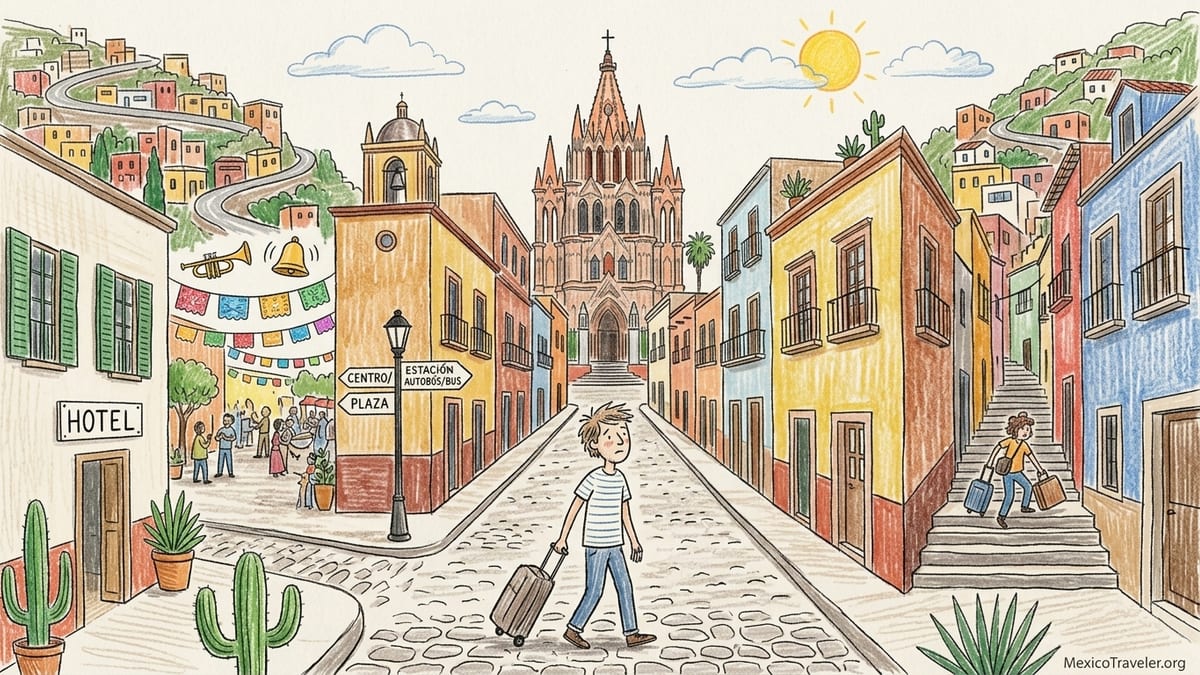
My rule is simple: on a short first visit, I pay for convenience. That usually means being within a 5 to 12 minute walk of the main plaza, because I want to pop out for coffee, museums, and dinner without planning my life around rideshares. On repeat visits, or on trips where I’m moving every other day, I start prioritizing logistics: a flatter walk with luggage, a place where a car can actually reach the door, and a fast exit route to the highway or the bus station.
In the colonial cities, distance can be deceptive. A stay that looks “close” on a map can involve steps, cobblestones, and steep grades that turn a 700-meter walk into a 20-minute haul with suitcases. That matters if you’re arriving by bus and walking from a taxi drop-off, or if your hotel’s valet parks your car off-site and you keep thinking, “I’ll just grab something from the trunk.”
I also learned to ask a few practical questions up front: Does the property have on-site parking, valet, or a partner garage, and how far away is it? In some centers, valet means your car will be parked well outside the historic zone, sometimes about a 15 minute drive away in San Miguel’s center, so you should treat your car like it’s in storage and travel with a day bag you can live out of.
Finally, I stop pretending I’m immune to noise. Plaza-side hotels can be magical and exhausting at the same time. Church bells are part of the romance, but they are also real. Weekends amplify everything: live music, rooftop bars, wedding fireworks, and late-night foot traffic. If I’m staying Friday and Saturday, I either choose thick walls and a courtyard room, or I choose a slightly quieter street just outside the most obvious square.
San Miguel de Allende: Why Centro Still Wins (And Where I’d Shift Next Time)
For a first trip, I’d still base myself in Zona Centro, ideally within a few blocks of the Jardín Principal and the Parroquia. This is the city where staying central changes your experience the most. San Miguel’s best evenings are the easiest kind: a long dinner, a last drink, then a safe-feeling stroll back through lit streets. When I stayed close enough to walk home, I used the city more. When I stayed farther out on another visit, I found myself negotiating rides and timing, and I went out less often than I intended.
The trade-off is price and noise, and both are very real right now. Recent accommodation research continues to point to Centro as the most convenient base for first-timers, but also the most expensive and the loudest, particularly around weekends and festivals when bells, fireworks, and plaza activity ramp up. I felt that firsthand on a weekend: street sound lingered late, and mornings started early. If you are sensitive to noise, the most important move is not abandoning Centro entirely, but choosing a side street rather than a directly plaza-facing room.
Luggage and parking are the other Centro realities. In the densest part of San Miguel, many boutique properties are in historic buildings with narrow streets and limited vehicle access. Some hotels include valet, but the car may be stored off-site, which changes how you pack and plan. One Centro property I researched plainly notes that its valet parking requires assistance and that the parking is about 15 minutes away from the hotel, which matches the pattern I ran into when asking around: you drop bags, then your car disappears for the duration.
Where would I stay next time if I wanted calmer nights and a better driving setup? I’d look just outside Centro rather than abandoning the core. Neighborhoods like San Antonio, Guadiana, and Guadalupe can still be walkable to the Jardín with fewer late-night spikes, and they’re often friendlier to arrivals, pickups, and quick exits. I would still plan my days around walking, but I’d be less likely to get the “weekend plaza soundtrack” directly under my windows.
Guanajuato Centro Histórico: Worth It for Walking, Brutal for Cars
Guanajuato’s Centro Histórico is the most dramatic base of the group, and for me it was the one that felt most “built for walking.” The heart of the center is effectively a pedestrian-first zone stitched together by plazas and stone alleys: Jardín de la Unión near Teatro Juárez, then down toward Plaza de la Paz and the Basílica. When I stayed in the center, my evenings were effortless: dinner near the Jardín, a slow walk past lit façades, and a return through narrow callejones that felt like the city’s whole point.
But you pay for that magic in muscle and logistics. Guanajuato is vertical, with stairs, slopes, and sudden drops that can be charming until you’re rolling luggage. If your accommodation is anywhere above the main pedestrian spine, assume you’ll be climbing. Even famous sights like the Callejón del Beso sit up in the tangle of lanes, and while they’re not far as the crow flies, the approach can be steep and stair-heavy.
If you are driving, Centro becomes a different kind of trip. Current local guidance is blunt: do not count on street parking in the historic center, because there is almost none, and the road network relies heavily on tunnels and one-way lanes. That matched my experience: navigating to a drop-off felt like threading a needle, and after that, the car became something I wanted to ignore. My best day in Guanajuato was the day I parked and didn’t touch the car again until I left.
Would I stay in Centro again? Yes, but only if I’m not planning to use the car daily. For a short stay focused on walking, museums, and evenings in the plazas, Centro is worth the premium. If I were driving with multiple bags, traveling with kids, or arriving late and wanting simplicity, I’d stay slightly outside the tightest core and use taxis to pop in, because the “last 500 meters” inside Guanajuato can be the hardest part.
Querétaro Centro: The Most Practical Historic Center Base
Querétaro is where I felt the least punished for choosing the historic center. Centro here is lively and beautiful, but it’s also comparatively navigable: streets are wider, the grid is clearer, and arriving with luggage is easier than in Guanajuato or San Miguel. When I stayed near the Plaza de Armas area, the walk to the main sights was straightforward, and I didn’t have to mentally budget for a steep return climb at the end of the night.
Parking is still a consideration, but it’s more solvable. The city and local reporting have emphasized public parking options in the Centro Histórico, including tools meant to help drivers find available spaces. In practice, that tracks with what I saw: you can treat Centro as a place where you can reasonably park in a garage and then walk, rather than a place where your car becomes a burden. It also helps that the historic center has major hotels that explicitly address parking and access, which is often not the case in the smaller, heritage-boutique properties in tighter colonial cores.
Querétaro also wins on onward travel. If you’re moving city-to-city by bus, the center works because you can be in the middle of the action without feeling stranded from transport. Several Centro hotels market the bus terminal as a manageable taxi ride, and in the real world that matters more than it sounds: an early departure feels calmer when you’re not fighting center closures or dealing with a complicated pickup point.
Where would I stay next time? Still Centro, especially on a short visit. Querétaro is one of the few cities where paying the “historic core premium” feels like you’re buying convenience without inheriting as many downsides. I’d still choose a room away from a bar-heavy street if I’m visiting on a weekend, but overall Centro is an easy yes here.
Morelia Centro: Plaza-Perfect Nights, Surprisingly Good Value
Morelia was my favorite “sleep right on the plaza” experience. The Centro Histórico is grand and stately, and the cathedral zone feels like it was designed for lingering. When I stayed right by Plaza de Armas with the cathedral essentially as my landmark, I could do the classic Morelia routine: coffee in the morning, a museum or two in the afternoon, then an evening stroll back through the center when the stone glows under streetlights.
Noise is the one caution. A plaza-facing location is beautiful, but it can also be loud, and traveler feedback for properties directly on the square often flags sound. My own takeaway is to aim for the same location but request an interior-facing room if possible, especially if you’re there on Friday or Saturday. Morelia can host big civil and religious events in the central squares, and you’ll hear them if you’re right on the action.
Logistically, Morelia is a solid base for moving onward by bus. The city’s main bus terminal has formal taxi service inside the station, which makes arrivals and departures simpler than in places where you’re negotiating on the curb. I used taxis easily, and I liked not having to guess where to meet a ride when I had luggage and a schedule.
Would I stay in Centro again? Yes, and I’d do it confidently. Morelia gives you the historic-center payoff without the same level of steep terrain stress as Guanajuato. It also felt like one of the better values among the colonial centers: you can stay in the core, walk everywhere, and still keep your overall trip costs under control compared with the priciest parts of San Miguel.
Puebla Centro: Worth It for Food and Sights, But Pick Your Micro-Location
Puebla’s Centro Histórico is a huge, museum-rich grid, and staying central worked best for me when I wanted early mornings and late nights with minimal transit. The Zócalo area is the anchor: cathedral, portales, cafés, and the simple pleasure of stepping out and being in the middle of it. Puebla is also the city in this set where I most appreciated being able to wander to dinner without planning, because the food scene is the trip.
The practical advantage in Puebla is that the center is flatter and more car-friendly than the tightest colonial cores. Parking exists, including dedicated lots and garages in the center, and some mainstream hotels list straightforward, paid self-parking rather than complicated off-site arrangements. On a recent date check for a major Puebla Centro property, self parking was listed around MXN 100 per day, which is exactly the kind of predictable detail I want when I’m building a moving itinerary.
If you are arriving by bus, Puebla is also unusually manageable. The main CAPU terminal is a few kilometers from the Zócalo, which in practice means a short taxi ride rather than a long cross-city trek. That made Puebla feel easy for a one or two night stay between other cities, especially if you’re using buses rather than renting a car.
Where would I stay next time? Still in Centro, but I’d be more selective about the street. Puebla’s center can go quiet quickly once you’re off the most active corridors, and “quiet” can feel either peaceful or empty depending on the block. If I’m traveling solo or coming back late, I’d bias toward the more visibly active parts closer to the Zócalo and established restaurant streets, then use rides for anything farther out at night.
The Takeaway
If you’re planning a first-time colonial Mexico circuit, I’d spend the money for a central base in San Miguel de Allende and Guanajuato because the evenings are the reason you’re there. In San Miguel, Centro is still the most convenient base, but you need to accept the premium and the weekend soundtrack, then mitigate it with smarter street selection and realistic parking expectations. In Guanajuato, Centro is unmatched for walking, but I’d only do it if I’m ready to park once and live on foot.
Querétaro is the practical sweet spot: Centro gives you the classic architecture and plaza life with fewer penalties, and it is the place I’d happily base myself again without overthinking. Morelia is my pick for “plaza-perfect” sleep, as long as you choose a room that doesn’t amplify night noise. Puebla rewards Centro stays with food, museums, and easy logistics, but it is the city where micro-location matters most because blocks can change vibe fast.
If you are driving the whole route, I’d rethink the idea that every night must be inside the tightest historic core. In San Miguel and Guanajuato, a slightly edge-of-center stay can reduce stress dramatically without sacrificing the trip, especially if you are moving often. In Querétaro, Morelia, and Puebla, you can stay central and still keep your day-to-day logistics sane.
FAQ
Q1. Which colonial Mexico city is most worth staying directly in the historic center?
San Miguel de Allende and Guanajuato benefited the most from a central base because evenings are best on foot and the atmosphere peaks after day-trippers leave.
Q2. Where is the best first-trip base in San Miguel de Allende?
Zona Centro, within a short walk of the Jardín Principal, is still the most convenient first-trip base, but expect higher prices and more weekend noise.
Q3. Is Guanajuato Centro a good idea if I’m driving?
It can be, but only if you plan to park in a paid lot or hotel arrangement and leave the car parked. Street parking in the center is extremely limited.
Q4. Which city felt easiest with luggage and uneven streets?
Querétaro Centro felt the most straightforward for arrivals because the historic core is more navigable and less stair-heavy than the steepest colonial cities.
Q5. Where did church bells and plaza noise impact sleep the most?
San Miguel Centro and plaza-adjacent stays in Morelia can be loud. Choosing an interior room or a side street usually helps more than changing neighborhoods entirely.
Q6. Is Puebla Centro practical if I’m arriving by bus?
Yes. Puebla’s CAPU terminal is a short taxi ride from Centro, and the historic grid is flatter and easier to navigate than many hill towns.
Q7. How should I think about parking in San Miguel Centro?
Assume limited on-site parking. Some Centro hotels offer valet that may park your car off-site, so pack as if you will not access your vehicle daily.
Q8. Which city center is best for spontaneous dinners after dark?
San Miguel Centro and Guanajuato Centro are easiest for walk-home nights. Puebla Centro is great for food as well, but micro-location matters for late-night comfort.
Q9. If I want quieter nights, what’s the simplest adjustment?
Stay close to Centro but not directly on the main plaza. In most cities, one to three blocks off the core can significantly reduce late-night noise.
Q10. Which city was the best all-around base for a multi-city itinerary?
Querétaro Centro is the most balanced: walkable, comparatively easy for parking, and well-positioned for onward travel without the steep-street penalties.