

I’ve spent real time in both San Miguel de Allende and Guanajuato City, and even though they sit close enough to pair on the same Bajío trip, they don’t feel interchangeable once you’re on the ground. One is a polished, romance-forward small city where your day can revolve around courtyards, galleries, and long dinners. The other is a cinematic tangle of tunnels, stairways, and steep alleys that pulls you into late nights, student energy, and viewpoints that make you earn the shot. After visiting both, I don’t think there’s a single “winner.” I do think there’s a smarter first pick depending on what kind of trip you’re planning, and I can point to specific moments in each city that tipped my preference for certain travelers.
Arrival And First Impressions: How Each City Meets You
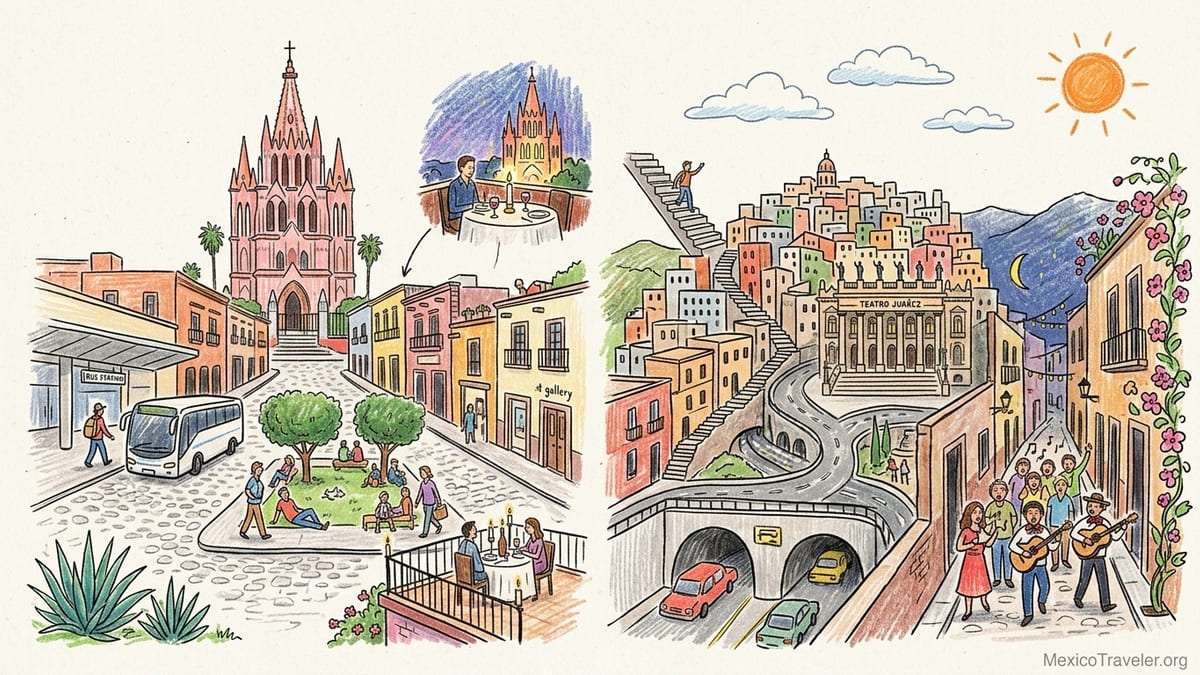
San Miguel de Allende feels designed to welcome you gently. The first time I arrived by bus, the logistics were straightforward: I stepped out into a manageable, modern station and was at my hotel quickly, with the city’s rhythm already readable. The center is compact and the main landmarks feel like they’re pulling you in on a string, especially once the Parroquia’s pink spires come into view.
Guanajuato City introduces itself like a plot twist. The approach drops you into a web of roads, underground tunnels, and steep streets that can be confusing the first time, especially if you arrive at night or with luggage. My first check-in required a taxi to a point where cars could go, then a short walk that turned into a stair-climb when the mapping pin didn’t account for a pedestrian alley. It was inconvenient, but also the moment Guanajuato started feeling like an adventure rather than a curated weekend.
If you’re coming from Mexico City by luxury coach, the time difference is real. ETN markets Mexico City to San Miguel de Allende at roughly four hours, with multiple departures daily and a stated starting price around $40 USD, which matched the general experience of this corridor being easy and comfortable. For Mexico City to Guanajuato, ETN lists the run at about five to six hours. The extra hour or two matters when you’re trying to squeeze a Friday evening arrival into a short trip.
Hotels And Costs In 2026: Where Your Money Goes Further
San Miguel de Allende is where I felt my budget get tested first. Recent 2026 pricing snapshots on major booking platforms put weekends in San Miguel noticeably higher than Guanajuato, especially in the walkable historic core. I routinely saw the “special” boutique hotels and well-located properties push the nightly rate into a range where you start calculating what you’re giving up elsewhere in the trip. Booking data for September 2026 also suggests that a 5-star stay in San Miguel averages around the mid-$200s per night, and that weekend 3-star stays can land around the $130s, with 4-star properties often well above that.
Guanajuato City, by contrast, is where I felt I could choose location and still keep a lid on nightly costs. Current 2026 deal tracking on metasearch sites shows Guanajuato’s average nightly rates far lower overall, with plenty of value options appearing even close to Centro. The practical result on my stays was simple: in Guanajuato I could pay for a better room or a better view without feeling like I’d traded away dinners, museums, and nightlife.
There is a catch in both places: cobblestones and stairs can make “value” a different kind of expensive if you overpack. The cheapest stay that looks close on a map can become a daily climb. After one Guanajuato stay where I underestimated the hill between my room and Teatro Juárez, I started paying a little more for a spot that saved my legs, especially on longer trips.
Terrain, Cobblestones, And Walkability: The Trip You Feel In Your Knees
Both cities are famous for cobblestones, but they behave differently. In San Miguel, the walking is steady and scenic, with inclines that are noticeable but usually not punishing if you stay near the heart of town. I could do a full day in San Miguel in sandals if I chose carefully, and I saw plenty of couples doing exactly that. The streets feel like they were made for wandering from café to plaza to gallery.
Guanajuato is another level: staircases appear where you thought there was a street, alleys tighten, and the city stacks itself vertically. That physicality is part of its magic. One afternoon, I followed a sloping callejón that kept narrowing until it became a staircase, then popped out above the center with a view that felt stolen. I also learned quickly that “ten minutes away” can mean ten minutes of climbing.
For travelers with mobility concerns, a stroller, or heavy luggage, San Miguel is simply easier. For travelers who love the feeling of a city revealing itself in layers, Guanajuato’s terrain is a feature, not a bug, as long as you plan your day around breaks and choose shoes like you’re prepping for a hike, not a fashion shoot.
Plazas, Evening Atmosphere, And Crowds: Where Each City Peaks
San Miguel’s center runs on plazas and people-watching. The Jardín Allende and the area around the Parroquia become a nightly stage where locals, visitors, and musicians share the same space. One of my most “San Miguel” moments was finishing dinner, walking into the Jardín, and realizing I’d accidentally timed it perfectly: the light had softened, the Parroquia was glowing, and the whole square felt like it had exhaled into evening. It’s a city that does romance without trying too hard.
Guanajuato’s nights feel more kinetic. The center can be packed, especially around performances and weekends, but the crowd energy reads younger and louder, helped by the city’s student culture. Even when it’s busy, it’s easy to duck into an alley and suddenly find yourself in a quieter pocket, hearing only footsteps and distant music bouncing off stone walls.
If you’re crowd-sensitive, San Miguel can feel intense in its core because so much of the action concentrates in a relatively small zone. Guanajuato can be busy too, but it disperses differently because the city is a maze. When I wanted a calm, candlelit night, San Miguel made it effortless. When I wanted a night that turned into a story, Guanajuato delivered more often.
Food, Museums, Galleries, And Culture: What You Actually Do All Day
San Miguel de Allende is where I built days around galleries, design-forward shops, and long meals. The city’s dining scene leans into destination travel: stylish interiors, strong cocktail programs, and a pace that encourages you to linger. I remember one rainy afternoon that could have felt like a washout, but in San Miguel it turned into a perfect excuse to spend hours moving between a gallery stop and a warm, unhurried lunch, then returning to the hotel to reset before the evening.
Guanajuato’s cultural attractions feel more dramatic and story-driven. Museums and historic sites are woven into the city’s identity, and you can go from a major theater facade to a small museum door in a few minutes, often by way of a staircase that drops you somewhere unexpected. If you’re deciding on one must-do that tends to define Guanajuato for many first-timers, the Museo de las Momias is the obvious example. Official municipal 2026 administrative fee documents list ticket pricing and discounts, and travel coverage this year has emphasized that the ticket is around 150 MXN for a general entry, with reduced or free entry categories for kids and seniors depending on credentials.
Here’s the difference in how I felt at the end of the day: in San Miguel, culture felt curated and elegant, like I’d chosen each stop. In Guanajuato, culture felt embedded in the streets themselves, like the city kept handing me the next scene without asking.
Nightlife And Signature Nights: Music, Callejoneadas, And Late Hours
If your ideal night ends with a great drink and a walk back through a well-lit, postcard-pretty center, San Miguel excels. It has nightlife, but it often feels like an extension of dinner: mezcal, wine, conversation, then a final loop around the Jardín as the cathedral lights dominate the frame. I’ve had nights there that felt tailor-made for couples, the kind where you don’t need a big plan because the atmosphere does the work.
Guanajuato is where I stayed out later without meaning to. The city’s tradition of callejoneadas, the musical walking tours through the alleys, is one of those experiences that can tip the scale if you want your nightlife to be participatory rather than just bar-hopping. There are also themed versions that appear on specific dates, including “Callejoneadas Macabras,” which have published official 2026 dates around Halloween and Día de Muertos weekend, listed for October 30, October 31, and November 1, 2026. Even on regular weekends, Guanajuato’s nighttime energy often feels louder, funnier, and more spontaneous.
My most telling comparison moment happened on two different Saturdays. In San Miguel, I watched couples dressed up for dinner, moving slowly, taking photos, lingering. In Guanajuato, I followed the sound of singing into a narrow lane and ended up walking with a group I’d never met, learning the rhythm of the city by keeping up with it.
Transportation, Day Trips, And Festivals: Planning A Full Itinerary In 2026
Transportation planning is where these two cities quietly diverge. Neither has a major international airport in town, so you’re usually working with Bajío International Airport (BJX) near León or Querétaro Intercontinental Airport (QRO), plus buses and shuttles. From BJX to Guanajuato City, university travel guidance has described taxis in the range of roughly 300 to 450 pesos, though real-world pricing varies by time and demand. For San Miguel, shuttle services are a common solution: local San Miguel resources and partner listings in 2026 commonly cite shared shuttle pricing around $25 USD per person for routes between San Miguel and BJX or QRO, with the reminder that these are reserved services rather than turn-up-and-go public buses.
For a one-week trip, I actually like combining the two: arrive via BJX, do Guanajuato first when you have energy for hills and late nights, then reset in San Miguel for slower mornings and longer dinners. The distance makes that pairing realistic, and it aligns with the way recent travel coverage increasingly frames them: two close, complementary colonial cities that reward being seen back-to-back.
Festival timing can swing the decision. Guanajuato’s biggest cultural trump card is the Festival Internacional Cervantino, and the official 2026 program announcements place the 54th edition from October 3 to October 18, 2026, with France as the invited country and a packed schedule across theaters, plazas, and university venues. San Miguel’s calendar has its own major moments: the municipal government’s 2026 Fiestas Patrias y Patronales programming highlights La Alborada in the early hours of October 3, 2026, when groups from traditional neighborhoods head toward the Parroquia with bands, mojigangas, and fireworks-like energy. If you can only visit once and you happen to be in the region around those dates, the choice becomes less about “which is better” and more about which kind of cultural intensity you want.
As for day trips, both are well-positioned: San Miguel makes it easy to build a relaxing itinerary with nearby vineyards or small towns, while Guanajuato is a good base for quick hops to León or other Bajío stops. The best day trip is often the one you’re already doing: taking the bus between them and treating the region like a single, connected destination.
The Takeaway
If I were choosing for a first visit, I would personally start with San Miguel de Allende. It’s easier to read, easier to walk, and it delivers that “Mexico colonial dream” feeling quickly, without the learning curve of tunnels and stairs. It’s the place I’d pick if I wanted to be certain the trip feels smooth from the moment I arrive.
For a couples trip, I’d still lean San Miguel, especially if the goal is romance, design-forward hotels, and dinners that turn into long, quiet walks. For a cultural weekend with performances, museums, and an atmosphere that feels theatrical even on an ordinary night, I’d choose Guanajuato, particularly in early October when Cervantino programming can transform the entire city.
For nightlife and social energy, Guanajuato is my pick. For photography, it depends on what you love: San Miguel gives you clean compositions, soft light on the Parroquia, and plaza scenes that feel timeless; Guanajuato gives you layers, stairways, rooftop angles, and the feeling of catching the city mid-scene. For a lower-budget stay, Guanajuato consistently felt easier on my wallet in 2026 hotel pricing. For a longer relaxing trip, I’d choose San Miguel because it’s simpler to settle into, repeat favorite places, and build a routine without constantly bracing for hills.
The honest answer is that neither city is universally superior. They’re different types of joy. San Miguel is the slow pour. Guanajuato is the spark. If you have the time, the best choice might be the one travelers increasingly make in 2026: visit both, and let the short distance between them become part of the story.
FAQ
Q1. Which city should I visit first: San Miguel de Allende or Guanajuato?
For most first-timers, San Miguel is easier to start with because the historic center is compact and the arrival logistics are simpler.
Q2. Which is better for a couples trip?
San Miguel de Allende, especially for romantic evenings around the Jardín and a hotel-and-dinner style weekend.
Q3. Which city is more budget-friendly in 2026?
Guanajuato City generally offers lower average hotel rates and more affordable options close to Centro compared with San Miguel’s core.
Q4. Which city has tougher walking conditions?
Guanajuato City. Its steep hills, stairs, and alleyways are part of the charm but can be physically demanding.
Q5. Is San Miguel de Allende still worth it if I don’t want a luxury trip?
Yes, but you’ll want to book early and consider staying just outside the very center to control costs while still walking into town.
Q6. What’s the easiest way to get from Mexico City to San Miguel de Allende?
A direct luxury bus is one of the simplest options, with operators like ETN advertising roughly four hours travel time on this route.
Q7. What’s the easiest way to get from Mexico City to Guanajuato City?
A direct bus is usually the most straightforward, and ETN lists the travel time at roughly five to six hours depending on the run.
Q8. What festival dates matter most in 2026 for Guanajuato City?
The Festival Internacional Cervantino is scheduled for October 3 to October 18, 2026, and it can significantly affect crowds and hotel availability.
Q9. What’s a signature San Miguel event to plan around in 2026?
La Alborada, tied to the city’s patronal celebrations, is highlighted for the early morning of October 3, 2026 and brings major nighttime-to-dawn energy downtown.
Q10. Can I realistically combine both cities in one trip?
Yes. Many travelers pair them because they’re close enough for the same regional itinerary, often using buses or pre-booked transfers between stops.