


I’ve driven a lot of Mexico, but the Bajío still feels like the sweet spot for a first colonial road trip: compact distances, big-city conveniences, and towns that reward slow mornings and unplanned detours. On my last loop, I kept the core tight: Querétaro to San Miguel de Allende to Dolores Hidalgo to Guanajuato. It was the most logical route for a week, and it’s the one I’d drive again. But I’d change how I used the car inside the historic centers, I’d rethink one overnight that turned into a parking headache, and I’d absolutely swap a couple of short drives for a first-class bus next time.
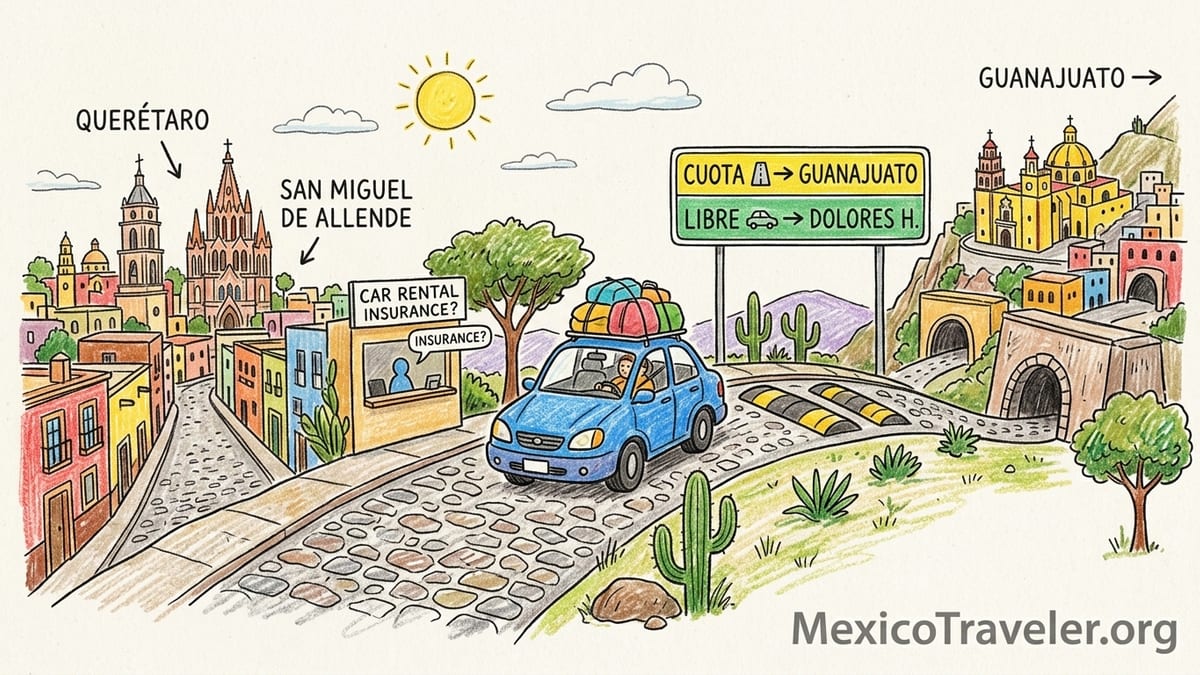
Before I Turned the Key: Picking Up the Car in Querétaro (and the Insurance Conversation)
I started in Querétaro because it’s an easier on-ramp than Mexico City for a first-time Mexico driver. I flew into Querétaro International Airport (QRO), walked up to the rental counters, and picked up a compact sedan that could handle steep cobblestones without feeling oversized in colonial lanes. I didn’t want an SUV for this route; the streets aren’t the issue, the parking garages are. Clearance, tight ramps, and narrow turns matter more than ground height in the Bajío.
The part that always deserves its own paragraph is insurance, because Mexico is not the place to wing it. At the counter, the agent did what agents do: asked whether I wanted to add protection packages, explained deductibles, and made it very clear that Mexican third-party liability is required and that outside policies and most credit-card coverage are not treated as proof of Mexican liability coverage. I asked the simplest question I’ve learned to ask: “If I decline your liability coverage, what exact proof do you accept, and what hold goes on my card?” In my case, the answer included a large authorization hold if I declined the local third-party liability protection. That hold, plus the general reality that counter staff are not there to evaluate your personal policy, is why I treat the counter as the moment to buy peace of mind rather than try to win a debate.
What surprised me was how the talk about deductibles changed my driving mood. Once you know the deductible can be significant, you stop pretending you’re going to “just squeeze through” a narrow street with mirrors inches from stone walls. That mindset saved me later in Guanajuato, where the car is more burden than freedom. If you’re doing this same route, plan to keep your vehicle small, take photos at pickup, confirm fuel policy, and get the rules in writing before you leave the airport lot.
The Route That Works in 2026: Querétaro → San Miguel → Dolores → Guanajuato
This is the compact colonial core for a reason: it’s coherent geographically, it avoids marathon drives, and it gives you variety without the constant unpacking that kills a week-long trip. Querétaro is the calm city base with an easy-to-navigate center and lots of services. San Miguel de Allende is the visual knockout, but it’s also where the car starts to feel like a complication. Dolores Hidalgo is the palate cleanser, a small-city stop with big history. And Guanajuato is the grand finale, dramatic and dense and absolutely not designed around private vehicles.
From Querétaro, I drove toward San Miguel de Allende via the corridor that locals use when the main federal routes snarl, and I kept my day simple: leave after breakfast, arrive by early afternoon, and check into lodging before the center gets busy. The biggest practical advantage of a car on this first leg was not the drive itself; it was being able to stay slightly outside the most restrictive historic-center blocks while still reaching viewpoints, artisan stops, and wineries or countryside restaurants without having to build my day around taxi availability.
The next legs are short on a map but long in feel if you drive them at the wrong time of day. That’s a theme of this road trip: distances are friendly, but traffic patterns, topes, and pedestrianized centers add real friction. This is not a “cities in a day” itinerary, even if Google makes it look that way.
Tolls, Toll Roads, and the Real Cost of Convenience
I’m a fan of cuotas on this route. Not because they’re romantic, but because they reduce the number of surprise towns, farm-vehicle slowdowns, and unpredictable passing situations. For budgeting, the key is accepting that tolls are part of the trip cost, like museum tickets. As of 2026 pricing, the Querétaro to Irapuato toll road segment is listed around 213 MXN for a standard car, and it’s one of the backbone segments you’ll touch if you connect between the Bajío cities using the faster corridor rather than lingering on free roads.
If you arrive via Mexico City, the Mexico City to Querétaro toll route is commonly budgeted in the low hundreds of pesos depending on exact entry and exit points, and it can feel like death by a few booths. I’ve done it both ways: once paying cash booth by booth, once using electronic tolling. Cash is doable, but it’s slower and you need small bills and coins. Electronic tags are smoother, but you’re still at the mercy of which lanes are open and whether your tag is read cleanly.
Here’s the thing I would change: I wouldn’t chase the “cheapest possible” toll total by mixing in too many libres. On paper, skipping a toll can look like a win. In practice, the time cost is real, and the fatigue cost is real. On this trip, I took one “free-road shortcut” that turned into a sequence of topes, local traffic, and tractor-speed segments. I arrived more tense than I wanted, and I burned the exact amount of daylight I’d hoped to spend walking.
Driving in the Bajío: Topes, Countryside Curves, and My Two Dumb Mistakes
Let’s talk about topes, because they are the reason your average speed in Mexico is always slower than your optimistic spreadsheet. Topes come in every shape: gentle humps, sharp table-top speed breakers, and the kind that feel like a dare. They appear at town entrances, by schools, near markets, and sometimes with signage that is more decorative than helpful. My biggest mistake was assuming that “no sign” meant “no tope.” It doesn’t. I hit one outside a small community at a speed that made my luggage thump hard enough to remind me I’d packed breakables too casually.
Mistake number two: trusting the first navigation suggestion in a colonial city. In San Miguel de Allende, my phone routed me toward a street that looked open until the last second, when it became effectively pedestrian-only. I didn’t get a ticket, but I did get that sinking feeling of being the clueless driver inching through a place that clearly preferred I didn’t exist. The takeaway is simple: in these towns, you drive to a parking destination, not to the hotel door. Historic centers are full of one-way lanes, temporary closures, and streets that are technically drivable but socially not meant for through-traffic.
Outside the cities, the countryside portions are easy and pretty, but they’re not mindless. You’ll see slower trucks, occasional aggressive passing, and changing light conditions in late afternoon. I made a point of finishing each driving day before dark. That’s not fear-mongering; it’s just good road-trip hygiene on roads where a missed tope, a bike without reflectors, or an unlit shoulder can turn a relaxed day into a stressful one.
Parking, Luggage, and the Historic-Center Reality (Where the Car Helps, and Where It Hurts)
The car was genuinely convenient in Querétaro. The historic center is lively and walkable, but it’s also the sort of city where you can actually use a parking garage as a home base without feeling like you’re rolling dice. Querétaro has formal categories and regulated maximum parking tariffs, and in 2026 the published maximums for “exclusive public parking” in the center include a per-hour cap and a day cap by category. In plain language: you can plan around parking costs rather than discovering them at the exit gate.
San Miguel de Allende is where the “car or no car” debate becomes real. Parking in the central zone is widely reported as some of the priciest in the region, with hourly rates that can climb far above what you’ll pay in Querétaro. That cost changes your behavior fast. I found myself doing something I hate on trips: moving the car just because the meter was ticking. It also made luggage a tactical problem. Rolling a suitcase over uneven stone streets from a garage to a hotel sounds manageable until you do it uphill, in heat, while dodging scooters and pedestrians.
Guanajuato is the final boss of colonial parking. The city’s drama is the point: tunnels, steep grades, staircases, pedestrian alleys, and a historic core where the car feels like an intruder. If your lodging doesn’t include parking, you’ll likely use a public lot and then walk or taxi in. This is where having a car stops being “freedom” and becomes “logistics.” My change for next time would be simple: I’d book a hotel that explicitly includes parking, even if it costs more, or I’d arrive by bus and skip driving inside the city entirely.
One more luggage reality: if you’re doing this loop, pack like you’re changing hotels often. Soft bags are easier than hard-shell suitcases when you’re dragging them over cobblestones, lifting them into small trunks, or squeezing them through narrow stairwells. My single best packing decision was keeping a small day bag accessible in the car so I wasn’t constantly opening the trunk in busy areas.
When I’d Take a First-Class Bus Instead (and How I’d Mix It With a Car)
If I rewrote the trip to be smoother, I’d build it around two modes: first-class buses between cities, and local rides once I’m in a pedestrian-oriented center. The Querétaro to San Miguel de Allende connection is a perfect example. In 2026 schedules and published fares, you can find frequent service from Querétaro’s main bus terminal to San Miguel’s central station, with economy and first-class options and travel times generally around the 1.5 hour range. That is exactly the kind of segment where the bus wins: no parking hunt in San Miguel, no navigating closures, no paying premium hourly rates just to keep the car somewhere safe.
For this specific route, my ideal “next time” plan would look like this in spirit: start in Querétaro with no car, enjoy the city on foot, then take a first-class bus to San Miguel and stay car-free there, too. I’d rent a car only for the countryside days, the wineries and viewpoints, and the small-town hops where a vehicle adds real value. Dolores Hidalgo can be done as a stopover with a car or reached by regional bus, but once you’re in Guanajuato city, the bus-plus-taxi approach is often less stressful than trying to thread a sedan through tunnel traffic and tight ramps.
The biggest benefit of going bus-first is that it changes what you can book. You’re no longer filtering hotels by “includes parking” in places where parking is scarce or costly. You can stay in the prettiest pedestrian streets without the guilt of wondering where your car is sleeping.
The Takeaway
If you want a colonial Mexico road trip you’ll actually enjoy driving, the compact core of Querétaro, San Miguel de Allende, Dolores Hidalgo, and Guanajuato is the route I’d recommend and happily repeat. It’s close enough to feel efficient, varied enough to feel like travel, and popular enough that services like toll roads, gas stations, and reliable lodging are easy to line up.
What I’d change is how I treat the car once I arrive. I’d stop trying to “drive into the center” and instead plan each city around one good parking decision, or skip the car entirely in the most pedestrian places. I’d also commit to toll roads as a sanity purchase, because saving a few pesos is not worth arriving frayed.
And if you’re tempted to extend the trip, do it thoughtfully. Morelia, Puebla, and Zacatecas are worthy, but they’re not automatic add-ons to this compact week. They shine as separate arcs, not as boxes to tick after you’ve already maxed out your walking energy and your parking patience.
FAQ
Q1. Is the Querétaro to San Miguel de Allende drive easy for first-time Mexico drivers?
Yes, it’s one of the more manageable intercity drives in central Mexico, but the challenge starts when you enter San Miguel’s historic center, where streets can narrow and closures change.
Q2. How much should I budget for tolls on the Bajío core route in 2026?
Budget a few hundred pesos for key cuota segments over the week if you prioritize toll roads; one commonly cited segment, Querétaro to Irapuato, is listed around 213 MXN for a standard car in 2026.
Q3. Do I really need to buy rental-car insurance in Mexico?
You need Mexican third-party liability coverage one way or another. Rental counters typically require their own liability product unless you present acceptable proof that specifically covers Mexico, and policies vary by company.
Q4. What kind of car is best for Querétaro, San Miguel, Dolores Hidalgo, and Guanajuato?
A compact sedan or small hatchback is ideal. You want something easy to maneuver and park, with enough power for hills and enough clearance to handle uneven pavement and topes.
Q5. Are topes really that common on this route?
Yes. Expect them at town entrances and near busy pedestrian areas. They’re a major reason drive times can be longer than you’d expect from the map distance.
Q6. Where is parking most difficult on this itinerary?
Guanajuato city is the toughest because of tunnels, steep streets, and a dense historic core. San Miguel can also be challenging due to high demand and premium central pricing.
Q7. Should I bring cash for toll booths and parking garages?
Yes. Even when cards are accepted, cash speeds things up and helps avoid awkward situations when a machine is down or a booth is cash-only.
Q8. What’s the single best way to reduce stress in San Miguel de Allende with a car?
Choose lodging with guaranteed parking or plan to park once in a reputable garage and walk everywhere. Treat the car like storage, not daily transportation.
Q9. When is it smarter to take a first-class bus instead of driving?
For city-to-city hops like Querétaro to San Miguel, the bus can be faster door-to-door once you factor in parking and navigating restricted streets.
Q10. Can I extend this route to Puebla, Morelia, or Zacatecas in the same week?
You can, but it often turns the trip into a checklist. Those cities are better as intentional extensions with extra days, rather than being squeezed into an already full Bajío week.