

I used to think “seeing colonial Mexico” meant renting a car, white-knuckling Highway 57, and paying for hotel parking I would never use. Then I tried the bus instead, and the route through the Bajío snapped into focus like a well-planned itinerary: Mexico City to Querétaro, Querétaro to San Miguel de Allende, and on to Guanajuato with just a backpack, a rolling suitcase, and a few very teachable mistakes. This is the intercity transport guide I wish I had before my first departure, written from the perspective of a traveler who actually rode the coaches, waited in the terminals, checked luggage, missed an ideal departure time, and learned how far “the bus station” can be from the hotel you booked in a historic center.
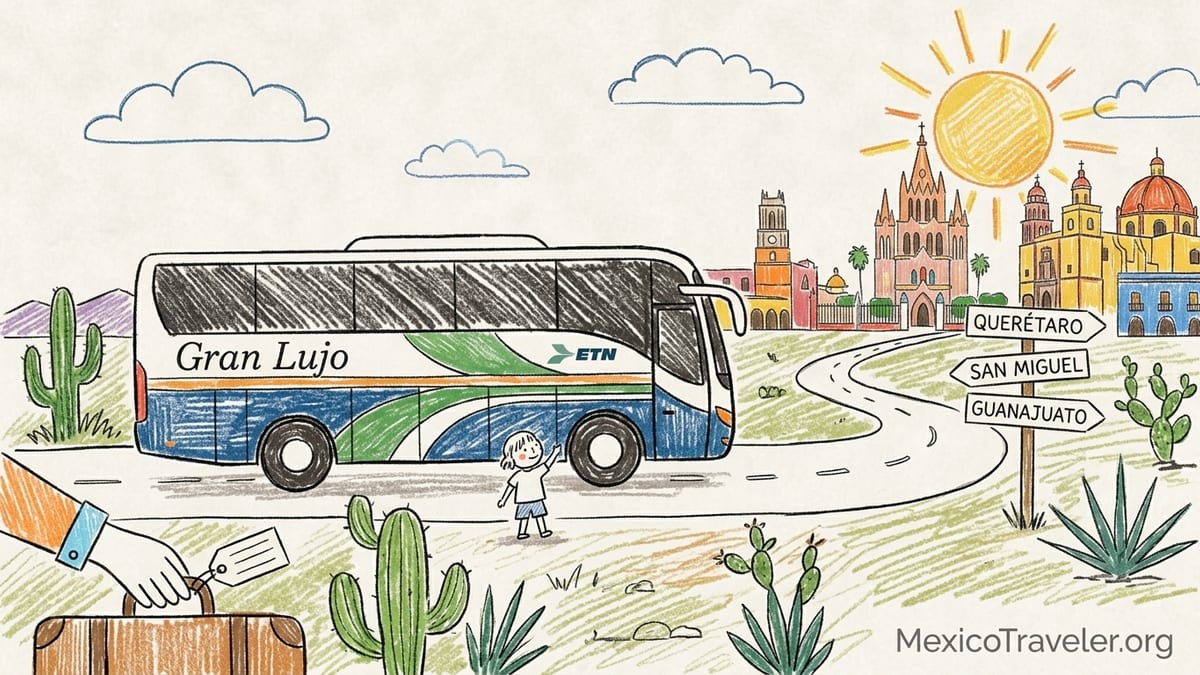
Why the Bus Is the Smart Way to Do the Bajío Heritage Circuit
This corridor is one of Mexico’s most practical overland routes: frequent service, modern terminals, and comfortable “Gran Lujo” coaches that feel closer to a domestic business-class seat than a budget bus. It is also an area where driving can add hassle instead of freedom. In colonial cities like San Miguel de Allende and Guanajuato, the place you want to sleep is rarely the place you want to park.
What makes buses work here is simple geography. Mexico City, Querétaro, San Miguel, and Guanajuato sit in a chain of manageable distances, and the main operators treat these routes as core business. ETN in particular advertises very frequent Mexico City to Querétaro departures, and it also sells Querétaro to San Miguel connections, which is exactly what you want when you are building a multi-stop itinerary without a car.
My key lesson before we even get into the stations is this: the bus itself is the easy part. The hard part is the transfer on each end. Your day can unravel because you chose a late departure, underestimated terminal distance, or arrived at a luggage counter too close to cut-off time. Once I started planning around terminals and transfers, everything became smoother.
Leg 1: Mexico City to Querétaro (ETN from Central del Norte)
I departed Mexico City from Terminal Central de Autobuses del Norte, commonly called “Central del Norte.” It is the northern intercity terminal, and it is the one you want for most Bajío routes. ETN sells Mexico City to Querétaro service from multiple Mexico City terminals, but Central del Norte is the workhorse for this corridor and the one I used.
On ETN’s own route information, the Mexico City to Querétaro run is positioned as a high-frequency service, with travel time generally in the 3 to 4 hour range and “more than 40” daily departures, often around hourly depending on the day. The price that ETN itself currently advertises for a budget-minded fare on Central del Norte to Querétaro starts around 405 pesos, with the important caveat that seat inventory and promotional pricing can change quickly by day and time.
I bought my ticket online ahead of time and traveled with a digital boarding pass on my phone. ETN actively pushes digital boarding for this corridor, and in practice it meant I did not have to queue at a ticket window. What I did still have to do was show up early enough to document my suitcase. ETN’s terms spell out that each passenger gets 25 kilograms of luggage included, and that baggage documentation can be done up to 30 minutes before departure. That 30-minute cut-off is not theoretical. I watched people hustle to the luggage counter, and I was glad I didn’t test it.
Seat comfort was the reason I chose ETN for this first leg. ETN markets “asientos cama” and a Gran Lujo experience on the route, and my coach delivered: wide recline, leg support, and a quieter cabin than I expected. The practical comfort detail I appreciated most was not a gadget, it was personal space. On a busy corridor out of Mexico City, having a true, roomy seat changes your mood for the entire day.
My mistake on this leg was choosing a late departure out of Mexico City thinking I was being “efficient” by squeezing in one more museum. What I underestimated was how long it takes to get across the city and into a major terminal, plus the added buffer needed for luggage documentation. The result was a stressful ride to the station and a rushed boarding. If I did it again, I would take an earlier bus and land in Querétaro with daylight and energy.
Tickets, Boarding, and Baggage: What Actually Happens on ETN
ETN makes buying straightforward, but the rules matter. ETN’s published conditions state you can purchase tickets up to one hour before departure, and that your boarding pass entitles you to travel coverage and 25 kilograms of luggage at no additional cost. In real terms, that meant my suitcase went under the coach with a claim tag, and I kept my counterfoil until the end of the trip.
ETN’s baggage documentation rule is the one that shapes your schedule: luggage can be checked until 30 minutes before departure. If you arrive later than that, you are gambling with the clock and the staff’s willingness to bend policy. The carry-on rule is also clearer than many travelers realize. ETN allows carry-on items that fit in the overhead compartment, like a small backpack or laptop bag, while larger bags are expected to be documented below.
If you exceed the 25-kilogram allowance, ETN’s terms describe an extra fee calculated per excess kilo, tied to the base fare of the ticket. I kept my luggage under the limit, but I weighed it at my hotel once I realized how strict Mexico’s premium bus operators can be compared with informal regional transport.
Boarding itself was routine: show the pass, head to the gate area, and be ready when the platform announcement happens. The “luxury” part of ETN is not just the seat. It is the rhythm: assigned seating, a cleaner boarding process, and fewer surprises. The one surprise you should still expect is traffic leaving Mexico City. Even a great operator cannot make a megacity disappear.
Arriving in Querétaro: Terminal Reality and Getting to the Historic Center
In Querétaro, the bus arrives at the city’s main bus terminal, and ETN operates within that facility with its own ticket counters and waiting area. ETN’s own route and destination pages emphasize that arrivals are at the Querétaro bus terminal, which is the key fact you need when you are booking hotels. You are not stepping out into the historic center. You are stepping out into a transport hub that requires a short onward transfer.
The terminal-to-hotel transfer is where many first-timers miscalculate time. My hotel was in the Centro Histórico area, and the bus station was not a walk I wanted to do with a suitcase. I took a taxi from the rank outside the terminal. It was fast and uncomplicated, but it was still an extra step I had not fully built into my arrival plan the first time. In other words, the bus is not door-to-door, and you should budget both money and mental energy for that final hop.
The station itself had the basics I needed: places to sit, restrooms, and food options that were good enough for a snack while I waited for my next departure. What it did not have was the calm charm of the cities you are coming here to see. Treat it like an airport. Arrive with buffer, keep an eye on your bags, and don’t assume you can do a quick dash outside and back during a tight connection.
One practical note: if you are connecting onward, plan your connection in Querétaro so you have time to retrieve documented baggage and re-check it on the next bus if required. The process is simple, but it is not instant, especially when multiple buses land close together.
Leg 2: Querétaro to San Miguel de Allende (ETN and the “It’s Only 80 km” Trap)
From Querétaro, I continued to San Miguel de Allende using ETN, departing from the Querétaro bus terminal at Luis Vega y Monroy #800 in the Ex-Hacienda Carretas area, and arriving at the San Miguel de Allende bus terminal at Calzada de la Estación #90 in Colonia Centro. ETN publishes both terminal addresses clearly in its route information, and having those exact details is incredibly useful when you are ordering a ride share or telling a taxi driver where you need to go.
ETN describes this as a short route of about 80 kilometers and advertises eight daily departures. The travel time ETN lists is about two hours. That time estimate felt honest in practice, but the “short route” framing can trick you into poor planning. I assumed a short distance would mean an easy, late-afternoon departure. What it actually meant was arriving in San Miguel with less daylight than I wanted and having to navigate a new city after check-in time.
Ticket purchasing worked the same way as the first leg. I used ETN’s digital ticketing, which meant less time at the counter. I still treated the luggage cut-off seriously, because ETN’s conditions apply across the network. My suitcase was tagged and placed below, and I kept the claim tag until I was standing in San Miguel’s terminal with my bag in hand.
Onboard comfort was consistent with the Mexico City leg: wide seats, a calmer cabin, and enough personal space that the ride felt like downtime rather than “transit.” The countryside views on this leg are not dramatic in an alpine way, but they are satisfying: a gradual shift from urban edges to highland landscapes, with the sense that you are moving into the heart of the Bajío rather than skirting it.
San Miguel and Guanajuato Connections: What I Used, What I’d Do Differently, and Where the Buses Actually Go
San Miguel de Allende’s bus terminal is at Calzada de la Estación #90, and that address matters because the historic center is walkable once you are there, but not necessarily from the terminal with luggage. The terminal is close enough to the core that it is not a long cross-town slog, yet it still felt far when I arrived tired and slightly late. I took a taxi from the line outside to my hotel, and the transfer was the difference between a smooth arrival and dragging a suitcase up uneven sidewalks.
Here is the mistake I made in San Miguel: I underestimated how much time it takes to get from a terminal to a boutique hotel, especially when your hotel is on a pedestrian-friendly street where cars do not always drop at the front door. If you are staying near the Jardín Principal area, you may have a short walk from your drop-off point. That is normal. It is also the exact moment you will be happiest you packed light.
For Guanajuato, I used intercity service rather than a private driver. The Guanajuato bus terminal is not in the postcard center; it sits outside the historic core, and that is by design. Third-party terminal information commonly describes it as located around kilometer 7 of the Guanajuato to Silao highway, with taxis at the door and urban public transport that runs toward the center. The practical takeaway is simple: arriving in Guanajuato by bus is easy, but you should expect a transfer to your hotel in the historic center.
On the Guanajuato to San Miguel corridor, Primera Plus is a major player and is useful for travelers stitching together different Bajío cities. For a concrete, real-world schedule example, aggregator timetable snapshots for September 2026 show a Primera Plus departure around 8:50 a.m. from Guanajuato’s central bus station arriving about 10:10 a.m. in San Miguel, with prices displayed in the mid-200 peso range. I treat aggregator prices as a planning reference rather than the final word, but they are helpful for sanity-checking what you might pay before you go to the operator’s official checkout.
When choosing between operators on these legs, my personal pattern was: ETN when I wanted maximum comfort and a predictable experience, Primera Plus when the schedule fit better or the connection was more convenient. Both are well-known, and both run from the main terminals rather than informal roadside stops, which is the biggest safety and reliability upgrade you can give yourself in this region.
The Takeaway
Traveling through colonial Mexico by bus taught me that the Bajío heritage circuit is not just doable without a car, it can be the more enjoyable way to do it. ETN’s frequency on Mexico City to Querétaro makes the route feel flexible, and its Querétaro to San Miguel service turns what could be a car-rental day into a simple, bookable hop. The coaches are comfortable enough that you arrive ready to explore instead of needing recovery time.
My biggest practical learning was to plan around terminals, not just cities. Every leg has two extra steps: getting to the departure terminal and getting from the arrival terminal to your hotel. Those steps are where your day can be lost or saved. The second lesson was to respect baggage timing. ETN’s 30-minute baggage documentation cut-off is real, and showing up with buffer is the difference between relaxed travel and sprinting through a terminal.
If you copy my route, copy my corrections too. Take an earlier bus out of Mexico City, avoid arrivals after dark when you can, and always look up where the terminal sits relative to your hotel. The reward is a classic Mexico itinerary that feels grounded and human: watching the landscape change through a clean window, stepping off into a new city with your bag in hand, and realizing you did not need a steering wheel to connect the dots.
FAQ
Q1. Where do ETN buses depart in Mexico City for Querétaro?
ETN sells Mexico City to Querétaro departures from multiple terminals, but Central del Norte is a primary option and the one I used for this route.
Q2. How frequent is the Mexico City to Querétaro bus service on ETN?
ETN promotes very high frequency on the corridor, describing more than 40 daily departures with many departures spaced about hourly depending on the day.
Q3. What is the current lowest fare ETN advertises for Central del Norte to Querétaro?
ETN currently advertises fares starting around 405 pesos for Mexico City Central del Norte to Querétaro, subject to availability and travel date.
Q4. How much luggage is included on ETN, and when do you have to check it?
ETN includes 25 kilograms of luggage per passenger, and its terms state luggage documentation can be done until 30 minutes before departure.
Q5. Where does the ETN bus arrive in Querétaro?
ETN arrivals are at the Querétaro bus terminal, where ETN has ticket counters and waiting areas inside the main facility.
Q6. What terminals does ETN use for Querétaro to San Miguel de Allende?
ETN lists departures from the Querétaro bus terminal at Luis Vega y Monroy #800 and arrivals at San Miguel’s terminal at Calzada de la Estación #90.
Q7. How many daily departures does ETN advertise between Querétaro and San Miguel?
ETN’s route information describes eight daily departures on the Querétaro to San Miguel de Allende route, with schedules varying by date.
Q8. Is San Miguel’s bus terminal actually in the historic center?
The terminal is in Colonia Centro and is relatively close to the main sights, but you will likely still want a taxi if you have luggage.
Q9. Where is the Guanajuato bus terminal relative to the city center?
The Guanajuato bus terminal is outside the historic core along the Guanajuato to Silao highway area, so most travelers use a taxi or city bus onward to their hotel.
Q10. What is the most common timing mistake on this route?
Choosing a late departure and underestimating terminal-to-hotel transfers is the mistake I made. Earlier departures and bigger buffers make the trip easier.