

I used to think “Colonial Mexico” was a single, postcard-ready aesthetic: cantera stone, iron balconies, and church bells echoing over a zócalo. Then I started traveling inland through Mexico’s historic highland cities and realized it’s less a look than a living corridor, shaped by Spanish-era urban planning, Indigenous neighborhoods, mining wealth, and a present-day rhythm of markets, students, commuters, and weekend travelers. This guide is written from my own journeys through Querétaro, San Miguel de Allende, Guanajuato, Puebla, Morelia, and Zacatecas, with a planning layer built from current, independent research on what is open, what it costs, and how to move between cities efficiently.
What “Colonial Mexico” Means for This Trip, and the Corridor That Makes Sense
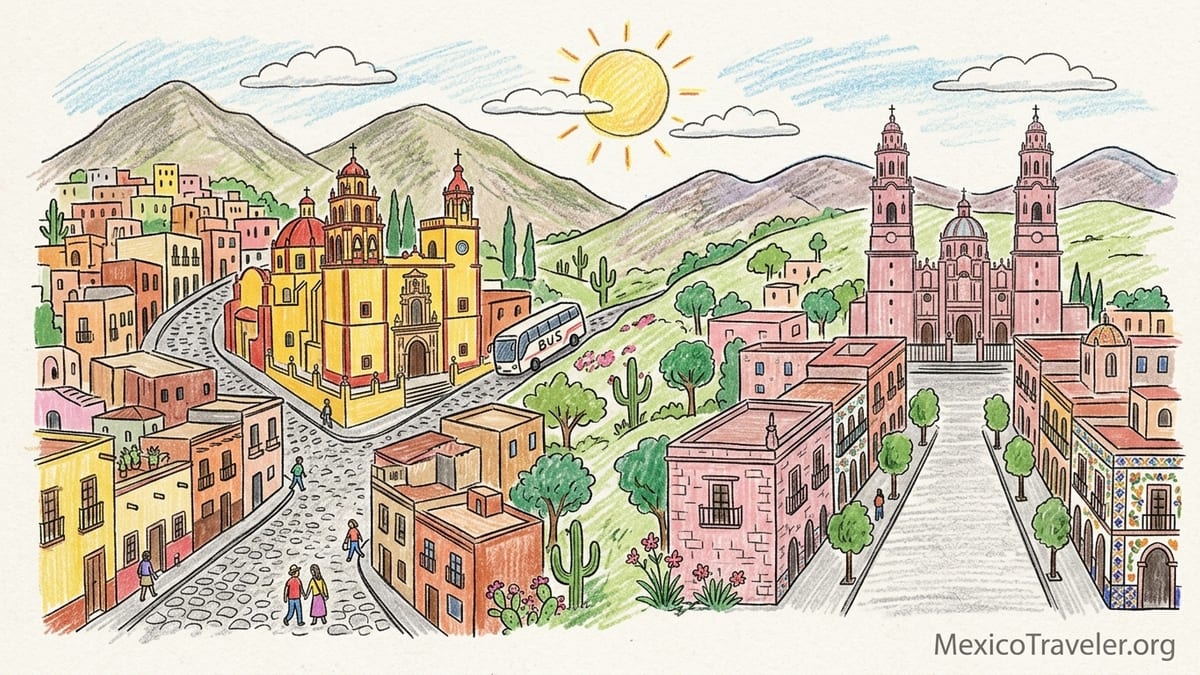
For travelers, “Colonial Mexico” usually means the inland cities that flourished under New Spain, roughly from the 1500s into the early 1800s, and still preserve historic street plans, cathedrals, monasteries, mansions, and civic buildings. But on the ground, I felt it most in how cities are laid out: central plazas that still act as meeting rooms, narrow streets that turn walking into a tactile experience, and a constant soundtrack of bells, vendors, and buses threading through centuries-old grids.
The most intuitive travel spine is the highland corridor that links the Bajío (Querétaro, San Miguel de Allende, Guanajuato) with extensions toward Michoacán (Morelia), Puebla (Puebla City), and farther north into Zacatecas. These places sit at altitude, and that changes everything: the sun is intense, mornings can feel crisp, and climbing cobbled hills can hit harder than you expect even if you’re reasonably fit.
I built my own route around what’s easiest by bus, because Mexico’s first-class coach network is one of the most comfortable ways I’ve found to move through historic cities without the stress of parking or driving in tight centers. From Querétaro, I used the main bus terminal to connect onward, including a smooth hop to San Miguel de Allende that is commonly served by comfortable operators such as ETN Turistar. ETN itself positions the Querétaro to San Miguel run as a frequent, roughly one-hour ride, which matched the sense of an easy regional connection rather than a major transit day.
My definition of success for this kind of trip is simple: choose a corridor, travel light enough to walk from a drop-off to a historic center hotel, and plan each city around two things, mornings for museums and churches, evenings for plazas and food. When I got that balance right, I felt like I was traveling through cities, not just sightseeing.
Querétaro: My First Real “Colonial” Arrival, and Why It’s a Smart Base
I arrived in Querétaro by long-distance bus and oriented myself the way I always do in a new city: I asked one practical question, “How do I get from the terminal to the historic center without drama?” Once I was dropped near the core, the city immediately felt legible: broad promenades feeding into tighter lanes, and a center that rewards wandering without constantly forcing you uphill.
Walking Querétaro felt forgiving compared with other highland cities. The historic center has plenty of level stretches, and while you still have cobbles, you don’t have the relentless steep grades I later felt in Guanajuato. In the evenings, the plazas had a calm, lived-in feel, families circling benches, couples lingering under warm streetlights, and the steady pulse of church bells marking time more clearly than my phone ever did.
From a planning standpoint, Querétaro’s UNESCO recognition is not a vague marketing line. The Historic Monuments Zone of Querétaro is inscribed on UNESCO’s World Heritage List for its unusually preserved mix of Spanish geometric planning alongside older, more winding Indigenous quarters, and for the density of baroque religious and civil monuments from the 17th and 18th centuries. That context helped me read what I was seeing: not just pretty façades, but an entire city plan that has survived.
If I were doing this again, I’d give Querétaro at least two nights, not because it’s the flashiest stop, but because it’s the city that made the rest of the corridor easier. It’s a strong transit node, and its historic center is a great place to “dial in” your pacing before you reach hillier, more physically demanding cities.
San Miguel de Allende: The Most Polished Stop, With Real Trade-Offs
I reached San Miguel de Allende from Querétaro by bus and immediately felt the shift. San Miguel has a curated sheen: design-forward boutiques, rooftop terraces, and a center that can feel like it’s perpetually set up for golden-hour photos. I still enjoyed it, but I enjoyed it best when I treated it as a real city early in the morning, before day-trippers filled the main viewpoints and the sidewalks tightened.
On foot, San Miguel is a steady workout. The streets climb, the stones can be slick after rain or early-morning cleaning, and the sidewalks pinch in ways that force you into the street more often than I liked. The upside is that the city rewards slow movement. I found myself pausing constantly, not just to look at architecture, but to catch my breath and notice small sensory details, the smell of coffee drifting out of a doorway, the echo of a bell bouncing off a façade, the sudden open space of a plaza after a narrow lane.
What surprised me most was how much the evening atmosphere changes street by street. A single turn can take you from lively dining rooms and rooftop music to quiet residential blocks where you hear only footsteps and distant bells. That contrast is part of San Miguel’s magic, but it also means you should choose lodging based on your tolerance for nighttime noise and your willingness to climb home after dinner.
UNESCO-wise, San Miguel’s listing is specific: UNESCO inscribed the Protective Town of San Miguel and the Sanctuary of Jesús Nazareno de Atotonilco for its cultural interchange, reflecting the town’s historical role as a meeting point where Spanish, Creole, and Indigenous influences blended, and for the sanctuary as an exceptional example of cultural exchange expressed through architecture and interior decoration. Even if you don’t make it to the sanctuary, knowing it is part of the same UNESCO property clarifies why San Miguel is framed as more than a pretty town.
Guanajuato: Steep Streets, Student Energy, and the Museum I’m Glad I Didn’t Skip
Guanajuato was the city that changed my walking strategy. I arrived by bus and almost immediately understood that the historic center is built into a bowl of hills. Streets turn into staircases, alleys tilt upward without warning, and what looks like a short distance on a map can feel like a climb. It’s beautiful, but it is not gentle on your legs.
In the evening, though, Guanajuato is exactly the kind of place I travel for. The plazas feel theatrical, with people spilling from cafés and conversations echoing off stone. The atmosphere has a youthful intensity, and even if you don’t seek out nightlife, you feel the city’s student heartbeat in how late the center stays awake.
The museum that anchored my visit was the Museo Regional de Guanajuato, Alhóndiga de Granaditas. I walked in specifically because I wanted something concrete beyond viewpoints and alleyways, and it delivered. The current official listing through INAH’s “Lugares” platform gives practical visiting hours: Tuesday to Saturday 10:00 a.m. to 6:00 p.m., and Sunday 10:00 a.m. to 3:00 p.m., at Mendizábal No. 6 on the edge of the center. Those hours matter because Guanajuato is the kind of city where you can lose half a day just wandering, and suddenly it’s closing time.
Guanajuato is also a UNESCO World Heritage city. UNESCO’s “Historic Town of Guanajuato and Adjacent Mines” listing emphasizes the city’s baroque and neoclassical architecture and its mining landscape set in steep valleys at roughly 2,084 meters of altitude. That altitude isn’t an abstract fact: I felt it when I pushed uphill too fast on my first afternoon and realized I was breathing like I’d just jogged.
If I could redo one thing here, I’d add an extra night. Guanajuato deserves a day for museums and a separate day for slow neighborhoods, long meals, and an evening that doesn’t end with you checking your watch and calculating your climb back to the hotel.
Morelia: Pink Stone, Big-Sky Boulevards, and an Easier Walking Rhythm
After the Bajío’s tight lanes, Morelia felt spacious. The streets in the historic center gave me room to walk side-by-side again, and the city’s signature pink stone made the architecture glow differently depending on the time of day. If some colonial cities feel like you’re threading a maze, Morelia felt like walking through a grand, open-air civic room.
My favorite moments were simple: the sound of footsteps on broad sidewalks, the way the cathedral anchors your sense of direction, and the feeling that you can cover real ground without constantly dodging cars in narrow alleys. Compared with Guanajuato, Morelia was physically easier and more linear. It’s still at altitude, but the terrain didn’t turn every errand into a climb.
Morelia’s UNESCO status is clear and well established. UNESCO’s page for the Historic Centre of Morelia describes an exceptional fusion of styles and highlights the dense concentration of monuments, including numerous churches and civil constructions. Importantly, the site’s inscription is tied to preservation efforts in the historic core, which is visible in how cohesive the center feels.
When planning, I treated Morelia as a “reset city” in the route: a place to sleep well, walk widely, and give my knees a break from constant hills. If you’re building a trip that includes Zacatecas later, this kind of reset becomes more valuable than you might expect.
Puebla: The Most Rewarding Food City in the Corridor, With a Strong Museum Day
Puebla was the stop that pulled me into a different version of colonial Mexico. It felt less like a compact hill town and more like a major historic city with an ongoing modern life: busy streets, serious commuting energy, and a center where grand architecture is woven into everyday routines. I arrived via the city’s main bus infrastructure, and the scale of the place was immediately clear.
For planning, Puebla is one of the easiest cities in this guide to structure into a clean, satisfying day: mornings for churches and libraries, afternoons for museums, and evenings for food. The museum I built around was Museo Amparo, because it’s both central and well organized for travelers who want to understand Mexico beyond a single era. According to Museo Amparo’s current visitor information, it is open Wednesday through Monday from 10:00 a.m. to 6:00 p.m., closed Tuesday, with general admission listed at 85 pesos, and free entry on Sundays and certain categories such as students and teachers. Those specifics helped me time my visit and budget for it rather than guessing at the door.
I paired it with a visit to the Biblioteca Palafoxiana, one of the places that made Puebla feel intellectually alive, not just beautiful. I found conflicting information across sources about the most current public service details, including a government service page updated July 23, 2026 that references limited hours for access to consultation of the collection, while another source associated with the Museo Amparo describes a general visitor entry price of 48 pesos. Because hours and access rules can change, I’d confirm the same-week schedule locally before you build your day around it, especially if your only free slot is a Monday or a half-day.
Puebla’s UNESCO designation is also foundational to why it belongs in a colonial itinerary. UNESCO lists the Historic Centre of Puebla as a World Heritage property tied to its strategic position on the historic trade route between Veracruz and Mexico City and the preservation of its urban and architectural heritage. If you want a city that feels both monumental and practical, Puebla is it.
Zacatecas: High-Altitude Grandeur and Why I’d Plan Two Nights
Zacatecas felt like the northern punctuation mark of my colonial-city travels: dramatic stone architecture, a center that rises and folds, and an atmosphere that leans more monumental than bohemian. Arriving here, I felt the altitude in the sharpness of the light and in how quickly I got thirsty while walking. This is a city where you should carry water and assume your “short stroll” will include stairs and inclines.
UNESCO recognizes the Historic Centre of Zacatecas as a World Heritage site, and UNESCO’s documentation confirms its inscription date and the property’s significance. In practical terms, that translates to a compact historic center with concentrated architectural impact. It’s a city that photographs well, yes, but it also feels weighty in person, especially around its main squares and stone façades.
For a current, practical attraction, I looked at the Teleférico. An official Zacatecas state government catalog entry lists a public-facing schedule of 10:00 a.m. to 6:00 p.m. and notes you can present at either station to ride. Another official tourism page highlights discounts for residents and instructs travelers to confirm conditions at stations. Because pricing details were not consistently visible across the sources I reviewed, I would treat the schedule as the most reliable planning element and confirm the fare on-site the morning you plan to go.
Zacatecas is the city where I most regretted trying to compress too much into one day. If you’re coming from a long bus ride, arrive, take an easy evening walk, and save your big sightseeing for the next morning. Two nights gives you a buffer for altitude fatigue and for the simple fact that the city is more physically demanding than it looks on a map.
The Takeaway
If you want the feeling of Colonial Mexico without turning your trip into an exhausting checklist, I’d frame the route as a set of walking experiences rather than a string of monuments. Querétaro is the easiest place to find your rhythm. San Miguel is the most polished and the most crowded, but still rewarding if you move early and pick your neighborhood carefully. Guanajuato is the steepest and most theatrical, and I’d never skip the Alhóndiga museum if you want historical substance. Morelia gives you space and elegance, and Puebla delivers the strongest mix of major-city energy, museum infrastructure, and food culture. Zacatecas is your high-altitude finale, best enjoyed with time and patience.
My biggest mistake the first time I tried to stitch these cities together was underestimating how much altitude and cobblestones change your pace. Now, I plan shorter walking days, I schedule museums for midday when my legs need a break, and I choose lodging where I can actually walk home at night without turning dinner into a climb expedition. When you respect the terrain, the corridor opens up, and the bells, plazas, and evening air start to feel like a coherent journey rather than a rush between photo stops.
FAQ
Q1. What does “Colonial Mexico” mean in a travel-planning sense?
It refers to inland cities shaped during New Spain, where historic centers preserve colonial-era street plans, churches, civic buildings, and neighborhoods that still function as today’s urban core.
Q2. Which cities make up the most convenient colonial corridor?
A practical corridor is Querétaro, San Miguel de Allende, and Guanajuato, with strong extensions to Morelia, Puebla, and Zacatecas depending on your time.
Q3. Which of these cities are UNESCO World Heritage sites?
Querétaro, San Miguel de Allende (with the Sanctuary of Atotonilco), Guanajuato, Morelia, Puebla, and Zacatecas all have UNESCO World Heritage listings tied to their historic centers or associated monuments.
Q4. What city is easiest to walk?
Querétaro and Morelia felt the most forgiving for long walks, with fewer relentless climbs than hillier cities like Guanajuato and parts of San Miguel de Allende.
Q5. What city is the most physically demanding?
Guanajuato is the most demanding on foot because the center sits in steep valleys and hills, and many routes involve stairs, inclines, and uneven cobblestones.
Q6. What are the current visiting hours for the Alhóndiga de Granaditas museum in Guanajuato?
INAH’s current listing shows Tuesday to Saturday 10:00 a.m. to 6:00 p.m., and Sunday 10:00 a.m. to 3:00 p.m. It’s closed on Mondays.
Q7. What are the current hours and admission for Museo Amparo in Puebla?
Museo Amparo lists Wednesday through Monday 10:00 a.m. to 6:00 p.m., closed Tuesday, with general admission at 85 pesos and free entry on Sundays plus other categories such as students and teachers.
Q8. Is it better to travel by car or by bus on this route?
For most travelers, first-class buses are simpler because historic centers have tight streets and limited parking. Using buses also reduces stress on long travel days.
Q9. How many nights should I budget per city for a first trip?
A comfortable pace is two nights each in Querétaro, Guanajuato, Puebla, and Zacatecas, with at least two nights in San Miguel if you want to enjoy mornings and evenings without day-trip pressure.
Q10. What’s the easiest mistake to avoid on a Colonial Mexico itinerary?
Don’t underestimate altitude and cobblestones. Plan fewer “must-do” stops per day, schedule indoor breaks, and choose lodging that matches your walking tolerance at night.