

I arrived in San Cristóbal de las Casas expecting pastel streets, cool mountain air, and a convenient base for day trips. What I did not expect was how deeply a single day visiting the nearby Tzotzil Maya communities of San Juan Chamula and Zinacantán would challenge how I think about “cultural tourism.” These are not open-air museums or frozen-in-time villages. They are living, complex Indigenous communities negotiating modern Mexico on their own terms, and entering them as a visitor requires more care, more listening, and more humility than most guidebooks admit.
Getting From San Cristóbal and Why I Chose a Local Maya Guide
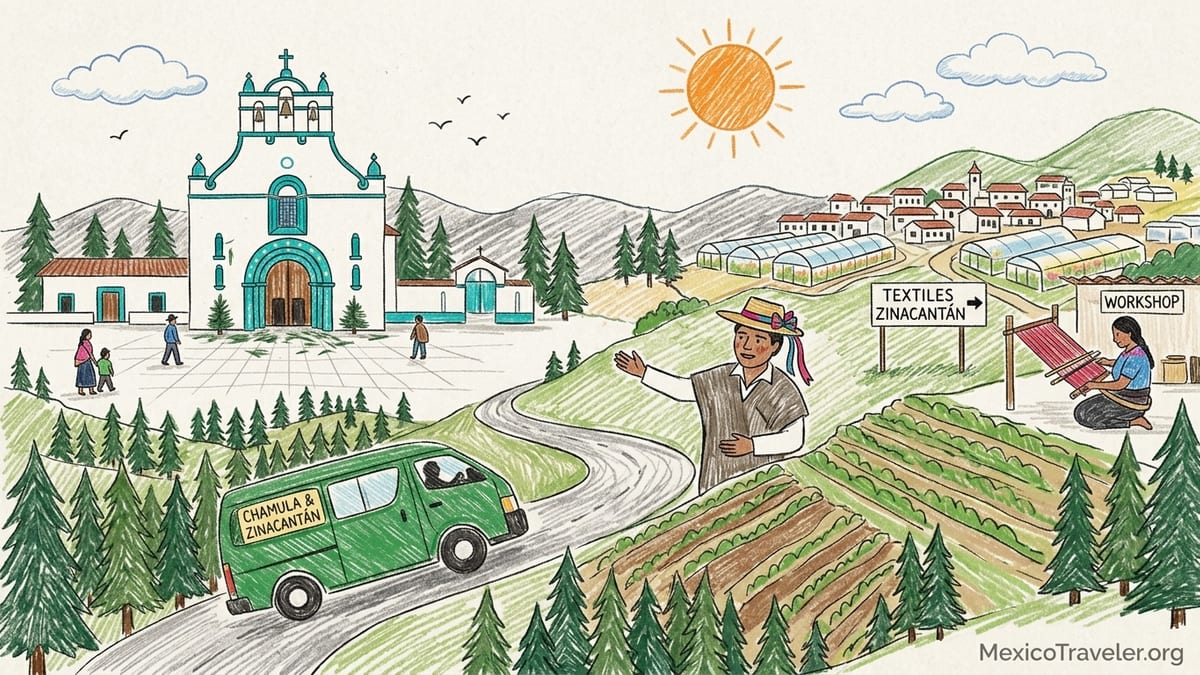
San Juan Chamula and Zinacantán lie roughly 10 to 12 kilometers outside San Cristóbal de las Casas, on different branches of the same mountain road that climbs through pine forest and terraced fields. Shared colectivos leave from around Avenida Insurgentes and the northern market area, with hand-painted signs for “Chamula” or “Zinacantán” in their windows. In October 2026, fares were typically in the range of 25 to 40 Mexican pesos per person each way from the city, paid in cash directly to the driver. Taxis can be arranged through hotels or official sitios in the historic center; quotes I received to visit both communities, wait, and return to San Cristóbal ranged between 500 and 700 pesos for the car, negotiable depending on waiting time.
Instead of arranging transport first, I started by looking for a guide. In San Cristóbal you can easily book day tours at agencies clustered along Real de Guadalupe and near the central plaza. Many advertise “Chamula & Zinacantán Indigenous Villages” as half-day trips, usually four to six hours with hotel pick-up included. Prices in late 2026, according to agencies and online booking platforms I checked, generally ranged from about 400 to 800 pesos per person for group tours, sometimes including church entrance fees and a brief textile demonstration. However, the key question for this visit was who benefits. When I asked two agencies to name the guides and whether they were from the communities themselves, I got vague references to “local guides” but no clear answer about how money was shared.
That uncertainty led me to seek out a Tzotzil Maya guide directly. Through a San Cristóbal cultural center and word of mouth from my guesthouse, I was put in touch with a Chamula-born guide who works independently and collaborates with other Tzotzil guides. For a private full-day visit to both San Juan Chamula and Zinacantán, including interpretation in Spanish and English and coordination with families in each community, his fee was 1,400 pesos for one or two travelers, plus our own local transport and purchases. I appreciated that he explained his fee structure up front, and that it was clear he had ongoing relationships in both towns, rather than treating them as anonymous stops.
Traveling with him shaped how we were received. In both communities, he greeted authorities and hosts by name, switched naturally between Tzotzil and Spanish, and asked on our behalf whether photography, questions, and note-taking were appropriate in each space. That mediation did not guarantee access everywhere, nor did it turn private life into a show. Instead, it created a framework of consent. As a visitor, I was being introduced, not simply “going to see.”
First Impressions in San Juan Chamula: The Plaza and the Church Façade
We started in San Juan Chamula, which sits in a high basin surrounded by pine-covered hills. The colectivo from San Cristóbal dropped us a short walk from the central plaza, where the white façade of the Templo de San Juan Bautista dominates the square. The church is familiar at first glance, with arched doorways and a bell gable, but a closer look reveals a distinct local aesthetic: turquoise and green painted details, floral motifs, and carved saints set into the entrance, framed by colored tiles that echo designs seen on traditional Chamula clothing.
The plaza itself is a working civic space, not a curated visitor area. On the morning we arrived, municipal loudspeakers carried announcements in Tzotzil, and men in woolen tunics discussed village business near the town hall. Women walked quickly across the square balancing baskets of vegetables or firewood. A few tables were set up with belts and shawls for sale, but there was no line of souvenir stalls hugging the church, no costumed dancers posing for money. My guide reminded me that for Chamula residents, the plaza is where political authorities are installed, disputes are discussed, and festivals are organized.
At the edge of the plaza, just before the church gate, community representatives collect a small entrance fee from visitors. In late 2026, this was about 25 pesos per person, payable in cash. The fee is set by the community, not by an outside company, and it helps fund communal responsibilities, including maintenance of the church. Paying it felt less like buying a ticket to an attraction and more like acknowledging that I was stepping into a space that belongs to someone else.
Outside the church, photography was permitted but already needed sensitivity. There are no turnstiles or printed “no photo” signs, but there is a widely known rule that photographing inside the church is completely forbidden and that photographing people anywhere in Chamula without explicit permission is considered deeply disrespectful. My guide asked me to keep my camera strapped at my side and to avoid zooming in on individuals in the plaza, even from a distance, unless they clearly signaled consent. He explained that past abuses, including journalists and influencers who ignored the rules, had reinforced local mistrust of cameras.
Inside San Juan Bautista: Observing Without Turning Rituals Into Spectacle
Before we entered the church, my guide spoke quietly about expectations. Inside, no photos or videos under any circumstances. No whispered commentary or pointing at people. No walking between a person or healer and the altar or candles. No standing and staring if someone glanced at us uncomfortably; if that happened, we were to step away. He noted that the prohibition on photography is not a quaint superstition but a decision rooted in the community’s desire to protect its rituals from being consumed, misinterpreted, or mocked outside their context.
Stepping inside San Juan Bautista is disorienting if your only reference point for churches is European or colonial Mexican Catholicism. The pews have been removed, leaving an open floor scattered with pine needles that release a resinous scent. Statues of Catholic saints line the side walls in glass cases, draped with mirrors, ribbons, and flowers, but the main focus is not a distant altar. Instead, families and small groups create their own ritual spaces on the floor, setting out rows of colored candles, soft drinks, and other offerings. Copal incense hangs in the air, and low murmurs in Tzotzil mingle with the occasional soft chant.
My guide did not narrate what each person was doing, and I did not ask him to. Much of what happens here is part of private healing practices and communal tradition. What he did explain, once we stepped back outside, was the broader relationship between Indigenous belief and Catholic imagery. The saints, he said, can be understood as powerful beings who may have overlaps with pre-colonial Maya deities or local protective forces, but they are not simply interchangeable with Catholic theology as taught in seminaries. The use of candles of different colors, the arrangement of offerings, and the chants spoken in Tzotzil often draw from knowledge passed down within families rather than from priests.
Soft drinks, especially cola, often catch foreign visitors’ attention, sometimes for the wrong reasons. I had read casual comments online about “Coca-Cola rituals” that reduced complex practices to spectacle. My guide pushed back against that framing. He explained that carbonation and sweetness are associated by some with helping to release illness or “bad air” from the body, and that cola has been incorporated into rituals that historically used other fermented or effervescent drinks. It is not a gimmick for tourists, and it is not performed for cameras. As we sat later on the plaza steps, he emphasized that trying to decode rituals in a single visit risks misunderstanding them entirely. The most respectful posture for outsiders, he suggested, is to witness quietly and accept that we do not need to understand everything we see.
Tourism, Discomfort, and Knowing Where Your Money Goes in Chamula
Even with a trusted guide, San Juan Chamula raised uncomfortable questions about tourism. Outside the church, I noticed several large groups arrive from San Cristóbal in minibuses. Their guides, speaking in Spanish, gave brisk historical summaries at the edge of the plaza, then shepherded the groups inside for about ten minutes before moving them back out toward souvenir stalls. When I later checked online, many of these tours sold for around 500 to 700 pesos per person from city-based agencies, but in some cases it was not clear whether the guides were Chamula, Tzotzil from another community, or non-Indigenous outsiders living in San Cristóbal. Nor was it clear how much of each ticket price remained in Chamula beyond the fixed church entrance fee.
One moment in particular made me deeply uneasy. As we left the plaza, a man in a wool tunic stood with a lamb in his arms, clearly positioned where tour groups passed. Several visitors approached to take close-up photos without asking, assuming that his presence equaled consent. When someone tried to photograph him head-on, he turned his face away, and an argument broke out between another local man and a guide about respect. My own guide asked that we move on, and later explained that some people in the community feel pressure to be “picturesque” for tourists, while others resent being photographed as if they were part of a show. The absence of formal photography rules in the plaza does not mean that anything is acceptable.
In practical terms, if you want your money to support Chamula residents directly, the most transparent steps are to hire a Chamula guide where possible, pay the church entrance fee in cash at the official table, and buy food or handicrafts from people clearly working for themselves. In my case, that meant having a mid-morning snack of handmade tortillas and beans at a small comedor off the main street, where the owner set prices in front of me and kept the full payment. It also meant declining one agency tour whose representative could not explain whether the community had any say in itinerary design or pricing. These were small decisions, but they aligned with the idea that Chamula is a place where people live and govern themselves, not a backdrop.
Arriving in Zinacantán: Flowers, Textiles, and a Different Kind of Welcome
From San Juan Chamula we continued by taxi to Zinacantán, a separate Tzotzil municipality known for lush flower greenhouses and elaborately embroidered textiles. The road climbed and dipped through fields of maize and cabbage before opening onto slopes covered with plastic-covered greenhouses, their pale roofs catching the mountain light. My guide explained that many families combine subsistence agriculture with commercial flower production, selling carnations, chrysanthemums, and other blooms to markets in San Cristóbal and beyond.
At the town center, the main church sits on a raised platform overlooking the plaza, its white façade accented with blue and green details and flanked by civic buildings. Here, too, this is a functioning municipal seat, not a stage. But the atmosphere felt subtly different from Chamula. Around the plaza and along side streets, family-run weaving and embroidery workshops have opened their doors to visitors, often marked by hand-painted signs mentioning “textiles” or “bordados.” Tourism is still a delicate subject, but many women here have chosen to engage with it on their own terms, using workshops and cooperatives to sell their work directly.
Our visit had been pre-arranged with a small women’s cooperative that my guide knew personally. Before entering, he spoke with the group’s leader in Tzotzil about how long we would stay, what I hoped to learn, and whether photography would be acceptable. The answer came back clearly: I could photograph the weaving processes and finished textiles after asking each woman’s permission, but not faces in close-up and not children unless parents agreed. Prices would be fixed and clearly stated, with no bargaining. Most importantly, they wanted time to explain their craft, their designs, and how cooperative income was shared.
This consensual framing changed the dynamic from the beginning. I was not showing up unannounced at a stranger’s doorway. I had been invited into a workspace where knowledge and labor were valued, and where it was understood that my questions, purchases, and even my camera could contribute positively if handled respectfully.
Inside a Textile Workshop: What the Weavers Taught Me
The cooperative occupied a courtyard home with a packed-earth patio and a simple kitchen at one end. Along one side, several backstrap looms were anchored to posts or heavy furniture, each holding dense layers of cotton thread in shades of purple, blue, and magenta. A young woman, perhaps in her twenties, sat on a woven mat with the strap around her back, feet braced, leaning her body weight to tension the warp threads as she passed the shuttle. The rhythmic clack of wooden tools and the soft murmur of conversation in Tzotzil gave the space a gentle, focused energy.
One of the senior weavers began by showing us raw materials. She held up hanks of cotton thread, some commercially dyed, others colored with natural dyes derived from local plants and purchased from nearby producers. For demonstration, she pointed to a half-finished rebozo embroidered with oversized flowers, each petal shaded with at least three colors. It had already taken her more than three weeks of part-time work, she said, fitting weaving and embroidery around childcare, cooking, and tending small fields. She estimated that completing a complex ceremonial shawl could take two to three months of intermittent labor, depending on the design and household demands.
When I asked about motifs, the conversation turned to symbolism. Many designs referenced flowers, mountains, or clouds, reflecting both the surrounding landscape and longstanding Tzotzil aesthetics. Some patterns were associated with particular life events, like weddings or religious festivals in honor of San Lorenzo, the town’s patron. Others were personal innovations, new variations developed by younger weavers who experimented with color combinations after seeing fabrics in markets or on television. The cooperative members were clear: their work is not frozen in a pre-colonial past. It evolves, and modern elements like synthetic threads or store-bought sequins are sometimes incorporated for reasons of cost, durability, or fashion.
Rather than offering a quick “tourist activity,” the women invited me to try a few minutes on the backstrap loom. With patient guidance, I learned to pass the shuttle and beat the weft into place, quickly realizing that my attempts were uneven and slow. The point was not to “make my own scarf” but to feel in my own body how much coordination and strength the process requires. When I clumsily mis-threaded a section, the weaver smiled, corrected it, and continued. The moment underscored a simple truth: behind every textile in the San Cristóbal markets sits hours of concentrated human labor, often invisible to the final buyer.
Buying Textiles Ethically and Tracing Where the Money Goes
After the workshop, the cooperative laid out finished pieces on a table: table runners, cushion covers, blouses, and the heavy ceremonial shawls called mocheval in Zinacantán. Each had a handwritten price tag in pesos. In October 2026, smaller items such as belts and simple cushion covers at this cooperative were typically priced from around 250 to 600 pesos, while more elaborate rebozos and shawls could range from 1,500 pesos upward, depending on complexity and time invested. The prices were noticeably higher than what I had seen in some San Cristóbal souvenir stalls, but here the breakdown was transparent.
The cooperative’s leader explained that a portion of every sale goes to the individual weaver, another portion supports the shared workshop space and communal expenses, and a smaller amount is set aside for emergencies or collective projects. They do not sell on consignment to city shops that offer very low wholesale prices. Instead, they prefer direct sales to visitors or partnerships with fair-trade organizations that can document their sourcing. When I asked whether it was appropriate to bargain, she was frank. Negotiating down the price of an item that took weeks of work could mean that the weaver effectively earns only a few pesos per hour. Their request was simple: if the price is out of your budget, it is better to buy a smaller piece or nothing at all than to pressure them to accept less.
Comparing this experience to tours sold by outside companies was illuminating. In San Cristóbal I had seen leaflets for “Chamula & Zinacantán + Textile House Visit” tours that included a stop at a family home for a tortilla-making demonstration and textile shopping. The advertised prices per person were often similar to what I paid my independent Tzotzil guide. Yet when I asked one agency how much of that went to the family hosting the visit, the staff member could not say. Another told me vaguely that “the family receives something for each group.” By contrast, at the cooperative, every peso I paid went directly to their cash box, counted in front of me by the women themselves.
Buying textiles this way also felt more educational. Each piece came with a story: who made it, what patterns meant, how long it took, and how the income would be used. One weaver said she was saving for her daughter’s secondary school expenses. Another mentioned replacing an aging roof. These were not anonymous artifacts. They were livelihoods sewn in cotton.
Respectful Behavior: Photography, Homes, Ceremonies, and Daily Life
Across both San Juan Chamula and Zinacantán, certain ground rules emerged clearly from what my guide and community members told me. Photography comes first among them. In Chamula, the prohibition on photography inside the church is absolute and is enforced by the community. Authorities have, in documented cases, fined and expelled visitors who ignored it, and the controversy surrounding tourists who covertly recorded rituals has only reinforced local resolve. Even outside the church, the expectation is that you ask individuals for explicit consent before photographing them, and that you accept “no” without insistence or hidden shots. Long telephoto lenses aimed at people from across the plaza can be perceived as especially intrusive.
In Zinacantán, photography is less restricted but not free-for-all. Outside, many weavers are comfortable with being photographed at work if you ask politely and show interest in their craft, not only in getting an image. Inside homes and workshops, consent should be even more deliberate. One cooperative I visited asked that we focus on hands, looms, and textiles rather than faces, partly out of modesty and partly to avoid images being reused online without context. When in doubt, my guide’s rule was simple: camera down unless someone invites you to use it.
Entering homes and attending ceremonies requires similar care. A tortilla-making demonstration in a family kitchen or a visit to a small domestic chapel may feel like a charming “local experience” to travelers, but for residents it is their private space. Being there is a privilege, not a transaction. Remove hats when asked, sit where you are directed, and avoid walking around uninvited or touching objects, especially altars, framed photos, or ritual items. Offering a small, agreed payment or bringing a modest gift such as fruit can be appropriate when guided by your local host, but should not be assumed as a right to access.
When it comes to ceremonies, the safest principle is that public does not necessarily mean performative. A procession in the streets of Chamula, a festival in Zinacantán, or a gathering of musicians outside a chapel may be visible, but that does not automatically make it a show for visitors. Follow your guide’s lead, ask before joining or standing very close, and observe how residents behave. If they watch from a respectful distance, you should too. If they lower their phones or cover their heads, consider echoing that gesture. The goal is to fit into the community’s own rhythm, not to bend it around your curiosity.
What Felt Educational, What Felt Uncomfortable, and What It Says About Contemporary Maya Identity
Looking back on the day, the most educational aspects were not the moments of spectacle, but the conversations and small details that revealed contemporary Tzotzil Maya life in motion. Hearing how Zinacantán weavers mix ancestral motifs with new colors seen on television, or how Chamula families navigate both municipal politics and communal religious obligations, made clear that “Maya culture” is not an artifact from the Classic period. It is a living, negotiated identity that includes smartphones, pick-up trucks, community radio, and decisions about which elements of tradition to maintain or adapt.
At the same time, certain tourism practices unsettled me. Seeing visitors treated the Chamula church as a destination for “extreme” photos, even when they obeyed the no-camera rule inside, felt off. Comments I overheard framed rituals as exotic performances rather than acts of faith and healing. In Zinacantán, a different discomfort arose when another small tour group arrived at a workshop and immediately began bargaining aggressively over shawl prices, as if they were haggling in a mass-produced souvenir market. The women’s smiles tightened, and the mood in the courtyard shifted. It was a reminder that even “ethical” visits can slip into extractive dynamics if we carry with us a sense of entitlement.
Between the two communities, Zinacantán ultimately felt more openly informative for a visitor interested in learning specific skills or processes. The weaving workshop offered structured explanations, chances to ask questions, and clear insight into how textile production supports family economies today. Chamula, by contrast, demanded more quietness and acceptance of not knowing. It offered a powerful glimpse of religious and communal life, but much of that life is not mine to analyze or describe in detail. That is part of respecting contemporary Maya identity: acknowledging boundaries around knowledge.
What both visits reinforced is that present-day Maya communities in Chiapas are not simply guardians of ruins or caretakers of an “ancient” culture that belongs in museums. They are political actors, entrepreneurs, artisans, believers, parents, and citizens who share some aspects of their world with outsiders while rightfully keeping others for themselves. Traveling here should be about meeting people in that present reality, not about searching for a vanished past.
The Takeaway
Visiting San Juan Chamula and Zinacantán from San Cristóbal de las Casas can be among the most meaningful experiences in southern Mexico, but only if approached with humility and care. Choosing a guide who is from the communities or who works transparently with them changes everything, from how you are welcomed to where your money goes. It can mean the difference between treating villages as open-air exhibits and entering them as a guest whose presence has been negotiated and consented to.
If there is one practical lesson I carried away, it is to insist on clarity. Ask agencies who employs the guides, how communities participate in setting itineraries, and what portion of your payment stays in Chamula or Zinacantán. Ask guides and hosts where and when photography is appropriate, and believe them when they say “nowhere” or “not today.” Ask artisans how long their work takes and what designs mean, then decide your purchases in light of that labor rather than in search of a bargain.
Equally important is accepting that some forms of understanding are not available to short-term visitors. You can observe pine needles on the church floor, hear the murmur of Tzotzil prayers, and see candles flickering before saints’ images, but you do not need to decode every gesture to appreciate that you are in the presence of a living tradition. You can learn to pass a shuttle on a backstrap loom and still recognize that the deeper knowledge behind those textiles belongs to the women who hold it.
For future travelers, supporting local businesses without treating residents as exhibits means slowing down, saying fewer words, and listening more. It means seeing guides, weavers, and shopkeepers not as “culture bearers” put on display, but as professionals and neighbors in communities that existed long before tourism and will continue long after we leave. If you can carry that mindset into San Juan Chamula and Zinacantán, your visit will contribute, in however small a way, to a form of travel that honors living Maya culture rather than consuming it.
FAQ
Q1. Do I really need a local guide to visit San Juan Chamula and Zinacantán?
While it is physically possible to go by yourself in public transport, traveling with a qualified local guide, ideally from the communities, greatly improves both your understanding and your ability to behave respectfully. A guide can explain rules around photography and ceremonies, introduce you to families or cooperatives that welcome visitors, and help ensure that more of your spending benefits local people rather than distant intermediaries.
Q2. How much should I expect to pay for a responsible guided visit from San Cristóbal?
In late 2026, group tours sold by agencies in San Cristóbal often ranged from about 400 to 800 Mexican pesos per person for a half-day trip, including basic guiding and transport. Independent guides from the communities may charge a flat fee, for example around 1,200 to 1,500 pesos for one or two travelers, plus transport and your own purchases. Prices vary by season and group size, so always confirm costs in advance and ask how payment is shared with local hosts.
Q3. What are the current rules about photography in San Juan Chamula?
Photography and video are strictly forbidden inside the church in San Juan Chamula and during certain religious processions. Authorities take this very seriously, and visitors who ignore the rule can face fines or expulsion. In the plaza and streets, you should always ask individuals before photographing them and avoid taking pictures of people, especially elders or children, without explicit consent. When in doubt, keep your camera down and follow your guide’s instructions.
Q4. Is photography allowed in Zinacantán textile workshops?
Many weaving cooperatives and family workshops in Zinacantán do allow photography of looms, hands at work, and finished textiles, but only after you ask permission. Some prefer not to have faces or children photographed, and others may ask that images of their designs not be used commercially. It is best to check with your guide or host before taking out your camera and to respect any limitations they express.
Q5. How can I be sure the textiles I buy are locally made and fairly paid?
Buying directly from cooperatives or family workshops in Zinacantán or from clearly identified Chamula artisans increases the chance that textiles are locally made and that payments go straight to the producers. Look for clear, non-negotiable pricing, opportunities to see weaving or embroidery in progress, and explanations of how income is shared. If a seller cannot say who made an item or pressures you to bargain aggressively, consider purchasing elsewhere.
Q6. What should I wear when visiting these communities?
Dress modestly and comfortably, keeping in mind the cooler highland climate. Long pants or skirts and shirts that cover shoulders are recommended, especially if you will enter churches or family homes. Avoid flashy logos or clothing that might be considered revealing. Sturdy shoes are useful for walking on uneven streets, and a light jacket is helpful in the morning and late afternoon.
Q7. Can I attend religious ceremonies as a visitor?
Some public ceremonies, such as processions or festival events, are visible to visitors, particularly around the church plazas. However, you are present as an observer, not a participant, and certain parts of rituals may not be open to outsiders. Never attempt to enter restricted areas, interrupt activities, or treat ceremonies as photo opportunities. Your guide can advise which events are appropriate to watch and from what distance.
Q8. Is it appropriate to bring gifts for families or cooperatives?
In many cases, the most appropriate “gift” is paying fairly for services, textiles, or food. If your guide suggests bringing something extra, practical items such as fresh fruit or pantry staples may be appreciated, but these should be coordinated with hosts in advance. Avoid bringing used clothing or random items without knowing whether they are wanted, as this can create awkwardness or dependency.
Q9. How can I tell if a tour is community-run or controlled by an outside company?
Ask direct questions before booking. Who owns the vehicles and employs the guides? Are the guides from San Juan Chamula, Zinacantán, or other local communities? How are host families or cooperatives chosen and paid? Community-run or community-partnered tours are typically transparent about these details, while companies that cannot answer clearly may be keeping most of the revenue in the city.
Q10. What is the main difference between visiting living Maya communities and archaeological sites?
Archaeological sites, such as classic-period Maya ruins, are managed as heritage areas where visitors explore structures and museum-style information. San Juan Chamula and Zinacantán, by contrast, are contemporary communities where people work, worship, and raise families. Visiting them is not about climbing pyramids or decoding hieroglyphs. It is about meeting present-day Maya people, respecting their rules, and understanding that their culture continues to evolve, rather than existing only in the distant past.