


By the time the howler monkeys started their guttural pre-dawn chorus somewhere beyond the palm trees, I was already awake in my small guest room on Palenque’s jungle road. I had come to Chiapas for one reason only: to spend an unhurried morning inside the ancient Maya city of Lakamha’, better known today as Palenque, and to understand what its temples and inscriptions actually say about Pakal and his dynasty. That meant getting to the archaeological zone as soon as the gates opened, figuring out the modern maze of tickets and fees, and deciding whether to follow a guide or the stone glyphs themselves.
Staying Near the Ruins and Beating the Crowds
I based myself in the hotel strip along the carretera a las ruinas, the jungle road that runs from the modern town of Palenque up toward the archaeological zone and the national park entrance. Many small hotels and cabanas sit here within a 5 to 10 minute drive of the ruins, and the area feels noticeably greener and quieter than the concrete blocks of the main town. From my room, I could hear insects and distant bird calls all night, and by 5:45 a.m. the first colectivos and tour vans were already rumbling past toward the park.
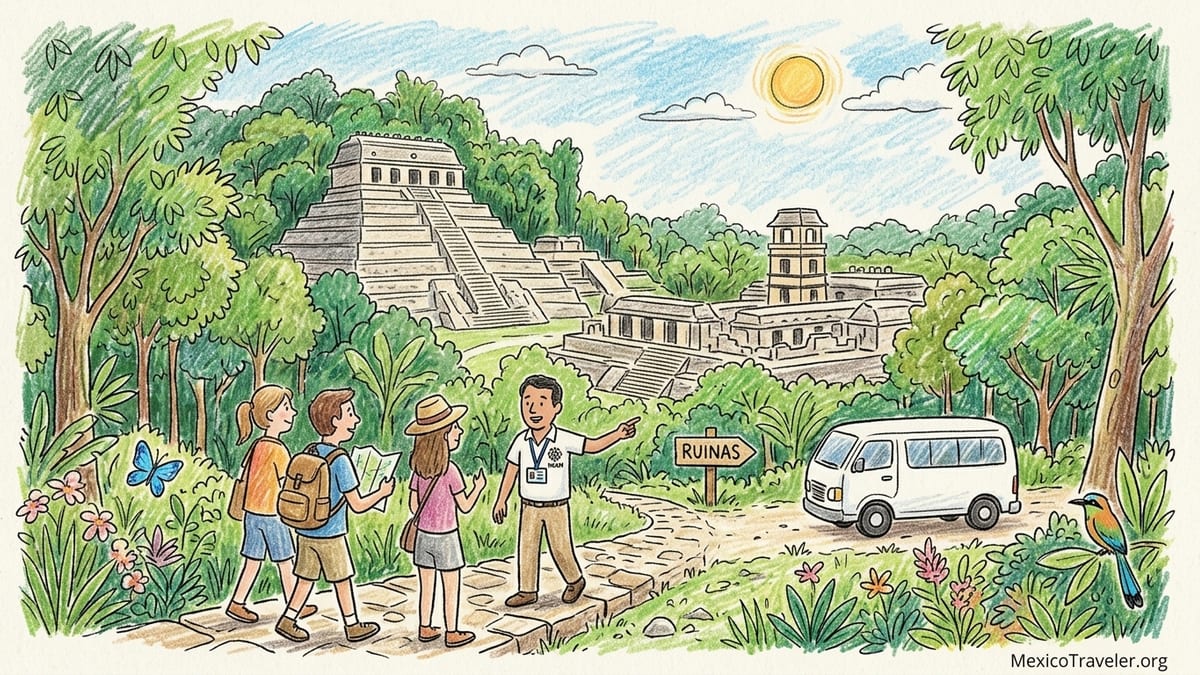
I left my hotel just after 7:00 a.m., early enough to reach the entrance slightly before the official 8:00 a.m. opening, but not so early that I had to wait in the dark. A passing colectivo heading to "ruinas" picked me up outside the hotel. These white shared vans ply the route between town and the archaeological zone throughout the day, and the ride from the jungle road hotels to the visitor center took a little under ten minutes. The air was already thick with humidity, and the windows fogged from the difference between the cool van interior and the warm outside air.
The driver dropped me at the large Centro de Atención a Visitantes (often called CATVI), which serves both the Palenque National Park and the archaeological site. From here, everything about the visit begins: tickets, toilets, basic food options, souvenir kiosks and a small cluster of officially credentialed guides waiting for the day’s first arrivals. A short walk up the paved path from the drop-off point leads to the main booths and the first glimpse of the forested hills that hide the ruined city.
Arriving early mattered immediately. There were only a handful of people milling around at 7:45 a.m., mostly independent travelers and a couple of small tour groups from Tuxtla and Villahermosa. By the time I left the site shortly after midday, the same area was crowded with large groups and school excursions. The early start did not just buy cooler temperatures and softer light for photography. It also meant shorter lines, more quiet moments in front of key monuments and space to hear the forest instead of competing loudspeakers.
Navigating Tickets, Dual Fees and Actual Costs
One detail that often surprises first-time visitors to Palenque is that entering the ancient city requires paying two separate public fees. One goes to Mexico’s National Institute of Anthropology and History (INAH) for the archaeological zone itself. The other goes to the National Commission of Natural Protected Areas (CONANP) for access to the surrounding Palenque National Park, which encompasses the forested hills and access road around the ruins.
The process is straightforward once you know what to expect. At the visitor center, I first paid the CONANP park charge at a small booth where staff were processing day visitors and vehicles. In 2026, the posted fee at Palenque is 215 pesos per adult for general admission to the national park, with a reduced rate around 110 pesos for Mexican residents and further discounts for students and teachers carrying national credentials. This ticket covers the entire park area, including the road section up to the ruins and the forest around the site.
A short walk away, still inside the same visitor complex, is the INAH ticket office. Here I paid the archaeological entrance fee for the ancient city and its on-site museum. Official INAH information currently lists Palenque in its highest price category, with a 210 pesos entrance fee for foreign visitors and a 105 pesos rate for Mexican nationals and foreigners with Mexican residency. Sundays are free for Mexican citizens, and there are nationwide exemptions for children under 13 and seniors with Mexican identification. The fee includes access to the Museo de Sitio “Alberto Ruz Lhuillier,” the site museum located on the same access road.
All tickets were sold in person at the CATVI windows the morning of my visit. There was clear signage in Spanish and English explaining which line was for the park and which for the archaeological zone, and payment was accepted in cash. Card machines were present but not consistently in use, and several staff quietly advised non-Mexican visitors to bring enough pesos just in case. Between the two public fees, the total base cost for two foreign adults in 2026 comes out to approximately 850 pesos before any extras such as parking or guiding. That was slightly higher than I had expected when I first budgeted for the trip, but still felt reasonable given that the combined ticket also includes a World Heritage archaeological city and one of the most impressive regional museums in the Maya area.
Hiring a Licensed Guide and Understanding the Site
As soon as I stepped away from the ticket booths, three men approached wearing laminated ID badges with the INAH logo. They were among the licensed guides who work legally inside the park. Rates are not fixed on a single posted board, but the group of guides at the visitor center used a laminated sheet that suggested prices depending on group size and language. For a two-hour private tour in Spanish for two people, the starting quote that morning was around 1,000 to 1,200 pesos. English and French tours were quoted slightly higher.
I chose to join a small mixed-language group: four people in Spanish, three in English, with one guide switching between the two. The negotiated rate worked out to roughly 350 pesos per person for about two and a half hours, with the understanding that we would begin at the Temple of the Inscriptions and finish at the Cross Group before exploring on our own. The fee included the guide’s interpretation but no transport or extras. Payment was in cash at the end of the tour.
In a site as dense with carved information as Palenque, a good guide makes a significant difference. The official INAH signage around the ruins is generally clear, with Spanish and English texts that summarize historical periods, rulers and major phases of construction. However, it is necessarily concise. The narrative at Palenque comes from long, complex hieroglyphic texts on temple panels and stucco reliefs. These do not read like myths, but like city annals recording births, accessions, rituals and political alliances of real rulers.
Our guide carefully distinguished this epigraphic history from the older romantic legends once popular in travel writing. Rather than describing Pakal as a mysterious astronaut or a semi-mythical "king of the jungle," he explained that INAH’s interpretation presents K’inich Janaab’ Pakal I as a Classic-period Maya ajaw, or lord, who ruled from AD 615 to 683. Inscriptions at Palenque trace his lineage from earlier rulers, record his accession as a teenager after political turmoil, and describe how his successors used temples to cement both dynastic continuity and connections to powerful patron deities. Hearing this with the temples physically in front of us, instead of filtered through outdated myths, was precisely why I was glad I had invested in a licensed guide.
First Impressions: Entering the Ancient City
The path from the ticket control into the main ceremonial zone leads uphill through dense greenery. Even just after 8:00 a.m., the air was heavy and the stone underfoot felt slick from overnight condensation. Within a few minutes, the trees opened onto the broad grassy expanse of the Great Plaza, framed by monumental structures in every direction. Directly ahead rose the stepped mass of the Temple of the Inscriptions, to the right the sprawling complex of El Palacio with its iconic tower, and behind us the forested slopes hiding residential groups and lesser-known temples.
The first surprise was how intimate the space feels compared with better-known sites such as Chichén Itzá or Teotihuacan. Palenque is not arranged around enormous, exposed plazas baked by the sun, but around a more compact series of interconnected courts and platforms where jungle still creeps close to the edges. The murmur of a nearby stream, the Otulum, was a constant background sound, reminding me that the Classic Maya name of this city, Lakamha’, means “Place of the Great Waters.”
Our guide led us straight toward the base of the Temple of the Inscriptions, pausing just short of the rope that now blocks access to its monumental stairway. This was my second surprise: at Palenque today, visitors can no longer climb the major pyramids, including the Temple of the Inscriptions and the temples of the Cross Group. The decision, according to both guides and INAH notices, is meant to protect fragile structures and conserve stucco, as well as to reduce accidents on steep, uneven steps made even more slippery by the region’s high humidity.
Instead of ascending, we circled the base, examining the massive stone blocks and the narrow openings that once led to the famous funerary chamber of Pakal. The scale is still overwhelming at ground level. Standing there, it is hard not to think of the 1950s excavations that cleared the blocked stairway and revealed a vaulted chamber deep inside the pyramid, where Pakal’s sarcophagus and carved lid were found along with rich grave goods. Today, access to the tomb is completely closed to the public. What remains visible is the exterior temple, its broad staircase and the context in which it dominates the Great Plaza.
Temple of the Inscriptions and the Story of Pakal
Even without climbing, the Temple of the Inscriptions remains Palenque’s emotional and intellectual core. Our guide used a nearby shade tree and a laminated reproduction of the temple’s interior panels to walk us through what INAH archaeologists have learned from decades of epigraphic work. The three large glyphic panels inside the upper temple are among the longest Maya inscriptions known. They do not describe a generic underworld journey in mythic time, but outline the history of Palenque’s royal house leading up to and beyond Pakal’s reign.
According to INAH’s published summaries, these texts record the births and accessions of earlier rulers, like K’uk’ Bahlam I and K’an Joy Chitam I, and link them through ritual events to important calendar stations in deep mythic history. Within this framework, the panels emphasize Pakal’s own accession date in 615, his status as a legitimate heir after a period of political instability, and the major building programs undertaken during his long rule. They also anticipate the future, noting the planned ceremonial roles of his sons and successors. It is, in effect, a dynastic history carved in stone.
This historical reading differs sharply from the once-popular pseudoarchaeological interpretations that portrayed Pakal’s sarcophagus lid as a rocket ship or mechanized device. At the site, INAH material presents the lid as a complex composition showing Pakal at the moment of death or transition, falling into or emerging from the maw of a cosmic creature associated with the underworld, framed by a world tree and celestial symbols. The imagery anchors him in a deeply Maya cosmology where lineage, maize and sacred time intertwine. Hearing the guide align this with the inscriptions and with comparable iconography from other Classic-period sites made the monument feel less like a mystery and more like a legible, if intricate, statement of political theology.
Standing there in the mid-morning heat, with sweat already running down my back, I was struck by how much time you can spend at just this one structure if you allow the texts to slow you down. Many groups pose for a quick photograph in front of the staircase and then move on. With a guide who can read at least the broad strokes of the glyphs, the temple becomes a narrative anchor that reframes the rest of the city. It took nearly forty-five minutes before we turned toward the Palace, and I did not feel a second was wasted.
Exploring El Palacio: Towers, Passages and Inscriptions
El Palacio, or the Palace, stretches along one side of the Great Plaza like a low, terraced acropolis crowned with colonnaded buildings and the unusual four-level tower that appears in almost every postcard of Palenque. Approaching from the Temple of the Inscriptions, we walked up a set of broad stone steps to reach the complex’s first courtyard. Here, climbing is still permitted in a controlled way. Visitors can ascend various staircases to reach different levels of the Palace, walk through roofless halls and peer into vaulted interior rooms, always following roped-off areas and directional signs.
The stone was still slick in shaded spots, and some steps are narrow or irregular, so handrails and caution are essential. Compared with the main pyramids, however, the Palace remains one of the few places where you can physically engage with upper levels of monumental architecture at Palenque. From the higher platforms near the tower, the view back toward the Temple of the Inscriptions and across the Great Plaza is one of the site’s finest.
Historically, INAH describes the Palace as a complex of administrative and residential structures used by the royal court. The tower likely functioned as an observation point and perhaps had astronomical or ritual significance, while the interior tablets and carved piers record important events in the lives of Pakal and his successors. Our guide pointed out a replica of the Palace Tablet, one of the longest inscriptions found here, whose original is preserved to protect it from weathering. The text records the accession of K’inich K’an Joy Chitam II, one of Pakal’s sons, and ties his rule back to his father and grandfather, underscoring how succession and continuity were central concerns for Palenque’s elites.
Inside, some passages are low and partially reconstructed, and conservators were visibly at work in certain sections, their tools and barriers discreet but present. Archaeological activity at Palenque is far from finished. Recent INAH reports describe ongoing excavations in residential groups and lesser-known sectors, including a cemetery discovered in Group IV. Visitors do not see trenches in the main plazas, but the plastic sheeting and scaffolded corners of certain structures are reminders that this is an active research site as well as a photogenic ruin.
The Cross Group: Temples of the Sun, Cross and Foliated Cross
From the Palace, a shaded path leads uphill to one of Palenque’s most important ceremonial ensembles: the Cross Group, consisting of the Temple of the Cross, Temple of the Foliated Cross and Temple of the Sun. The route winds through forest and smaller platforms, and the ascent is where the site’s humidity becomes truly apparent. Even in the shade, the climb left most of our group flushed and breathing more heavily than the modest distance would suggest. Stone steps here are particularly slippery in the morning when condensation still clings to mossy corners.
At the top of the first slope, the Temple of the Cross rises ahead on a high stepped platform, while the Temple of the Foliated Cross stands to the right and the lower, more compact Temple of the Sun to the left. These three temples were built under K’inich Kan Bahlam II, Pakal’s son, in the late seventh century, and their dedication texts, as interpreted by INAH and other scholars, weave together dynastic events with the stories of patron deities sometimes called the Palenque Triad. The group’s layout suggests a carefully planned symbolic landscape rather than a random cluster of shrines.
Climbing is again restricted. Rope barriers prevent ascent of the tall central stairways, and INSIDE access to the inner sanctuaries is closed to casual visitors. However, you can still approach relatively close to the base, which allows you to study architectural details and, where preserved, stucco fragments and stair moldings. From the open platform in front of the Temple of the Foliated Cross, there is an excellent vantage point back across the valley toward the Palace and the Temple of the Inscriptions, reminding you how interconnected these monuments are visually.
Our guide explained that the Temple of the Sun is especially noted for its carved panel depicting ritual scenes around an emblematic sun shield, while the Temple of the Foliated Cross emphasizes maize imagery and a leafy world tree. Rather than treating them as generic “sun temples” or “corn temples,” INAH interpretations situate these buildings within a local Palenque theology that linked Kan Bahlam’s rule to cosmic cycles and to deities responsible for agricultural fertility, warfare and dynastic legitimacy. Without someone to unpack that, these would simply be beautiful, somewhat inaccessible pyramids framed by jungle. With the epigraphic context, they become stages for specific rituals performed on specific dates, many of which are recorded in the carved texts themselves.
Wildlife, Weather and Walking Conditions in the National Park
It is easy to forget, while reading plaques about Classic-period rulers, that you are standing inside a modern protected area as well as an archaeological zone. Palenque National Park covers the forested hills around the ruins, and even during a focused morning among the monuments, the living jungle insists on its presence. From the earliest hour, I heard howler monkeys somewhere beyond the main clearings, their deep, resonant calls carrying over the treetops like distant thunder. I never saw them clearly from the plazas, but several visitors on forest-side paths pointed to moving branches high above where dark shapes leaped between trees.
Birdlife was more visible. While sitting for a short rest near the stream below the Palace, I watched bright blue and yellow butterflies drift over the water, and small birds dart between shrubs. On the shaded trail down toward the museum in the late morning, a pair of motmot-like birds with pendulum tails flashed briefly across the path before vanishing into the undergrowth. None of these encounters were staged or guaranteed. They were simply the kind of unscripted wildlife moments that occur when large human crowds have not yet filled the walkways.
The environment is beautiful but demanding. Humidity at Palenque often sits well above 80 percent, and temperatures climb quickly once the sun clears the canopy. Even in October and November, which many travelers consider shoulder or “cooler” months, the combination of heat and steep stone steps makes the visit feel more strenuous than a flat walk of similar distance. Surfaces range from relatively smooth, restored plazas to rough, original steps with uneven risers. Several areas near the stream and in shaded corridors of the Palace remained damp well into the late morning, and I saw more than one person slip slightly while descending too quickly.
Good footwear is not optional here. Closed shoes with real tread made me feel much more secure when climbing the permitted staircases and navigating slick patches. I also lost count of how many times I wiped my camera lens and phone screen because of condensation and sweat. Photography is allowed for personal use without additional fees, but tripods and equipment that look “professional” can trigger extra charges and restrictions at INAH sites, something worth checking locally before arrival. Between wiping lenses and seeking shade, I was grateful I had started early. By 11:30 a.m., exposed plazas were noticeably hotter, and the simple act of walking between the Cross Group and the museum had become a slow, sweaty effort.
The Site Museum: Alberto Ruz Lhuillier’s Legacy
After the guided tour ended at the Cross Group, I peeled off and followed the descending forest trail toward the Museo de Sitio de Palenque “Alberto Ruz Lhuillier.” The walk takes about 15 to 20 minutes at a relaxed pace, passing smaller residential platforms and traces of lesser-visited structures before crossing the stream on a small bridge. It is here, in the transitional zone between core monuments and visitor infrastructure, that you most clearly perceive the distinction between archaeological complex and national park. The forest feels wilder, with thicker undergrowth and fewer maintained lawns, and signage shifts from dynastic explanations to more general information about protected flora and fauna.
The museum itself sits near the road, somewhat hidden in the trees. Admission is included with the INAH ticket. Inside, air conditioning and softer lighting provide instant relief from the heat outside. INAH’s curators present one of the richest collections of artifacts from any Maya site museum, including sculptures, ceramics, jewelry and architectural elements recovered during decades of excavation. The exhibits are in Spanish with some English translations, and they walk visitors through Palenque’s development from early occupation through its Classic peak and eventual decline.
One of the highlights is the display related to Pakal’s tomb, including a replica of the famous sarcophagus lid and parts of the jade funerary mask associated with his burial. Here, explanatory panels revisit the interpretation of the lid in clear, measured language, emphasizing its iconography of world tree, celestial bands and underworld creatures rather than sensationalist theories. Seeing the reproduction in the controlled environment of the gallery, with line drawings nearby, clarified details that are difficult to appreciate from photographs alone.
The museum also devotes attention to the Cross Group temples and to the wider political landscape of the Usumacinta region. Palenque was not an isolated jungle kingdom, but part of a network of city-states that traded, intermarried and at times fought with neighbors like Toniná, Yaxchilán and Pomoná. Inscriptions at Palenque and these other sites record captive-taking, alliance-building and ritual events that reveal Palenque’s political importance as a regional power during the seventh and eighth centuries. This broader context helped me see the temples I had just visited not just as aesthetic masterpieces, but as instruments in competitive Maya statecraft.
Time, Costs and Was a Guide Worth It?
From hotel departure to walking back out through the park gates, my visit to Palenque’s archaeological zone lasted just under five hours. Roughly three hours were spent among the core monuments and plazas, with about two hours of structured guiding and an hour of free wandering. Another hour unfolded on the forest trail and in the museum. That felt like a minimum for a thoughtful first visit. You can sprint through in two or three hours, but you will compromise depth at either the temples or the museum.
In terms of budget, two foreign adults in 2026 can expect to pay about 850 pesos in public entrance fees, plus transport and optional guiding. A short colectivo ride from the jungle road hotels or the main town to the visitor center costs a modest sum per person, far below the entrance fees. The most variable line item is guiding. Joining a small mixed group brought the price of a two and a half hour tour down to around 350 pesos per person in my case. A fully private tour could cost closer to 1,000 or 1,500 pesos for a couple, depending on language, duration and negotiation.
For travelers who already have a deep background in Maya epigraphy or who prefer to read site reports on their own, it is certainly possible to explore Palenque independently using INAH’s signage and a good printed guidebook. For most visitors, however, a licensed on-site guide is worth the fee. The inscriptions at Palenque are dense and not easily decoded from short panel texts. A solid guide can bridge that gap by summarizing decades of INAH research into accessible stories without resorting to outdated legends. In my case, understanding the historical sequence around Pakal, Kan Bahlam and their successors turned what could have been a picturesque ruin into a legible capital city with remembered rulers and recorded events.
Looked at as a whole, the total cost for two adults, including a shared guide, transport from nearby accommodation and modest snacks, came in under what many beach resort excursions cost per person in other parts of Mexico. It felt like exceptional value for a full morning in a World Heritage city and national park, especially given that revenue from both INAH and CONANP tickets supports heritage conservation and environmental protection.
The Takeaway: What Impressed Most and What I Would Do Differently
Two elements of Palenque impressed me most. The first was the way the city’s architecture is inseparable from its forested setting. From the Palace tower and the platform below the Temple of the Foliated Cross, I could see pyramids rising like stone islands above a sea of green, with low clouds clinging to distant ridges. Unlike more exposed sites, Palenque still feels partly claimed by the jungle. That intimacy with the surrounding national park landscape gives each view depth and context that photographs rarely capture.
The second was the intellectual richness of the inscriptions and their INAH-backed interpretation. Learning that the Temple of the Inscriptions functions as a dynastic ledger, that the Cross Group’s panels anchor specific rituals in time, and that the Palace tablets record concrete political transitions, all shifted my impression of the site. Palenque is not just an evocative ruin. It is one of the most eloquent Maya voices we have, narrating its own history in stone with a clarity rarely matched elsewhere.
If I could change anything about my visit, I would give the site a full day instead of a single extended morning. With more time, I would explore additional residential groups along the ecological and archaeological trails that branch away from the main plazas, and I would linger longer in the museum’s less dramatic but equally informative sections. I would also consider visiting on a weekday outside national holidays, when both school groups and domestic tourism flows are lighter.
Was Palenque worth traveling into Chiapas specifically to see it? Absolutely. Even if you come to the state for waterfalls, canyons or colonial towns, this ancient city justifies its own detour. The combination of monumental architecture, active scholarship, living jungle and tangible epigraphic history makes it one of the most complete archaeological experiences in the Mundo Maya. Go early, carry water, respect the roped-off areas, and give yourself time to let the stones speak. They have a great deal to say.
FAQ
Q1. Do I need to buy Palenque tickets in advance?
For an independent visit, you normally buy both the national park and INAH archaeological tickets in person at the visitor center on the day of your visit. As of late 2026, advance online tickets are promoted on some official platforms, but on-the-spot purchase remains the standard for most travelers.
Q2. How much does it cost for two adults to visit Palenque?
In 2026, foreign visitors pay about 215 pesos per person for Palenque National Park and 210 pesos per person for the archaeological zone and museum, so two adults should budget roughly 850 pesos in mandatory public fees, plus transport and any optional guide.
Q3. Can I still climb the pyramids at Palenque?
Climbing the major pyramids, including the Temple of the Inscriptions and the main temples of the Cross Group, is no longer allowed in order to protect the structures and visitor safety. Limited climbing within the Palace complex is still permitted on designated stairways and platforms.
Q4. Is a licensed guide at Palenque worth the extra cost?
For most visitors, yes. A licensed guide helps interpret the dense Maya inscriptions and explains INAH’s current historical understanding of Pakal and his dynasty, turning a beautiful ruin into a much more meaningful archaeological experience.
Q5. How difficult is the walking at the site?
The main plazas involve moderate walking, but humidity, heat and many stone stairways make the visit more strenuous than it looks. Trails to the Cross Group and down to the museum include uphill and downhill sections with slippery steps, so sturdy footwear and regular water breaks are important.
Q6. What wildlife might I realistically see at Palenque?
You are likely to hear howler monkeys and see a variety of birds and butterflies in the surrounding forest. Actual close sightings of monkeys or other larger animals are possible but not guaranteed, and often occur along quieter paths rather than in the busiest plazas.
Q7. What time of day is best for photography?
Early morning offers softer light, fewer visitors in your frames and slightly cooler temperatures, which helps prevent constant lens fogging. By late morning, light becomes harsher and plazas fill with groups, making thoughtful photography more challenging.
Q8. How much time should I plan for a first visit?
A minimum of four to five hours allows enough time for a guided overview of the main temples, unhurried exploration of the Palace and Cross Group, the forest trail, and a meaningful visit to the site museum.
Q9. Is Palenque suitable for travelers who are not archaeology experts?
Yes. You do not need a background in Maya studies to appreciate Palenque. With basic preparation or a good guide, the combination of architecture, jungle setting and clear INAH signage makes the site accessible and engaging for non-specialists.
Q10. Does visiting Palenque require an overnight stay nearby?
Staying at least one night close to the ruins is highly recommended so you can arrive at the site around opening time. While day trips exist from other Chiapas hubs, the early start and flexible schedule you get by sleeping near the jungle road greatly improve the overall experience.