

The Lacandon Jungle is where Chiapas feels at its most remote: low mist over the canopy at sunrise, howler monkeys calling before dawn and Maya sites slowly emerging from the forest. From the traveller hub of Palenque, you can reach Yaxchilán, Bonampak and the Lacanjá community on a range of guided tours that mix archaeology, river travel and rainforest nights. This guide explains how those trips actually work on the ground in 2026 so you can choose the right combination of ruins, jungle and overnight experiences.
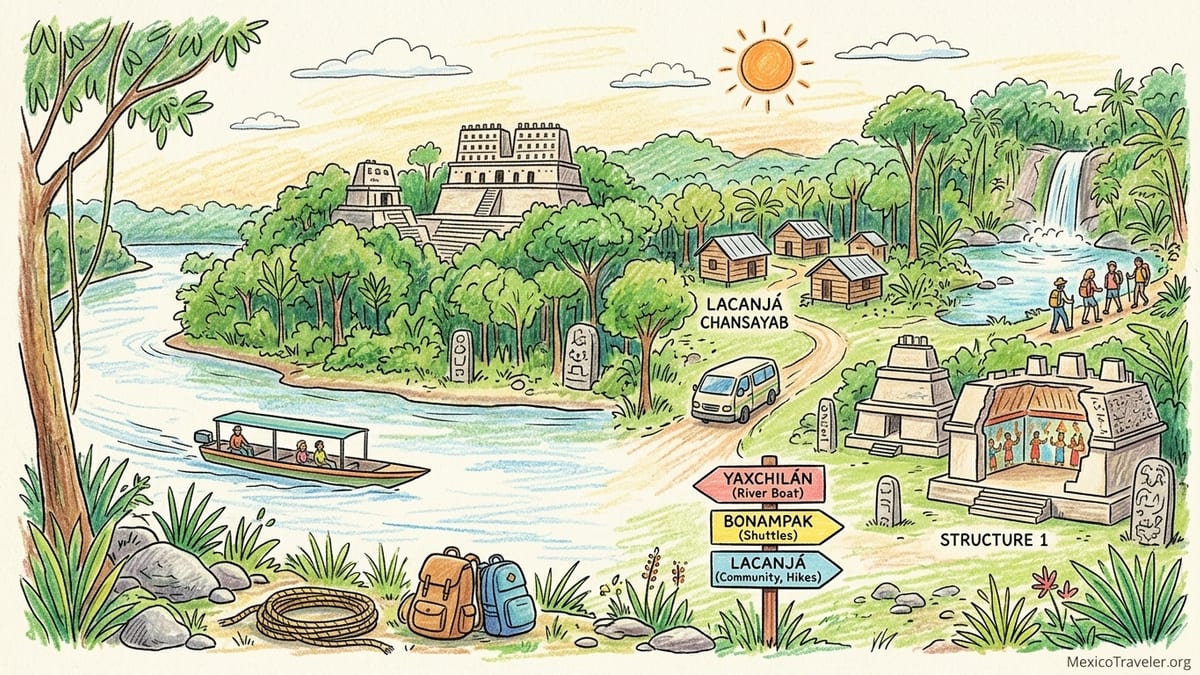
Understanding Yaxchilán, Bonampak and Lacanjá from Palenque
For visitors based in Palenque, the classic Lacandon Jungle circuit links three distinct experiences. Yaxchilán is a major Classic-period Maya city perched on a bend of the Usumacinta River, reached only by boat from the riverside village of Frontera Corozal about 185 kilometers by road from Palenque. The setting feels isolated even today, with the jungle pressing in on plazas and roof combs. Bonampak, by contrast, is famous not for scale but for its painted murals that show courtly life and warfare in vivid detail. It lies inland from the river and is reached by road plus a compulsory transfer into vehicles operated by the local Lacandon community. Lacanjá Chansayab is a Lacandon Maya settlement further west along the same frontier highway that serves as a base for jungle walks, river rafting and the little-visited ruins of Lacanjá, sometimes called the Lost City.
Yaxchilán and Bonampak are administered as archaeological zones by Mexico’s National Institute of Anthropology and History, while Lacanjá is a community area with a mix of small local initiatives. INAH currently lists free admission to Yaxchilán for both foreign and Mexican visitors, but boat transport from Frontera Corozal costs about 1,200 pesos and there is an additional local self-defense fee of around 35 pesos. That 1,200-peso charge is for the entire boat, not per person, so the real cost per visitor depends on how many people share. At Bonampak, INAH publishes a basic archaeological admission, but reaching the site requires paying the Lacandon community entrance fee and hiring one of their shuttles from the highway access. Those community and transport tariffs are set locally and collected per person or per vehicle depending on the component, so total costs fluctuate and are easiest to understand when bundled into a guided tour quotation from Palenque.
From Palenque town, almost all tours follow Federal Highway 199 then the frontier road toward Benemérito de las Américas. Road conditions on this route change with weather and maintenance but, as of late 2026, travellers report mostly paved surfaces with occasional potholes, speed bumps and agricultural or police checkpoints. Drive times from Palenque to Frontera Corozal usually fall between four and five hours including a breakfast stop used by many tour operators. Lacanjá Chansayab lies somewhat closer to Palenque than the river and works both as a midway stop on a long day trip or as an overnight base that breaks the long return drive.
Although confident independent travellers can in theory self-drive to Frontera Corozal and negotiate a boat, most visitors now choose organized tours from Palenque or San Cristóbal de las Casas. These packaged trips combine highway transport, river boat, site admissions and community fees into a single rate and, crucially, rely on drivers and guides who know current local security conditions. For first-time visitors or anyone with limited Spanish, these guided arrangements usually remove a lot of uncertainty around payments, schedules and access rules.
One-Day Archaeology Excursions from Palenque
The fastest way to sample the Lacandon Jungle from Palenque is a single long day focusing on Yaxchilán and Bonampak. Several regional operators now market this as a one-day product of roughly 14 hours, with hotel pickup in Palenque around 5:30 or 6:00 in the morning and return by about 8:00 in the evening. A typical private or small-group tour includes round-trip highway transport, breakfast stop on the way out, the shared riverboat from Frontera Corozal to Yaxchilán, admissions and local community fees, a simple regional lunch and a guided visit at both archaeological sites.
The key logistical difference between the two ruins is how you reach them once you leave the main road. Yaxchilán requires the river crossing along the Usumacinta. At Frontera Corozal’s embarcadero you board long, narrow motorized launches with a canopy roof and basic bench seats. INAH lists the standard boat service at 1,200 pesos per craft, and that tariff refers to the whole boat for a round trip of about one hour each way, usually with up to six or eight passengers. In practice, tour companies prearrange their own boats so you may never see the raw price, but independent travellers sharing with others will want to confirm how many people are splitting the fare before departure.
Bonampak is reached by land from the frontier highway. Instead of private cars and outside tour vehicles entering the reserve, visitors transfer into pickups, vans or minibuses owned by the Lacandon ejido and sold as a short shuttle service along the access road. Current community practice, described by travellers and local press in 2024 and 2025, is to charge a per-person entrance to the Bonampak reserve and a separate fee for the community vehicle, which usually operates effectively as a shared taxi between the highway and the site. When you buy a day tour from Palenque, those costs are mostly invisible because they are embedded in your overall package. If you arrive in your own car, you will pay INAH admission at the archaeological ticket office and the community-related fees at or near the turnoff from the highway.
Physically, a one-day run to both ruins is not especially technical but it is long. Walking at Yaxchilán involves uneven limestone steps, tree roots, humid conditions and some short but steep climbs. Bonampak’s core is more compact yet still requires ascending stairways to reach the mural chamber on Structure 1. Combine that with eight to ten hours of road and river travel plus high humidity and you have a day that can feel punishing if you dislike heat or get carsick. For visitors on tight schedules, however, this concentrated format offers a realistic way to see both sites in a single calendar day without overnighting in the jungle.
Two-Day Jungle and Ruins Combinations
Travellers who can spare more time increasingly favor two-day combinations that mix Yaxchilán and Bonampak with jungle activities or a slower pace. Several agencies based in Palenque and the wider Yucatán region advertise “Selva Lacandona 2 días” or similar, often including Yaxchilán, Bonampak and a night at Lacanjá Chansayab. A mid-range example promoted in 2026 lists a price of about 6,500 pesos per person for a private two-day, one-night package with transport from Palenque, boat to Yaxchilán, admissions, three or four meals, bilingual guide and rustic cabin accommodation inside the Lacanjá community.
A common itinerary for these two-day tours departs Palenque around 6:00 in the morning on Day 1, reaches Bonampak by late morning for a guided visit, then continues to Lacanjá for lunch and check-in. The afternoon might include a short jungle walk to a waterfall on the Lacanjá River or time to rest in a hammock overlooking the forest. After dinner in a community dining room or small restaurant, guests sleep in basic wooden cabins or concrete bungalows with private bathrooms, mosquito nets and intermittent electricity supplied from the village grid or generators. On Day 2, the program usually continues either with an early jungle hike or directly with the drive to Frontera Corozal for the Yaxchilán boat, followed by the long return to Palenque in the afternoon and evening.
By stretching the itinerary over two days, you significantly reduce the sense of rushing between vans, boats and ruins. This also builds in more buffer time for weather or security related delays on the frontier road, which occasionally sees temporary closures or slowdowns, particularly during heavy rains or local protests. From a comfort perspective, two-day tours are better suited to families with school-age children, photographers carrying heavier gear and anyone sensitive to heat or motion, because you get a proper night’s sleep near the jungle instead of 14 continuous hours on the move.
Costs for these combinations break down across several components even if you pay one figure. In addition to the 1,200-peso Yaxchilán boat cost per craft and INAH’s listed archeological entries, operators pay Lacandon-managed fees in Lacanjá and Bonampak for reserve entry, local guides and the mandatory transfer vehicles. When comparing quotes, ask agencies to clarify which payments go directly to community partners. Some, especially those that advertise collaboration with specific Lacanjá families or eco-camps, highlight that a meaningful share of the package stays in the villages through lodging, meals and guide services.
Lacanjá Community Stays and Overnight Rainforest Experiences
Lacanjá Chansayab has evolved into the main overnight base for independent travellers and small groups who want to stay inside the forest without a full-scale resort. The community offers several clusters of rustic cabins and tented camps marketed under names such as Campamento Río Lacanjá, Top Che and similar projects. Rooms are usually simple wooden or brick structures with tin roofs, mosquito nets, cold-water showers and basic bedding. Electricity is generally available in the evenings, and the village now has grid power and satellite internet, though Wi-Fi in individual lodges can be slow and intermittent. Visitors should expect patchy mobile reception and treat any online connection as a bonus, not a guarantee.
Overnight guests usually eat in simple dining palapas or small on-site restaurants serving set menus: eggs, tortillas and beans at breakfast, chicken in tomato sauce, grilled fish or stewed pork for main meals, accompanied by rice, salad and fresh juices. Tour packages often include dinner and breakfast, while independent travellers may pay per meal. Vegetarian options exist but are limited, so those with dietary restrictions should communicate clearly when booking and carry some high-energy snacks. Since supermarket access is several hours away in Palenque or Ocosingo, choice is more restricted than in town and prices reflect the logistical effort of bringing supplies into the community.
Lacanjá stays typically include or offer add-on rainforest walks to nearby waterfalls and the partially cleared ruins of Lacanjá itself, which sit about an hour and a half into the forest along narrow footpaths. Community guides, often Lacandon Maya trained under Mexican adventure standards, lead these excursions. They interpret medicinal plants, tree species and basic wildlife tracks, and set the group’s walking pace according to fitness levels. A standard loop might involve three or four hours of walking with stops for swimming in a clear river pool and exploring moss-covered structures still tangled in vine roots.
Accommodation standards in Lacanjá remain deliberately rustic, with plenty of insect life, night sounds and occasional power cuts. For many visitors, that is part of the appeal. However, travellers used to air-conditioned beach hotels or boutique jungle lodges elsewhere in Mexico should adjust expectations. Sheets may be slightly damp in the humid air, showers may only offer cold water and generators can shut off overnight, cutting fan power. Travelling with a small battery-powered fan, headlamp, dry bags and a lightweight sleep sheet can greatly improve comfort during a community stay.
Guided Rainforest Walks and Wildlife-Focused Trips
Beyond the marquee ruins, the most rewarding part of staying in the Lacandon Jungle is time on foot in the forest. Multiple operators sell dedicated hiking days from Palenque to Lacanjá, focusing on jungle paths, river crossings and cascades rather than archaeology. A typical day-hike product picks guests up in Palenque at first light, stops for breakfast on the highway, then hands the group over to Lacanjá-based guides for a four to six kilometer walk through secondary and primary forest. The route often includes swimming at waterfalls, crossing shallow streams on foot and visiting a small, vine-covered ruin hidden in the trees before lunch in the village and the road transfer back to town.
For more committed nature travellers, multi-day wildlife itineraries exist that combine overnight camping with rafting or kayaking on the Lacanjá or Lacantún rivers and side trips to Yaxchilán or Bonampak. These programs might run three to five days and are usually sold by niche eco operators. Rafting segments on the Lacanjá are marketed as scenic rather than extremely technical, with modest rapids and long calm sections where you drift between overhanging branches and see kingfishers, herons and occasional river turtles. Nights are spent in tents on raised platforms or at simple riverside camps, with community cooks providing meals.
Wildlife expectations should be realistic. This is excellent habitat for howler and spider monkeys, toucans, motmots, various parrots and raptors, along with more secretive mammals such as tapirs, peccaries and jaguars. However, dense vegetation and the animals’ natural shyness mean sightings are far from guaranteed. Many visitors hear howler monkeys before dawn or catch glimpses of troops in the canopy near Lacanjá and Yaxchilán, and birders with binoculars regularly tick off a long list of forest species. Close encounters with big cats remain exceptionally rare and should never be promised by a responsible guide. Instead, tours should emphasize tracks, calls, feeding sign and broader ecological interpretation as much as dramatic animal moments.
Physical difficulty on jungle walks ranges from easy to strenuous depending on rainfall and itinerary. Roots and mud make even short sections slippery, and high humidity increases fatigue. Most commercial tours from Palenque set their hikes at an accessible moderate level but assume guests can walk several kilometers on uneven ground without knee or balance issues. Trail runners with good grip, light long trousers, insect repellent and a compact rain jacket are more important here than heavy mountaineering boots. Travellers with mobility limitations can still enjoy short forest forays near Lacanjá cabins or viewpoints at Yaxchilán but may find longer treks impractical.
Booking, Community Enterprises and Practical Logistics
When arranging Lacandon Jungle travel from Palenque, you face a choice between booking through locally rooted community enterprises or via outside intermediaries such as national tour chains and online resellers. Community-based providers in Lacanjá and Frontera Corozal often operate modest websites or rely on partner agencies in Palenque to market their cabins and guide services. Larger intermediaries package these same on-the-ground services under their own branding, sometimes at a markup that reflects added overheads and multilingual support. For travellers who prioritize maximising the share of payment that reaches local hosts, it is worth asking a Palenque agency which camp, lodge or boat cooperative they actually use and how much of your fee is passed through.
Checking credentials is more practical in person than online. In Palenque, look for agencies with established street-front offices, visible business licenses on the wall and printed itineraries that list inclusions transparently. Ask whether river and rafting guides hold Mexican adventure tourism certifications and whether vehicles are insured and registered as tourist transport rather than informal taxis. In Lacanjá, many camp operators display recognition plaques or training certificates issued by Chiapas tourism authorities. Speaking directly with hosts or guides, even in basic Spanish, often reveals whether they are long-term community residents with a stake in sustainable tourism or outside brokers.
Most Lacandon Jungle tours must be paid in Mexican pesos. Some Palenque agencies now accept card payments in their offices or online deposits from abroad. Boatmen in Frontera Corozal, community gatekeepers in Bonampak and Lacanjá lodges, however, usually deal in cash. ATMs are limited or nonexistent along the frontier highway, and machines in Palenque can occasionally run short of funds on busy weekends. As a result, it is sensible to withdraw enough pesos in Palenque to cover tips, additional community fees not bundled into your tour and incidentals such as drinks and souvenirs. Carrying small denominations is crucial, since change for large notes is hard to find in remote villages.
Facilities along the route are basic but present. INAH lists toilets at Yaxchilán, though visitors should not expect hotel-level cleanliness or abundant paper. Bonampak likewise has simple restrooms near the parking area and site entrance. In Lacanjá, camps have shared or private bathrooms plus cold showers, while trailheads and waterfalls rarely offer formal facilities. Travelers who prefer higher standards of sanitation often pack hand sanitizer, a small pack of tissue and a quick-dry towel for use after swimming. Drinking water is usually included in guided tours, but bringing your own reusable bottle reduces plastic waste and lets you take advantage of safe refill points.
Weather, Safety, Cancellations and Current Road Advice
The Lacandon Jungle climate is warm and humid year-round, with average temperatures above 22 degrees Celsius and frequent rainfall. The wettest months are typically June through October, when rivers run higher and trails become muddier. Heavy downpours in this period sometimes delay boat departures to Yaxchilán or make certain unpaved access roads temporarily impassable. Tour operators build in some flexibility for timing, but in rare instances they cancel or modify itineraries for safety, offering date changes or partial refunds according to their policies. Before booking, request written terms for weather-related changes and clarify whether any nonrefundable community or transport fees fall outside agency control.
From a broader safety perspective, remote roads in Chiapas can occasionally be affected by local protests, blockades or security incidents. Conditions are fluid, and official travel advisories from foreign ministries and Mexican authorities sometimes recommend caution on nighttime driving, especially along the Ocosingo route and the frontier road. In 2026, many travellers still report uneventful journeys with daylight departures and use of recognized tour operators. Nonetheless, itineraries may be altered at short notice if agencies learn of issues ahead. When booking, ask who monitors current conditions and how they will communicate last-minute changes, and favor companies that propose early-morning departures and avoid driving after dark.
Travelers with medical conditions such as severe allergies, asthma or cardiovascular issues should factor the remoteness of the region into their plans. Clinics in Palenque handle routine problems, but more serious cases may require evacuation to larger cities. Carrying any personal medications, a basic first-aid kit and copies of prescriptions is critical. Mosquito protection matters not only for comfort but also to reduce exposure to mosquito-borne illnesses that exist in the region. Lightweight long-sleeve clothing, repellent containing an effective active ingredient and bed nets in good condition significantly cut bite numbers.
Because services in the Lacandon Jungle operate on thin margins and depend on local communities, travellers sometimes encounter informal changes in prices or fees compared with what was quoted months earlier. Rather than assuming bad faith, it helps to ask politely when and why tariffs changed and to keep a small contingency budget for such differences. If you are uncomfortable with on-the-spot negotiations at river docks or community gates, booking a package through a reputable Palenque agency that guarantees a final price and absorbs minor increases can make the experience smoother.
Which Tour Style Fits You: Comparisons by Traveler Type
Budget-conscious travellers are usually best served by long day trips or stripped-down two-day packages that rely on shared transport, minimal extras and basic cabins in Lacanjá. For example, a day excursion that fills a Yaxchilán boat to capacity can spread the 1,200-peso craft cost across several passengers, while shared vans amortize fuel and driver wages. Budget travellers willing to sacrifice some flexibility for a fixed low price might accept larger groups and simpler meals to make these costs work. Those who prefer more control can reduce expenses by self-driving to Frontera Corozal and Lacanjá but must still factor in fuel, parking and mandatory community charges that cannot be negotiated away.
Photographers, especially those interested in ruins emerging from mist and wildlife, usually benefit from overnight or two-day programs. Staying in Lacanjá or along the river positions you for sunrise and late-afternoon light when Yaxchilán’s structures and surrounding forest look most dramatic, and when birds and monkeys are more active. A two-day tour that visits Bonampak on Day 1 and Yaxchilán on Day 2 without a frantic schedule allows extra minutes to work each angle, wait out passing tour groups and experiment with long exposures in the shaded forest. Bringing protective gear for cameras, such as dry bags and microfiber cloths, is essential due to humidity and sudden showers.
Archaeology enthusiasts, who may already have visited Palenque itself, typically favor itineraries that maximise site time over secondary activities. For them, the best option is often a two-day combination from Palenque with extended guided visits at both Yaxchilán and Bonampak plus optional add-on exploration at Lacanjá’s lesser-known ruins. Requesting a guide with strong historical knowledge rather than a generalist nature guide can make a significant difference. Some agencies can arrange bilingual specialists who focus more on inscriptions, dynastic history and iconography, though these services often cost more and may require private arrangements instead of standard shared-group offerings.
Families and travellers seeking a gentle introduction to the rainforest atmosphere without overtaxing children might consider an overnight Lacanjá stay with one major ruin day. A pattern that works well in practice is Day 1 drive from Palenque to Lacanjá with a short jungle walk and swimming at a waterfall, sleep in a cabin with the night sounds of frogs and insects, then Day 2 drive to Bonampak for a relatively compact site visit before returning to Palenque. Attempting both Yaxchilán and Bonampak in a single very long day with kids can be exhausting because of the heat, early start and long transport hours.
Travellers who truly want an immersive rainforest experience, complete with multiple jungle walks, river journeys and nights far from town, should opt for full two-day or multi-day tours rather than anything labeled as a “marathon” day trip. This is especially true for those sensitive to car travel or older visitors who might find 14 hours of movement too tiring. While a well-organized single-day Yaxchilán and Bonampak loop is feasible if your time in Chiapas is very limited, it is not the ideal way to appreciate the subtle qualities of the forest, community life in Lacanjá and the evocative setting of the Usumacinta River.
FAQ
Q1. Is the 1,200-peso Yaxchilán boat charge per person or per boat?
INAH currently lists the standard Yaxchilán boat service at around 1,200 pesos per craft for the round trip from Frontera Corozal, not per passenger, so the per-person cost depends on how many people share the boat.
Q2. How are Bonampak’s community and transport fees charged?
Visitors pay INAH archaeological admission plus local Lacandon fees for reserve entry and the mandatory shuttle vehicle from the highway turnoff, usually calculated per person for entrance and as a shared vehicle charge for the short transfer.
Q3. How long is the drive from Palenque to Yaxchilán and Bonampak?
Most tours allow four to five hours to reach Frontera Corozal from Palenque, including a breakfast stop, with Bonampak and Lacanjá positioned slightly closer along the same frontier highway.
Q4. What is the accommodation like in Lacanjá Chansayab?
Lacanjá offers simple cabins and camps with mosquito nets, basic beds, cold-water showers and evening electricity, plus on-site dining rooms serving set menus of regional dishes.
Q5. Will I have internet and phone signal in the Lacandon Jungle?
Lacanjá now has grid electricity and limited satellite internet, but Wi-Fi is patchy and mobile reception unreliable, so travellers should not depend on constant connectivity.
Q6. Are Lacandon Jungle hikes suitable for children and older travellers?
Short jungle walks around Lacanjá and the core areas of Yaxchilán and Bonampak are manageable for reasonably fit visitors, but longer treks with muddy trails and river crossings can be challenging for small children or those with mobility issues.
Q7. What wildlife am I likely to see on jungle tours?
Most visitors hear and often glimpse howler and spider monkeys and see a variety of birds, reptiles and insects, while sightings of larger mammals such as tapirs or jaguars are rare and should never be guaranteed.
Q8. Do I need to book Lacandon Jungle tours in advance?
In high season and holiday periods it is sensible to book at least several days ahead through a Palenque agency or directly with Lacanjá camps, while in quieter months some travellers arrange tours with one or two days’ notice.
Q9. Is it better to visit as a one-day excursion or a two-day trip?
A one-day circuit suits travellers with very limited time who tolerate long transport days, while two-day tours offer a slower pace, an overnight jungle experience and more flexibility for weather or delays.
Q10. How much cash should I bring and are there ATMs along the route?
ATMs are concentrated in Palenque, so visitors should withdraw enough pesos there for tips, snacks and any extra community fees, as card payments are uncommon once you leave town.