

Reaching Bonampak is not something you do on a whim. By the time my colectivo from Palenque had rattled past cattle pastures, Zapatista murals and endless walls of jungle, and I had transferred into a Lacanjá community truck for the final stretch, several hours had passed. I had already paid more in transport and community fees than the official ticket to the archaeological zone. All of this for a site with just one medium-sized acropolis, one main plaza and a handful of structures. Yet inside one of those modest temples are the Bonampak murals, often called the Sistine Chapel of the Maya world, images that fundamentally changed what scholars thought they knew about Maya politics and warfare. The tension between the effort to get here and the compactness of the ruins defines the Bonampak experience.
Getting to Bonampak from Palenque and Lacanjá
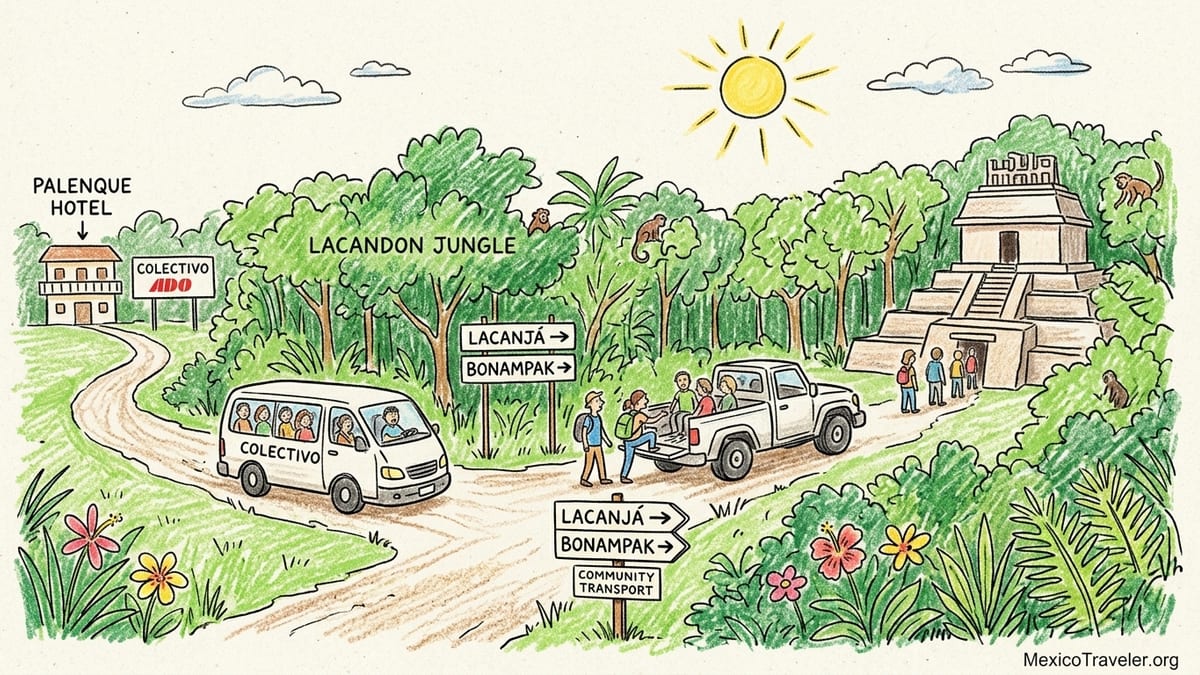
I traveled to Bonampak from Palenque, the most common jumping-off point in northern Chiapas. I set out just after 5:30 in the morning from a small hotel near Palenque’s bus station. The first leg was a colectivo along the Carretera Fronteriza del Sur, the border highway that traces the edge of the Lacandon Jungle. Minivans congregate near the ADO terminal and at small agencies along the main avenue. I joined a van already loaded with local families heading to communities along the route, paying a fare that came to a few hundred pesos for the three-hour ride to the Lacanjá Chansayab turnoff, a rough midpoint between Palenque and the Guatemalan border.
From the highway junction a narrow road heads into Lacanjá territory, where access is controlled by Lacandon Maya communities. Here, private cars, agency minibuses and independent travelers like me are funneled into a local Jeep-style shuttle system. A community representative directed me and two Mexican travelers into the back of a pickup fitted with benches. We paid a per-person community-transport fee in cash for the roughly 40-minute drive to the Bonampak access area. In my case, the colectivo, community entry and truck transport already totaled several hundred pesos, more than the archaeological admission itself.
Travelers who base themselves in Lacanjá instead of Palenque have a shorter approach. On a separate visit I overnighted in a Lacanjá jungle cabaña and arranged transport through my host. The local operator bundled a community access fee with a flat-rate vehicle charge to shuttle several guests together. Per person it worked out slightly cheaper than the independent approach from Palenque, and we were able to leave later in the morning because the drive to Bonampak from Lacanjá is less than an hour. In both cases, everything was handled in cash and there were no posted timetables, so it was important to confirm departure times with drivers and lodge owners directly the night before.
Regardless of the starting point, visitors should expect the overland journey from Palenque to Bonampak to take about three and a half to four hours one way, longer if there are checkpoints or roadwork along the highway. The remoteness is real. There are stretches with no cell coverage, and you are dependent on local transport providers once you leave the main road. This isolation is part of Bonampak’s mystique, but it also means the day feels very long compared with the relatively compact ruins you will eventually explore.
Understanding the Real Costs: Tickets, Community Fees and Transport
The financial side of a Bonampak visit is less straightforward than many other Mexican archaeological zones, so it is worth breaking down. The Instituto Nacional de Antropología e Historia (INAH) currently lists a general admission of 210 Mexican pesos for foreign visitors to Bonampak, with a lower rate for Mexican nationals. This ticket gives access to the archaeological site itself, including the acropolis and the Temple of the Paintings. The price is paid at an official INAH booth and is clearly posted in pesos.
On top of that official fee, INAH’s visitor information notes two additional local charges. One is a community entry fee set by the Lacandon authorities, and the other is a transport fee for the compulsory transfer into local vehicles for the final stretch through community land. Recent guidance indicates a community charge on the order of a few dozen pesos per person and a transport cost of a couple of hundred pesos per vehicle. In practice, what I experienced matched that structure: a small per-person fee at the community control point and a flat rate charged for the pick-up truck that was then informally divided by the passengers on board.
From Palenque, the initial colectivo along the Frontera highway added another few hundred pesos round-trip, so by midday I had already paid several times the base INAH admission just to reach the gates. Organized tours from Palenque consolidate these costs into a single figure. At the time of my visit, full-day shared Bonampak and Yaxchilán excursions advertised prices in the low thousands of pesos per person, typically including transport from Palenque hotels, breakfast en route, the river boat to Yaxchilán and both archaeological admissions. Standalone Bonampak visits or Lacanjá-based trips were somewhat less expensive but still represented a full-day outlay once meals and tips were factored in.
Because local community fees are periodically adjusted and conditions in Chiapas can shift, it is essential not to rely on numbers printed in older guidebooks. Instead, travelers should verify current rates through updated INAH information, recent tour listings or by contacting Lacanjá lodges directly before building Bonampak into a tight budget itinerary. What is consistent is the structure: one INAH archaeological ticket per person, one community entry fee per person, and one vehicle-based fee for the final segment, regardless of whether you are in a private car, tour minibus or shared community truck.
First Impressions: A Modest Plaza in a Deep Jungle Setting
After so many hours of transit, the first glimpse of Bonampak can surprise travelers expecting something on the scale of Palenque or Tikal. From the small parking and services area, a short path leads through secondary forest to the site entrance. There is no towering pyramid in view, no expansive city plan laid out like a stone map. Instead, the jungle opens onto a single grassy plaza dominated by a long acropolis on one side and a low building platform on the other, with several carved stelae rising from the lawn.
The compactness is striking. Bonampak’s known monumental core fits easily into a space you can walk across in a few minutes. The acropolis that houses the Temple of the Paintings climbs the slope in tiers but lacks the massive volume of Palenque’s Temple of the Inscriptions or the vertiginous stairways of Tikal’s Temple IV. This sense of scale is important to manage expectations. Bonampak is not about climbing huge pyramids or wandering through a sprawling palace. It is about entering one particular structure and confronting what is on its interior walls.
The setting, however, is powerful. The surrounding Lacandon Jungle feels close and humid. Tree lines crowd the edges of the plaza, and you can hear howler monkeys in the canopy and bird calls rising over the low hum of insects. On my first visit the air was heavy and damp, with mist still clinging to the treetops in late morning. On my later visit from Lacanjá after an overnight rain, the lawns were slick and the stone steps darkened with moisture. It is a place where the forest has not receded far from the ancient stones, and that closeness shapes how you experience the site’s limited but significant architecture.
There are basic facilities near the entrance, including simple toilets and a small area where local guides wait for visitors. Shade is intermittent along the main plaza, so humidity can feel intense by midday. The walking inside the core is short but includes uneven steps up the acropolis and into the temple rooms. Visitors with mobility issues may find the slippery, worn stone challenging, especially after rain, and there are no elevators or handrails of the kind you might find in more developed sites.
Inside the Temple of the Paintings: Rules, Access and Atmosphere
The heart of Bonampak is Structure 1, often referred to as the Temple of the Paintings or Temple of the Murals. It is a relatively small building atop a terrace of the acropolis, with three low doorways opening into three separate chambers. Each of these rooms is covered, wall and vault, with painted scenes dating to the late eighth century, commonly associated with events around 790 AD. These murals are the reason archaeologists, art historians and dedicated travelers make the long trip.
Access to the murals is tightly controlled to protect the fragile pigments from light, heat and humidity. During my visits, a site guardian stationed at the top of the stairway regulated entry. Only a handful of people were allowed into the temple at the same time, and visits were limited to a short window of several minutes per group. Photographs were either prohibited outright or permitted only without flash, depending on current conservation rules. On my first visit, the guardian asked us to put away cameras and phones entirely. On the second, non-flash photos were tolerated briefly but with clear reminders not to linger with devices held up.
Inside, the rooms are dim. Narrow openings and protective measures keep natural light low, and no bright artificial lighting has been installed, so your eyes need a moment to adjust. Once they do, the scenes begin to emerge: procession lines of nobles in elaborate costumes, musicians and dancers, warriors grasping spears and shields, and prisoners in postures of defeat and pain. In one chamber the atmosphere is ceremonial, with lords being dressed and presented. In another, the violence of warfare is front and center, including bound captives and bloodletting rituals. The murals wrap around you on all sides, turning the small room into an intense narrative space.
The time limits inside each chamber create a certain pressure. You find yourself moving slowly along the walls, trying to absorb as much as possible, yet knowing that the guardian will soon call your group back out to the terrace to make room for the next visitors. It can feel rushed after the long journey to reach the site, especially for photography enthusiasts or anyone who has studied the murals in books and wants to examine specific details of costume, glyphs or musical instruments. Returning travelers sometimes choose to visit Bonampak more than once over several days from a Lacanjá base precisely to have repeated, shorter encounters with the paintings rather than a single hurried walk-through.
Why the Murals Matter: Maya Politics, Warfare and Iconography
The Bonampak murals are not only visually arresting. They are historically important because they preserve, in unusual detail and color, scenes of royal ceremony, warfare and courtly life in a Classic Maya kingdom. For many years, early scholarship tended to imagine the Maya as relatively peaceful star-gazers whose cities functioned more like ceremonial centers than militaristic states. The discovery and study of Bonampak’s paintings helped overturn that notion. Here, in three contiguous rooms, is a narrative that runs from the preparation for a dynastic ceremony to the brutal aftermath of battle and the ritual display of captives.
In the first room, the walls show an elaborate court scene. The ruler of Bonampak, often identified as Yajaw Chan Muwan, appears with his wife and heir amidst attendants and visiting dignitaries. They are surrounded by musicians, dancers and nobles being dressed in fine textiles and feathered regalia. This is political theater, a staged moment of royal presentation that underscores lineage and alliances. On the vaulted ceiling, additional figures float in a more abstract space, connecting the earthly court with a supernatural register. For archaeologists, the combination of hieroglyphic captions, costume details and the presence of foreign lords offers insight into how regional powers like Yaxchilán influenced Bonampak’s politics.
The second room is perhaps the most jarring for visitors. It depicts an intense battle scene that fills the walls with motion. Warriors stride and leap, brandishing spears and shields. Opponents fall or cower. Captives are seized, stripped and forced onto stairways. The composition is chaotic but structured, with the victorious Bonampak and allied forces clearly distinguished by costume and position. In the upper registers, lines of warriors advance, while in the lower areas the defeated are gathered and displayed. This imagery, combined with historical interpretation of the texts, has been central to arguments that Maya kings engaged in warfare that involved real capture, torture and execution, not symbolic or ritualized mock combat.
The third room returns to a more controlled setting, yet the violence of the battle still resonates. Here the walls show a post-victory ritual, including a bloodletting ceremony in which elite figures pierce their flesh to feed the gods with their own blood. Musicians once again appear, and the court gathers to witness the outcome of the campaign. For iconographers and epigraphers, these images are a treasure trove. They show specific instruments, garments and body postures, as well as banners, shields and war regalia that can be compared with carved stelae and painted ceramics from across the Maya lowlands. Scholars such as Mary Miller have argued that no other single monument gives such a layered, human view of Classic Maya society, encompassing both its pageantry and its cruelty in one integrated program.
For a visitor, understanding this background before entering the temple changes the experience. Without context, the dark rooms can feel like an impressive but confusing swirl of figures. With even a basic grasp of the narrative sequence and its implications for Maya political history, the murals become a vivid storyboard of dynastic power, military alliance and ritual duty. This is why knowledgeable local guides, although not mandatory, can add enormous value to a Bonampak visit, particularly for travelers who may only have a few minutes in each chamber.
Expectation vs Reality: A Critical Look at the Site Experience
Bonampak’s tension lies in the gap between its extraordinary artistic importance and its modest physical footprint. Many travelers I spoke to on site had pictured something closer to Palenque, with towering pyramids, wide palace courtyards and long jungle walks. Instead, they found a compact acropolis, a single primary temple with restricted access, and a visit that, outside of the murals, could be completed in under an hour. After spending six to eight hours in vehicles to get in and out from Palenque, several admitted to feeling a measure of disappointment, especially those traveling with children who were more excited by climbing big structures than peering at faded paintings in the half-dark.
From an archaeological perspective, however, the site delivers exactly what makes it globally significant. The murals are unique, far better preserved than most surviving Maya wall paintings, and densely informative about court life, warfare and ritual. The stelae in the plaza, though less visually dramatic to non-specialists, also carry finely carved reliefs and glyphs that complement the interior scenes. For visitors who prioritize depth of interpretation over breadth of monuments, Bonampak can feel deeply rewarding. In my case, having studied reproductions of the murals in Mexico City’s National Museum of Anthropology, stepping into the actual rooms where they were painted was a powerful moment that justified the journey.
Conditions on site do shape that experience. Humidity is high almost year-round in the Lacandon Jungle. Even in the dry season, you can expect to sweat during the short climb to the temple, and in the rainy season, the combination of mud on the path and slick stone steps increases the difficulty level. There is little in the way of interpretive signage in English, so without a guide or prior reading, many visitors struggle to grasp what they are seeing. Toilets at the entrance are serviceable but basic, and there are no on-site cafes or extensive shade structures. For some travelers used to the facilities at more developed UNESCO sites, this minimal infrastructure can feel at odds with the long-haul effort required to reach Bonampak.
There is also the psychological aspect of time. On both of my visits, I spent far longer sitting in vehicles, waiting at checkpoints and changing transport than actually exploring the ruins. Guided excursions I observed typically allocated about an hour at Bonampak, of which only a portion was spent in the mural temple due to entry restrictions. Several participants expressed that they would have liked more time to wander the plaza quietly or simply sit and listen to the jungle after leaving the crowded temple rooms, but the tour timetable left little flexibility. Independent travelers who arrange their own community transport from Lacanjá have more control, although even then coordination with drivers and community schedules sets boundaries on how long you can linger.
Tour Options Compared: Organized Excursions, Lacanjá Overnights and Combined Itineraries
Most visitors reach Bonampak in one of three ways, each with its own trade-offs in cost, comfort and depth of experience. The most popular is the organized day tour from Palenque that combines Yaxchilán and Bonampak. These trips begin very early, often around 5:30 or 6:00 in the morning, and include hotel pickup, a drive along the Frontera highway, breakfast at a roadside restaurant, a riverboat journey on the Usumacinta to reach Yaxchilán, and finally a stop at Bonampak on the return drive. All community fees, boats and site admissions are usually bundled into a single per-person price. For travelers with limited time who want to see both major Usumacinta sites in a single day without having to negotiate local transport, this is the most straightforward option.
The trade-off is pace. On sample itineraries I reviewed and on the combined tour I joined, Yaxchilán often received the lion’s share of time, with two hours or more to wander its forested acropolis, while Bonampak was allocated about an hour. Within that hour, guests needed to walk in, queue for the murals, cycle through the rooms, take photos if allowed and then return to the minibus. There was little opportunity for a second look at the paintings or for extended discussion with a guide about the iconography. For many participants, though, the boat ride on the Usumacinta and the grandeur of Yaxchilán’s architecture were the emotional highlights of the day, with Bonampak appreciated but not central.
An alternative is to base yourself in the Lacanjá area for a night or two. Several Lacandon-run eco-lodges and cabaña clusters offer simple cabins, meals and access to jungle trails and waterfalls. From these bases, Bonampak is significantly closer. On my overnight stay, I arranged a mid-morning departure that avoided the dawn start from Palenque, and I was able to spend longer at the site because I did not have a boat schedule to keep. The per-person cost for Bonampak from Lacanjá was lower than a full Palenque-based tour, but when lodging and meals were added, the overall expense was comparable. What I gained instead was the ability to experience the murals without feeling rushed and to return to the jungle lodge in the late afternoon rather than endure another long drive that same day.
The third option is a dedicated Bonampak excursion from Palenque without Yaxchilán. A few agencies and private drivers offer this for travelers particularly interested in the murals or wary of the early start and long day of the combined trip. The total number of hours on the road is still substantial, but the entire schedule revolves around Bonampak, so guides can spend more time on historical background and visitors can linger in the plaza or climb the acropolis steps more than once. Per person prices vary according to group size and the inclusion of meals, but they tend to be somewhat lower than full Yaxchilán plus Bonampak packages.
Which option makes sense depends on priorities. If you want an efficient overview of two of the most important sites in the Usumacinta region and do not mind a packed day, the combined tour is hard to beat. If the murals themselves are the main draw and you prefer a slower rhythm with more contact with Lacandon communities and the surrounding forest, then an overnight in Lacanjá with a focused Bonampak visit may be more satisfying, even if it does not save money compared with a one-day package. Independent travelers with their own vehicle can, in theory, replicate all of these patterns, but they still need to work within community transport rules for the final approach.
The Takeaway
After two separate visits to Bonampak, once folded into a long combined tour and once approached more slowly from a Lacanjá base, my verdict is nuanced. For history enthusiasts with a strong interest in Maya art, epigraphy or political history, the journey is worth it. Standing inside the Temple of the Paintings, surrounded by vivid scenes of royal ceremony and brutal warfare that directly informed modern understanding of Classic Maya society, is an experience that no reproduction can fully replicate. The cost and logistical complexity feel like a reasonable investment in accessing one of the most important painted cycles in the ancient Americas.
For families, the calculus is more complicated. Children who enjoy boats, jungle scenery and the adventure of remote travel may find the combined Yaxchilán and Bonampak day engaging, especially with the variety of experiences along the way. However, the murals themselves are delicate, dimly lit and tightly controlled, with rules that can frustrate younger visitors who want to touch or photograph everything. Parents should also consider the long hours in vehicles, limited restroom stops and the heat and humidity on site. Bonampak is probably best suited to older children and teenagers already interested in history or archaeology rather than very young kids.
Photographers face both rewards and constraints. The approach along the Frontera highway, the jungle around Lacanjá and the exterior of Bonampak’s acropolis all offer evocative opportunities for landscape and documentary shots. Inside the Temple of the Paintings, however, photography rules, low light and time limits make careful tripod work or extended framing impossible. If your primary goal is to capture dramatic images of towering temples, stelae in golden light or sweeping jungle canopies, sites like Palenque, Yaxchilán or Calakmul will offer more satisfying returns on time and expense than Bonampak.
For travelers whose main criterion is sheer monumental impact, Bonampak may not be the best allocation of a limited Chiapas itinerary. The site is small, climbing opportunities are modest, and the main attraction requires patience, prior knowledge and a willingness to engage with subtle detail rather than spectacular skyline views. In such cases, adding a second day at Palenque, exploring lesser-known nearby waterfalls or focusing on Yaxchilán’s dramatic river approach might deliver a more immediately impressive experience. In the end, the artistic and historical significance of Bonampak’s murals does justify the effort and cost for a certain kind of visitor. The key is to be honest with yourself about whether that visitor is you.
FAQ
Q1. How much does it cost to visit Bonampak?
The official INAH admission for foreign visitors is currently 210 pesos per person, with additional community entry and local transport fees that together usually exceed the ticket price. Travelers should also budget for transport from Palenque or Lacanjá and meals, which often bring the total cost for a day visit into the low thousands of pesos per person if using an organized tour.
Q2. How long is the journey from Palenque to Bonampak?
From Palenque, the drive along the Frontera highway and into Lacanjá or Bonampak access points typically takes three and a half to four hours one way, depending on traffic, checkpoints and road conditions. Combined tours that also visit Yaxchilán are full-day outings that usually run from around 5:30 or 6:00 in the morning to early evening.
Q3. Can I visit Bonampak independently without a tour?
Yes, it is possible to travel independently by colectivo from Palenque to the Lacanjá area and then arrange community transport to Bonampak on site. However, you must still use local vehicles for the final approach through community land and pay the associated fees. Independent travel requires flexibility with timing and comfort with limited Spanish, since schedules and prices are usually communicated informally.
Q4. Are the murals easy to see once I am inside the temple?
The murals are visible but the rooms are deliberately kept dim to protect the pigments, so it takes a few moments for your eyes to adjust. Details emerge better if you have some prior knowledge of what to look for, such as the battle scene in the second room or the royal presentation in the first. Time inside is limited, so many visitors find it helpful to study reproductions or diagrams beforehand.
Q5. What are the current rules on photography inside the Temple of the Paintings?
Photography rules can vary slightly over time as conservation policies are updated, but flash is consistently prohibited and in some periods all photography inside the mural rooms has been banned. Even when non-flash photos are tolerated, visitors are asked to move quickly and not hold up the flow of people. Travelers who want images of the murals should be prepared for strict limits compared with other archaeological sites.
Q6. How difficult is the walking at Bonampak?
The distances are short but involve uneven, sometimes slippery stone steps up the acropolis and into the temple rooms, along with humid conditions and limited shade. Most reasonably fit visitors manage without trouble, but those with mobility challenges or balance issues may find the climb demanding, especially after rain when the stones are wet.
Q7. Is Bonampak safe to visit right now?
Security conditions in Chiapas can change, so travelers should check recent local advice from their hotel in Palenque or Lacanjá, current tour operator guidance and any government travel updates before going. During my visits, the route was functioning normally with routine checkpoints, and organized tours were operating daily, but it is wise to confirm the latest situation close to your travel dates.
Q8. Should I combine Bonampak with Yaxchilán in one day?
Combining the two is the most common choice and maximizes what you see for the time spent on the Frontera highway. The trade-off is a very long day and only about an hour at Bonampak, which can feel rushed if the murals are your main interest. Travelers focused more on the overall adventure, including the boat ride to Yaxchilán, tend to find the combined tour very satisfying.
Q9. Is Bonampak a good destination for children and families?
Bonampak can work for families with older children who enjoy history, nature and long road trips. Younger kids may struggle with the early starts, heat, long vehicle hours and strict rules inside the mural rooms. Families often find that Palenque and nearby waterfalls provide a more flexible and immediately engaging day out.
Q10. If I have limited time, is Bonampak worth prioritizing over an extra day in Palenque?
If you are particularly interested in Maya art and political history, Bonampak offers something you cannot see elsewhere, even in large museums. If your main goal is to experience impressive ruins and enjoy a less rushed pace, an additional day exploring Palenque’s expansive site, museum and nearby natural attractions may provide more overall enjoyment for the same amount of time and money.