

By the time my boat finally rounded the last bend of the Usumacinta River and the temples of Yaxchilán appeared above the jungle canopy, I understood why this site changes the way people think about Maya ruins. Yaxchilán is not a quick detour from a highway. It is a journey into rainforest, accessed by a long road into the Lacandon Jungle and then by boat along Mexico’s wild southern border. Reaching the city from Frontera Corozal is as much a part of the experience as wandering its plazas and carved lintels, and it is that river approach that makes Yaxchilán one of the most distinctive archaeological adventures in Mexico.
From Palenque To The Edge Of The Jungle
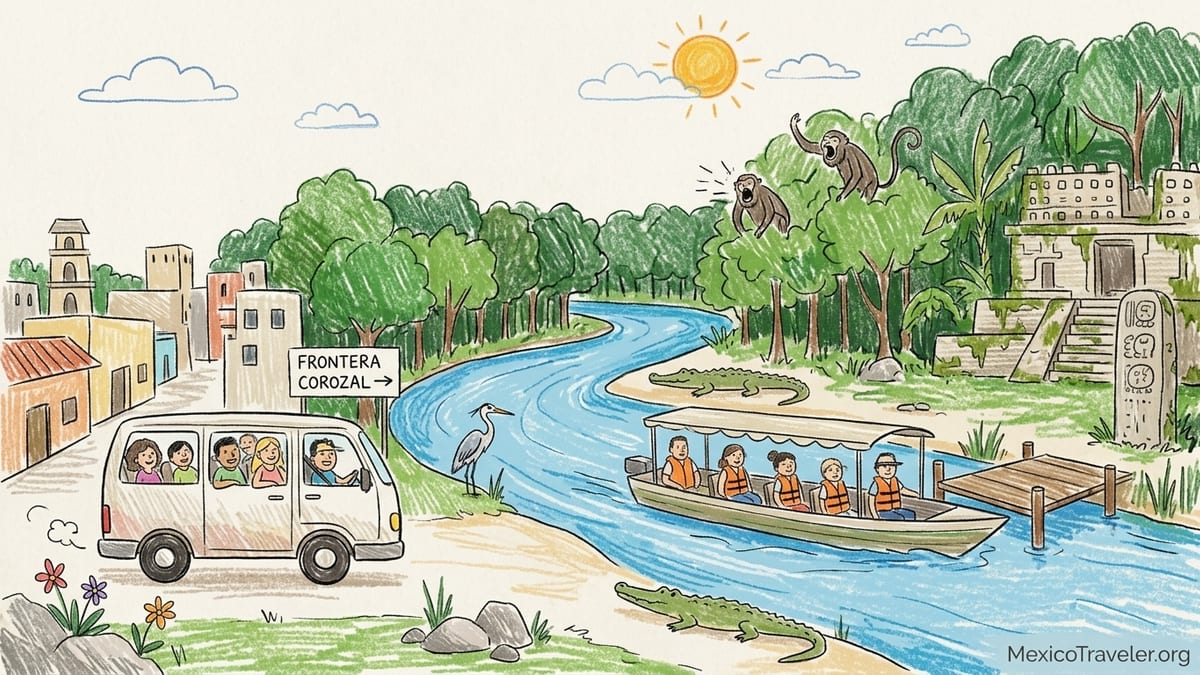
My day began before dawn in Palenque, the closest travel hub with a good range of hotels and transport services. Most shared tours leave town between 5:30 and 6:00 a.m., which matches what local agencies in Palenque currently advertise for combined Yaxchilán and Bonampak excursions. I set out at 5:45 a.m. in a shared van arranged the previous afternoon on Palenque’s main hotel strip, joining a small group of travelers dozing in their seats as we rolled out of town toward the Lacandon Jungle.
The road from Palenque to Frontera Corozal is paved but narrow, running roughly 150 kilometers through lowland forest, small ejidos and military checkpoints. Including a breakfast stop near the town of Benemérito de las Américas, the drive took just under four hours. We passed through at least one federal checkpoint where soldiers briefly looked into the van and waved us on. Independent travelers who make this run by public transport usually change colectivos in Benemérito or at junctions like San Javier, but on this occasion the dedicated tour vehicle took us all the way to the river without changes.
Arriving at Frontera Corozal around 9:45 a.m., the atmosphere shifted from highway journey to river town. Everything in this settlement faces the Usumacinta. Long narrow lanchas with canvas roofs lined the muddy embankment, boatmen calling out to guides and coordinating departures toward Yaxchilán and, for others, across the river to Guatemala. Even if you travel independently, Frontera Corozal is the unavoidable springboard; from here, river transport is the only way to the ruins.
While our transport company handled the formalities, I watched independent travelers walk to the ticket office near the dock to arrange their own boats. Current information from local operators in Frontera Corozal indicates that hiring a private lancha for up to a handful of passengers costs in the region of 2,000 to 2,500 Mexican pesos for the round trip, including about two hours on-site at Yaxchilán. Prices fluctuate with fuel costs and negotiation, but this gave me a baseline for later comparisons with what I paid through a Palenque agency.
Arranging The Boat And Understanding The Costs
In my case, the river transport was wrapped into a full-day Yaxchilán and Bonampak package bought in Palenque. Several agencies in town currently advertise this combination day trip in the 1,900 to 2,700 pesos per person range, depending on whether breakfast, entrance fees and Bonampak’s mandatory local transfer are included. My tour sat somewhere in the middle: 2,200 pesos covered road transport from Palenque, breakfast on the way, the shared boat to Yaxchilán, and the return transfer via Bonampak. I still had to pay archaeological site fees separately in cash.
Travelers who arrive independently at Frontera Corozal handle things differently. They first pay a community fee in town, then buy entrance to the Yaxchilán archaeological zone through the official ticket office, and finally negotiate the lancha. Boatmen tend to quote a flat rate for the boat, not per person, so a small group of four paying 2,200 pesos for the round trip might effectively match or undercut many Palenque day tours while enjoying more flexibility on site. Solo travelers, by contrast, often find the group excursion from Palenque more economical than covering the entire boat cost alone.
One important detail for planning is payment methods. On my visit, both the Frontera Corozal community fee and the river transport were strictly cash only. The archaeological entrance fees in Chiapas can sometimes be paid with card terminals, but outages are common. In practice, every traveler on our boat used cash. I would not rely on any electronic payment working consistently in Frontera Corozal or at Yaxchilán, and there are no ATMs at the dock or the ruins. Bringing enough pesos from Palenque or a larger city is essential.
The schedule also deserves close attention. Our Palenque van reached the river around mid-morning, which meant the sun was already harsh on the water. Some agencies and online trip reports recommend either an earlier or later boat departure to soften the heat. Independent visitors with their own vehicle in Frontera Corozal can ask for a first departure around 7:00 a.m. and be back before midday, or aim for a mid-afternoon run when day tour crowds thin and light softens at the ruins.
The River Journey To A Lost City
Boarding the lancha brought the journey’s tone into sharp focus. The boat was long and slender, with wooden bench seats running down each side and a canvas roof stretched overhead. Life vests were standard and, on my trip, actually worn rather than used as cushions. The outboard motor coughed to life with a loud, throaty growl that never really faded; earplugs were not necessary but would have made conversation easier over the hour-long ride.
Once the boat nosed out into the current of the Usumacinta, the scale of the river became clear. This is not a gentle creek but a broad, fast waterway that forms the international border between Mexico and Guatemala. In the dry season, when I visited, the banks sloped down in terraces of exposed sand and mud, tree roots clutching the last edges of soil. Guides in Frontera Corozal explained that in heavy rains the river can rise several meters, sometimes forcing delays or cancellations of trips until conditions improve. For safety, no reputable operator will cross in periods of severe flooding or strong debris flow, so travelers on fixed itineraries should build in some flexibility.
The noise of the motor became a kind of background vibration, mixing with the slap of the hull against the water. Comfort was basic but manageable. Benches had thin foam pads and the canvas awning offered intermittent shade, but knees pressed close to fellow passengers and the humid air quickly glued shirts to backs. Still, there was a sense of openness that made almost everyone on board lean out and scan the treeline for wildlife instead of retreating into their own thoughts.
Wildlife sightings on this stretch of the Usumacinta are not guaranteed, but they are frequent enough to keep cameras ready. During my crossing, we passed herons stalking the shallows and kingfishers flashing blue-white as they dipped for fish. Twice our boatman slowed the engine so we could listen to howler monkeys roaring somewhere inside the forest, their calls sounding like distant thunder. Crocodiles do inhabit the river basin, and some travelers report seeing them basking on sandbanks, though I did not spot any myself. The humid air, smell of wet earth, and constant insect buzz gave the sense of approaching a living, breathing jungle rather than a curated attraction.
Roughly 45 minutes downstream, our guide gestured ahead. The first visible sign of Yaxchilán was not a towering temple but a simple wooden jetty tucked against the right bank of the river. Only when I looked up into the trees behind it did the stonework come into view: weathered stairways clinging to the hillside, moss-draped walls woven into the foliage. The boat swung in against the shore, bumping lightly against the dock. Stepping from the rocking lancha onto the worn boards, I had the distinct feeling of arriving at a hidden city that still belongs more to the forest than to modern tourism.
First Steps Inside Yaxchilán: Paths, Humidity And Maintenance
From the landing, a shaded path leads inland toward the archaeological core. Immediately the humidity closed around me like a blanket. Even in the dry season, the rainforest at Yaxchilán traps heat and moisture, and every movement brings a film of sweat. Good footwear matters here; the path itself is reasonably clear but rooty, and the stone steps that soon appear can be slick with moss or organic debris. On my visit, site staff had done a thorough job keeping the main routes open, but fallen leaves, seed pods and patches of mud remained part of the terrain.
Most organized tours grant around two to two and a half hours on site, and my group received just over two hours between disembarking and returning to the boat. That is enough for a focused visit to the Great Plaza, the Labyrinth and the main hilltop structures such as Building 33, but it does not allow in-depth exploration of every terrace or minor group. Travelers who have read extensively about Yaxchilán’s dynastic history may want more time and should negotiate a longer stay when arranging their boat in Frontera Corozal.
In terms of maintenance, Yaxchilán sits in a delicate balance between excavation and rewilding. The core structures are stabilized, major stairways are safe to climb with care, and the lawns of the Great Plaza are cut short enough for comfortable walking. At the same time, vines and moss still creep over many facades, and tree roots wrap themselves around stone blocks. It never feels over-manicured. Compared with larger sites like Palenque or Chichén Itzá, there are fewer railings and cordoned-off zones, which increases both the sense of intimacy and the responsibility to tread lightly.
Facilities are notably sparse. There are basic toilets near the entrance path, closer to the landing area than to the main plazas. On my day, water was available only in the form of what visitors had carried in; there were no functioning snack stands or permanent vendors inside the archaeological zone. Occasional reports mention local Lacandon Maya selling drinks or coconuts at the dock, but this cannot be relied on, and in my case there were none. There is no mobile coverage within the ruins and only intermittent signal at the river, so offline maps and pre-arranged meeting times with your boatman are essential.
The Labyrinth, Great Plaza And Carved Stelae
The first major structure that confronts most visitors is the so-called Labyrinth, an intricate multi-level range building of low vaulted rooms tucked at the edge of the Great Plaza. Entering its cool interior after the bright heat of the path was an immediate relief. A handheld light proved useful inside, as several of the interconnected corridors receive little natural illumination. The play of darkness and small framed windows looking out onto the plaza gives a visceral sense of Maya architectural design, where movement through constricted spaces heightened the drama of emerging into ceremonial courtyards.
From the Labyrinth, I stepped directly into the Great Plaza, one of the most atmospheric open spaces in the Maya world. The plaza is framed by long palace ranges and smaller temples, with several upright stelae standing in the grass. Their surfaces, carved with images of rulers and complex hieroglyphic texts, are weathered yet still legible in parts. Many of the finest pieces from Yaxchilán, including complete lintels and sculptures, were removed in the nineteenth and early twentieth centuries and now reside in national museums abroad, yet the stones that remain in situ convey enough narrative to anchor the site in history rather than myth.
Modern epigraphic work has shown that Yaxchilán was a major Classic Period city that thrived particularly in the seventh and eighth centuries. Its rulers appear frequently in inscriptions, engaged in warfare, alliances and ritual bloodletting with neighboring powers along the Usumacinta. Several of the stelae in the Great Plaza commemorate specific ceremonies, capturing dates in the Long Count calendar and naming local lords. While my guide summarized these stories in accessible terms, even travelers without deep background in Maya history can appreciate the delicacy of the relief carving, from rich headdresses to the folds of ritual garments.
Walking slowly across the plaza, with howler monkeys roaring somewhere above and scarlet macaws flashing like embers against the canopy, I felt the river just out of sight beyond the trees. That physical relationship between waterway and civic center is central to Yaxchilán’s identity. The city rose to power in part because of its control over river trade routes, and standing in the Great Plaza today, the Usumacinta still feels like the city’s lifeline.
Climbing To Building 33 And The Hilltop Complex
The climb from the Great Plaza up to the acropolis where Building 33 sits is steep and, in the heat, demanding. Stone stairways lead in flights up the hillside, shaded by giant ceiba and sapodilla trees. Site staff have cleared the steps, but underfoot they remain irregular, some stones worn to gentle curves by centuries of use. I paused often both to catch my breath and to let slower climbers move ahead, using each stop as an excuse to listen to forest sounds and feel the air move slightly cooler at higher levels.
Building 33, attributed in inscriptions to the ruler Bird Jaguar IV, is one of Yaxchilán’s most iconic structures. It sits on a wide terrace overlooking the river valley, its three doorways facing out toward Guatemala beyond the canopy. The facade preserves sculpted roof comb elements and, in earlier photographs and drawings, carried some of the grandest stucco and carved decoration at the site. Even in its current weathered state, the monument retains a sense of theater. Standing in the central doorway and looking down, it is easy to imagine royal processions climbing the stairs, accompanied by incense and music, while the ruler appeared framed above.
Historically, the carved lintels associated with Buildings 33 and its neighboring temples have been crucial for understanding the political life of the city. Yaxchilán is particularly rich in lintel inscriptions that combine hieroglyphic text with detailed narrative scenes. Several of these masterpieces were removed in the nineteenth century and now reside in international museum collections, but replicas and fragmentary originals on-site still hint at their complexity. They depict royal bloodletting rituals, war captives and the conjuring of ancestral visions, with glyphic captions that allow modern scholars to date events with precision.
From a visitor’s perspective, the practical challenge of this hilltop area is pacing. In the combined Yaxchilán and Bonampak schedule, many groups feel rushed as they try to see both the Great Plaza and the upper terraces within their allotted time. I spent roughly twenty minutes at Building 33, which felt just enough to appreciate the view and photos without lingering deeply over every carving. Those with mobility issues or low heat tolerance may choose to prioritize the lower plazas and skip the upper climb; for them, the river setting and Labyrinth already provide ample reward.
Humidity, Rain And The Realities Of A Rainforest Site
Exploring Yaxchilán is a lesson in managing tropical conditions. The humidity was intense even on a dry-season morning, and within minutes of leaving the shade of the Labyrinth my clothes were damp. Stairs and stone platforms, while structurally sound, can be treacherous when wet. Local guides repeatedly reminded visitors to keep at least one hand free when descending steps and to step on the rougher edges of stones rather than their smooth centers.
Rain is a critical factor throughout the year. Although my day stayed dry, boat operators in Frontera Corozal explained that moderate showers seldom halt trips, but heavy downpours, lightning or sudden river level rises can. In such cases, departures are delayed or canceled outright. Because Yaxchilán has no road access, there is no alternative way out if conditions deteriorate while you are inside the ruins. For this reason, boatmen tend to build a safety margin into the time they leave visitors at the site, preferring to have everyone back at the river landing well before late afternoon storms that often develop in the wet season.
Inside the site, shelter during rain is limited to the interiors of structures, the Labyrinth and small roofed rest areas near the entrance path. That can make sudden showers memorable but inconvenient, especially when descending muddy slopes back to the river. Standard guidebooks often fail to mention that there are no proper cafés or covered restaurants at Yaxchilán itself. Food is essentially what you bring in your daypack. Some tour companies arrange lunch back in Frontera Corozal after the return boat, which was the case for my group, so I relied on snacks and at least two liters of water carried from Palenque.
There are no trash cans deep inside the archaeological zone, and waste must be carried back out. Given the remoteness of the site and limited staff capacity, visitors’ behavior has an outsized impact on cleanliness. On my visit, I saw little litter, a sign that most groups and guides are taking the conservation message seriously. Still, it only takes a few careless visitors to change that, so treating Yaxchilán as a wilderness hike rather than an urban park helps frame expectations about packing out everything you pack in.
Toilets, Food, Water, Coverage And Other Overlooked Details
Toilets at Yaxchilán are functional but basic, located near the path between the jetty and the main entrance. Water pressure, soap availability and cleanliness can vary with visitor numbers and maintenance cycles. Travelers used to the facilities at larger sites like Palenque or Tulum may find Yaxchilán’s restrooms more rustic. Using them immediately on arrival and again before boarding the boat back is a sensible routine, as there are no facilities on the river and no toilets deeper in the ruins.
Food options are minimal. On my trip, our tour package included a hearty roadside breakfast on the way from Palenque but left lunch to be purchased at simple comedores back in Frontera Corozal after visiting the ruins. At the dock, a handful of small eateries offered plates of grilled chicken, rice and tortillas for the equivalent of 120 to 180 pesos, along with cold soft drinks and bottled water. Independent travelers should not expect vegetarian menus or specialty coffees here. Bringing energy bars, nuts or fruit from Palenque is the safest way to avoid going hungry, especially if boat schedules slip.
Water is non-negotiable. The combination of heat, humidity and physical exertion can surprise even fit travelers. I carried two one-liter bottles and drained both by the time we returned to the river, then bought another chilled bottle at a Frontera Corozal comedor before the drive back. For those sensitive to single-use plastic, bringing a large refillable bottle and topping up in Palenque or at trusted accommodations before departure is advisable, as drinking-water refills at Yaxchilán itself are not currently available.
Mobile coverage is effectively absent at the ruins and weak in Frontera Corozal, at least for major Mexican carriers. This has implications for navigation and payments. Offline maps, printed reservation details and cash reserves become more important. If something goes wrong with your boat schedule or you are delayed inside the ruins, communication relies largely on your guide and boatman. Booking with a reputable agency or arranging your lancha through well-known local cooperatives reduces risk in such a low-connectivity environment.
Comparing DIY Costs With Palenque Excursions
At the end of the day, I compared what I had actually spent with what it would have cost to arrange the journey entirely on my own. My shared tour from Palenque priced at 2,200 pesos included hotel pickup, road transport, breakfast, the round-trip boat from Frontera Corozal and the stop at Bonampak. On top of this, I paid archaeological site fees and community charges in cash, adding roughly a few hundred pesos more for the entire day. Lunch in Frontera Corozal cost another 150 pesos. In total, my door-to-door expenditure hovered somewhere below 3,000 pesos.
Looking at current tariffs in Frontera Corozal, a private lancha for Yaxchilán alone often runs between 2,000 and 2,500 pesos per boat. Add the cost of getting from Palenque to the river and back on public transport or by rental car, plus meals and site fees, and a solo independent traveler could easily match or exceed what I paid through a Palenque agency. A couple or small group of three or four might save money by splitting the boat cost and using colectivos to reach the border town, but they would trade the convenience of hotel pickup and a coordinated schedule for a more complex day of logistics.
One advantage of dealing directly with boat operators in Frontera Corozal is flexibility. Independent visitors can negotiate more time at the ruins, change their departure hour to chase better light, or even skip Bonampak entirely in order to immerse themselves in Yaxchilán. The downside is exposure to any last-minute changes in road security, transport availability or river conditions without the buffer of an agency that can rebook, coordinate or refund.
Palenque-based excursions tend to bundle Yaxchilán and Bonampak into a long but efficient day. Current advertised rates around 1,900 to 2,700 pesos per person typically cover transport, boat and guiding, with food and site fees sometimes included, sometimes not. Fully private tours out of Palenque, which can cost several times more, appeal to travelers who value flexibility and personal attention over strict budgeting. Ultimately the “better” option depends on how comfortable you are negotiating in Spanish, traveling by rural public transport and accepting a looser schedule.
Was Combining Yaxchilán With Bonampak Too Rushed?
A key question for many travelers is whether it makes sense to see both Yaxchilán and Bonampak in a single day. My own experience leans toward yes, but with clear trade-offs. After our two-plus hours at Yaxchilán, we took the boat back to Frontera Corozal, had a quick lunch, then changed to a smaller Lacandon-operated vehicle near San Javier for the final stretch to Bonampak. By the time we reached Bonampak, the afternoon was already well advanced.
Bonampak itself is much smaller than Yaxchilán, but it contains the famous mural-filled Temple of the Paintings, whose interior frescoes are among the most important surviving Maya artworks. Our time on site was just under an hour, which allowed for a walk through the plaza, a guided viewing of the murals and a brief climb to the upper structures. It did not leave much room for quiet contemplation or repeat visits to the mural rooms. The sense of being on the clock was more pronounced here than at Yaxchilán.
If your primary interest lies in deep archaeological exploration, photography or epigraphy, combining both sites in one day may feel compressed. You will see the highlights but not linger. For more casual travelers, the combination works surprisingly well: you experience the river journey to a remote city in the morning, then balance your impressions with Bonampak’s vivid interior art in the afternoon. The shared narrative of the Usumacinta region ties the day together.
From a practical standpoint, the long driving hours and early departure mean fatigue becomes a factor by evening. We rolled back into Palenque close to 8:00 p.m., twelve to thirteen hours after leaving our hotels. Anyone with back issues, small children or low tolerance for van travel may find this demanding. Splitting Yaxchilán and Bonampak into separate days, perhaps based in a simple lodge closer to the jungle, would reduce the pace but is more complex and costly to organize.
The Takeaway
By the time I stepped off the boat back in Frontera Corozal, shoes damp from the river spray and shirt clinging to my back, it was clear that Yaxchilán’s magic does not lie only in its monuments. It lies in the sequence of moments that carry you there: the long predawn road from Palenque into the Lacandon Jungle, the checkpoint pauses that remind you this is a frontier region, the negotiations at the dock, and then the hour on the Usumacinta with jungle pressing close and howler monkeys announcing your arrival.
Inside the site, the Labyrinth, Great Plaza, stelae and hilltop Building 33 offer a concentrated dose of Maya architecture and history framed by living rainforest. The carved lintels and uprights, even when weathered or represented by replicas, remain central to modern understanding of Classic Maya politics and ritual life. At the same time, the reality of visiting is refreshingly unscripted. Paths are somewhat rugged, stairs require care, humidity is intense, and services are few. Yaxchilán still feels like an expedition more than a museum visit.
Is the river approach worth it compared with more accessible ruins like Palenque, Uxmal or Tulum? For travelers who value atmosphere, landscape and the feeling of traveling to the end of the road, the answer is yes. The boat journey amplifies the isolation of the city and anchors it in its historical role as a river power. Those who prefer short transfers, air-conditioned cafés and strong mobile signal may be happier limiting themselves to sites closer to major towns, where infrastructure is more developed.
Ultimately, the remote journey to Yaxchilán suits certain travelers especially well: photographers willing to carry gear through humidity for the sake of unique images; history enthusiasts intrigued by dynastic rivalries along the Usumacinta; and visitors who already know they love the combination of river travel and rainforest. If that sounds like you, then boarding a lancha at Frontera Corozal and watching the jungle city rise above the water will likely become one of the defining memories of your time in southern Mexico.
FAQ
Q1. How long is the boat ride from Frontera Corozal to Yaxchilán?
The ride typically takes between 40 minutes and 1 hour each way, depending on river level, current and boat engine power.
Q2. How much does the boat from Frontera Corozal to Yaxchilán cost?
Recent local quotes suggest around 2,000 to 2,500 Mexican pesos per private boat for the round trip, including a couple of hours at the ruins.
Q3. Can I pay for the boat or entrance fees with a credit card?
In practice, you should plan to pay everything in cash. Card terminals are unreliable and often unavailable in Frontera Corozal and at the site.
Q4. Are there toilets and food available at Yaxchilán?
There are basic toilets near the entrance path but no full-service restaurant. Food options are limited to what you bring or simple meals back in Frontera Corozal.
Q5. Is there mobile phone coverage at the ruins?
Mobile coverage is generally absent inside Yaxchilán and weak at the river, so you should not rely on data or calls during your visit.
Q6. What happens if heavy rain affects river conditions?
In periods of strong rain or high water, boat operators may delay or cancel departures for safety. There is no road alternative, so flexibility in your schedule helps.
Q7. How much time do tours usually allow at Yaxchilán?
Shared day tours from Palenque usually allow around two to two and a half hours on site, which is enough for the main areas but not every structure.
Q8. Is it worth combining Yaxchilán with Bonampak in one day?
Yes for most travelers, but the day is long and slightly rushed. You will see both sites’ highlights but have limited time for in-depth exploration.
Q9. Do I need a guide to visit Yaxchilán?
A guide is not mandatory, but having one adds valuable context to the carvings and history. Many boat packages include guiding or offer it for an extra fee.
Q10. Who should choose Yaxchilán over more accessible Maya ruins?
Yaxchilán is best for travelers who enjoy remote experiences, boat travel, and hiking in humidity, and who are comfortable with basic infrastructure and long days.