

Palenque in northern Chiapas has quietly become one of the most compelling bases in the Mundo Maya region. In 2026 it combines a world-class archaeological site, lush national park jungle, turquoise waterfalls and a growing range of hotels and tours, all now connected to the wider peninsula by the Tren Maya. This guide explains how to structure one to three days in and around Palenque, what each major attraction offers, how to get there, what it costs and which type of visit makes the most sense for different travelers.
Palenque in 2026: Why Base Yourself Here in the Mundo Maya
Palenque is a small jungle town about 9 kilometers from one of the most important Classic Maya cities, framed by low mountains and thick forest. While visitors once treated it as a quick stop between San Cristóbal de las Casas and the Yucatán, the ongoing rollout of the Tren Maya has turned Palenque into a natural hub for combining archaeology, waterfalls and multi-day itineraries through Chiapas, Tabasco and the eastern peninsula. Passenger trains already connect Palenque with San Francisco de Campeche and onwards toward Cancún, and long-distance buses still link it to Villahermosa and Chiapas highland towns, giving visitors more route options than ever before.
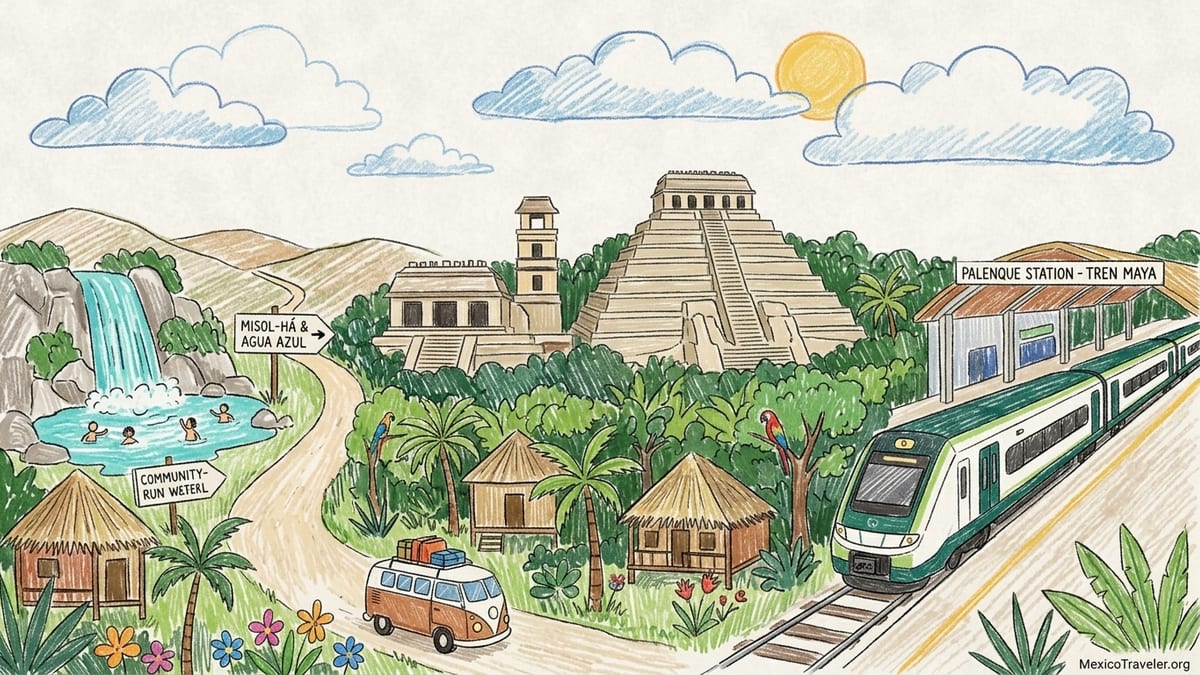
What makes Palenque stand out against other Mundo Maya centers is the way its core attractions sit close together yet feel distinct. The archaeological zone and Palenque National Park occupy a compact protected area where ruins, forest and wildlife blend into a single experience. Just beyond, a ring of waterfalls, community-run nature reserves and eco-parks forms an easy circuit of day trips. In practice this means you can wake up in a jungle bungalow listening to howler monkeys, spend the morning inside the Temple of the Inscriptions, then cool off under a 35-meter waterfall at Misol-Há in the afternoon.
Visitor infrastructure has also matured. In 2026 the main access road between town and the ruins is lined with small hotels, jungle lodges and tour offices, while the new Tren Maya station sits on the former airport grounds at Pakal Ná, connected to town by taxis and local transport. At the same time, entry remains tightly controlled inside the archaeological zone and national park, and waterfall areas are still largely managed by local ejidos, which keeps the experience relatively grounded compared with resort areas on the Caribbean coast.
For travelers choosing a base within the broader Mundo Maya region, Palenque now competes directly with hubs like Mérida or Valladolid for ruin-focused trips, with the added appeal of more dramatic jungle and river landscapes. It works especially well as the first or last stop of a Tren Maya circuit that also includes Campeche, Calakmul, Chichén Itzá and Cancún.
Palenque Archaeological Zone & National Park: What to See and How Long to Spend
The Palenque archaeological zone is the centerpiece of any visit. Official information from the National Institute of Anthropology and History confirms that admission to the ruins in 2026 is 210 Mexican pesos per person, and this is paid directly at the Visitor Center ticket booths at the entrance. Separate from this, visitors must also pay an admission to Palenque National Park, administered by CONANP. Current verified figures for 2026 indicate a general CONANP fee a little above 215 pesos per day, applied to all visitors entering the park, with reduced rates for residents, students and educators. Because these are separate agencies, you receive two tickets and must keep both on hand during your visit.
Most travelers should plan at least four to five hours inside the archaeological zone and surrounding forest. This allows enough time for the main monumental core and a slower walk along the forest trails that descend past smaller temples and streams. Those with a strong interest in Maya history or photography often spend a full day, especially if they hire a certified guide at the entrance to explain the dynastic history of rulers such as K’inich Janaab’ Pakal and to decipher inscriptions that are otherwise easy to overlook.
From central Palenque town, the ruins are roughly 9 kilometers away along the main access road. In 2026 shared colectivos and combi vans run frequently from near the ADO bus terminal and main avenues, taking around 15 to 20 minutes depending on traffic. Taxis quote fixed prices that are still modest by international standards, making it simple to go in for the morning, return for lunch, then head back in the late afternoon if desired. Because vehicle access to the archaeological parking area is straightforward, private drivers and organized tours also use this road.
Palenque National Park overlaps with the ruins and surrounding jungle and is more than just a buffer zone. Park entry is checked on the main road, and your CONANP ticket technically covers access for the day across this protected area, including some trailheads used by local guides for birding or night walks. The combination of two separate fees means the all-in cost for an independent visitor to the ruins and park in 2026 is around 425 pesos, before any optional guiding or transport costs.
Inside the Ancient City: Temple of the Inscriptions, El Palacio, Cross Group & Site Museum
The Temple of the Inscriptions dominates the main plaza and is the structure most associated with Palenque worldwide. It is the stepped pyramid that housed Pakal’s tomb, discovered in 1952 by archaeologist Alberto Ruz L’Huillier, whose work transformed understanding of Maya funerary practice. Today, the tomb itself is closed to visitors to protect the structure and its carvings, but standing in front of the temple while a guide recounts the discovery and the elaborate sarcophagus lid is still a highlight. Visitors can no longer climb to the top, but good telephoto lenses capture carvings on the upper panels from the plaza below.
Directly opposite stretches El Palacio, a sprawling complex of courtyards, corridors and a four-story tower. It is one of the best places in the city to appreciate Palenque’s distinctive architectural style, with its sloping walls, roofcombs and delicate stucco work. Even without a guide, you can spend close to an hour weaving through its passageways, imagining court life and watching the way sunlight filters through doorways and onto reliefs. The elevated walkways also provide layered views back toward the Temple of the Inscriptions and out over the forest canopy.
On slightly higher ground lies the Cross Group, a trio of temples called the Temple of the Cross, Temple of the Foliated Cross and Temple of the Sun. A moderate, sometimes humid climb up stone steps rewards visitors with one of the best panoramic views over the site and surrounding hills. This area is particularly suited to sunrise or early-morning visits when temperatures are cooler and the light over the forest is soft. Travelers focusing on archaeology often allocate a disproportionate amount of time here, both for the view and to examine the carved panels that record key ritual episodes in royal life.
For an indoor break, the Alberto Ruz L’Huillier Site Museum near the entrance brings many of these stories together. It houses original sculptures, ceramics and some funerary items recovered from the tombs, presented with bilingual explanations that help contextualize what you have seen outside. While opening hours can vary seasonally, the museum is generally open the same days as the site and rewards at least 45 to 60 minutes. Many visitors time it for the heat of the day, combining it with lunch at the small cafés around the Visitor Center before returning to town or moving on toward waterfalls.
Waterfalls Near Palenque: Agua Azul, Misol-Há, Roberto Barrios & Aluxes Ecoparque
One of Palenque’s biggest draws beyond the ruins is its cluster of waterfalls set in forested valleys to the south and west. Agua Azul, about 60 to 70 kilometers from Palenque on the road toward Ocosingo, is the most famous. Here the river descends through a long staircase of turquoise cascades and travertine pools, with pathways and viewpoints along one side. In the dry season the water glows a distinctive milky blue, and some designated pools are opened for swimming under the supervision of local community authorities. In rainy months when the river runs brown and strong, local staff often restrict or prohibit swimming entirely for safety, even if tour brochures still show images from the dry season.
Misol-Há sits closer to Palenque, roughly 20 kilometers from town along the same road. Instead of multiple steps it is a single dramatic curtain of water around 35 meters high plunging into a circular pool. A path leads behind the falls along the rock wall, and there are basic changing areas and lifejacket rentals near the entrance. Swimming here is usually permitted when water levels are moderate, but again local attendants may temporarily close access to the main pool after heavy rains or storms. Visitors planning to swim should bring sturdy sandals, as rocks around the edge can be slippery and uneven.
Roberto Barrios waterfalls lie in a rural ejido about 30 to 40 minutes’ drive from Palenque in the opposite direction from Agua Azul. The cascades here form a series of wide terraces and deep green pools, with fewer built-up stalls and a more relaxed atmosphere. Because the river layout is gentler and the area sees fewer large bus tours, many visitors find it easier to find a quiet corner to swim or simply sit with feet in the water. Local ejido rules govern where swimming is allowed, and community members on site monitor behavior. This is often the best choice for travelers who want extensive swim time and a less commercial environment.
Closer to town, Aluxes Ecoparque sits on the main road between Palenque and the ruins, only a few kilometers from the archaeological zone. It is a conservation-focused park that rehabilitates animals rescued from trafficking and habitat loss, with shaded walking paths, lagoons and enclosures for species such as macaws, crocodiles and spider monkeys. While swimming is not part of the experience, it is easy to combine a two-hour visit to Aluxes with a half-day at the ruins because they are in the same direction from town. Some jungle lodges sit within walking distance or a short taxi ride of both.
How to Combine Attractions: Time, Distance and Reasonable Day Plans
Because Palenque’s main sites spread along two primary road corridors, it is helpful to think in terms of how much time each demands and how far you will travel rather than trying to string everything together in one exhausting loop. The archaeological zone and Alberto Ruz L’Huillier Museum together justify at least half a day, and many travelers prefer to dedicate a full day so they can enter at opening time, take a guided visit, break for lunch and still have energy for forest trails. From central Palenque this round-trip, including time at the site, typically runs from early morning until mid-afternoon.
Misol-Há works well as a half-day excursion combined with either a late start from Palenque or an early finish at the ruins. The drive from town is less than an hour, and one to two hours at the falls, including time to swim and walk behind the cascade, is usually enough. Some tour operators run combined ruin and Misol-Há itineraries that leave town early, focus on the main groups at the archaeological site in the morning, then reach Misol-Há mid-afternoon for a swim before returning around sunset.
Agua Azul, at almost double the distance, tends to be more practical as part of a full-day waterfall circuit or as a transit stop for those traveling between Palenque and San Cristóbal de las Casas via the mountain road. Many day tours marketed from both Palenque and San Cristóbal follow a pattern of visiting Agua Azul and Misol-Há along the way and then either continuing to or from the ruins. These days run long, frequently 10 to 12 hours including driving, and are better suited to travelers with limited time who accept a fast-paced day in exchange for hitting multiple highlights.
Roberto Barrios and Aluxes Ecoparque are close enough to Palenque that they can anchor relaxed half days or late-afternoon excursions. Roberto Barrios usually requires a half-day including transport and swimming time, while Aluxes can be tacked onto a morning at the ruins or visited as a standalone activity when you want something light between heavier days of ruins and long transfers. Realistically, a visitor with three nights in Palenque can comfortably experience the archaeological zone and museum on one day, a waterfall-focused day incorporating either Agua Azul and Misol-Há or Roberto Barrios, and then a flexible day for Aluxes, town and additional ruins time.
Getting to Palenque in 2026: Tren Maya, Buses, Cars and Transfers
For 2026, access to Palenque continues to evolve as the Tren Maya network expands. The Palenque station, built on the site of the former airport near the Pakal Ná area, now anchors one end of the railway line that runs across Campeche and Yucatán toward Cancún. Official timetables published for the Campeche to Cancún route show that services linking Cancún and Palenque cover the full run in just under 11 hours, with intermediate stops in cities such as Mérida, Valladolid and San Francisco de Campeche. Tourist-class fares published for this corridor have been a little above 2,000 pesos for the Cancún to Palenque leg, with higher prices for premium seating.
From Villahermosa, the Tabasco state capital and nearest commercial airport, Palenque is roughly 150 kilometers by road. Bus aggregators and recent traveler reports indicate that ADO and related companies operate several daily buses between Villahermosa’s main terminal and Palenque, usually taking around two hours and costing in the mid-hundreds of pesos depending on class and time of day. Shared vans and shuttle services may operate from Villahermosa airport itself, and some hotels or agencies in Palenque can arrange private transfers for those arriving on late flights, often quoted as a flat fee per vehicle.
San Cristóbal de las Casas, in the Chiapas highlands, is connected to Palenque both by a direct but sometimes politically sensitive mountain route and by a longer detour via Villahermosa and Tuxtla Gutiérrez. In recent years, ADO has preferred the safer, longer route through Tabasco for many schedules, making bus journeys between San Cristóbal and Palenque take around eight to nine hours. Independent travelers occasionally still use collectivos on Highway 199 through Ocosingo, trading shorter travel times for a route where local roadblocks and speed bumps are more common. Those hiring a rental car typically follow the ADO detour via Villahermosa to minimize risk.
From Cancún and Campeche, Tren Maya services are increasingly the most comfortable way to reach Palenque, especially for travelers already exploring the Yucatán peninsula. Published service patterns show direct tourist-class trains from Cancún Airport station to Palenque, while other itineraries may involve a change in San Francisco de Campeche. For travelers who prefer buses, ADO still sells overnight routes from Cancún, Playa del Carmen and Mérida to Palenque, often combining portions of the trip with connections in Villahermosa or Tuxtla. Rental cars remain an option but entail long days of driving, and many visitors choose to pick up cars in Mérida or Campeche, make a loop through Calakmul and Xpujil, and then reach Palenque from the north rather than driving the entire distance from Cancún in one shot.
Where to Stay and Eat: Town, Ruins Road and Jungle Lodges
Accommodation in and around Palenque falls into three broad zones. In-town options cluster around the ADO bus terminal, the main commercial avenues and the central park. These are convenient if you want easy access to shops, ATMs, inexpensive eateries and local colectivos. Rooms range from simple guesthouses to mid-range hotels with pools, and walking to dinner is straightforward. Noise from traffic and bars can be higher here, but logistics for early-morning departures by bus or Tren Maya are easiest.
Along the road from town to the ruins, a string of small hotels and eco-lodges sit under tall trees, often with open-air restaurants and hammocks. This area provides a strong sense of being in the jungle without fully leaving services behind. Many properties here run on-grid electricity and have Wi-Fi, but nights are darker and quieter than in the center. The location also shortens travel time to the archaeological zone, Aluxes Ecoparque and some trailheads inside the national park, which is attractive for travelers focused on nature walks or early site visits.
Deeper into the forest are more rustic jungle lodges, some accessed by side roads off the main highway. These emphasize immersion in the environment, with cabins looking into forest canopy, limited lighting at night and the sounds of howler monkeys and frogs replacing city noise. While some now operate online reservations and card payments, it is wise to confirm exact access instructions, reception hours and whether taxis can easily reach the property late in the evening. Travelers relying entirely on public transport may prefer staying along the main road or in town and visiting more remote eco-lodges on day trips or pre-arranged transfers.
Food in Palenque reflects both Chiapan and broader Mexican influences. In town, comedores and taquerías near the market serve inexpensive plates such as tamales chiapanecos, grilled meats and regional stews, while more contemporary cafés cluster around the main avenues serving espresso, pastries and vegetarian options. Along the ruins road, hotel restaurants often blend Mexican standards with simple international dishes and fresh juices, opening early for breakfast so guests can reach the site near opening time. At the waterfalls, food tends to be basic and local grilled fish, quesadillas, empanadas and fruit juices served in open-air stalls, so travelers with dietary restrictions may want to bring snacks.
Seasonal Weather, Safety, Accessibility and Local Transport
Palenque’s climate is hot and humid year-round, with a pronounced rainy season and a somewhat drier period. The driest months tend to run from roughly February through early May, when skies are more often clear, paths are firm and rivers like those at Agua Azul maintain their signature blue color. The rainier stretch, from late May through October, brings afternoon showers and occasional heavy downpours that can swell rivers and partially flood some low-lying trails. November and December often sit in between, with fresher temperatures but still some lingering rain.
These weather patterns directly affect waterfall conditions and swimming safety. At Agua Azul, community authorities sometimes restrict access to certain pools, or in very high water suspend swimming entirely and focus visits on viewpoints and restaurants. At Misol-Há, spray from the falls and slippery rocks increase in the rainy season, and although swimming may still be allowed in portions of the main pool, visitors must follow posted guidance on lifejacket use and areas off-limits. Roberto Barrios, with its wider but calmer pools, often remains more swimmable, yet local attendants still advise against entering areas where currents are too strong or depth uncertain. Travelers wanting guaranteed swimming should therefore aim for the drier months and always check conditions on arrival rather than assuming year-round access.
Local transport within Palenque is straightforward. Taxis are plentiful in town and at the Tren Maya station and can be hired either for simple point-to-point transfers or half-day hires to waterfalls and ecoparks. Colectivos and combi vans follow fixed routes between town, the ruins and nearby communities, with very affordable flat fares. Organized tours typically include minibus transport, hotel pick-up and drop-off, and entrance coordination, which can simplify logistics for visitors who do not speak Spanish or prefer not to navigate multiple payments at checkpoints and ejido entrances.
In terms of accessibility, the archaeological zone has some paved paths and relatively flat areas near the entrance, but reaching structures like El Palacio and the Cross Group involves uneven stone steps and slopes. Wheelchair users and travelers with limited mobility can still enjoy the grand plaza views, the lower sections of key temples and the site museum, though not all areas will be reachable. At the waterfalls, paths are often unpaved, stepped and occasionally muddy, with handrails in only some sections. Those who need stable footing may find Roberto Barrios’ wider, gently sloping access tracks somewhat easier than the steep approaches at Agua Azul, but support from companions is still helpful.
Sample One, Two and Three Day Itineraries
With one full day in Palenque, the most rewarding focus is archaeology. Start early to reach the archaeological zone around opening time, when temperatures are cooler and tour groups fewer. After buying both the INAH and CONANP tickets, hire a certified guide for a two-hour overview that covers the Temple of the Inscriptions, El Palacio and the Cross Group. Break for a simple lunch near the Visitor Center, then spend the early afternoon exploring the forest trails and smaller temples before finishing at the Alberto Ruz L’Huillier Site Museum. Return to town in the late afternoon, stopping at Aluxes Ecoparque only if you still have energy and the park is open.
With two days, you can dedicate the first to the ruins as above and the second to nature. One common plan is to join a small-group tour that visits both Misol-Há and Agua Azul. These often depart in the morning, drive first to Misol-Há for an hour or two of walking and swimming, then continue to Agua Azul for lunch, viewpoints and, when conditions allow, swimming in designated pools. Expect a full day of eight to ten hours including driving. Travelers who prefer a slower pace and more swim time may instead choose a half-day private taxi or guided trip to Roberto Barrios, leaving the remaining daylight for a relaxed evening in town.
With three days, you can separate archaeology-focused and nature-focused excursions more cleanly. A useful structure is to spend Day 1 at the ruins and museum, Day 2 on the longer Agua Azul and Misol-Há loop, and Day 3 on a mix of Roberto Barrios and Aluxes Ecoparque, leaving time to wander Palenque town, sample local restaurants and shop for handicrafts. Archaeology enthusiasts might instead use Day 3 for a second, slower morning at the ruins concentrating on photography and quieter corners of the site, followed by Aluxes in the afternoon. Nature lovers could allocate an entire day to Roberto Barrios, packing a picnic and moving slowly between pools.
Travelers combining Palenque with San Cristóbal or Campeche can also use these itineraries as through-routes. For example, some tour operators sell journeys from San Cristóbal to Palenque that stop at Agua Azul and Misol-Há along the way, effectively turning the transfer day into the nature-focused component of the itinerary. Similarly, visitors arriving from Campeche by Tren Maya can often arrive by late morning, check into a hotel near the ruins road and still spend the afternoon at Aluxes or in town, then tackle the archaeological zone fully the following day.
Independent Exploration vs Guided Tours: What to Book
Deciding between independent exploration and organized tours in Palenque depends on your comfort with Spanish, your budget, and how much you value flexibility. Independent travelers can easily reach the archaeological zone using taxis or colectivos, pay the INAH and CONANP admissions on site and then either explore on their own or hire a guide just for the ruins. This approach keeps costs lower, spreads activities over several days and works especially well for photographers, families with small children or repeat visitors who want to linger in certain areas.
Private guided days are most useful for travelers who want in-depth interpretation or custom pacing. A typical private archaeological tour includes hotel pick-up, transport to and from the site, help at the ticket booths and three to four hours of guided exploration tailored to the group’s interests, with optional add-ons such as a visit to the site museum or a short jungle walk. Private nature days can string together Roberto Barrios or Misol-Há with quieter viewpoints and swimming spots and may include a stop in rural communities for lunch. Prices vary with group size and inclusions, but many visitors find that sharing a private guide among three or four people brings the per-person cost close to that of a higher-end group tour while retaining flexibility.
Combined ruins-and-waterfalls tours represent the most practical option for travelers on tight schedules or those who prefer to outsource all logistics. These full-day group excursions typically start with hotel pick-up in Palenque town, a guided visit to the main ruins in the morning, and then continue by minibus to Misol-Há and Agua Azul for afternoon swimming and early dinner stops before returning after dark. Entrance fees are sometimes included, though in other cases participants pay INAH, CONANP and waterfall community fees separately in cash at checkpoints. The day feels long but efficient, and for many short-stay visitors this single product covers nearly all of Palenque’s headline experiences.
In booking terms, independent exploration suits budget travelers, slow travelers and those sensitive to rushed group schedules. Private days fit visitors who prioritize depth of interpretation, comfort and tailored pacing, such as multigenerational families or serious history and nature enthusiasts. Combined group tours are most practical for solo travelers or couples with only one or two days in the area, or for those nervous about managing multiple tickets and transport changes in Spanish. Regardless of the style you choose, it is sensible in 2026 to confirm departure times, inclusions and payment methods a day or two in advance, as schedules can shift with weather, demand and evolving Tren Maya connections.
FAQ
Q1. How much does it cost to visit Palenque ruins in 2026?
The total cost for foreign visitors is a combination of the 210 peso INAH archaeological admission and a separate CONANP national park fee a little above 215 pesos, paid as two tickets at the entrance, plus any optional guide or transport costs.
Q2. How far are the Palenque ruins from town and how do I get there?
The archaeological zone sits about 9 kilometers from central Palenque. You can reach it in 15 to 20 minutes by taxi, shared colectivo van or as part of an organized tour that includes hotel pick-up.
Q3. Can I swim at Agua Azul, Misol-Há and Roberto Barrios?
Swimming is usually possible in designated pools at all three waterfalls during the drier months, but access is controlled by local communities. After heavy rains, authorities may partially or fully prohibit swimming at Agua Azul or Misol-Há for safety, while Roberto Barrios often remains more swimmable but still subject to local guidance.
Q4. Is Palenque safe for independent travelers in 2026?
Current reports describe Palenque town, the ruins and main waterfall areas as generally calm for visitors who use common sense, avoid isolated areas at night and follow local advice on road conditions. Routes toward the Chiapas highlands can be more sensitive, which is why many buses and rental cars choose the longer but more stable route via Villahermosa.
Q5. What is the best time of year to visit Palenque?
The period from roughly February to early May offers the driest weather, clearer skies and the most attractive blue tones at waterfalls like Agua Azul. The rainy season from late May through October brings greener jungle but muddier trails and more variable swimming conditions.
Q6. How does the Tren Maya change access to Palenque?
The Tren Maya connects Palenque with cities such as San Francisco de Campeche, Mérida, Valladolid and Cancún, allowing visitors to integrate Palenque into wider rail itineraries around the Yucatán peninsula rather than relying solely on long-distance buses.
Q7. Where should I stay in Palenque for the best experience?
Travelers who prioritize convenience and services often choose hotels in town near the bus terminal and restaurants, while those seeking a jungle atmosphere favor lodges along the road to the ruins, which still offer easy access to the archaeological zone and Aluxes Ecoparque.
Q8. Do I need a guide to enjoy the archaeological site?
A guide is not mandatory, but hiring a certified guide at the entrance significantly enriches the experience by explaining the history, inscriptions and symbolism. Independent travelers on tight budgets can explore on their own and rely on information boards and the site museum.
Q9. Are the Palenque ruins and waterfalls accessible for people with limited mobility?
Some paved paths and flat viewing areas at the archaeological zone allow visitors with limited mobility to appreciate major structures, but many temples and waterfalls involve uneven steps and slippery ground. Those with mobility challenges should plan with companions and focus on the most accessible viewpoints.
Q10. Should I book tours in advance or on arrival?
In high season and around holidays, it is wise to reserve popular ruins-and-waterfalls day tours or private guides a few days ahead. During quieter periods, many travelers successfully arrange excursions on arrival in Palenque through hotel desks and local agencies.