


The Mexican Mundo Maya is finally being sold as one connected heritage region rather than a handful of famous ruins. With the launch of the Tren Maya inter-city railway and a growing choice of specialist tour operators, it is now far easier to combine headline sites such as Chichén Itzá and Palenque with jungle cities like Calakmul and the lesser-known southern routes around Bacalar. This guide looks at the best archaeological tours and multi-day cultural packages across the five official Mundo Maya states of Campeche, Chiapas, Quintana Roo, Tabasco and Yucatán, comparing how different options actually work on the ground.
Understanding Mexico’s Five-State Mundo Maya
Mexico’s Secretaría de Turismo officially defines the Mexican section of the Maya World as a five-state region: Campeche, Chiapas, Quintana Roo, Tabasco and Yucatán. For travelers, that means the classic beach resorts of Cancún and the Riviera Maya are only one small part of a much larger cultural landscape that stretches through rainforest, lagoon country and lowland plains. Palenque sits in the jungle of Chiapas, Calakmul rises from the forests of Campeche, while great ceremonial centers like Chichén Itzá and Uxmal dot the drier interior of Yucatán.
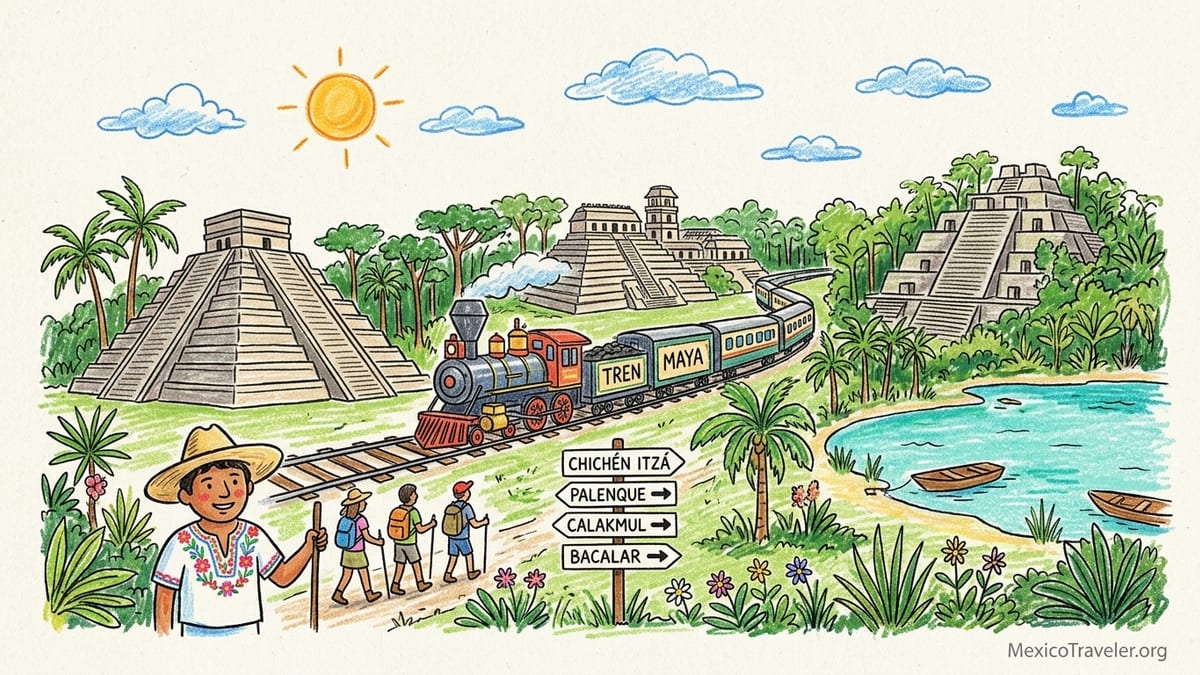
The creation of the Tren Maya, a 1,500‑kilometer railway loop that connects Palenque with Escárcega, Campeche, Mérida, Cancún, Tulum, Bacalar and back toward Campeche, has reshaped how multi-site archaeological trips are planned. Sections are now fully operational, and official cultural packages combine train segments with ground transfers and guided visits to major sites. At the same time, independent guides, community-run cooperatives and long-established tour companies continue to operate by road, especially in more remote corners where train access only covers part of the journey.
For visitors, the key is to treat Mundo Maya México as a cross-regional destination rather than a single-state road trip. A well-designed itinerary might start with a short excursion to Chichén Itzá from Cancún or Mérida, continue to the jungle temples and waterfalls around Palenque, link through Calakmul in Campeche and finish on the lagoon at Bacalar. Not every traveler will cover all five states in one holiday, but the best archaeological tours now think beyond state borders, focusing instead on layers of history, ecosystems and living Maya communities.
Because transport, opening hours and local regulations change, it is important to verify the status of each archaeological zone shortly before traveling. The Instituto Nacional de Antropología e Historia (INAH) confirms that flagship sites including Chichén Itzá, Palenque, Calakmul and Dzibanché are open in 2026 with standard daytime visiting hours, although special operations and crowd control plans are put in place around the equinoxes. Tickets for INAH sites are purchased at on-site ticket offices, usually in cash, and local state agencies may charge a separate fee in addition to the federal archaeological ticket.
Current Conditions at Key Maya Archaeological Sites
Chichén Itzá, in the state of Yucatán, remains one of Mexico’s busiest archaeological zones. INAH information for 2026 confirms that the site opens daily, with standard hours typically running from early morning to late afternoon. Around equinox dates in March and September, INAH implements special crowd management operations and reminds visitors that access to restricted structures is not allowed, tripods and drones require prior authorization, and last entry may be brought forward on the busiest days. Travelers should expect security checks at the gate and a clear separation between the archaeological core and extensive craft and souvenir areas just outside.
Palenque in Chiapas is fully open in 2026, including its on-site museum. INAH states that the archaeological zone opens from 8:00 to 17:00 every day, with final entry normally mid-afternoon so staff can clear the site on time. The ruins lie inside a national park several kilometers from the modern town, so access is controlled at a park gate and again at the archaeological entrance. During peak seasons such as Easter Week and major national holidays, INAH can adjust entry procedures or cap numbers for safety reasons, and visitors are asked to follow staff guidance, stay out of roped-off areas and keep to established paths.
Calakmul, in Campeche, is more logistically demanding. The ruins stand deep inside the Calakmul Biosphere Reserve, more than 60 kilometers down an internal access road from the highway near the community of Conhuas. The archaeological core opens daily, generally from morning to late afternoon, but travelers must also factor in separate reserve access fees and the long approach drive. Recent traveler reports from 2025 and 2026 describe checkpoints at the reserve entrance, basic visitor facilities and limits on how early you can enter and how late you can leave, partly to protect wildlife in this critically important forest.
On the southern Quintana Roo routes, the archaeological zones of Bacalar’s hinterland, including Kohunlich, Dzibanché and the fortified site of Becán in neighboring Campeche, are open with regular hours in 2026. These sites are more lightly visited than Chichén Itzá or Tulum, and facilities are simpler: parking, basic restrooms and a small INAH office selling tickets. Shade can be limited on exposed plazas, and services around the sites are modest, so travelers often rely on their tour operator for drinking water and snacks. It is sensible to confirm opening times in Bacalar or Chetumal a day before travel, because temporary closures can occur during heavy rain, infrastructure repairs or local events.
Short Archaeological Excursions from Cancún and Mérida
Cancún and Mérida remain the main gateways for travelers who want introductory Maya experiences without devoting their whole trip to archaeology. From Cancún, the classic day trip is Chichén Itzá, reached by highway in roughly 2.5 to 3 hours each way. Mass‑market operators sell bus tours that include transport, bilingual guide, buffet lunch at a roadside complex and a cenote swim stop, often for per-person prices broadly comparable to a mid-range hotel night. These tours typically spend about three hours inside the archaeological zone, which is sufficient for a guided circuit around El Castillo, the Great Ball Court, the Sacred Cenote and the Observatory, but leaves little time to wander independently.
More specialist operators out of Cancún and Playa del Carmen offer small-group or private Chichén Itzá visits with early departure to arrive near opening time. These packages usually cap the group at around 10 to 15 people, include an English and Spanish speaking archaeological guide and sometimes add other languages on request, such as French or German. Because numbers are low, guides can tailor the route to traveler interests, spending longer on architecture, iconography or astronomical alignments. Prices per person are higher than for mass tours, especially on a private basis, but the experience feels closer to a curated field visit than a sightseeing stop.
Mérida serves as the cultural base for western Yucatán, and day trips from the city focus on Uxmal, Kabah and other Puuc Route sites in addition to Chichén Itzá. Archaeological tours from Mérida frequently package Uxmal with a working hacienda or cenote visit, offering a mixed day of ruins and rural life. Group sizes range from van-based groups of 12 to 18 travelers to private vehicle arrangements for couples or families. Because driving times are shorter than from Cancún, travelers based in Mérida often report spending closer to four hours at Uxmal, giving more room for detailed explanation of palace complexes and decorative façades.
Across both hubs, independent travelers can also hire licensed guides directly at the sites. At Chichén Itzá, guides wait just inside the main gate, posting indicative prices per group for one- to two-hour tours in Spanish and English, with some offering other languages. INAH authorizes these guides, but payment is negotiated in cash on the spot and does not include transportation. This arrangement works well for visitors who reach the sites by rental car, scheduled bus or Tren Maya services and want expert interpretation only at the ruins themselves.
Multi-Day Palenque & Lacandon Jungle Experiences
Once travelers move beyond the Yucatán day-trip circuit, Palenque becomes the natural anchor for more immersive Maya journeys. Sitting at the edge of the Chiapas rainforest with direct Tren Maya connections to Campeche and Calakmul, Palenque combines a major archaeological zone with a small but well-developed tourist town. Multi-day packages typically base travelers in Palenque for at least two or three nights to balance ruins, waterfalls and jungle explorations.
Standard two or three-night packages include a guided visit to the archaeological site of Palenque itself, often in the early morning before temperatures rise, plus excursions to Agua Azul and Misol-Ha waterfalls. Some itineraries add boat trips on the Usumacinta River or extend deeper into the Lacandon Jungle to sites such as Bonampak and Yaxchilán, where painted murals and riverside temples offer a complementary picture of Classic Maya life. These more ambitious programs can involve long road transfers, river launches and overnight stays in simple lodges run by Lacandon Maya communities.
Specialist archaeology-focused trips to Palenque often reduce the number of side excursions in order to increase time among the temples and in the on-site museum. An academically minded small-group tour might, for example, schedule two half-days at the ruins plus an evening lecture at the hotel, discussing the dynasty of Palenque or the decipherment of Maya glyphs. Group sizes on such tours are usually capped around 12 to 16 participants, and guides may be archaeologists or epigraphers rather than generalist tour leaders.
Compared with day trips from the coast, Palenque packages require more logistical resilience. Seasonal road works, occasional social protests that temporarily block highways and heavy tropical rain can all affect journey times. This is one reason why many operators design Palenque programs as three or more nights rather than trying to compress everything into a weekend. The extra time creates a cushion for delays and offers flexibility to move activities around if weather or local conditions change.
Southern Maya Routes: Bacalar, Kohunlich, Dzibanché and Becán
Quintana Roo’s far south and adjacent Campeche offer some of the most rewarding combinations of archaeology and landscape in the Mundo Maya region. Bacalar, a town on the shore of the Lagoon of Seven Colors, has grown into a low-key alternative to the Caribbean resorts. It now also serves as a convenient base for southern Maya archaeological routes that link Kohunlich, Dzibanché and Becán, with some itineraries stretching across the state line toward Calakmul.
Day tours from Bacalar or Chetumal to Kohunlich and Dzibanché typically run by road in air-conditioned vans, covering around two hours of driving in each direction depending on the exact route and pick-up locations. These trips often include hotel pick-up, bilingual guide, entrance fees and a picnic-style lunch or roadside restaurant stop. Time on site varies, but many programs plan around two hours at Kohunlich, focusing on the Temple of the Masks, and a similar amount at Dzibanché, where visitors can still climb selected structures subject to current INAH rules.
Becán, across the border in Campeche, is sometimes added to a long day trip or visited on a separate excursion from Xpujil, the small town that functions as a staging post for Calakmul. Its moat-and-rampart fortifications make it a particularly vivid place to discuss regional conflict in the Classic period. Facilities remain limited, so tours frequently carry additional water, snacks and basic first-aid kits, underlining how much more self-reliance is needed away from the major resort corridors.
With the arrival of Tren Maya services in southern Quintana Roo and Campeche, some operators now market combinations such as Tulum to Bacalar by train, then road transfers to Kohunlich and Dzibanché, before continuing toward Xpujil and Calakmul. Even so, travelers should understand that train stations are often several kilometers from town centers or archaeological zones, requiring additional taxis or private transfers. In practice, this means southern routes still feel like semi-expeditionary travel rather than straightforward rail-based sightseeing.
Tren Maya Cultural Packages vs Independent Tours
The most visible new entrants to the Mundo Maya tour scene are official cultural packages promoted through the Tren Maya project and tourism authorities. One headline example is the “Santuario Maya” itinerary, which connects Tulum, Chetumal, Bacalar, Calakmul and Palenque in a single multi-day journey. Other published programs for 2026 include week-long routes that start in Cancún or Mérida, use multiple train segments, and fold in archaeological visits to Chichén Itzá, Edzná, Calakmul and Palenque alongside waterfalls and beach time.
These packages usually bundle train tickets in tourist or premier class, ground transfers from stations, hotel accommodation, some meals, local guides and entrance fees to selected archaeological zones and natural attractions. Group sizes vary, but mainstream packages often work with 20 to 30 participants, traveling in full-size coaches between stations and hotels. Guiding tends to be in Spanish and English as standard, with other languages occasionally available for larger groups or charter departures.
Independent small-group operators, by contrast, may use Tren Maya only for certain legs and rely on chartered vans elsewhere. A private or small-group archaeology-focused package from Mérida to Campeche and onward to Palenque might, for instance, include one or two rail segments where times align well, then switch to road to access Calakmul at convenient hours. These itineraries usually keep groups under 12 travelers and can accommodate more flexible site schedules, such as arriving at ruins for opening time or staying until late afternoon without being beholden to train timetables.
Fully independent travelers have several options. Some purchase Tren Maya point-to-point tickets between major hubs, then organize on-the-ground excursions with local agencies once they arrive in places like Valladolid, Campeche, Bacalar or Palenque. Others rent cars in Yucatán or Quintana Roo and drive to archaeological zones themselves, hiring guides at site entrances. While this approach gives maximum control over how much time is spent at each site, it also puts all responsibility for navigation, safety and compliance with INAH rules on the traveler. In remote regions such as the Calakmul Biosphere Reserve, many visitors still prefer to hire a driver-guide or join a small-group tour rather than self-drive long distances on narrow forest roads.
How Much Time Do You Really Spend at the Sites?
One of the most important distinctions between different types of Maya archaeological tours is not the itinerary on paper but the actual hours spent among the ruins. Large day tours from Cancún to Chichén Itzá, for example, often advertise early departure and late return, yet once you account for hotel pick-ups, rest stops, souvenir breaks and buffet lunches, many travelers report only around three hours on site. Within that window, a one-and-a-half to two-hour guided tour leaves limited time for solo exploration, photography or quiet contemplation.
Small-group and private excursions tend to allocate more time at key sites. A dedicated Chichén Itzá tour out of Mérida might schedule four hours on site, allowing for a thorough guided explanation followed by free time. Similarly, specialist packages in the Puuc region often offer long half-days at Uxmal, with a slower pace and the option of extended talks on architectural styles. Because vans can move quickly between hotels and ruins, and group check-in takes less time, more of the day is available for the core archaeological content rather than logistics.
Remote sites require an even more carefully managed time budget. Calakmul is a clear example: travelers face several hours of driving from Xpujil or nearby lodges to reach and return from the site. Even with an efficient schedule, reports from recent group tours describe about three and a half to four hours at the ruins themselves, within a full-day outing that can run 10 to 12 hours door to door. Operators must also consider reserve rules on entry and exit times, wildlife considerations and the stamina of participants, especially in hot, humid conditions with many unshaded staircases.
For in-depth archaeology enthusiasts, these constraints make longer itineraries highly attractive. A ten-day train-and-road package that builds in multiple nights in Mérida, Campeche, Palenque and Bacalar can accommodate at least two major sites with generous on-site time in each region, plus several half-day visits to secondary sites. By contrast, a brisk seven-day route that promises “all the highlights” across five states often ends up compressing visits into two or three hours per site, which is enough for an introduction but insufficient for those hoping to study architecture or epigraphy in detail.
Why Seven Days Is Not Enough for the Whole Mundo Maya
Marketing materials sometimes suggest that travelers can “see the Mundo Maya” of Mexico in one week. While it is technically possible to visit a surprising number of sites in seven days using a mix of Tren Maya segments and long road transfers, the experience tends to be superficial. The distances between Cancún, Mérida, Campeche, Calakmul, Bacalar and Palenque are significant, and even with improved infrastructure, moving a group between these points still consumes many hours.
A typical seven-day circuit might include Chichén Itzá from Mérida, Uxmal or another Puuc site, a stop in Campeche, a long day to Calakmul from Xpujil and a finale in Bacalar or Tulum, possibly with a rushed half-day at Palenque if the route bends that far south. This kind of itinerary gives travelers a valuable overview of architecture across different ecological zones, but it demands early starts, late arrivals and limited downtime. There is little scope for weather delays, schedule changes or spontaneous cultural encounters in living Maya communities.
Remote destinations such as Calakmul and the Lacandon Jungle sites around Bonampak and Yaxchilán in Chiapas particularly resist compression. Reaching Calakmul alone can require an overnight stop in Xpujil or nearby lodges to avoid driving forest roads in the dark. Visiting Bonampak and Yaxchilán involves transfers to river ports, boat journeys and coordination with community-run services that operate on local schedules. Trying to add these destinations into a single-week trip that also includes Chichén Itzá and the Riviera Maya often produces more time in vehicles than among the ruins.
Travelers genuinely interested in the breadth of the Mexican Mundo Maya are better served by either extending their trip to 10 to 14 days or focusing their seven days on one or two regions. For instance, one week split between Mérida and Campeche can deliver deep engagement with Puuc and Chenes style architecture and day trips as far as Edzná. Alternatively, seven days between Palenque and Bacalar can prioritize jungle and southern sites. Attempting to “collect” all five states in one go may look impressive on a map but usually shortchanges the very experiences travelers come for.
The Takeaway
Planning the best Maya archaeological tour in Mexico now involves more choices than ever. The five-state Mundo Maya region brings together the tourist infrastructure of Quintana Roo, the cultural depth of Yucatán and Campeche, the rainforests of Chiapas and the lesser-known sites and wetlands of Tabasco. With the Tren Maya connecting major hubs, travelers can stitch together ambitious cross-regional itineraries that would have been cumbersome only a few years ago, especially when paired with trusted local ground operators.
For first-time visitors whose primary base is Cancún or the Riviera Maya, a small-group or private day trip to Chichén Itzá or a combination of Chichén Itzá and a cenote offers a strong introduction. Those with a week and a curiosity for history might consider dividing their time between Mérida and Bacalar, adding Uxmal, Kohunlich and Dzibanché to their schedule. Travelers prepared to dedicate 10 days or more and use Palenque and Calakmul as anchors can begin to appreciate the full geographic and cultural scope of the Mundo Maya, especially when they include both major UNESCO-listed sites and lesser-visited jungle cities.
Ultimately, the best tour is the one that balances logistics with real time on the ground, uses guides who can interpret both stones and contemporary culture, and respects the living communities who share their heritage with visitors. Whether you arrive by Tren Maya, coach tour, rental car or a blend of all three, treating Mundo Maya México as more than a backdrop for quick selfies is the surest path to a genuinely memorable journey.
FAQ
Q1. Are Palenque, Chichén Itzá and Calakmul fully open to visitors in 2026?
As of late 2026, INAH confirms that Palenque, Chichén Itzá, Calakmul and the main southern Quintana Roo sites are open with standard daytime hours, although procedures and last entry times may change during peak periods such as equinox operations or national holidays. Travelers should check local updates shortly before their visit.
Q2. How do Tren Maya cultural packages differ from regular bus tours?
Official Tren Maya cultural packages usually combine rail segments with hotel stays, transfers, some meals, guides and entrance fees, working with medium-sized groups and bilingual staff. Traditional bus tours operate only by road, often from a single base like Cancún, and may involve larger groups and less varied routing, though they can be cheaper for short stays.
Q3. Can I visit Calakmul as a day trip from Bacalar or Chetumal?
It is possible but demanding. A Calakmul day trip from Bacalar or Chetumal typically involves several hours of road travel each way and results in a very long day, even with an organized tour. Many travelers instead overnight closer to the site, near Xpujil or Conhuas, to reduce travel time and arrive earlier at the ruins.
Q4. Do guided tours include entrance fees to archaeological sites?
Most multi-day packages and organized day tours include INAH entrance fees and any relevant state or biosphere reserve charges in their published prices, but this varies by operator. Travelers should always ask for a clear breakdown of what is covered, including museum entries, reserve fees and optional activities, before booking.
Q5. Are private archaeological tours worth the extra cost?
For travelers who value flexible pacing, in-depth explanation and photography time, private tours can be very worthwhile. They allow you to start early, adjust the focus toward architecture or history, and spend more time at specific structures. For budget-conscious visitors primarily seeking a general overview, a reputable small-group tour often provides a good compromise.
Q6. How much walking is involved at major Maya sites?
Most sites require walking on uneven surfaces and climbing low steps, with distances at large complexes like Chichén Itzá and Calakmul adding up over several hours. Travelers should expect at least a few kilometers of walking during a standard guided visit and bring sturdy footwear, water and sun protection, particularly in exposed plazas.
Q7. Can I easily find English-speaking guides at the sites?
At major sites such as Chichén Itzá, Uxmal and Palenque, there is a well-established pool of licensed guides offering services in Spanish and English, and sometimes other languages. At more remote ruins like Dzibanché, Becán or Calakmul, the choice is more limited, so arranging a guide in advance through a tour operator or your accommodation is advisable.
Q8. Is it safe to travel independently around the Mundo Maya region?
Most travelers who follow standard precautions report positive experiences in the Mundo Maya region. Independent travel by bus, train or rental car is common, but routes to remote sites involve long drives and limited services. Using established tour operators, checking local advice and avoiding night driving in rural areas helps manage risk.
Q9. How far in advance should I book Tren Maya tickets and packages?
For peak seasons such as Christmas, Easter and summer holidays, it is sensible to book Tren Maya tickets and rail-based packages several weeks or months in advance, especially for premier-class seats and popular itineraries. Outside these periods, there is more flexibility, but travelers with fixed dates or complex routes should still secure arrangements early.
Q10. What is the best itinerary for a first-time visitor interested in Maya sites?
For a first visit of about 10 days, many travelers enjoy starting in Mérida for Chichén Itzá and Uxmal, continuing by train or bus to Campeche and then on to Palenque, finishing with a few days in Bacalar or the Riviera Maya. This route samples different landscapes and architectural styles without trying to see every site, leaving room for future trips focused on deeper exploration.