

By the time the bus from Villahermosa rolled into the low, humid plains of La Chontalpa, the air already smelled faintly of smoke, earth and something richer I could not yet name. I had booked a combined day trip to the Comalcalco Maya ruins and a working cacao hacienda, expecting a pleasant history lesson and some chocolate samples. What I found instead was a living landscape where ancient brick temples, Yokot’an Maya heritage and the taste of freshly ground cacao are still woven tightly together.
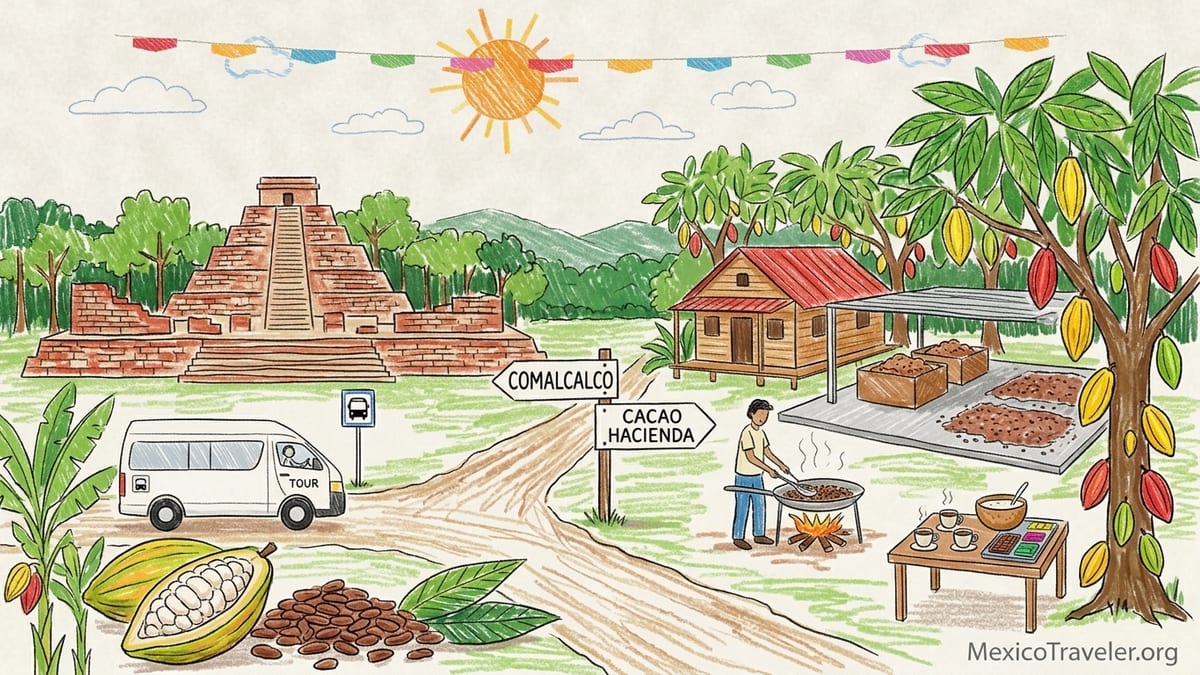
Booking the Cacao and Comalcalco Day Trip from Villahermosa
I planned this trip as most travelers will: starting in Villahermosa, the state capital and main gateway to western Tabasco. Several local agencies in the city center and hotel district around Tabasco 2000 advertise full-day “Comalcalco y Ruta del Cacao” tours. In October 2026, most quoted prices between 1,150 and 1,400 Mexican pesos per person for a shared tour, with a minimum group of two. My own package cost 1,250 pesos, paid in cash at a small agency desk inside a central Villahermosa hotel.
The advertised inclusions were fairly standard: round-trip transportation from Villahermosa, entrance and guided visit at the Comalcalco archaeological zone, a cacao hacienda visit with explanation of cultivation and processing, a tasting, and a brief stop in Comalcalco town. Lunch was explicitly not included, nor were souvenirs or additional chocolate purchases at the hacienda store. Pickup was scheduled for 8:00 a.m., with a promised return to Villahermosa around 6:00 p.m., enough for an unhurried but full day.
Transport turned out to be in a clean, air-conditioned fifteen-seat van rather than the full-size coach suggested by the brochure. Our guide was a local Tabasqueño, Spanish-speaking but with patient, functional English for key explanations. The group that day was mixed: a pair of domestic travelers from Mexico City, a family from Monterrey, and two foreign visitors, including me. That combination shaped how the day unfolded, with the guide constantly weaving between everyday Mexican references and more basic context for those of us encountering Tabasco for the first time.
Independent travelers could certainly do this route without an agency. Comalcalco town lies roughly 55 to 60 kilometers northwest of Villahermosa, and frequent public buses and combis connect the two for around 80 to 120 pesos one way, depending on the company. From the town center, official INAH information confirms that taxis or moto-taxis make the short hop to the archaeological zone a few kilometers away. However, reaching the scattered rural cacao haciendas then becomes more complex without your own car, which is one reason many visitors still opt for an organized tour for this particular combination.
First Impressions of Comalcalco: A Maya City Built of Brick
We reached the Comalcalco archaeological zone mid-morning, when the heat was already pressing but the site still mostly quiet. Unlike the limestone hills that surround better-known Maya cities, here the land is low, flat and heavy with clay. That geological difference explains Comalcalco’s most striking feature. In this part of Tabasco there is virtually no building stone, so ancient Maya builders turned instead to fired clay brick and oyster-shell lime mortar, creating a city that looks almost Mediterranean from certain angles.
INAH signage at the entrance and in the on-site museum describes Comalcalco as the most westerly major city of the Maya world, occupied for more than a thousand years from roughly the second century before our era into the late Classic period. Instead of the gray blocks of Tikal or Palenque, the main temples and palaces here rise in deep red and brown tones, their surfaces once covered with thick stucco made by burning heaps of river oyster shells. Our guide pointed to a reconstructed cross-section where layers of compacted earth, oyster-shell lime and carefully placed bricks were exposed, showing three distinct construction systems that specialists now group under the label “Maya Gulf Coast architecture.”
Walking up the Gran Acrópolis, I could feel the difference underfoot. The steps were narrower, sharper, each brick clearly discernible even after centuries of erosion and modern conservation. At the top, warm wind blew across the surrounding cacao country, and my guide described how Comalcalco once functioned as a port city connected by rivers to the Gulf of Mexico and inland routes toward the highlands of Chiapas and Guatemala. Archaeological research has documented large quantities of ceramic figurines, molded bricks with glyphs and images, and evidence of intensive trade, including the export of cacao and finished pottery to distant sites.
Inside the small but excellent site museum, I could finally see some of the famous decorated bricks up close, their incised glyphs and images of deities and lords now protected behind glass. One panel explained that recent conservation work, including emergency stabilization after the 2024 tropical storm season, has focused on structures like Estructura 5, described as an example of “Maya yokot’an architecture.” The term yokot’an, more widely known in Spanish as chontal, refers to the Maya people who still live in the surrounding region and whose language can still be heard in markets and small villages. In that moment the line between past and present became very tangible.
From Ancient Cacao Trade to a Working Hacienda
After about two hours at the ruins, including free time to climb temples and walk shaded paths, we climbed back into the van and drove fifteen minutes along a narrow paved road lined with coconut palms, banana plants and scattered houses. Comalcalco’s reputation as an ancient cacao-producing zone is not just romantic marketing. Archaeological and historical sources connect this region to pre-Hispanic cacao cultivation, and modern Tabasco remains one of Mexico’s key cacao-growing states. That continuity becomes obvious as soon as you turn off the highway and into a working plantation.
Our tour that day visited Hacienda Cacaotera Jesús María, a long-running family estate that has embraced tourism while still cultivating cacao and producing chocolate. Other tours in the region may substitute Hacienda La Luz or smaller producers, but the general format is similar: a guided walk through shaded cacao groves, an explanation of post-harvest processing, demonstrations of roasting and grinding, and tastings in a combined workshop and retail area.
At Jesús María, the visit fee for independent travelers in late 2026 was posted at around 120 to 150 pesos per person for the basic tour in Spanish, with additional cost for chocolate workshops. In my case, the hacienda entrance and standard tour were bundled into the Villahermosa agency’s day-trip price, which meant I did not pay separately on arrival. Our group was folded into a larger on-site tour of about twenty people, almost entirely domestic visitors from other parts of Mexico, which gave the experience a casually social feel rather than a heavily scripted one.
The first steps under the shade of mature cacao trees felt like entering a different climate. The harsh midday sun softened to a greenish glow filtered through broad leaves, the air cool and heavy with moisture. The guide from the hacienda reached up to pull down a low-hanging cacao pod, its thick yellow skin ridged and slightly rough to the touch, and cut it open with a practiced stroke. Inside, the beans were wrapped in slippery white pulp that smelled faintly like lychee and citrus. We were invited to suck the pulp from a fresh seed: sour-sweet, floral and absolutely nothing like chocolate.
Fermentation, Drying and the Reality of Chocolate Making
The tour route passed from the grove to a covered area where shallow wooden boxes were stacked in tiers. Here the hacienda guide explained the fermentation process, the crucial stage in which those sweet, pale seeds begin to transform into something that can eventually become chocolate. At Jesús María, the boxes were partially full of beans covered in sticky pulp, generating a surprising amount of heat. Lifting the lid released a cloud of steam and a wave of aromas somewhere between overripe fruit and fresh bread.
From there we moved to the drying yard, a wide expanse of concrete and wooden slats where beans were spread in thin layers to dry in the sun. On the day of my visit the sky was clouding over, so workers periodically pushed the beans into piles and pulled them under a sliding roof system that protects them from sudden downpours. That simple, practical choreography, repeated day after day, connected directly back to the archaeological evidence of cacao as a traded commodity in ancient Comalcalco. The tools have changed, but the sequence of fermenting, drying, transporting and transforming cacao remains essentially the same.
Inside a small open-sided workshop, we reached the part of the tour that most visitors come for: roasting and grinding. Contrary to some glossy brochures I had seen in Villahermosa, we did not participate in every stage as full hands-on chocolatiers. At Jesús María, the standard group visit is more observational, with occasional audience participation. One staff member roasted fermented, dried beans in a shallow metal pan over gas flame, stirring until the air filled with an intense, slightly smoky aroma that finally resembled the chocolate we know. We were invited to peel a few warm beans by hand, rubbing off the brittle shells to reveal nibs that tasted dark, bitter and powerfully concentrated.
Grinding was demonstrated on both a traditional stone metate and a small mechanical mill. On the metate, the rhythmic scraping as the worker pressed roasted beans back and forth soon produced a glossy paste that clung together from the heat generated by friction. We were not offered the chance to do this ourselves in any substantial way, which is worth noting for travelers expecting a full “make your own chocolate bar” experience. Instead, each visitor was given a tiny pinch of freshly ground cacao paste to taste, unsweetened and intense, before moving on to the final tasting area where more elaborated products awaited.
Tastings, Pozol and Living Yokot’an Heritage
The tasting room at Jesús María is part showroom, part café. Long counters displayed chocolate bars in various cacao percentages, flavored tablets, cocoa powder, artisanal bonbons, and bags of roasted beans. For groups like ours, the hacienda offers a standard set of tastings included in the visit price: small cups of hot chocolate made with water and with milk, a taste of a cold cacao drink, and samples of atole or other seasonal preparations. Additional items, such as elaborate desserts or full cups of drinking chocolate, carry extra charges similar to café prices in a mid-range Mexican city.
One of the most revealing elements of the visit was the explanation of pozol, a thick, slightly sour drink that has sustained people in Tabasco’s heat for centuries. Here it was prepared in the traditional way described by local Yokot’an communities: starting with nixtamalized maize ground into dough, mixed with ground cacao and water, then stirred briskly in a large jícara or bowl until it formed a foamy, opaque liquid. We watched as the hacienda guide used a wooden whisk to aerate the drink. Those who wished could taste a small cup, cool and slightly grainy, with a tang that comes from fermentation when pozol is prepared in advance and carried for long journeys.
Throughout the explanations, references to the Yokot’an or Chontal Maya were clear and specific, not just decorative mentions. Our hacienda guide, who identified herself as coming from a nearby community, described how cacao cultivation and pozol-making remain everyday practices in rural households, not simply revived traditions for tourists. She spoke of how her grandparents still planted cacao under taller shade trees, how pozol accompanied them to the fields, and how certain cacao-based drinks are reserved for festivals or rituals in village churches and chapels in the Chontalpa region.
At the same time, the commercial framing of the experience was always evident. After tastings, visitors were steered naturally toward the retail area, where bars of locally branded chocolate ranged from around 60 to 120 pesos, rising higher for gift boxes and special editions. Compared with supermarket prices in Mexico, these are higher, but knowing how much manual labor and climatic risk goes into each bean, they felt fair rather than exploitative. The key, for me, was that the hacienda’s staff seemed genuinely proud to present cacao as part of a living Yokot’an heritage that has economic value for small producers, not as a frozen museum piece.
Costs, Guides and the Balance Between Learning and Commerce
Evaluating the overall value of the day requires separating the elements controlled by the Villahermosa tour agency from those provided by INAH and the cacao hacienda. My 1,250-peso package included round-trip transportation, basic entrance and guiding at Comalcalco, and the standard hacienda tour with tastings. If I had arranged everything independently, I estimate that transport by public bus and local taxis might have totaled around 300 to 400 pesos, Comalcalco entrance and museum another 90 to 100 pesos for a foreign visitor, and the hacienda tour 120 to 150 pesos, with extra for tastings beyond the basics. That suggests the agency margin covered the convenience of a dedicated van, a bilingual guide and bundled logistics rather than delivering big savings.
The quality of guiding was a highlight at both main stops. At Comalcalco, our agency guide deferred correctly to INAH regulations and local site staff, focusing on broad historical context, while official panels and the small museum provided detailed information on architecture, chronology and conservation. Although our guide occasionally repeated popular anecdotes, he was careful not to contradict posted INAH explanations about the city’s periods of occupation, brick construction methods or its role as the westernmost major Maya center in Tabasco.
At Hacienda Jesús María, guiding responsibilities shifted to the estate’s own staff, who were clearly accustomed to hosting mixed groups. Their explanations of cacao biology, harvest timing and processing were straightforward and practical, grounded in visible, working installations rather than diagrams alone. When asked whether visitors could personally participate more deeply in chocolate-making, the guide explained that separate, longer workshops were available for smaller groups at an extra charge, while the standard tour necessarily prioritized safety and flow over full hands-on involvement.
The main commercial pressure came at the end of the hacienda visit, where the layout encourages browsing and purchases. Prices for chocolate and cacao products were competitive with other specialty producers in Mexico, and there was no aggressive upselling, but travelers on tight budgets should be prepared to navigate temptations. Overall, considering transport, interpretive quality and the depth of the experiences at both Comalcalco and the hacienda, I felt the total cost was reasonable. Critical travelers might wish for a slightly longer stay at the ruins or a more generous chocolate tasting, but the day delivered substantial substance rather than surface-level photo stops.
One Hacienda or Several: Does the Experience Repeat?
Some itineraries in Tabasco promote visiting multiple cacao haciendas in a single day, stringing together Jesús María, La Luz and smaller estates in the same region. Before traveling, I was tempted by this idea of a full cacao immersion. After experiencing one plantation in depth, however, I am convinced that more is not always better. The core agricultural and processing cycle does not change dramatically from hacienda to hacienda. Trees, pods, fermentation boxes and drying yards will look broadly similar, and explanations necessarily cover overlapping ground.
Where differences do emerge is in emphasis and presentation. Hacienda Jesús María, for instance, leans strongly into explaining both artisanal and more modernized small-scale processing, with clear demonstrations of roasting and grinding and a retail selection focused on bars, cocoa powder and pozol-related products. Other estates in the area may emphasize historic architecture, old machinery or family history, or offer more elaborate gastronomic experiences with full meals and chocolate pairings at higher prices. Those contrasts can be meaningful for travelers with strong culinary or historical interests, but they require time and energy to appreciate fully.
In practice, for a single day combining Comalcalco and the cacao route, visiting one well-chosen hacienda felt sufficient. The sensory impressions of fresh cacao pulp, the heat of fermentation boxes, the smell of roasting beans and the taste of pozol stayed vivid long after we left. Adding a second near-identical walk through groves and drying patios might have diluted rather than deepened those memories. For travelers with more days in Tabasco, spacing hacienda visits across separate mornings or afternoons could make more sense, especially if combined with different attractions such as the riverine wetlands of the Centla biosphere reserve or other smaller archaeological sites in the state.
If your time in Tabasco is limited to a single full day outside Villahermosa, I would recommend focusing on one plantation that aligns with your interests rather than chasing a checklist of multiple estates. That way, the cacao experience can serve as a counterpoint to Comalcalco’s ruins, not as a competing main event that leaves you rushing through one or the other.
Independent Travel vs Guided Package: What Works Best?
Looking back at the day as a whole, the key question for many travelers will be whether to book an organized tour from Villahermosa or to go independently. For confident Spanish speakers comfortable navigating regional buses, taxis and rural roads, arranging Comalcalco and a hacienda visit on your own is entirely feasible. The archaeological zone is clearly signposted from Comalcalco town, and INAH provides reliable opening hours and entrance fees. Many cacao estates list current tour schedules and prices at their entrances or by phone. Traveling this way would likely save some money and allow you to adjust the pace, especially if you want longer at the ruins or at the museum of site.
That said, there are trade-offs. Coordinating bus schedules, transfers and hacienda opening times can be tiring in the heat, particularly if you do not know the area. Some plantations are reachable only by private car or pre-arranged transport from town. A guided package, like the one I chose, removes those logistical frictions and ensures you can move smoothly from one place to another. It also guarantees at least basic interpretive commentary in Spanish, and sometimes in English, throughout the day.
From a budget perspective, independent travel might reduce the overall cost by perhaps 20 to 30 percent, especially if you are comfortable using local buses and self-guiding at the ruins. A private driver or rented car would narrow that margin quickly. For solo travelers, the social aspect of a group tour may also be a decisive factor, as it was for me. Sharing impressions of pozol and brick temples with fellow travelers as the van rolled back toward Villahermosa at sunset added emotional texture that is hard to replicate alone.
Ultimately the choice turns on your priorities. If you value flexibility, deeper time at particular stops, and the challenge of navigating on your own, independent travel will reward you. If your main goal is to ensure you experience both Comalcalco and a functioning cacao hacienda in one seamless, low-stress day, a reputable guided package from Villahermosa remains the most efficient option.
The Takeaway
Combining Comalcalco’s brick temples with a working cacao estate turned out to be a remarkably coherent way to spend one full day in Tabasco. Rather than feeling like two unrelated attractions pasted together for tourists, the ruins and the hacienda revealed different layers of the same long story. At Comalcalco, INAH’s conservation work and interpretation show how a Maya city adapted to a landscape without stone, building with brick and oyster-shell mortar and anchoring trade networks that moved cacao across rivers and coasts. At the hacienda, modern farmers and chocolatiers continue to cultivate, ferment, dry and transform cacao in ways that echo ancient practices while sustaining contemporary livelihoods.
Was it the absolute best use of a single day in Tabasco? For travelers interested in both archaeology and food culture, my answer is yes. The experiences are mutually reinforcing. Climbing a brick pyramid in the morning and then holding a warm, freshly roasted cacao bean in the afternoon makes the region’s history feel immediate and alive. Sampling pozol while listening to stories of Yokot’an grandparents in the fields grounds that history in living memory.
There are, of course, other compelling options. Nature enthusiasts might prefer to devote a day to the wetlands and birdlife closer to the coast, and those with more time could explore additional archaeological zones or multiple haciendas in greater depth. But for a first immersion in Tabasco that connects landscape, people and flavor, the cacao route paired with Comalcalco offers a concentrated, satisfying introduction.
If you decide to go, consider your own comfort with Spanish, transport logistics and budget when choosing between an organized tour and independent arrangements. Whichever route you take, arrive early, drink plenty of water, taste the pozol if offered, and give yourself a quiet moment among the brick temples to imagine the ancient traders who once shipped cacao from this very region. Then, when you raise a cup of chocolate in the shade of a modern cacao tree, you will know exactly how far that story has traveled.
FAQ
Q1. How much does a combined Comalcalco and cacao hacienda day trip from Villahermosa cost?
In late 2026, shared full-day tours from Villahermosa that include transport, Comalcalco entrance and a standard hacienda visit commonly range around 1,150 to 1,400 Mexican pesos per person, depending on the operator, season and group size. Independent travelers using public transport and paying entrances separately can often spend less overall but assume more logistical responsibility.
Q2. Can I make my own chocolate at the hacienda, or do I only watch demonstrations?
On the standard group tour at Hacienda Jesús María, visitors mostly observe the roasting and grinding stages, with small participatory moments such as peeling roasted beans or tasting fresh ground paste. More intensive, hands-on chocolate workshops where you form your own bars or tablets are usually offered separately for smaller groups at additional cost, which should be confirmed directly with the hacienda when planning your visit.
Q3. Is Comalcalco suitable for travelers who have already visited major Maya sites like Chichén Itzá or Palenque?
Yes. Comalcalco offers a distinct experience because its monumental structures are built with fired clay bricks and oyster-shell lime mortar rather than carved limestone. This unusual architecture, combined with its role as one of the westernmost Maya cities linked to cacao trade, makes a visit feel complementary rather than repetitive for travelers who have seen other famous sites in the Maya area.
Q4. Do I need to speak Spanish to enjoy the cacao route and Comalcalco?
A basic level of Spanish is helpful, especially for independent travelers using local buses and taxis or joining hacienda tours that may be conducted primarily in Spanish. Some guides in Villahermosa and at larger haciendas offer commentary in simple English, but this is not guaranteed on every visit. Travelers who do not speak Spanish and prefer detailed explanations may find an organized bilingual tour from Villahermosa more comfortable.
Q5. What should I wear and bring for a day visiting Comalcalco and a cacao estate?
The climate in La Chontalpa is hot and humid year-round. Lightweight, breathable clothing, a hat, comfortable walking shoes with good grip, sunscreen and insect repellent are essential. Carry a refillable water bottle and a small towel or scarf to manage perspiration. Many travelers also bring cash in small denominations for snacks, tips, and chocolate purchases at the hacienda shop, as card payment may not always be available or reliable.
Q6. How physically demanding is the visit to Comalcalco and the hacienda?
At Comalcalco, exploring the site involves walking on uneven ground and climbing stepped structures that can be steep and narrow, though it is possible to appreciate much of the architecture without climbing the highest temples. Cacao hacienda visits typically require walking short distances along shaded paths and standing for explanations. Travelers with limited mobility should consult guides in advance, as some routes can be adjusted, but complete accessibility is not guaranteed.
Q7. Is pozol safe to drink for visitors not used to fermented beverages?
Pozol served at reputable haciendas or local eateries is generally prepared with attention to hygiene and is safe for most visitors. The drink can have a mild fermented tang, especially when prepared ahead of time, which may be unfamiliar but is part of its traditional character. Travelers with sensitive stomachs may wish to start with a small portion, and those with dietary restrictions related to maize or cacao should ask about ingredients before tasting.
Q8. Can I visit more than one cacao hacienda in a single day along with Comalcalco?
It is possible to visit multiple haciendas if you arrange private transport or a custom tour, but combining more than one plantation with Comalcalco in the same day can feel rushed and somewhat repetitive. Since the basic agricultural and processing stages are similar across estates, many travelers find that one well-chosen hacienda provides enough depth, especially when paired with a substantial visit to the ruins and museum.
Q9. Are there good places to eat lunch during the tour?
Most organized tours stop in or near Comalcalco town, where small restaurants and fondas serve regional dishes such as fish from local rivers, stews and simple set meals. Some haciendas also offer basic food options or snacks, though this varies. Because lunch is often not included in the tour price, it is wise to carry a bit of extra cash and perhaps a light snack to bridge the gap between breakfast and a late midday meal.
Q10. When is the best time of year to visit Comalcalco and the cacao route in Tabasco?
Comalcalco and the surrounding cacao region can be visited year-round, but travelers sensitive to extreme heat and rain may prefer the drier, slightly cooler months from roughly November to February. The rainy season typically brings heavier downpours that can briefly interrupt outdoor activities or require beans to be moved quickly from drying yards, though these conditions also offer a vivid look at how cacao producers work with the climate. Checking local forecasts shortly before your trip can help with planning.