

In 2026 I finally did what many travelers to Mexico’s Maya world only talk about: I visited both Palenque and Chichén Itzá within the same year, with a notebook in hand and an eye on every peso I spent. I wanted to answer a question I am asked constantly as a travel writer: if you have time and money for only one major Maya site, which delivers the more impressive and worthwhile experience?
How and When I Visited Both Sites
I visited Chichén Itzá first, on March 18, 2026, staying in Valladolid and entering the site right after opening at 8:15 a.m. I waited in line at the official Visitor Center ticket windows and paid the unified "Boleto Único" charged jointly by INAH and the Yucatán state tax authority. For foreign visitors in 2026 this combined ticket is 697 pesos, calculated as 105 pesos for the federal INAH archaeological fee plus 592 pesos for the state component collected by the Agencia de Administración Fiscal de Yucatán. I spent just over six hours inside, leaving around 2:30 p.m. after walking nearly every accessible section in the main core of the site.
Palenque came later in the year, on July 6, 2026. I based myself in Palenque town and took a taxi at 7:30 a.m., reaching the entrance a few minutes before the 8:00 a.m. opening. Here, the costs are split differently. At the lower checkpoint, inside Palenque National Park, I paid the protected-area fee, collected on behalf of Mexico’s protected areas agency, which in 2026 is a little over 200 pesos per person for general visitors, with a lower tier for Mexican citizens and residents. A few minutes later, at the Visitor Center, I bought my INAH archaeological ticket for 210 pesos as a foreign visitor. Door to door, that morning I spent close to 450 pesos in official fees before even buying water or snacks.
At both sites I hired local guides at the gate. In Chichén Itzá three freelancers approached me immediately with laminated IDs and sample routes. I joined a small English and Spanish group tour lasting about two hours for 900 pesos in total, shared among six people. At Palenque, the scene was calmer. After some brief negotiation I arranged a private bilingual guide for three hours at 1,200 pesos, which allowed time for detailed stops in the Temple of the Inscriptions, El Palacio and the Cross Group. In practice, I spent about six hours at Palenque as well, entering at opening and leaving just after 2:00 p.m.
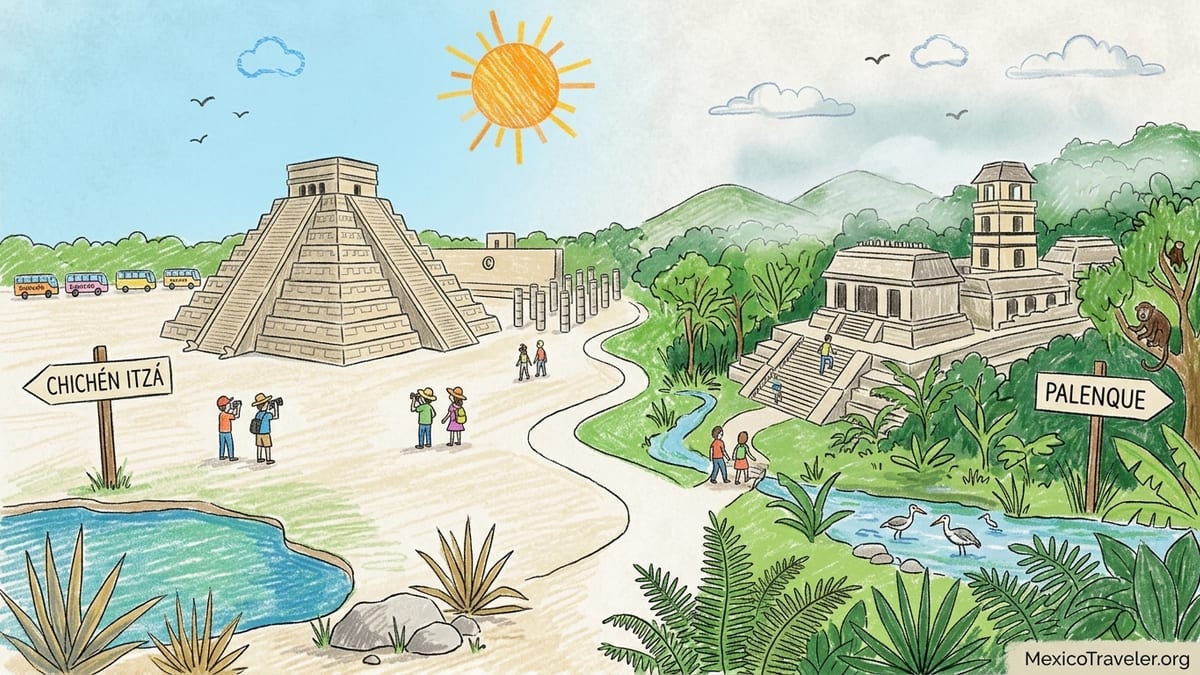
Crowd levels were dramatically different. At Chichén Itzá, even in March before Easter, buses from Cancún, Mérida and Playa del Carmen began unloading before 9:30 a.m., and by mid-morning the Great Plaza around El Castillo felt like a festival. At Palenque, on a July weekday in the rainy season, the parking lot never filled, and even the Temple of the Inscriptions was often shared with just a few dozen people at a time.
Architecture in Context: Jungle City vs Stone Cosmogram
Architecturally, Palenque and Chichén Itzá represent different chronological and stylistic moments in Maya history. Palenque peaked in the Classic period, roughly between the 7th and 8th centuries, under rulers such as Kʼinich Janaabʼ Pakal, whose tomb was discovered inside the Temple of the Inscriptions in 1952. The core of the site is relatively compact, gathered along the Otulum stream and framed by low jungle-clad hills. Structures emerge from dense greenery, so you constantly alternate between canopy shade and bright clearings.
Chichén Itzá, by contrast, flourished later and shows a blend of Puuc and so‑called Toltec styles. The site plan feels more like a vast ceremonial campus built around wide plazas and monumental platforms. El Castillo, the iconic stepped pyramid dedicated to Kukulcán, dominates the Great Plaza, while the Great Ball Court, Temple of the Warriors and surrounding colonnades extend outward on carefully leveled ground. Standing near the northern stairway of El Castillo, you can see how deliberately the builders aligned monuments with cardinal directions and astronomical events.
When comparing specific structures, Palenque’s Temple of the Inscriptions impressed me for its layered narrative power. You can no longer descend into Pakal’s tomb, but the exterior tells a story in relief panels and hieroglyphic texts, and the relationship to the palace complex is clear from the main plaza. El Palacio itself, with its four-story observation tower, airy corridors and interior courtyards, feels like a place where people actually lived and governed. Carved stucco panels still cling to its walls in places, hinting at what the complex once looked like when painted in reds and blues.
At Chichén Itzá, El Castillo is visually overwhelming but more abstract. Visitors can no longer climb its steps, so interaction is limited to walking the perimeter and listening to guides explain how equinox shadows create the famous serpent effect on the north staircase. The Great Ball Court, however, is deeply experiential. Its stone rings high above the playing field, the whispering acoustic effect across the length of the court, and the reliefs showing decapitated players make it easier to imagine how ritual sport and political power intertwined here. The Temple of the Warriors, closed to climbing but ringed by a dense forest of columns, shows a different, more militaristic iconography than you find at Palenque.
Historical Interpretation and On-Site Guiding
In practice, good interpretation depends on both signage and guiding. At Chichén Itzá, INAH has installed bilingual Spanish and English panels at major monuments, summarizing construction dates, architectural features and basic iconography. These signs are clear, but they compete visually with rows of souvenir stands and a constant flow of tour groups. On my March visit, the explanations of astronomical alignments at El Castillo and ritual ballgame details at the Great Ball Court were thorough, but the broader story of Chichén’s political history and regional power was only briefly mentioned.
My group guide at Chichén Itzá followed a fast, well-rehearsed circuit designed for day-trippers from the coast. We spent the bulk of our two hours around El Castillo, the Ball Court and the Temple of the Warriors, with a quick look at the Sacred Cenote from a distance. Questions were encouraged but the pace was brisk, so nuanced topics like debates over Toltec influence or the multiple construction phases of the pyramid were handled in a simplified way. For travelers whose main reference point is the “New Seven Wonders” list, this narrative is satisfying, but history enthusiasts might leave wanting more.
Palenque delivered a different kind of interpretation. The official site museum, located near the entrance and included in the INAH ticket, houses some of the finest original sculptures and the replica of Pakal’s sarcophagus lid. My guide suggested starting inside on that hot July morning so that when we later stood in front of the Temple of the Inscriptions, we could connect the reliefs and glyphs directly with what we had just seen in climate-controlled galleries. The labels are primarily in Spanish, but many key pieces have English summaries.
On the ground, Palenque guides tend to specialize in epigraphy and dynastic history, because the site lends itself naturally to telling a family saga. Over three hours, my guide wove the lives of Pakal, his mother Sak Kʼukʼ and his sons into everything from the layout of El Palacio to the orientation of the Cross Group temples. There was more time for follow‑up questions and even reading glyph blocks together in shaded corners of the palace. As a result, Palenque felt like a coherent, lived-in city, while Chichén Itzá, for all its grandeur, sometimes felt more like a monumental stage set.
Heat, Crowds and Visitor Comfort
For overall comfort, the biggest factors are climate, shade and crowd management. Palenque sits in the lowland jungle of Chiapas, where July brings high humidity and regular afternoon showers. On my July 6 visit temperatures climbed past 30 degrees Celsius by late morning, yet the combination of tree cover and the breeze along the Otulum stream meant that I could usually find shade when I needed it. Trails between major groups of buildings wind through forest, and there are several small rest areas with benches and modest food stands near the entrance and parking area.
Chichén Itzá in March was hotter in perceived temperature, despite slightly lower humidity, because so much of the core site is open limestone plaza without shade. By 11:00 a.m. the stones underfoot radiated heat and most visitors sought the narrow strips of shadow cast by El Castillo or nearby trees. There are a few shaded rest areas behind the souvenir lines and around the Visitor Center, but if you linger in the Great Plaza to photograph El Castillo from multiple angles you will do it mostly under direct sun.
Crowding adds another layer. At Palenque, even at mid‑day, I could frame wide shots of the Temple of the Inscriptions and El Palacio with only a handful of people in view. Climbing some of the secondary structures on the site’s fringes felt almost meditative. In contrast, by late morning at Chichén Itzá I found myself waiting for gaps between large tour groups to take photos where El Castillo was not ringed by selfie sticks. The Great Ball Court, in particular, can fill with several groups at once, each guide trying to demonstrate the acoustic trick by clapping, which breaks the atmosphere for everyone else.
Facilities at both sites are adequate, with toilets near the entrances and basic food options. However, the commercial footprint at Chichén Itzá is far larger. A long corridor of vendors lines the main paths selling carved obsidian, embroidered blouses and mass‑produced souvenirs. The calls of “almost free” and “good price, my friend” are constant. At Palenque, vendors are concentrated mostly outside the main gate and in a small area near the parking lot, which keeps the archaeological core quieter and more contemplative.
Photography and Sense of Place
From a photographer’s perspective, Palenque and Chichén Itzá each offer distinct advantages. Palenque rewards early arrival with misty, diffused light filtering through trees, creating depth and contrast between mossy steps, white limestone and dark foliage. On July 6, light rain around 9:30 a.m. briefly emptied the central plaza in front of El Palacio, leaving me almost alone to compose shots of the palace tower rising above low fog. Long lenses help pick out stucco details, while a wide‑angle lens captures the relationship between temples and forested hills.
Chichén Itzá, on a clear March morning, gives you iconic postcard compositions: El Castillo centered against a deep blue sky, its four stairways carving shadows across the pyramid’s terraces. The Great Ball Court’s long walls and repeating reliefs lend themselves to strong geometric frames. The Temple of the Warriors, especially when shot from the far edge of the colonnade, gives a sense of endless columns receding into the distance. For visitors capturing memories on a phone camera, Chichén Itzá is straightforward to photograph, because the structures stand free of trees and are visible from many angles.
Yet the sense of place is quite different. Palenque feels intimately connected to its environment. Standing in the palace’s upper corridors, you look out not onto a parking lot or highway, but onto jungle canopy and the faint white outlines of more unexcavated structures. Bird calls and the rush of the river blend with the sounds of visitors. That natural setting made my photos feel less like isolated architectural studies and more like fragments of a living landscape.
At Chichén Itzá the surrounding landscape plays a smaller role in the immediate experience. The site sits on relatively flat karst terrain, and apart from low tree lines at the margins, you spend most of your time on exposed plazas. El Castillo is visually powerful partly because it rises abruptly from this level surface. However, the constant movement of groups and vendors means that truly contemplative shots demand either very early arrival or patient waiting for brief lulls. For photographers seeking atmospheric, story‑driven images, I found Palenque more rewarding overall.
Real Costs and Logistics from Major Tourist Hubs
For many travelers, the key decision is not just what happens inside the archaeological zone, but the time and money involved in getting there. Chichén Itzá sits between several major hubs on the Yucatán Peninsula. From Cancún, organized day tours with hotel pickup, transport, guide service and lunch commonly start around 1,400 to 1,800 pesos per person in 2026, with the 697‑peso entrance not always included in the advertised price, or sometimes listed as a separate “government tax” to be paid in cash on arrival. From Mérida or Playa del Carmen, similar packages exist at slightly lower or higher prices depending on distance and extras like cenote stops.
Independent travelers often base themselves in Valladolid, a smaller colonial city about 45 minutes from the site. On my March trip, I paid roughly 200 pesos each way for a taxi shared with another traveler, plus the entrance fee at the gate. Public buses and colectivos from Valladolid run more cheaply, often under 100 pesos round trip, though schedules can be irregular at mid‑day. Travel time from Cancún by rental car is around two and a half hours each way, making a same-day round trip long but feasible.
Palenque requires more commitment. The town lies in Chiapas, several hours from the most popular beach destinations. Many visitors arrive by overnight or daytime buses from San Cristóbal de las Casas or Villahermosa. On my July itinerary, I arrived in Palenque town the previous afternoon on a first‑class bus that took a little under five hours from Villahermosa. A taxi from town to the site the next morning cost about 100 pesos one way, shared with two other visitors I met at my guesthouse. Because Palenque’s official entrance fees include both the national park and the archaeological zone, travelers must budget for at least two separate payments on arrival.
When I compare real-world expenses door to door, a typical independent day at Chichén Itzá from Valladolid in 2026 cost me around 1,200 to 1,400 pesos, including transport, the combined entry ticket and a modest lunch. A similar full day at Palenque, staying in town, ran closer to 1,000 to 1,300 pesos, including the two sets of official fees, taxi transfers and basic meals at local fondas. For visitors already in Cancún, Playa del Carmen or Mérida, however, Chichén Itzá will almost always be cheaper and easier to reach than Palenque, which typically requires at least one domestic flight or a long bus journey to Chiapas.
What Surprised Me, What Disappointed Me, and Which Was Better Value
Before 2026, my expectation matched that of many first-time visitors to Mexico. I assumed Chichén Itzá, as a World Heritage Site and internationally marketed “New Wonder of the World,” would be the clear standout: more spectacular, better interpreted and unquestionably the must‑see. I pictured Palenque as a beautiful but secondary jungle ruin, better suited to archaeology buffs than casual travelers.
The reality surprised me. Chichén Itzá certainly delivered visual drama. Standing in the Great Plaza with El Castillo rising ahead of me, the Great Ball Court to one side and the Temple of the Warriors behind, I felt I was in the heart of a pan‑Maya icon recognized around the world. The equinox tale, whether or not you visit in those exact days, captures visitors’ imaginations, and guides do an effective job explaining how the pyramid functions as a giant calendar. For visitors with only a passing interest in history, this concentrated punch of spectacle is immensely satisfying.
Yet it was Palenque that lingered with me long after I left. The combination of jungle setting, manageable scale, intricate stucco detail and the dynastic narrative around Pakal and his successors made the site feel richly three‑dimensional, historically and emotionally. El Palacio and the Temple of the Inscriptions work together like chapters in a novel, and the Cross Group, reached by a forested trail, adds further layers to the story of kingship and cosmology. The ability to move between monumental plazas and quieter peripheral structures created a rhythm that kept me engaged for the full six hours.
My main disappointment at Chichén Itzá was the commercial intrusion. The density of vendors along nearly every major path and the frequency of loud tours made it difficult to connect with the site in a contemplative way. I also found the multiple fee components confusing for some visitors. Several travelers in my group were surprised to learn that the total entrance price was several hundred pesos higher than the amount quoted in older guidebooks that only listed the INAH portion. At Palenque, my only real disappointment was that access to certain areas was more restricted than older travelers’ accounts had led me to expect, including tighter limits on climbing some structures, which reflects evolving conservation priorities.
In terms of value, I weigh not only pesos per ticket but historical depth and visitor experience. Purely on cost, Palenque and Chichén Itzá are both expensive by Mexican standards once you factor in all components, but Chichén Itzá has become one of the costliest archaeological sites in the country for foreign visitors. When I consider that Palenque’s combined national park and INAH fees gave me a less crowded, more immersive and more interpretive experience, I judge Palenque to offer better value for travelers whose priority is Maya history and architecture rather than ticking off world-wonder lists.
The Takeaway: Who Should Choose Which Site
Looking back on my 2026 visits, here is how my thinking evolved. I arrived in Mexico expecting Chichén Itzá to dominate my impressions. I imagined that its reputation, size and alignment with global bucket‑list culture would make it an unquestioned favorite. Instead, I was surprised by how much Palenque moved me, even though it asked more effort in travel logistics and involved paying separate archaeological and protected-area fees at the gate.
What surprised me most was the storytelling difference. At Palenque I felt guided through the lives of real rulers, their mothers and heirs, anchored by the Temple of the Inscriptions and El Palacio. At Chichén Itzá the story was more about cosmic order and spectacle, centered on El Castillo and the Great Ball Court, but with less sense of individual personalities. I left Chiapas with the sense that I had walked through a living city, while Yucatán impressed me with its monumental symbolism.
My disappointments reflected modern tourism pressures. At Chichén Itzá, heat on open plazas, congested tour timing and the near-continuous corridor of vendors eroded some of the magic. At Palenque, certain closed stairways and chambers reminded me that popular accounts from decades past are no longer accurate; you cannot simply wander everywhere today, and that is necessary for conservation but sometimes frustrating for curious travelers.
When I consider which site offered better value in 2026, I give the edge to Palenque for travelers focused on archaeology, photography and atmosphere, particularly those already planning to explore Chiapas or the wider Mundo Maya interior. For visitors centered in Cancún, Playa del Carmen or Mérida, the calculus shifts because of transport costs and time. If I had to choose which site I would revisit first, I would personally return to Palenque: I would like to spend a second quiet morning sketching details in El Palacio, hiking further along jungle trails and revisiting the museum with more time.
For first-time visitors to Mexico, especially those on short beach vacations, Chichén Itzá remains the most practical choice. It connects easily with day trips, delivers famous views in a few hours and works well for mixed-interest groups. Families with younger children might also prefer Chichén Itzá because of the straightforward logistics and abundant services, provided they plan for heat with hats, sunscreen and plenty of water. History enthusiasts, epigraphy fans and travelers willing to invest extra days in Chiapas will likely find Palenque more rewarding. Photographers divided between iconic postcard shots and moody jungle scenes might even plan both, combining Chichén Itzá’s grand geometry with Palenque’s layered textures.
For those plotting a larger Mundo Maya circuit, a balanced itinerary can weave both sites into a coherent narrative. Starting in Yucatán, you might visit Chichén Itzá and nearby sites like Ekʼ Balam, then travel inland through Campeche or Villahermosa before reaching Palenque and, eventually, cross-border destinations such as Tikal in Guatemala. In that context, Chichén Itzá shines as a monumental expression of late Maya cosmology and broad Mesoamerican currents, while Palenque offers a richly detailed Classic-period courtly world. Together they form complementary chapters in the story of the ancient Maya, and seeing both close in time, as I did in 2026, is the best way to decide which ruins impress you more.
FAQ
Q1. Is Chichén Itzá or Palenque easier to visit on a short trip based in Cancún?
Chichén Itzá is easier if you are staying in Cancún, Playa del Carmen or the Riviera Maya. Dozens of agencies offer day tours with hotel pickup, and the drive is roughly two and a half hours each way. Palenque, in Chiapas, requires at least one domestic flight or a long bus ride, so it rarely fits comfortably into a three or four night Cancún stay.
Q2. How much should I budget for entrance fees at each site in 2026?
At Chichén Itzá, foreign visitors in 2026 pay a combined ticket of just under 700 pesos that includes the federal archaeological fee and a higher state levy collected at the gate. At Palenque, you pay two separate amounts on arrival: a national park or protected-area fee at the lower checkpoint and the INAH archaeological ticket at the Visitor Center, which together come out to a little under 500 pesos per adult foreign visitor before guides, food or transport.
Q3. Can I still climb the main pyramids at Chichén Itzá and Palenque?
No. At both sites, climbing the principal pyramids, including El Castillo at Chichén Itzá and the Temple of the Inscriptions at Palenque, is no longer allowed for conservation and safety reasons. Some smaller or secondary structures remain climbable at Palenque, usually those on the fringes of the core area, but rules can change, so you should always follow current signs and instructions from staff.
Q4. Which site is better for travelers highly interested in Maya history and inscriptions?
Palenque is generally the better choice for serious history enthusiasts and those fascinated by Maya writing. Its palace complex, dynastic tomb and on-site museum provide rich context about specific rulers, family trees and historical events. Chichén Itzá offers powerful architecture and some inscriptions, but the interpretive focus for most visitors is on cosmic symbolism, the ballgame and equinox phenomena rather than detailed royal biographies.
Q5. How should I plan around the heat at both sites?
At Chichén Itzá, where plazas are wide and exposed, aim to arrive right at opening and plan to spend the late morning in shaded areas or back at the Visitor Center. Bring a hat, sunscreen, a refillable water bottle and light, breathable clothing. At Palenque, jungle shade helps, but humidity is high, especially in summer, so pace yourself on stair climbs, rest frequently and consider visiting the museum during the hottest hour of the day to cool down indoors.
Q6. Are official guides worth the extra cost?
Yes, particularly if you are interested in more than just photographs. At Chichén Itzá, a shared small-group guide can spread the cost and ensure you understand the alignments and symbolism of El Castillo and the Great Ball Court. At Palenque, a private or small-group guide can transform the site into a vivid narrative of rulers and rituals and make the museum far more meaningful by linking artifacts to the buildings outside.
Q7. What are realistic total day costs for budget-conscious travelers?
For independent travelers in 2026, a frugal full day at Chichén Itzá from Valladolid might total around 1,200 to 1,400 pesos, including the combined entrance ticket, shared transport and simple meals. A similar day at Palenque, staying in town, can run roughly 1,000 to 1,300 pesos with protected-area and archaeological fees, taxi transfers and basic food. Organized tours from Cancún or Mérida will add to these amounts, often significantly.
Q8. Which site is better for families with children?
Families with young children often find Chichén Itzá more straightforward because of shorter travel times from coastal resorts, wide open spaces where kids can walk safely and plentiful services near the entrance. However, the heat and lack of shade on the main plazas can be challenging. Palenque’s shaded trails and smaller crowds can be more comfortable for older children interested in nature and history, but the longer journey to Chiapas and multiple fee stops may be tiring on a short family holiday.
Q9. How do Palenque and Chichén Itzá fit into a longer Mundo Maya itinerary?
On a multi-week circuit, many travelers start in the Yucatán Peninsula, visiting Chichén Itzá and perhaps Uxmal or Ekʼ Balam, then move south or west through Campeche and Tabasco toward Chiapas. Palenque often pairs naturally with river sites such as Yaxchilán and Bonampak or with cross-border extensions to Tikal in Guatemala. In this wider context, Chichén Itzá represents a grand ceremonial center with regional influence, while Palenque offers a more intimate look at Classic-period royal life.
Q10. If I only have time for one site, which would you personally choose and why?
If I had to choose only one based on my 2026 visits, I would pick Palenque. The combination of lush jungle setting, detailed palace architecture, strong historical storytelling and relatively low crowd levels made it the more immersive site for me. Chichén Itzá is undeniably spectacular and more convenient from major tourist hubs, but if your main goal is to feel you have stepped into the heart of a Maya city rather than checked off a world wonder, Palenque offers a deeper and more atmospheric experience.