

I knew the San Cristóbal de las Casas to Palenque day tour would be a long one. Every agency along Real de Guadalupe repeated the same promise: waterfalls, jungle, ancient ruins and a late-night return, all in one unforgettable day. What none of the glossy posters captured was just how much of that “day” would be spent in the dark, in a cramped van, on one of Mexico’s most winding roads. After documenting a full guided journey in September 2026, including exact times, costs and what we actually experienced at each stop, I would think carefully before recommending a round-trip one-day excursion to most travelers.
The Reality Behind the Classic San Cristóbal–Palenque Day Tour
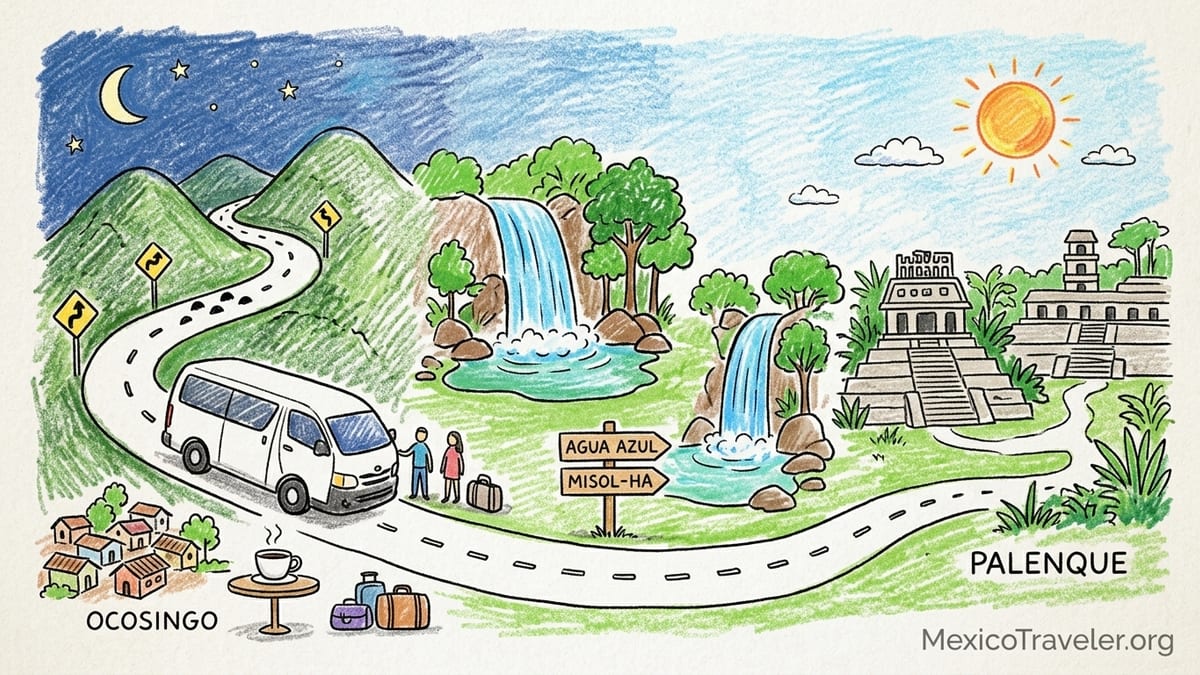
In San Cristóbal de las Casas, you cannot walk a block without seeing an offer for “Agua Azul + Misol-Ha + Palenque” day tours. Dozens of small agencies, from desk fronts on Real de Guadalupe to hostel counters, sell essentially the same product: a shared minibus that leaves in the very early morning, stops at the waterfalls of Agua Azul and Misol-Ha, visits the Palenque archaeological site, and either returns to San Cristóbal late at night or drops you in Palenque town if you choose not to come back. In September 2026, I joined one of these tours specifically to track the real timings, comforts and compromises involved.
The “headline” facts sounded tempting. The tour I booked in person cost 950 pesos per person when paid in cash, almost identical to the price mentioned by several recent traveler reports for a similar one-way version that ends in Palenque. It claimed to include all entrance fees, transport and a basic guiding service, with optional drop-off at hotels in Palenque. Competing offers along the same street ranged from about 850 to 1,100 pesos, with the higher-priced ones advertised on large international platforms but often delivered by the same local operators once on the ground.
On paper, it looks like an efficient way to see three major attractions in a single day, especially if you have limited time in Chiapas. In practice, the equation is not so simple. To understand why, it helps to walk through the day as it actually unfolded, from the first knock on my guesthouse door to the moment the van finally pulled in at the archaeological site.
A Documented Day: Pickup, Road Conditions and Actual Timings
The agency voucher listed pickup between 3:30 and 4:00 am. The minibus, a 15-seater Toyota HiAce, arrived at my guesthouse on the outskirts of the centro at 3:40 am. By 4:05 am we had collected 13 passengers from various hotels around San Cristóbal, all of us still half-asleep and wrapped in jackets against the Highland chill. The guide, who doubled as the driver, gave a brief welcome in Spanish, then repeated essential details in English.
Leaving San Cristóbal at around 4:10 am, we descended toward Ocosingo along Federal Highway 199. This road is legendary among travelers, and not in a relaxing way. It is narrow, full of tight curves and speed bumps, and passes through several small communities. Recent self-drive reports from 2026 describe it as beautiful but slow, and our experience matched that. Even in the pre-dawn hours, the van swayed through constant turns. By 5:30 am, at least three passengers were visibly uncomfortable with motion sickness, despite having taken medication.
We reached Ocosingo a little before 6:30 am, stopping at a simple roadside restaurant used by several tour operators. Breakfast was not included, which the agency had correctly stated in advance. Most people spent around 90 pesos on eggs, tortillas and coffee, and we had about 30 minutes here. Between the bathroom line, ordering and eating, this felt rushed but just about manageable. We left Ocosingo at 7:05 am and continued east toward Agua Azul.
Waterfalls on the Clock: Agua Azul and Misol-Ha
By 8:30 am we turned off Highway 199 toward Agua Azul. The waterfalls sit about 69 kilometers from Palenque and are accessed via a short spur road. We arrived at the parking area at 8:45 am. Here the guide collected our IDs briefly to purchase the necessary local tickets included in our price, then handed us back our documents and gave us instructions: we had one hour and forty minutes to explore, swim, buy snacks and return to the van by 10:25 am sharp.
This sounded generous at first, but the reality of moving in a group quickly ate into that time. We spent nearly ten minutes just walking from the van through the gauntlet of souvenir and snack stalls to reach the best viewpoints. It was possible to swim in designated pools, and a few passengers did, but they barely had 20 minutes in the water once changing, stashing belongings and walking back were factored in. Toilets were available but basic and cost a small fee. Those who wanted to photograph multiple viewpoints, swim and shop had to prioritize carefully.
At Misol-Ha, roughly 20 kilometers from Palenque along the same route, time felt even tighter. We arrived slightly before 11:30 am and the guide announced we would depart at 12:15 pm. That gave us about 45 minutes to walk to the base of the 35-meter waterfall, circle behind the curtain of water along a slippery stone path, take photos and use the restroom. Anyone wanting to visit the small cave or swim in the plunge pool would have had to sacrifice either photos or a bathroom break. Families with children, in particular, moved more slowly and ended up with less than half an hour at the main viewing area.
In both spots, the waterfalls were undeniably impressive. The problem was not the attractions themselves but the constant awareness of the clock. The guide kept a strict schedule to avoid arriving too late in Palenque, and every delay, from a slow breakfast cook to a missing passenger at the van, squeezed the timetable further. By midday, several of us were already yawning, a combination of the 3:30 am wake-up, the heat and humidity at lower altitude, and the cumulative motion of more than five hours on winding roads.
Finally Reaching Palenque: Arrival, Entrance Fees and Time Inside
We left Misol-Ha at 12:18 pm and reached the access road for the Palenque archaeological zone shortly after 1:00 pm. The guide stopped briefly at a roadside checkpoint to pay the national park bracelet fee, which is separate from the main archaeological site ticket. Current 2026 tariffs mean that foreign visitors pay the national park conservation fee plus the federal archaeological entry fee, totaling around 435 pesos for someone without local discounts. Our tour price covered both amounts, and the guide handled the paperwork.
We parked near the main entrance to the ruins at 1:25 pm. The guide gathered us under a patch of shade and explained that he would accompany us inside for an initial walkthrough of about one hour, then leave us with free time until 4:00 pm. That gave us about two hours and thirty minutes in total at Palenque, though in reality it was slightly less once we factored in bathroom stops and regrouping.
The guiding service itself was competent but necessarily compressed. In roughly 60 minutes, he led us past the Temple of the Inscriptions, the Palace, the Cross Group and a handful of smaller structures, pausing to outline the history of King Pakal, the discovery of his tomb in the mid-20th century and the importance of Palenque’s inscriptions for Maya scholarship. There was no time to linger over glyphs or explore side paths deeply. Photography stops were limited to a few minutes per viewpoint while the group clustered around.
Once the guided segment ended, independent exploration time varied dramatically depending on personal energy levels. Several passengers, especially older travelers and a family with two small children, chose to rest in the shade near the central plaza rather than climb more structures. Others headed toward the smaller temples in the jungle path or to the museum, but quickly realized that reaching the museum, visiting thoroughly and returning to the van would leave almost no margin for delays. By 3:50 pm the guide was already gently but firmly encouraging everyone toward the exit to avoid penalties for late parking and to start the long return to San Cristóbal.
Fatigue, Motion Sickness and the Toll of the Return Journey
If the outward journey felt long, the way back underlined just how demanding this excursion can be. We departed the Palenque parking area at 4:10 pm, rejoined Highway 199 and prepared for another five to six hours of curves. The afternoon heat lingered in the van, which had functioning air conditioning but limited airflow to the back rows. Most passengers dozed fitfully, jolted awake whenever the van braked for a speed bump or swerved to avoid a pothole.
Motion sickness was a continuing theme. At least four people used motion-sickness tablets or acupressure bands, and the guide carried basic bags in case anyone felt unwell. The narrow, patchy road surface and sudden slowdowns through villages meant it was impossible to maintain a smooth pace. Around 6:30 pm, as we approached Ocosingo again, we paused for a 20-minute bathroom and snack break at the same roadside restaurant, then pressed on into the dusk.
The social atmosphere of the van, cheerful in the morning, had dimmed into silence by evening. People were simply tired. When we finally re-entered San Cristóbal at 9:50 pm, almost 18 hours after our pickups began, drop-offs around town took another 20 minutes. Back in my room just after 10:15 pm, I realized that I had spent around 11 hours of the previous 18 in a vehicle. I had also visited two waterfall complexes and one of the most significant Maya sites in Mesoamerica, but the exhaustion made it hard to savor the day.
For young, healthy travelers on very tight itineraries, this tradeoff may be acceptable. For families with small children, older travelers, people prone to motion sickness, or anyone who wants to deeply understand Palenque’s history and architecture, the cost in energy and comfort is high. The road’s curves, limited rest facilities along the way, and the simple fact of back-to-back activities in heat and humidity mean this is not a casual day trip in the usual sense.
Round-Trip Excursions vs One-Way Transfer Tours
Not all San Cristóbal to Palenque tours are structured the same way, and the differences matter. The tour I joined was advertised as round-trip, with the option for passengers to stay in Palenque instead of returning. About a third of our group chose to do so, having pre-booked hotels near the ruins and onward buses toward the Yucatán or back to Mexico City. For them, the day still started at 3:30 am and followed the same tight schedule, but they avoided the long night drive back to the Highlands.
Separate agencies in San Cristóbal now market this one-way concept more clearly as a “transfer tour.” A typical package includes pickup from your hotel in San Cristóbal, breakfast stop in Ocosingo, entry and free time at Agua Azul and Misol-Ha, ticketed entrance to the Palenque site, and final drop-off at a hotel or bus station in Palenque town in the late afternoon. Pricing for these options as of late 2026 runs roughly between 900 and 1,200 pesos per person depending on whether entrance fees are folded into the tour price or collected as cash on the day.
Round-trip excursions, like the one I took, are usually priced in a similar range, which means you essentially “pay” with your time and fatigue for the chance to sleep again in San Cristóbal that night. The travel time is identical in both directions, and your hours at Palenque do not increase. A one-way transfer tour does not fix the problem of limited time in the ruins, but it halves the number of hours you spend on the same winding road in a single day.
Private transfer tours offer another alternative. Several local companies and taxi cooperatives advertise private trips from San Cristóbal to Palenque with stops at one or both waterfalls. Recent quotes suggest around 3,500 to 4,500 pesos for a small group, which becomes competitive for three or four travelers splitting the cost. These private options usually start slightly later, around 5:30 or 6:00 am, allow more flexibility at each stop, and can adjust the itinerary in case of heavy rain or delays. However, they still face the same road conditions and long driving times, and often do not include a licensed archaeological guide at Palenque itself.
Costs and Benefits of Going Separately and Staying Near the Ruins
To evaluate whether the one-day excursion is truly “worth it,” it helps to compare it with traveling separately from San Cristóbal to Palenque and spending one or two nights near the ruins. One straightforward option is the overnight ADO or OCC bus. Schedules as of October 2026 often show departures from San Cristóbal in the late evening and arrivals in Palenque around dawn, with ticket prices in the range of 450 to 650 pesos depending on class and exact schedule. Seats recline more than minibus seats, and the ride feels less punishing when you can sleep through much of it.
From Palenque town, you can then take a colectivo or taxi to the archaeological site the same morning, paying your own entry fees at the park gate. As noted earlier, the combined federal and national park fees for foreign visitors currently add up to a little over 400 pesos. Once inside, you can hire an official site guide at the entrance plaza. Rates vary with group size and language, but a small group might pay around 1,000 to 1,500 pesos for a two-hour in-depth tour that focuses on history, iconography and the latest archaeological interpretations rather than on sprinting between viewpoints.
Accommodation near Palenque covers a wide spread of budgets. Simple guesthouses in town often list double rooms between 500 and 900 pesos per night, while mid-range jungle lodges along the road to the ruins tend to charge 1,200 to 2,000 pesos for bungalows or cabins with fans, mosquito nets and pool access. At these prices, two nights for a couple can total between 1,000 and 4,000 pesos depending on comfort level. Add in meals, local transport, entrance fees and a guided visit, and a realistic all-in cost for two people spending two nights, visiting Palenque thoroughly and possibly adding a half-day at either Agua Azul or Misol-Ha might land somewhere between 4,000 and 7,500 pesos.
Now compare that to a classic one-day tour for the same couple. At a typical price of around 950 pesos per person for a round trip with entrance fees included, they will spend about 1,900 pesos for the full day. That looks significantly cheaper on paper. However, what they “save” in pesos they pay in sleep, energy and depth of experience. They get about 2.5 hours inside the ruins, with no time left over for the on-site museum or for more contemplative exploration, and they finish the day too tired to do much the next morning.
If you fold in onward travel, the cost gap narrows further. Many travelers use Palenque as a stepping stone toward Campeche, Mérida or the Caribbean coast. A one-way transfer tour that ends in Palenque and a next-day bus toward the Yucatán may ultimately cost only slightly more than a round-trip excursion plus an additional intercity bus ticket later. When you factor in quality of experience, staying a night or two close to the ruins often delivers more value per hour and per peso than any same-day loop back to San Cristóbal.
Who Might Still Consider the One-Day Tour
Despite its drawbacks, there are circumstances where a very long one-day excursion could still make sense. Travelers on extremely limited schedules, such as those attending a conference in Tuxtla Gutiérrez or San Cristóbal with only a single free day, may accept the tradeoff simply to witness Palenque’s main monuments once in their lives. In that case, choosing a reputable local agency that clearly states pickup times, inclusions and expected return hour is crucial, as is preparing with motion-sickness remedies, snacks and plenty of water.
The day tour can also appeal to certain backpackers who treat it as a one-way transfer rather than an excursion. Several recent travelers have reported booking the standard Misol-Ha, Agua Azul and Palenque package in San Cristóbal for around 950 pesos, asking the seller to note that they would stay in Palenque, and then simply not boarding the van back at 4:00 pm. Used this way, the tour becomes an efficient bridge between two bases with sightseeing built in. For those already acclimatized to long travel days and used to shared shuttles, this can feel like a smart use of both time and money.
That said, families with children, older travelers and anyone who is particularly interested in archaeology rather than in ticking off famous names should think very carefully. Children often struggle with the pre-dawn wake-up, long periods in a confined van and limited access to bathrooms with changing facilities. Older adults may find the constant jostling on the curves and the steep stairs at the ruins particularly draining. And serious archaeology enthusiasts are likely to leave frustrated after barely scratching the surface of a site that deserves at least a full day of focused attention.
When I compared my own experience to that of travelers who had spent two days around Palenque, the difference was striking. They spoke about slow early-morning walks through the mist, listening to howler monkeys before tour buses arrived, and visiting the museum in the cooler hours of the day. By contrast, my memories were sharper at the waterfalls, where we arrived relatively early, but hazier inside the ruins, where the heat, crowds and ticking clock blurred the narrative.
Did I Really Experience Palenque, or Just Photograph It?
This question haunted me on the drive back to San Cristóbal. I had stood before the Temple of the Inscriptions, climbed the Palace and gazed across the jungle canopy from the Cross Group. I had a camera roll full of stone staircases, stucco reliefs and carved panels. Yet the rushed pace meant I absorbed little of the site’s deeper story in the moment. Key details about dynastic succession, ritual practice and Palenque’s role in the wider Maya world slipped past while I hurried to keep up with the group.
In conversation with other passengers, a similar theme emerged. One couple admitted they had joined mainly to “get the photo” and were satisfied despite the fatigue. Another traveler, an architecture student, regretted not having time to sketch or to sit quietly and decode the layout of the plaza. A family with teenagers said they enjoyed the waterfalls more than the ruins, in part because swimming felt like a reward after the long drive, whereas the hot mid-afternoon visit to Palenque felt like school.
If your goal is to say you have “seen” Palenque in a literal, visual sense, a one-day tour will accomplish that. You will stand in front of its most iconic structures, hear a condensed version of its history and leave with photographs that prove you were there. If, however, you are drawn to the stories carved into stone, interested in how recent excavations have changed our understanding of Maya politics, or simply want time to sit in the shade and feel the weight of centuries around you, the schedule is too compressed.
Looking back, I would describe my own visit on the one-day excursion as an introduction rather than an experience. It whetted my appetite and gave me a mental map of the site, but it did not allow enough time to digest. For that, a slower itinerary, ideally with at least one night near the ruins and a dedicated half or full day inside the site, proved to be what travelers who raved about Palenque had chosen.
The Takeaway
After tracking the minute-by-minute reality of a San Cristóbal de las Casas to Palenque one-day tour, my advice is simple: think twice before booking a round-trip excursion unless you truly have no other option. The combination of a pre-dawn start, more than ten hours of driving on a winding road, short windows at Agua Azul and Misol-Ha, and barely two and a half hours inside Palenque leaves little room for rest, reflection or unexpected delays.
For most travelers, a smarter approach is to treat the journey as part of a longer route. If your schedule allows, take an ADO or OCC bus from San Cristóbal to Palenque, stay one or two nights near the ruins, and hire a licensed guide on-site for a thorough tour. If you are keen to see the waterfalls as well, consider a one-way transfer tour that ends in Palenque, or book a separate half-day excursion from Palenque town on a different day. This way, you distribute the travel time over several days, enjoy more at each stop and reduce the risk of turning a bucket-list site into a blur.
If I were planning again with the same knowledge, I would book a transfer-style tour from San Cristóbal to Palenque that includes at least Agua Azul and a brief stop at Misol-Ha, specify in advance that I will stay in Palenque, and then reserve two nights in a mid-range lodge near the archaeological zone. I would spend one full day at the ruins and museum with a dedicated guide and keep the second day flexible for a return trip to a favorite spot or simply for rest by the pool. For a region as rich as Chiapas, that feels like the right pace to turn a long day of logistics into a memorable journey rather than an endurance test.
FAQ
Q1. How long does the San Cristóbal to Palenque day tour actually last?
The full round-trip day tour typically runs about 16 to 18 hours from first pickup to final drop-off, with around 10 to 11 of those hours spent in the vehicle.
Q2. How much time do you really get inside the Palenque archaeological site on a day tour?
Most shared minibus tours provide roughly two to three hours at the ruins, including a short guided walk. Actual free time for independent exploration is often closer to 90 minutes.
Q3. Are entrance fees and guides usually included in the San Cristóbal day tour price?
Many agencies bundle entrance fees into the quoted price, but some collect them in cash on the day. A basic group guiding service is common, though it is usually brief and introductory rather than in-depth.
Q4. How bad is the road between San Cristóbal and Palenque for motion sickness?
The main route along Highway 199 is very winding, with frequent curves and speed bumps. Travelers prone to motion sickness often report discomfort and should bring medication or remedies.
Q5. What are the main differences between a round-trip excursion and a one-way transfer tour?
A round-trip excursion takes you from San Cristóbal to the waterfalls and Palenque and back the same day. A transfer tour follows a similar route but ends in Palenque, letting you stay overnight instead of returning.
Q6. Is it cheaper to visit Palenque on a one-day tour or to go separately and stay overnight?
On paper, a one-day tour usually costs less. However, once you account for better sleep, more time at the ruins and flexibility, overnight visits often provide better overall value.
Q7. How many nights should I plan near Palenque to enjoy the ruins properly?
One full day at the site is the bare minimum. Staying one or two nights near Palenque allows time for the ruins, the museum and possibly a relaxed visit to nearby waterfalls.
Q8. Is the one-day excursion suitable for families with children?
Families can complete the tour, but the pre-dawn start, long van rides and limited bathroom and play breaks make it challenging for younger children and their parents.
Q9. Can I join the day tour and stay in Palenque instead of returning to San Cristóbal?
Yes, many operators allow you to finish in Palenque if you tell them when booking. In that case the tour doubles as a transfer, and you skip the long night drive back.
Q10. If I care mostly about understanding Palenque’s history, what is the best way to visit?
Travel separately to Palenque, stay at least one night nearby and hire a licensed guide at the site. This gives you unhurried time for the ruins, the museum and questions.