

In early September 2026 I based myself in Palenque for five days with a single mission: visit Agua Azul, Misol-Há and Roberto Barrios on separate days, at different times and in different weather, to understand how these three waterfall areas really compare. Travelers in town were constantly booking combo tours at the last minute without realizing how different these places are in terms of color, current, walking difficulty, crowds and even where you are actually allowed to swim. What follows is my experience on the ground, with concrete dates, prices and times, to help you decide which Palenque waterfalls truly deserve a spot in your itinerary.
When I Visited Each Waterfall and Why Conditions Matter
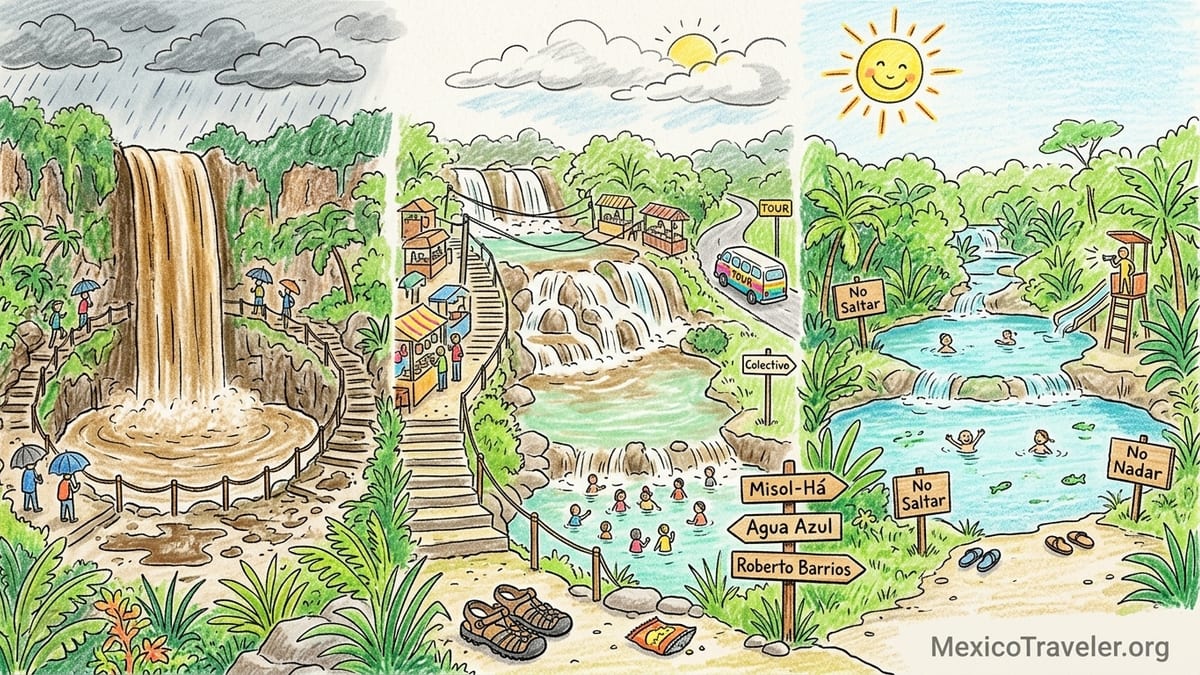
I visited the three waterfalls on separate days in September 2026, which is still rainy season in Chiapas and a good test of how flows and water color change. On 6 September it had rained heavily overnight, so I chose Misol-Há in the late afternoon, arriving around 15:30 under overcast skies and occasional drizzle. On 7 September I went to Agua Azul, leaving Palenque at 08:00 and reaching the falls at 09:40 under mixed sun and cloud after light morning showers. On 9 September I visited Roberto Barrios on a mostly sunny, humid morning, arriving around 10:15 after a dry night that allowed the pools to clear. These dates and conditions shaped everything from swimming safety to photography.
Water color at these sites is extremely sensitive to recent rain. Local tour operators and the information boards at Agua Azul note that the famous turquoise appears most reliably in the drier months from roughly November to April, when river levels are lower and limestone sediment remains suspended in calmer water. After strong rains, sediment and runoff turn the water brown or milky green and sometimes increase currents to the point that authorities close popular swimming sections. During my September visits, Agua Azul was a mix of pale blue and cloudy brown, Misol-Há was powerful and tannin-dark, and Roberto Barrios, thanks to a drier 24 hours, offered the clearest turquoise pools.
This difference between low-flow and high-flow conditions is not just cosmetic. On wetter days, lifeguards and ejido staff at all three waterfalls rope off certain areas and post temporary “No nadar” signs where currents or depth make swimming unsafe. I saw this at Agua Azul, where a lifeguard explained that the uppermost pools sometimes close entirely after storms, and at Roberto Barrios, where one of the more dramatic chutes was off-limits despite looking tempting. In practice, this means that in rainy season you should not assume every turquoise pool on Instagram will be both accessible and legal to swim in during your own visit.
The other impact of conditions is on walking and access. Trails around Agua Azul and Roberto Barrios become slick when it rains, and steps behind Misol-Há’s curtain can be muddy. On my Agua Azul day I watched several day-trippers from San Cristóbal slip on wet limestone slabs while rushing back to their tour van. Good sandals or shoes with grip are more important here than at many other Mexican attractions, especially if you are carrying kids or camera equipment along narrow, sometimes crowded walkways.
Getting There from Palenque and What I Paid
All three waterfalls lie along or off Highway 199 between Palenque and San Cristóbal de las Casas. Misol-Há sits about 20 kilometers from Palenque, or roughly 30 minutes by road. Agua Azul is about 60 to 65 kilometers away, usually 1 hour 20 minutes to 1 hour 40 minutes depending on traffic and weather. Roberto Barrios is closer in the opposite direction along a secondary road; the village is about 35 kilometers from Palenque, with a typical drive of 45 minutes to 1 hour in a colectivo or taxi. Distances and times are also listed on several local operator fact sheets and tourism brochures I checked in town.
For Misol-Há and Agua Azul I tested both an organized tour and independent travel. On 5 September I booked a combined Agua Azul and Misol-Há excursion through a local agency just off Palenque’s central park for 550 pesos per person in cash. This matched the 500 to 700 peso range I saw across agencies for 2026 departures that include round-trip transport but not entrance fees. The van collected me outside my hotel at 08:00, stopped first at Misol-Há for about 1 hour, then continued to Agua Azul for about 2 hours 30 minutes before returning to Palenque around 17:30.
On 7 September I repeated Agua Azul independently using public transport to compare cost and flexibility. From Palenque’s colectivo stand on Avenida Benito Juárez, a shared van toward Ocosingo charged me 80 pesos to the Agua Azul junction, a journey of about 1 hour 15 minutes. From the junction, local taxis and pickup trucks were waiting; I paid 40 pesos to be driven down the 4-kilometer access road to the park entrance. On the return I shared a pickup back to the highway for 30 pesos and flagged a passing colectivo for 70 pesos back to Palenque. In total, transport for my independent Agua Azul visit cost 220 pesos, roughly half the tour price, at the expense of less predictable timing.
For Roberto Barrios on 9 September I took a colectivo from near Palenque’s market signed “Roberto Barrios.” The driver waited to fill most seats, then charged 70 pesos per person each way. The ride took just under an hour in each direction. I also checked prices for a private taxi or driver at several stands; quotes in September 2026 ranged from 900 to 1,200 pesos round trip for a half-day with up to four passengers, including waiting time at the falls. For couples or small groups, this private option can undercut a per-person tour to Agua Azul and Misol-Há, especially if you want freedom to linger.
Entrance Fees, Opening Hours and On-Site Rules
Entrance fees change periodically, but in September 2026, posted prices at the gates and on ejido boards were broadly consistent. At Misol-Há I paid 40 pesos per adult to the ejido ticket booth along the access road. The signboard indicated general opening hours from 08:00 to 17:00, with the last entry suggested before 16:30 during the rainy season. For those staying overnight in the basic cabañas beside the parking area, access to the falls after hours is limited and arranged through the reception desk, not treated as standard day entry.
At Agua Azul, fees are paid in two stages that often confuse visitors. First, along Highway 199, there is a small community toll where my tour van paid 20 pesos per person. About 4 kilometers later at the official entrance to the Cascadas de Agua Azul protected area, I paid 60 pesos at the government ticket office, receiving a printed receipt that matched the 60-peso rate reported by current regional guides and agencies for 2026. Signs at the gate listed general hours from 08:00 to 18:00, though tour groups often arrive and depart according to fixed schedules that cluster mid-morning and mid-afternoon.
Roberto Barrios is entirely community-run. At the village entrance on 9 September I paid 50 pesos to the ejido, a rate that agreed with other recent visitor reports. A laminated sign in Spanish clarified that this fee supports trail maintenance, lifeguards and bathrooms. There were no turnstiles, but there was a simple logbook where the attendant recorded visitor numbers and license plates. Opening hours were listed as 09:00 to 17:00, with the note that swimming is prohibited after closing time and that alcohol is not permitted anywhere in the falls area.
Across all three waterfalls, swimming rules are signposted in Spanish and sometimes English, but they are not identical and they do change with conditions. At Agua Azul, red “Zona peligrosa” signs and ropes mark sections where entering the water is banned, including several pools just above drop-offs. Lifeguards told me that deaths and rescues have led to stricter enforcement in recent years, particularly during high water. At Misol-Há, swimming at the base of the main plunge is allowed only when flows are moderate and under the supervision of staff; during my September visit, strong current meant that only a roped-off corner of the plunge pool was open and several visitors were turned back. At Roberto Barrios, a mixture of painted wooden signs and flagging tape marks out prohibited ledges and deeper chutes. I found that locals sometimes ignored these, but lifeguards actively whistled people away, and I would strongly recommend following the official indications rather than copying what others do.
Walking Difficulty, Facilities and Crowds at Each Waterfall
Misol-Há is the most compact and straightforward of the three. From the parking lot and ticket booth it is less than five minutes on a gently sloping, paved path with railings to the main viewing platform. From there, a stone and dirt trail continues behind the waterfall curtain. This section includes uneven steps, mud and spray; I saw older visitors and small children turning back or clinging to the rail. Completing the loop behind the falls and back to the platform took me about 20 minutes at a slow pace, including time for photos. For most visitors with average mobility, Misol-Há qualifies as an easy short walk, but the wet, narrow ledge behind the falls would be tricky for those with knee problems or for parents carrying babies.
Facilities at Misol-Há are basic but convenient. There are paid toilets near the parking lot and simple changing cubicles near the pool, both maintained by the community. A modest restaurant and several snack stalls sell quesadillas, grilled meats, chips and drinks. When I arrived around 15:30, two small tour vans were departing and the area felt calm, with perhaps 30 people total. Staff at my Palenque guesthouse told me that from about 10:00 to 12:30 in high season the falls can become crowded as day tours from both Palenque and San Cristóbal overlap, with photo queues forming at the main viewpoint.
Agua Azul is physically more demanding and much more developed. The riverside path climbs and dips alongside a chain of cascades and pools, with short, steep flights of concrete or stone steps and stretches of slick rock. From the lower bridge where most tours park to the farthest commonly visited lookout, it took me around 35 minutes of steady walking in each direction, without stopping at every stall. There is little shade on the upper section, and in September’s humidity I arrived at the top drenched in sweat. Anyone with limited mobility, very young children or heavy camera gear should consider how far they actually want to walk before committing to the full route.
In exchange for the effort, Agua Azul offers the widest range of facilities. There are paid toilets, basic changing rooms and numerous restaurants and food stands lining the first several hundred meters of the path. Stalls sell everything from fried fish and empanadas to coconut water and fresh fruit. There is also a large parking area capable of hosting dozens of tour buses and vans. The downside is that Agua Azul feels the most commercialized. When my tour group arrived at 11:00, the lower pools were already crowded with national tourists, families and groups from San Cristóbal. Popular photo spots, such as the classic view of the stepped falls framed by jungle, required patience and some jostling. By 13:30, when we left, the midday heat and tour schedules combined into a noisy, congested scene.
Roberto Barrios offers the opposite experience. From the village parking area a dirt path and simple bridges lead through forest to a sequence of cascades and pools, each with its own character. The walking is mostly gentle, with a few short, steeper scrambles down to specific pools. Circuiting the main area and returning to the entrance took me about 50 minutes at a leisurely pace, with time to swim in two spots and take photos. Trails here feel more like forest paths than built promenades, and in wet conditions the clay sections become soft, so closed shoes are more comfortable than flip-flops.
Infrastructure at Roberto Barrios is minimal but adequate. Near the entrance I found toilets, rustic changing cabins and a handful of food stalls selling simple plates of chicken, tortillas and cold drinks. There is ample unpaved parking along the road. On my mid-morning visit there were perhaps 40 people scattered across several pools, including a few local families and a handful of foreign travelers. Because the cascades are spread out, it was easy to find quiet corners with just one or two other swimmers, something that would be almost impossible at Agua Azul in similar season.
Swimming Conditions and Safety: Where I Actually Got in the Water
At Misol-Há, the main attraction is visual rather than aquatic. The single curtain, dropping roughly 30 to 35 meters into a round plunge pool surrounded by forest, makes a dramatic impression even on cloudy days. Swimming is technically allowed in the pool when flows are not excessive, but during my 6 September visit staff had limited access due to strong current. A roped zone close to the shore was open, but the water was dark and choppy, with spray reducing visibility. A local lifeguard explained that after heavy rain, submerged rocks are harder to see and the turbulence near the fall line can pull swimmers closer than expected. I chose not to get in here and instead walked the path behind the falls to enjoy the sensory experience of thunder and mist without added risk.
Agua Azul is where most visitors expect to swim, but not every pool is fair game. Along the lower section of the river there are designated bathing areas marked by signs and accessed via gentle ramps or steps. In September 2026, despite the recent rains, two of these lower pools were open and monitored by lifeguards, who used whistles liberally when people approached ropes or deeper currents. I waded and swam in one of the calmer pools for about 25 minutes. The water was cooler than I expected but comfortable after the hot walk. Upstream, several turquoise terraces that feature heavily in promotional photos were entirely closed to swimming, roped off with clear warning signs. It was tempting to ignore the rules as some younger visitors did briefly for selfies, but staff insisted they get out, reminding them of past accidents.
Roberto Barrios provided my most enjoyable swimming of the trip. The river here forms a series of natural infinity pools and small cascades, many of which are suitable for relaxed bathing when flows are moderate. On 9 September the water was a soft turquoise-green, clear enough to see the pale limestone bottom and small fish. At the first main pool I joined a local family in a shallow corner to cool off, then moved to a second pool where the water was chest-deep and gently overflowing into the next cascade. Lifeguards were present at key spots, and “No saltar” signs marked out ledges where jumping was prohibited. Not every pool is safe or permitted for swimming; a spectacular chute closer to the bottom of the trail was off-limits that day due to stronger current. Even so, I had two lengthy, peaceful swims with only a handful of other people around.
Across all three sites, it is crucial to respect on-site instructions rather than assuming all water is equal. Guides and lifeguards repeatedly reminded visitors that river dynamics can change in hours, especially after storms higher up in the watershed. A pool that was calm in the morning can become opaque and faster-moving by afternoon. For families, life jackets are not routinely included in entry, though some vendors at Agua Azul and Roberto Barrios rent flotation devices like foam noodles or simple vests. I did not see professional-grade life jackets in widespread use, so if your children are not confident swimmers you may wish to bring your own gear or choose shallow-wading areas only.
Photography, Atmosphere and the Impact of Tours and Stalls
Photographically, each waterfall delivers a distinct mood. Misol-Há is all about vertical drama. From the main platform, you get a classic postcard shot of the single white curtain framed by jungle. Late afternoon on my visit brought softer side light through the mist, creating a moody, almost cinematic effect despite the overcast sky. Walking behind the falls, I found several vantage points where the water formed a translucent curtain in front of the forest beyond, ideal for slower shutter speeds and handheld long exposures. Because the area is compact, it is easy to work around other people, especially if you wait a few minutes between tour groups.
Agua Azul, with its tiered limestone cascades, offers variety but also the challenge of crowds and clutter. Lower down, cable lines, food stands and souvenir stalls compete with the water for attention. It can be hard to frame a clean shot without power cables, handrails or vendor awnings intruding. The classic views are further upstream, where turquoise water steps over pale rock in a sequence of broad curtains. Even there, tour groups often line the main lookouts. Between 11:00 and 13:00 on my visit, I regularly found myself waiting for ten or more people to clear a given viewpoint. Photographing from side angles or small rock outcrops helped, but required careful footing on slippery surfaces.
Roberto Barrios felt much more relaxed and photogenic in a natural way. There are no dense rows of stalls along the water, and only a few simple benches and handrails. The pools are staggered, each with its own curve, ledge or small fall, which lets you compose images that look wild while still being safe to access. The forest canopy casts dappled light that can be trickier for photography than Agua Azul’s more open sky, but it also means softer contrast during midday. Between 10:30 and 12:30 I rarely had to wait for more than one or two people to move out of frame, and often had entire pools to myself for several minutes at a time.
Commercial activity changes the character of each site. At Agua Azul the long corridor of stalls selling textiles, wooden carvings, snacks and souvenirs creates the sense of a busy market grafted onto a river. This has advantages: if you want a full sit-down lunch, cold beers or a quick plate of fried fish, you will find plenty of options, and families can buy inflatable toys or snacks on the spot. The downside is that some visitors felt pressured by constant vendor calls, and the noise level at the lower pools resembled a fairground more than a nature reserve. My experience on the combined tour was especially shaped by this: our driver suggested a specific restaurant, clearly affiliated with his company, where prices were higher and our stop longer than I might have chosen independently.
Misol-Há sits somewhere in between. The restaurant, cabañas and a few souvenir stalls are present but do not overwhelm the sound of the falls. Our tour schedule here was tight, with only one hour allocated, which left little time to order a full meal or explore beyond the main path. Roberto Barrios felt least affected by commercial schedules. I arrived independently, walked where I wanted, and left when I felt ready. There were no loudspeakers, no organized tour announcements and no restaurants blaring music. The atmosphere was closer to a community swimming spot than a packaged attraction, which for me made the experience more immersive and restful.
Families, Short Visits and Combined Tour vs Independent Trips
For families with children or travelers with only half a day, the choice of waterfall matters. Misol-Há is the simplest option for a short, low-effort outing from Palenque. You can reach it in about 30 minutes, see the main viewpoint, walk partway behind the falls if conditions allow, and be back in town within three hours. The short, paved approach and clear fencing near the edge make it manageable for school-age children under supervision. Swimming opportunities are limited and often restricted in rainy season, so this stop is better framed as a dramatic scenic visit than a water-play day.
Agua Azul works best for visitors who want to combine some hiking, optional swimming and a meal and do not mind crowds or a more commercial environment. If you join a standard Agua Azul and Misol-Há tour from Palenque for roughly 500 to 700 pesos per person, expect regimented timing: about one hour at Misol-Há and two to three hours at Agua Azul, with departure around 08:00 and return around 17:00. This is efficient for those without Spanish or without interest in arranging transport, but the fixed schedule may feel rushed. With kids, it can also be tiring, especially under midday sun as you climb up and down steps at Agua Azul and then travel back along a winding highway.
Roberto Barrios, by contrast, is more convenient for families who prioritize quieter natural pools and flexible time over restaurants and big infrastructure. The walk from the entrance to the first cascades is not long, and along the way there are several shallow, gently flowing sections where children can splash under close supervision. Because you control your arrival and departure, you can aim for cooler morning hours, avoid the tight turnaround of combo tours and take breaks whenever needed. The main considerations here are the more rustic trail and limited food choice, both of which become easier if you bring snacks and water from Palenque.
Comparing costs, my combined tour day to Misol-Há and Agua Azul cost 550 pesos plus about 120 pesos in entrance and tolls, for a total of around 670 pesos. Transport, timing and logistics were handled for me, but I had to follow the guide’s schedule. My independent Agua Azul day cost 220 pesos in transport and 80 pesos in fees, or roughly 300 pesos in total, and I stayed as long as I liked. Roberto Barrios independently cost 140 pesos in colectivos plus a 50 peso community fee, totaling 190 pesos. For a couple, two independent days to Agua Azul and Roberto Barrios would come to roughly 980 pesos in total, compared with around 1,100 to 1,400 pesos for two seats on a combined bus tour. For a family of four, hiring a private driver for Roberto Barrios or Agua Azul can become particularly good value, often matching or beating per-person tour costs while offering greater flexibility.
My First-Person Rankings and Which Waterfall I Would Skip
Having visited all three waterfalls in quick succession under varying weather, I left Palenque with clear personal favorites for different types of travelers. For pure swimming enjoyment, Roberto Barrios comes out on top. The variety of natural pools, the relative calm and the ability to find both shallow and deeper spots under lifeguard supervision made it the only place where I felt completely at ease spending long stretches in the water. Agua Azul offered pleasant swimming in specific lower pools, but the mix of crowds, ropes and brown-tinged water diluted the experience during rainy season. Misol-Há, while spectacular, simply did not invite me in the same way, and safety restrictions often curtail full immersion.
For photography and visual impact, Misol-Há narrowly wins. The single, plunging curtain framed by dense forest clings in the memory long after you leave, especially if you walk behind it and feel the vibration of the water from just a few meters away. Roberto Barrios ranks second in this category in my view, because its cascading pools and forest setting produce endlessly pleasing compositions without the distraction of heavy infrastructure. Agua Azul can be stunning in low-flow, clear-water conditions, when its terraces turn a luminous turquoise. During my September visit, however, the combination of less-than-perfect water color and dense commercial development around the lower pools made it slightly less compelling through the lens.
For families, my ranking depends on age and temperament. With young children or grandparents, Misol-Há is the simplest scenic outing: an easy walk, clear boundaries and a quick return to Palenque. With water-loving older kids or teens who want to swim, Roberto Barrios is my first choice thanks to its range of pools and less chaotic atmosphere, provided parents are willing to keep a close eye on them and respect closed areas. Agua Azul can work for families too, especially if you stick to the lower designated swimming zones and plan a sit-down lunch, but you should be prepared for crowds, vendor attention and more walking in heat.
For short visits and tight itineraries, I would choose Misol-Há if I had just a few hours, or Roberto Barrios if I had a half-day and prioritized swimming. For overall value from Palenque, considering transport time, fees, crowds and enjoyment, Roberto Barrios is the waterfall I would most eagerly visit again. Its combination of clear, tiered pools, manageable walking, affordable access and gentle atmosphere felt closest to the Chiapas I had imagined before arriving.
If I had to skip one waterfall on a future trip with limited time, it would be Agua Azul, especially in the rainy months when water color is less reliable and currents sometimes close upper pools. In the dry season, with bluer water and potentially fewer closures, my judgment might soften. But based on my September 2026 experience, if I had only two days for waterfalls from Palenque I would devote one to Roberto Barrios and one to a combined trip that includes Misol-Há, using Misol-Há as the dramatic but brief scenic counterpoint to a longer, more immersive day in calmer pools elsewhere.
FAQ
Q1. Can I safely swim at all three waterfalls near Palenque?
Swimming is not permitted everywhere, and rules change with river conditions. At Misol-Há, access to the main plunge pool is often restricted when flows are strong, and only a roped-off corner may be open. At Agua Azul, designated lower pools are monitored by lifeguards, while many upper terraces are permanently or temporarily closed to swimming. Roberto Barrios usually offers several calm pools suitable for bathing, but some chutes and deeper sections are off-limits. Always follow posted signs and lifeguard instructions rather than assuming any pool is safe.
Q2. Is a combined Agua Azul and Misol-Há tour from Palenque worth the price?
For travelers who prefer not to organize transport or speak limited Spanish, the combined tour offers good value. In 2026, prices in Palenque agencies commonly range from about 500 to 700 pesos per person for transport-only tours, with entrance fees paid separately. You are picked up at your hotel, visit Misol-Há for about an hour and Agua Azul for two to three hours, then return by late afternoon. The trade-offs are fixed schedules, crowded mid-morning and midday time slots, and less freedom to choose where and how long you swim or eat.
Q3. Which waterfall near Palenque is best for young children and older adults?
Misol-Há is generally the easiest for visitors with limited mobility, thanks to its short, mostly paved approach and clear railings around the main viewpoint. It works well as a quick scenic stop without the need for strenuous walking. Roberto Barrios can also be manageable for families if you focus on the first pools and avoid steeper side trails. Agua Azul involves more climbing on steps and slick rock, which can be tiring for some older adults and for very young children, especially in hot, humid weather.
Q4. How do rainy-season conditions affect water color and safety?
During the rainy months, typically from late spring through October, heavy storms can turn the usually turquoise water at Agua Azul and Roberto Barrios into cloudy brown or green tones. Increased flow can strengthen currents and reduce visibility, prompting authorities to close swimming areas that are normally open. At Misol-Há, the waterfall becomes more powerful and dramatic, but access to the plunge pool is more likely to be restricted. If clear blue water is a priority, visiting in the drier months from roughly November to April offers more reliable conditions, though closures are still possible after individual storms.
Q5. Can I visit the waterfalls independently using public transport from Palenque?
Yes, it is feasible to visit all three waterfalls without a tour. Colectivos run from Palenque toward Ocosingo and can drop you at the turnoff for Agua Azul, from which local taxis or pickups reach the entrance. Separate colectivos depart toward Roberto Barrios from near the market. Misol-Há sits directly along Highway 199 and can be reached by colectivos heading toward San Cristóbal. Independent travel reduces costs and gives you more flexibility with time, but requires patience with shared-van schedules, some Spanish for communication and attention to return options before late afternoon.
Q6. Are there restaurants and changing facilities at each site?
All three waterfalls offer at least basic facilities. Misol-Há has a simple restaurant, paid toilets and changing cubicles near the pool. Agua Azul has the most developed infrastructure, with numerous restaurants, snack stands, paid toilets and basic changing rooms along the lower path. Roberto Barrios has rustic toilets, improvised changing cabins and a few small food stalls near the entrance that serve simple meals and drinks. If you have particular dietary needs or are visiting early or late in the day, it is wise to bring some snacks and water from Palenque.
Q7. How much walking is involved at each waterfall?
At Misol-Há, the walk from the parking lot to the main viewpoint is less than five minutes on a gentle path. The optional trail behind the falls adds another 15 to 20 minutes of walking along slippery, uneven steps. At Agua Azul, exploring from the lower bridge up to the main upper viewpoints and back can take 60 to 90 minutes of walking with short, steep sections. Roberto Barrios involves roughly 40 to 60 minutes of easy to moderate walking if you explore multiple pools, with some steeper scrambles to reach specific cascades.
Q8. Which waterfall offers the best atmosphere for photography?
Misol-Há is arguably the most photogenic if you enjoy dramatic, vertical compositions of a single waterfall in dense forest, especially in softer late-afternoon light. Roberto Barrios is excellent for more intimate, natural-feeling images of turquoise pools framed by trees and rocks, without extensive infrastructure intruding. Agua Azul can be spectacular in clear-water conditions, but its lower section is visually busy due to restaurants, cables and stalls, and crowds at popular viewpoints may limit your options at peak times.
Q9. Is Roberto Barrios too remote or rustic for most travelers?
Although Roberto Barrios feels more off the beaten path than Agua Azul or Misol-Há, it is still quite accessible from Palenque via colectivo or private car in under an hour. Trails are informal but manageable in normal conditions, and the community has installed lifeguards and basic facilities. The main differences compared with Agua Azul are the absence of large restaurants and souvenir corridors and the more relaxed, local atmosphere. Travelers comfortable with simple infrastructure and prepared for a bit of mud or uneven ground usually find Roberto Barrios very rewarding.
Q10. If I only have one day in Palenque, which waterfall should I prioritize?
If you have just one free day and want to combine waterfalls with minimal planning, the standard combined tour to Misol-Há and Agua Azul is the most straightforward option from Palenque, giving you a dramatic single fall and classic tiered cascades in one trip. If your focus is tranquil swimming and you prefer fewer crowds over variety, dedicating a half-day to Roberto Barrios instead can be more satisfying. In my own ranking, Roberto Barrios offered the best overall balance of swimming, scenery and value, while Misol-Há delivered the strongest single visual impression in a shorter visit.