


I’ve stayed in Roma, Condesa, and Polanco on separate Mexico City trips, long enough in each to develop a routine: the same morning coffee walk, the same “where do I duck into a park” instinct, the same after-dinner question of whether I felt like strolling or calling a ride. The internet is right that this is the classic three-way choice, but the part that gets lost in most comparisons is the lived rhythm: how early the street noise starts, how often you rely on transport, how easy it is to string together museums and meals without thinking, and how your budget feels by day three. Here’s how all three neighborhoods actually played out for me, with current hotel and transport prices folded in so you can match the vibe to your trip.
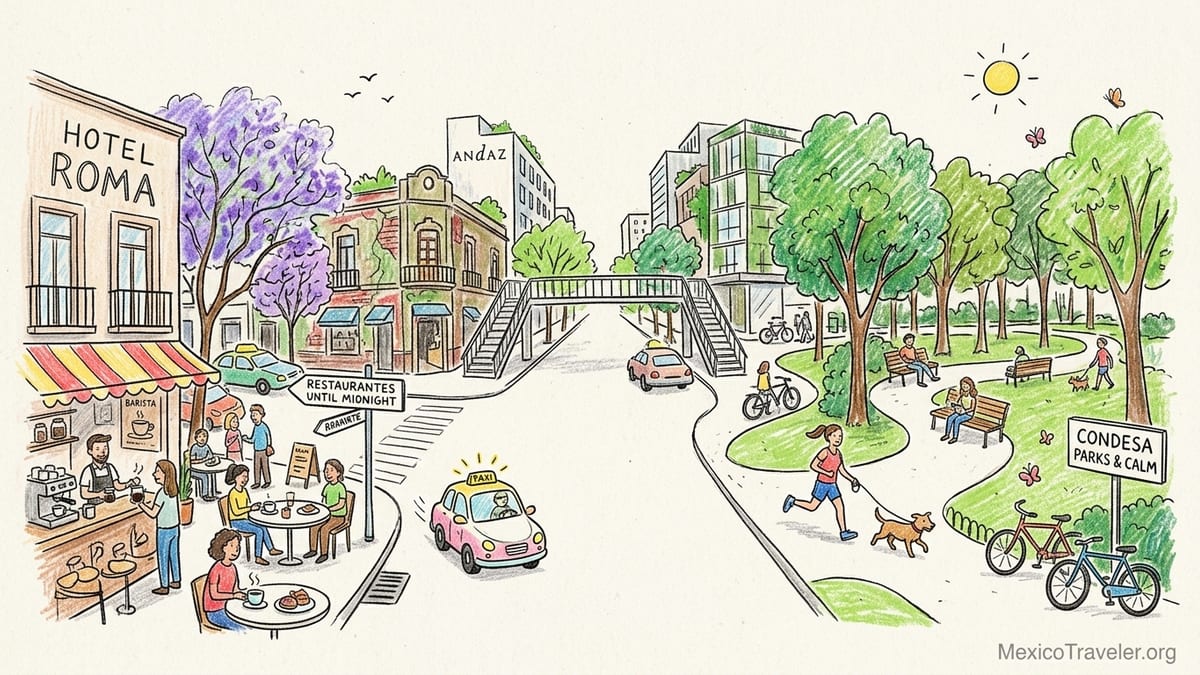
Roma: Coffee First, Then Restaurants Until Midnight
In Roma, my mornings started with movement whether I planned it or not. On my first day, I opened the curtains to early city noise: delivery trucks, a few impatient horns, and the quick, constant shuffle of people headed to work. It wasn’t chaotic, but it was never silent. I’d step out and within a block or two I could always find a café with a line that made me feel like I’d shown up late, even if it was still early. Roma rewarded that kind of aimless coffee walk: I’d grab a pastry, sit near a window, and watch the street become busier by the minute.
By late afternoon, Roma is where Mexico City starts to feel like it has plans for you. I’d leave my hotel thinking I’d have one cocktail and end up hopping between two or three places because everything was close and the sidewalks stayed active. The soundscape changed after dark: less delivery noise, more patio chatter, more music leaking from doorways. The best Roma nights for me were the unplanned ones, when I finished dinner and still had enough energy to walk a few blocks for dessert or another drink without opening a map.
Hotel-wise, Roma felt like the city’s boutique sweet spot: design-forward small hotels and renovated older buildings where the lobby smells like espresso. In late-summer and fall 2026 searches, midweek Roma Norte rates commonly sit in a wide middle band of about $56 to $167 per night, depending on how stylish you go and how far you are from the busiest corridors. I found Roma especially forgiving if you want a “nice but not luxury” stay: the kind of place with good linens and a great shower, even if the rooms are compact.
My biggest practical note about Roma is that it tempts you into walking a lot, then surprises you with how far “just one more place” can feel when your feet are done. I relied on ride-hailing more here late at night than I expected, not because it felt unsafe, but because it was easy to overextend. Roma is the neighborhood where I most often ended the evening saying, “We’ll walk it,” and then changed my mind two intersections later.
Condesa: Leafy Mornings, Park Loops, And An Earlier Night
Condesa has a softer start. The first morning I stayed there, I noticed the quiet before I noticed anything else: fewer abrupt horns, fewer delivery trucks idling under my window. The day began with dog walkers and runners circling the neighborhood’s green spaces, and I quickly copied that rhythm. Coffee in Condesa felt less like a race and more like a habit: I’d pick a café, linger, then do a slow loop through the parks as the neighborhood woke up.
The parks aren’t a side note in Condesa, they’re the anchor. On days when Mexico City felt huge, Condesa gave me an easy reset: a bench, shade, and the feeling of being in a neighborhood rather than a destination. After lunch, I’d often end up on another park loop almost accidentally, the way you do in places where sidewalks are pleasant and greenery is constant. Condesa is where I felt most comfortable traveling at an unhurried pace: less checking my phone, more letting the day happen.
Restaurants in Condesa were still excellent, but the vibe skewed “pleasant evening out” more than “we’re going to bounce around until 1 a.m.” I had nights that ended earlier simply because the neighborhood itself seemed to settle down earlier. After dinner, the walk home felt calmer, with fewer loud groups spilling onto the street. If you like a lively city but want a gentler landing zone, Condesa did that better than Roma for me.
Condesa hotels, in my experience, included a mix of small boutique properties and bigger, newer lifestyle names. Current pricing snapshots in 2026 show the neighborhood’s midweek range often clustering around roughly $58 to $106 for that middle band of rooms, with deals lower and upscale stays higher depending on date and demand. For a more “statement hotel” feel in Condesa, I also priced Andaz Mexico City Condesa in mid-September 2026, where a one-night rate for two adults commonly appears around the mid-$300s including taxes and fees on major booking platforms, which aligns with Condesa’s newer wave of premium inventory.
Polanco: Polished Streets, Bigger Rooms, And A Quieter After Dark
Polanco felt like a different Mexico City tempo: fewer surprises, more polish. The first time I walked out in the morning, the streets felt calmer in a “well-managed” way, and the storefronts read as more high-end right away. I remember stopping short at an intersection because the sidewalk flow changed: fewer people wandering with cameras, more people moving with purpose. Even the coffee routine felt different. Instead of hunting for the next café on a whim, I found myself choosing a place and committing, then lingering longer because I wasn’t being pulled down the street by the next interesting corner.
Polanco’s parks and green space access hit me as its real luxury. I could build museum and park time into the day without it feeling like a special outing. The area’s proximity to Chapultepec meant I did more “walk there, spend hours, walk back” days, and I ended up taking fewer short rides than I did in Roma. If Roma’s energy is about what’s happening on every block, Polanco’s is about having the city’s biggest cultural and green assets close enough that you can treat them like your neighborhood park.
At night, Polanco was quieter than I expected, especially on the more residential-feeling streets. After dinner, I was comfortable walking, but it wasn’t the same kind of people-watching stroll as Roma. It felt more like a composed, end-of-day walk, the kind you do after a good meal when you want calm rather than another stop. When I did go out, the night leaned toward lounges, hotel bars, and upscale dining rather than spontaneous bar hopping.
Polanco’s hotel inventory is where the price difference becomes most obvious. In late-summer 2026 snapshots, the midweek “middle band” of Polanco rooms is often around $95 to $197 per night, noticeably higher than Roma or Condesa. And if you step into recognizable luxury, the numbers jump: a Hyatt Regency Mexico City night in September 2026 has been showing around $271 including taxes and fees for certain near-term dates on major booking platforms, while a property like Las Alcobas has shown rates around 8,628 MXN per night (before taxes and fees) for certain September 2026 dates. In Polanco, the hotel becomes part of the trip in a way it often doesn’t in Roma, where you can treat the hotel as a stylish base and spend your money out on the streets.
Street Noise, Walking Comfort, And The “After Dinner” Test
When I’m choosing a neighborhood, I run a simple test: how does it feel at 7 a.m., and how does it feel at 10:30 p.m. after dinner when I’m debating a walk. Roma failed the silence test for me in the best and worst ways. It’s a neighborhood with momentum. In the morning, that meant sound, movement, and the sense that you’re staying in a place where people actually live and work. At night, it meant a steady stream of voices and music. I loved it on a food-focused weekend. I liked it less when I wanted an early night before a museum-heavy day.
Condesa passed the “reset” test. The street noise was gentler, and the green space changed how I moved. If I had a long day, I could walk home through leafy streets and feel my shoulders drop. After dinner, I didn’t feel pulled to keep going. Condesa let me decide whether I wanted nightlife, rather than presenting it to me automatically.
Polanco passed the “sleep” test most consistently. I slept better there, in part because of the neighborhood’s vibe and in part because Polanco hotels tend to be more insulated, with thicker walls and bigger rooms. After dinner, walking felt calm and deliberate. But it also meant that if I wanted a more spontaneous, street-level night, I had to plan it, or at least accept I might take a ride to where the buzz was.
For travelers who are sensitive to street noise, the difference matters. Roma can be exhilarating, but it can also be a lot. Condesa offers the best balance if you still want to be in a stylish, central area. Polanco is where I’d put someone who wants quiet and comfort first, even if it costs more.
Museums, Chapultepec, And How Much I Actually Used Transport
Polanco had the easiest access to my most repeated “Mexico City day”: Chapultepec park time plus a museum, followed by a calm dinner. It’s not that Roma and Condesa are far, but Polanco made the city’s big cultural center feel like part of my neighborhood routine. I did more walking and fewer short rides there, because the destinations I cared about were closer to begin with.
From Roma and Condesa, I used a mix of walking and public transport depending on the day’s plan. If I was staying in Roma and heading toward Chapultepec and the museum zone, I’d often start on foot, then switch to a ride or transit once the heat or time pressure kicked in. Condesa made those trips feel slightly easier because the park-to-park experience stitched together nicely. But I still ended up using transport more often than in Polanco when I had multiple stops across the city.
On this trip cycle, I leaned on Mexico City’s public transport when it was the clearest, simplest move. The Metro fare is five pesos per trip, and it runs long hours on weekends too, which makes it an obvious value choice when traffic is heavy. Metrobús has a standard fare of 6 MXN. For visitors who want to use the system smoothly, the Tarjeta de Movilidad Integrada is commonly sold for 15 MXN for the card itself, then you load it like a transit wallet. Those numbers sound small, but they add up in convenience: once you have the card and the confidence, you stop defaulting to cars.
That said, I still used ride-hailing frequently, especially at night or when I didn’t want to think. The “rely on transport” pattern changed by neighborhood: in Roma, I used rides to get home when I overdid the walking and stayed out late. In Condesa, I used rides for targeted cross-town plans. In Polanco, I used rides mostly when I chose to go somewhere that Polanco doesn’t naturally provide, like a livelier late-night scene.
Price Feel: Where My Budget Shrunk Fastest
The hotel rate is only the opening bid in Mexico City, and the neighborhood determines how your spending snowballs. Roma made me spend most impulsively, not because everything is expensive, but because temptation is constant. I’d step out for coffee and end up adding a pastry, then a second coffee at another spot, then a casual lunch because a patio looked inviting. By day two, Roma felt like a place where I could accidentally turn a simple weekend into a small food tour.
Condesa made my spending feel steadier. I still ate well, but my days had more low-cost “quality time” built in: parks, long walks, people-watching. It’s easier to have a satisfying day without constantly purchasing something. If you’re trying to balance splurges with calm, Condesa helps.
Polanco made my spending more intentional, and higher. Even when I tried to keep it simple, I could feel the baseline costs rising: bigger hotel bills, more upscale restaurant gravity, and more “this would be fun” shopping moments. Midweek room bands in late 2026 snapshots often put Roma Norte around $56 to $167, Condesa around $58 to $106, and Polanco around $95 to $197 for the middle slice of hotel rates. That’s not a rule for every date, but it matches how my wallet felt walking those streets: Polanco is where “just one more upgrade” is always an option.
If you’re traveling with family, that price feel matters because you multiply everything. A quieter neighborhood where you spend more time outdoors can reduce the sense that you’re paying for every hour of your day. For me, that’s where Condesa quietly wins, even if you still splurge on a nice hotel.
Which Neighborhood I’d Choose For Each Trip Type
For a first visit, I’d personally choose Roma if you want the city to meet you at street level. Roma is the easiest place to fall into Mexico City without trying: you can eat well immediately, walk to multiple neighborhoods, and stay out late without needing to plan every step. I’d choose Condesa for a first visit if you’re the kind of traveler who wants the same central location but prefers mornings that feel calm and green, with the option to dip into Roma’s intensity when you want it.
For a family trip, I’d choose Condesa most often. In my stays, it gave the best daily rhythm for mixed energy levels: early coffee for adults, park time for kids, and a calmer evening back at the hotel. Polanco is my second choice for families who want bigger rooms, more hotel amenities, and quick access to Chapultepec and museums, and who don’t mind paying for that comfort.
For a food-focused weekend, I’d stay in Roma. It’s the neighborhood where you can build a great trip by walking out the door and following your appetite. Condesa can absolutely be food-forward too, but Roma’s density makes it easier to stack meals and drinks without transport. For a luxury stay, I’d pick Polanco, because it’s where the city’s polished hotel experience shows up most clearly, and where high-end dining and hotel bars feel like part of the neighborhood’s default setting.
For a repeat visit, I’d choose based on what I missed the first time. If you’ve already done the big sights and want the city’s everyday buzz, Roma is the best “live like you belong here for a few days” base. If you want a restorative repeat visit, with long walks and park time built into the schedule, Condesa fits. If you want a repeat visit that feels like a treat, Polanco is where I’d go back to sleep well, walk to the park, and let the hotel be part of the experience.
The Takeaway
Roma, Condesa, and Polanco aren’t a simple “best, better, best” hierarchy. They’re three different daily lives. Roma is the neighborhood where mornings start loud and nights end late, and where restaurants are so dense you can almost travel by appetite alone. Condesa is the neighborhood where the parks shape your day, where the pace stays human, and where it’s easy to feel local even on a short trip. Polanco is the neighborhood where space, polish, and proximity to Chapultepec and museums make the trip feel comfortable and elevated, even if you trade some spontaneity and pay more for it.
If I had to pick one for most travelers who want to feel Mexico City quickly, I’d start with Roma or Condesa depending on your tolerance for noise and nightlife. If your trip is about museums, park time, and a hotel you’ll actually enjoy being in, Polanco earns its reputation. The best decision isn’t which neighborhood is “right.” It’s which rhythm matches the version of Mexico City you want to wake up to.
FAQ
Q1. Which is best for a first-time visitor to Mexico City: Roma, Condesa, or Polanco?
For most first-timers who want walkability and dining density, Roma is the easiest starting point; choose Condesa instead if you want a calmer, greener base with similar access.
Q2. Which neighborhood is quietest at night?
Polanco is typically the quietest-feeling after dark, followed by Condesa; Roma tends to stay louder later because of its nightlife and restaurant scene.
Q3. Which area is best for Chapultepec Park and the main museums?
Polanco is the most convenient if you want to treat Chapultepec and nearby museums like part of your daily routine, with less need for short rides.
Q4. How much are hotels right now in Roma, Condesa, and Polanco?
Recent 2026 midweek snapshots often show middle-rate bands around $56 to $167 in Roma Norte, $58 to $106 in Condesa, and $95 to $197 in Polanco, with premium properties costing more.
Q5. Is Roma or Condesa better for walking after dinner?
Both are walkable, but Condesa feels calmer for a post-dinner stroll; Roma is more lively and social, which can be fun but also noisier and busier.
Q6. Will I need taxis or ride-hailing if I stay in these neighborhoods?
You can walk a lot in all three, but most visitors still use ride-hailing sometimes, especially at night or for cross-town plans; Polanco often reduces short trips to Chapultepec.
Q7. What does public transport cost in Mexico City in 2026?
The Metro fare is 5 MXN per trip and Metrobús is 6 MXN per trip; many visitors use a Movilidad Integrada card (often sold for 15 MXN) and load it as needed.
Q8. Which neighborhood is best for a food-focused weekend?
Roma is my top pick for a food-forward weekend because the restaurant and bar density makes it easy to eat and drink well without planning or transport.
Q9. Which neighborhood is best for a luxury hotel experience?
Polanco is the most consistent luxury base, with higher-priced hotels and a more polished overall feel; it’s where the hotel itself often becomes part of the trip.
Q10. If I’m returning to Mexico City, where should I stay next time?
Pick Roma if you want energy and dining, Condesa if you want a calmer, park-centered routine, and Polanco if you want comfort, space, and an elevated stay near Chapultepec.