


I’ve visited Mexico City enough times that I no longer plan it like a checklist. I plan it like a day of walking: where I want my first coffee, which park I’ll cut through when the sun gets strong, and what neighborhood feels right when it’s 10 p.m. and I’m deciding between one last mezcal or going home early. The city is massive, but the visitor experience is surprisingly neighborhood-specific. Centro Histórico runs on history and momentum. Roma Norte and Condesa are built for lingering. Polanco is polished, museum-forward, and often car-first. Juárez and Reforma act like a spine that stitches together big-city monuments and modern hotels. Coyoacán is a slower orbit, where half a day can easily become a whole afternoon if you let it. What follows is the Mexico City I enjoyed most, based on meaningful time walking the streets, using the cafés, and paying attention to the practical stuff: traffic, transit, nighttime vibe, and how long it truly takes to move between these famous areas.
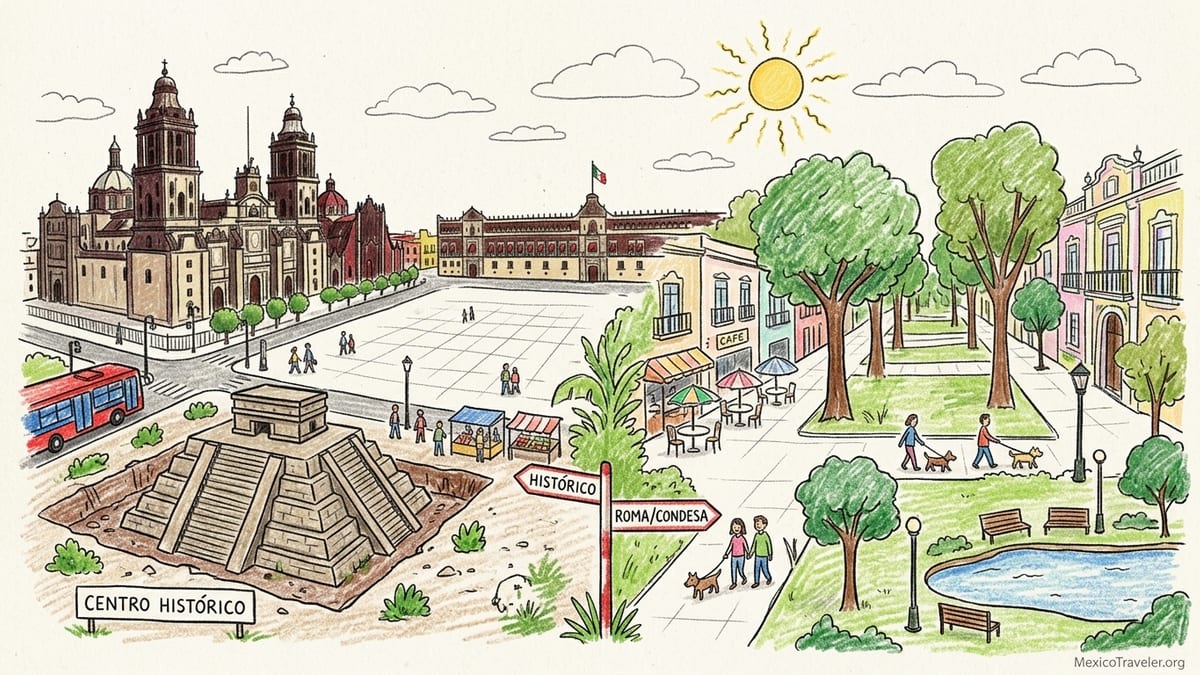
Centro Histórico: The Mexico City Morning That Feels Like a Movie Set
I like starting in Centro early, before the sidewalks fill and the soundscape turns into a full-volume mix of street vendors, tour groups, and traffic. Mornings here feel cool and echoey, especially around the Zócalo and the streets that radiate outward. The light hits the stone façades and you start noticing details that get missed later: iron balconies, carved doorframes, and the way entire blocks feel like they’ve been in continuous use for centuries. When Centro is calm, it’s one of the most atmospheric places in the city to walk.
My routine in Centro is built around short, purposeful walks. I’ll cross from the Zócalo area toward Palacio de Bellas Artes, then drift into Alameda Central for a breather when the sidewalks start to tighten. You can feel the neighborhood shift by the block: one street is formal and monumental, the next is a tangle of commerce and quick meals. The trick is to accept that Centro is intense and to use it in focused doses.
If you’re the kind of traveler who wants archaeology in the middle of an active city, the Museo del Templo Mayor is the perfect Centro anchor. It’s open Tuesday through Sunday, 9 a.m. to 5 p.m., and the admission fee has been listed at 100 pesos for the museum plus the archaeological site. That’s the kind of concrete, easy-to-understand attraction Centro does best: step out of colonial streets and into the bones of Tenochtitlan in minutes.
At night, Centro becomes more selective. Some streets around the main sights stay lively and well-lit, while others empty out quickly. I’m comfortable here after dark when I’m moving with a plan: a specific dinner spot, a performance, a clear route back. As a base, Centro works best for travelers who want early access to historic sights and don’t mind the daytime crowds. For me, it’s a neighborhood I return to repeatedly, but usually not where I choose to sleep for a full trip.
Roma Norte: Where I Kept Coming Back for Food, Coffee, and the After-Dinner Walk
Roma Norte has a certain frictionless ease: mornings feel neighborhood-local, not tourist-staged. Even when it’s busy, it’s the kind of busy that looks like people living their day. I like it for the simple rhythm of it: coffee first, a long walk second, lunch somewhere casual that turns out to be excellent, then a nighttime loop that doesn’t feel like a commute. The streets are walkable and visually varied, with a mix of older façades and newer storefronts that make even a repeat route feel slightly different each time.
My favorite Roma mornings begin with a café stop and a deliberate walk through the smaller streets rather than the big avenues. This is the neighborhood where I actually slow down and people-watch without feeling in the way. It’s also where I’ve had the easiest time building a “regular” routine in Mexico City: a morning coffee place I return to, a bakery I trust, a casual dinner option when I don’t want to think, and a late-night drink spot within a few blocks.
Roma also performs at night. You can feel the neighborhood’s food-and-nightlife reputation in the way tables fill up after 7 p.m. and the sidewalks stay active later than you’d expect. It’s not chaotic in the way Centro can be, but it is energetic. The important practical detail is that Roma is still part of the big city: you’ll hear traffic, and certain intersections can feel loud. I treat that as the tradeoff for staying in a place where you can finish dinner and still want to take a long walk.
If you’re choosing a neighborhood base and you want the highest odds of having a great day without overplanning, Roma is my repeat-choice. It’s the area I most often want to return to even when my itinerary pulls me elsewhere, because it’s where Mexico City feels easy to inhabit rather than simply visit.
Condesa: Green, Calm, and Built for the Midday Reset
Condesa feels like Roma’s quieter, greener cousin, and I mean that as a compliment. My clearest memories here are of shade and open space: tree-lined streets, dog walkers, and the feeling of being able to breathe for a second in a city that otherwise runs fast. The neighborhood’s reputation for parks and a calmer atmosphere matches what you feel on foot. If Roma is the “what should we eat tonight?” neighborhood, Condesa is the “let’s walk somewhere beautiful before we decide” neighborhood.
I tend to spend my Condesa hours in and around Parque México and Parque España. It’s the kind of area where you can run a very satisfying travel day without major attractions: coffee, a long park loop, a lazy lunch, and then an evening meal that doesn’t require a taxi afterward. The architecture is part of the pleasure. Even if you don’t have a background in design, you notice the curves, the balconies, and the way certain buildings feel distinctly early-20th-century urban.
Nighttime in Condesa is lively, but it doesn’t push as hard as Roma. It’s a more comfortable “one more drink” neighborhood, especially if you’re staying nearby and you want a walkable finish to the night. I also like Condesa when I’m traveling with someone who wants a calmer home base: it’s easier to imagine an early night here without feeling like you’re missing the city’s main event.
If I had to choose a neighborhood for a first-time Mexico City traveler who values parks, walkability, and a softer pace, Condesa is the safest recommendation. It’s not where I go for the most intense cultural hit, but it’s where I go when I want the city to feel gentle.
Polanco: Luxury Streets, Big Museums, and a Different Kind of Weekend
Polanco announces itself in a different language: wider streets, high-end storefronts, and a noticeably more “arrive by car” energy. Walking here is still pleasant, but it’s less about wandering and more about heading to specific destinations. If you’re coming to Mexico City for museums and a polished hotel experience, Polanco delivers that confidently.
The neighborhood’s major museum draw is the Museo Nacional de Antropología, which continues to be one of the most important cultural stops in the city. One notable recent change travelers should know is pricing: INAH reported updated tariffs, listing general admission at 210 pesos, with a 50 percent discount for Mexican nationals and foreign residents who can show documentation. The museum has also posted extended hours through early July 2026, staying open later during that period, which matters if you’re trying to fit it into a packed itinerary.
Polanco is also where a “museum day” can easily become a full-day circuit: you can spend hours inside a major collection, step back out into a sleek streetscape, and keep the day going without the sensory overload Centro can bring. It’s not my top pick for nightlife in the casual, spontaneous sense, but it is strong for planned evenings: a reservation dinner, a cocktail bar you’re meeting someone at, and a straightforward ride back to your hotel.
As an accommodation base, Polanco is ideal if you want calm, comfort, and proximity to major museums. It’s less ideal if your favorite travel moments come from street-level spontaneity, budget-friendly snacking, and late-night wandering. For me, Polanco is a neighborhood I’m glad to have in my week, but not the one I crave every day.
Juárez and Reforma: The Big-City Spine With the Best “First Walk” in Town
Juárez and Reforma are less a single neighborhood vibe and more a corridor experience. Reforma is where Mexico City feels monumental: broad lanes, landmark roundabouts, and a constant sense of movement. Juárez, nearby, carries more everyday texture, with hotels, offices, and pockets of restaurants that make it convenient for travelers who want to be central without being in the thick of Centro’s daytime surge.
My favorite Reforma ritual is a long walk that treats the boulevard like a guided timeline of the city’s modern identity: statues, major buildings, and the feeling of a capital showing off. On Sundays, that experience can shift dramatically because the city’s Muévete en Bici program opens major roads to non-motorized movement. The official city program describes the route across multiple boroughs, and in practice it turns Reforma into a moving promenade of bikes, skates, and families. It’s one of the most joyful “only in this city” experiences you can build into a trip without needing tickets.
Transit-wise, Reforma is also practical because it’s a Metrobús stronghold. The Mexico City government’s visitor-facing guidance has listed Metrobús at 6 pesos per ride and notes fully digitalized access, including the Tarjeta de Movilidad Integrada and tap options that reduce friction for visitors. That matters on a day when you’re going from Reforma to Centro, or Reforma to Roma, and you want something faster than a car but less involved than the Metro for a quick hop.
As a base, Juárez and Reforma are a solid “central compromise.” You’re close to Centro without living inside its intensity, and close to Roma and Condesa without paying the full premium of their most in-demand blocks. It’s not the most character-driven neighborhood on this list, but it is one of the easiest places to be logistically comfortable.
Coyoacán: A Half-Day That Can Turn Into a Whole Afternoon (In the Best Way)
Coyoacán feels like a mood change. The pace drops, the streets tighten into something more neighborhood-scale, and the experience becomes less about big-city spectacle and more about small details: a shady corner, a courtyard, a snack that turns into lunch. This is where I go when I want Mexico City to feel intimate. It is not the fastest neighborhood to reach from the central visitor zones, which is why I rarely use it as a daily base, but I almost always try to make room for it in a trip.
The major draw for many travelers is the Museo Frida Kahlo, also known as Casa Azul. The museum’s official visit guidance emphasizes ticketed entry, and in practice that means you should treat it like a timed plan rather than a casual drop-in. The point is not only to see a famous site, but to build a Coyoacán day that feels unhurried: museum first, then a long walk through the surrounding streets and plazas, then a late lunch that doesn’t feel rushed.
One current note travelers should keep in mind is that green spaces can change with weather and maintenance. In 2026, news reports documented the temporary closure of Los Viveros de Coyoacán due to high river levels and related issues after heavy rains, with officials communicating about reopening plans. If Viveros is on your personal “slow walk in a big city” list, it’s worth confirming its status close to your visit rather than assuming it will be open on the day you arrive.
For food and browsing, Coyoacán is also the kind of place where you can anchor yourself around a market stop and let the rest unfold on foot. The borough’s official information lists Mercado Coyoacán at Ignacio Allende s/n, Del Carmen, which is useful when you’re navigating by neighborhood rather than by specific storefront. Coyoacán is better as a half-day or full afternoon than as an accommodation base, unless your goal is specifically to stay somewhere quieter and you’re comfortable traveling into the rest of the city for most sightseeing.
The Takeaway
If I had to rank these neighborhoods by how often I wanted to return, Roma Norte and Condesa sit at the top for repeatability. They make daily life as a traveler feel smooth: coffee is easy, walking is pleasant, nights are enjoyable, and you can reset without leaving the neighborhood. Juárez and Reforma are the best logistical compromise, especially if you want monument-level sightseeing mixed with straightforward transit. Centro Histórico is essential, but I treat it as a powerful dose rather than an all-week home base: mornings are magical, midday is crowded, and nighttime is best with a plan. Polanco is excellent when your trip priorities are museums, comfort, and a more polished experience, but it can feel less spontaneous on foot. Coyoacán is my favorite “different day” in Mexico City, the kind of place that reminds you the city is made of many worlds, not just one.
Practically, the city’s affordability in public transportation helps connect these areas without overthinking it. Current visitor guidance has listed the Metro fare at five pesos per trip, and the Metrobús at six pesos per ride, both tied into the Movilidad Integrada system. That means you can build your days around how neighborhoods feel rather than around expensive transfers. My advice is simple: pick a base that matches your favorite daily rhythm, then use transit to treat the others as distinct chapters. Mexico City rewards that approach.
FAQ
Q1. Which Mexico City neighborhood is best for a first-time visitor?
Roma Norte or Condesa are the easiest first bases for walkability, cafés, and nights that feel lively without being overwhelming.
Q2. Is Centro Histórico worth staying in, or better as a day trip?
It’s absolutely worth visiting, but I often prefer it as a day-focused neighborhood and choose to sleep elsewhere for a calmer routine.
Q3. Which neighborhood is best for parks and a calmer atmosphere?
Condesa, especially around Parque México and Parque España, is the most consistently green and relaxed on this list.
Q4. Where should I go for museums in Mexico City?
Polanco is the strongest museum hub, anchored by the Museo Nacional de Antropología, with Reforma also offering easy access to major cultural stops.
Q5. What neighborhood is best for food and nightlife?
Roma Norte is the most reliable for dinner-to-drinks energy, with plenty of options that still feel comfortable on foot afterward.
Q6. How much does public transportation cost in Mexico City right now?
Current visitor guidance lists the Metro at five pesos per trip and the Metrobús at six pesos per ride, both commonly used by travelers for neighborhood hopping.
Q7. Is Coyoacán worth it if I only have two or three days in the city?
Yes, if you want a slower neighborhood experience. It works best as a dedicated half-day or afternoon rather than a quick stop.
Q8. Do I need to plan ahead for the Frida Kahlo Museum?
Yes. Treat it like a timed visit and plan your Coyoacán day around it rather than expecting a casual walk-in.
Q9. What’s the best way to experience Reforma like locals do?
Go on a Sunday during Muévete en Bici, when major roads open to bikes and pedestrians and the avenue becomes a moving promenade.
Q10. If I’m choosing only one neighborhood to stay in, which is the most versatile?
Roma Norte is the most versatile blend of food, walkability, and nighttime atmosphere, with easy access to Condesa, Juárez, and Reforma.