


I’ve arrived at Mexico City International Airport (AICM, also called Benito Juárez or “MEX”) enough times to know the first hour can make or break your mood. On my most recent trip, I landed at Terminal 1 at about 9:40 p.m., tired and hungry, carrying one rolling suitcase plus a backpack. I wasn’t traveling with kids, but I did have enough luggage that I didn’t want to wrestle stairs or squeeze onto packed public transport. I chose an authorized airport taxi, paid at a kiosk inside the terminal, and reached my stay in Roma Norte in a little over an hour door to door, including the wait and the traffic crawl. It cost more than I would have paid in a car-hailing app, but it was straightforward, legal inside the airport’s federal zone, and I didn’t have to negotiate on the curb. After researching the newest rules and the current transport options, I still think that choice made sense that night, but I would change my plan in a few very specific situations.
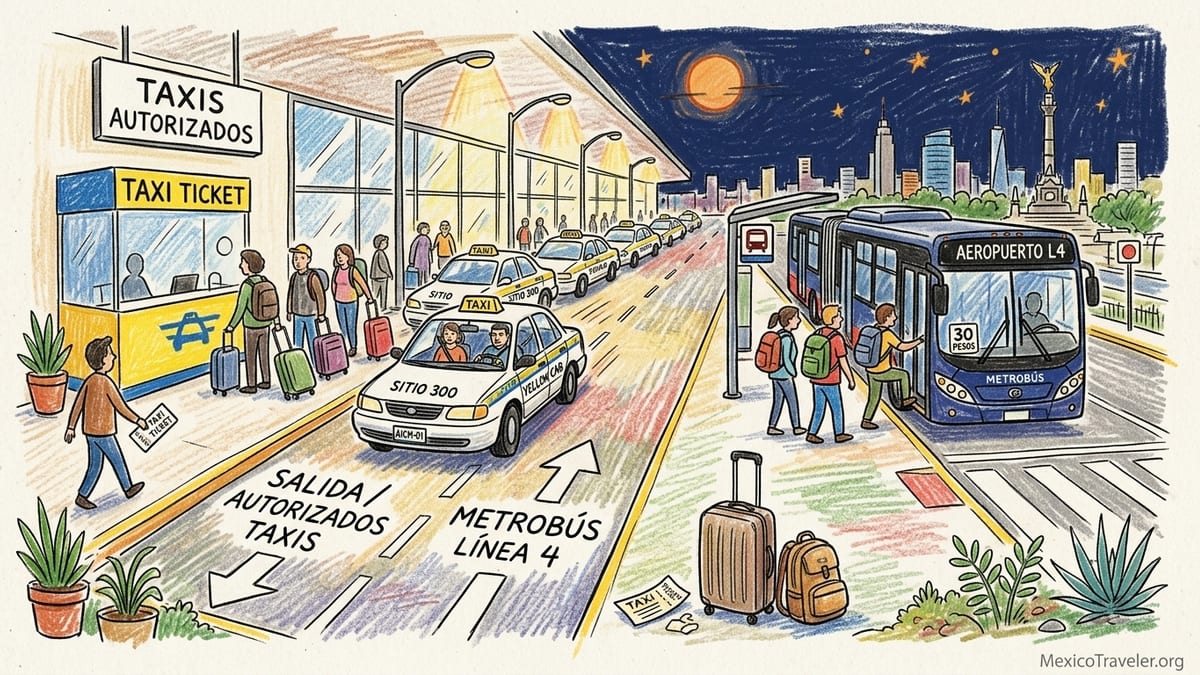
My Actual Arrival at AICM: Terminal, Timing, Bags, And What I Picked
I arrived into Terminal 1 (T1) at roughly 9:40 p.m. on an evening flight, and by the time I was walking out toward ground transportation it felt like classic Mexico City: warm air, a lot of motion, and a lot of choices. My luggage situation was manageable but not minimal: one medium rolling suitcase that I could lift into a trunk myself, plus a backpack with my laptop and a jacket.
I made the decision right there to use an authorized airport taxi rather than experiment. The biggest reason was friction. I wanted one payment, one line, one official process, and a driver who was already allowed to load passengers in the terminal area. I also wanted to avoid the awkward late-night dance of messaging a driver who may not be permitted to pick up inside the airport’s federal zone.
I bought my ride at an official taxi ticket counter inside the terminal. The process was simple: I told the attendant my neighborhood (Roma Norte), they quoted a price based on the zone, I paid, and I walked to the designated taxi area with the ticket. I genuinely remember it being around the mid-to-high hundreds of pesos for the trip, which lined up with what I have seen reported for official taxi rides into central areas.
From curb to hotel door, my total was a bit over an hour. That included a short wait in the taxi line and then heavy traffic for stretches, even at night. The ride itself felt safe and uneventful: no bargaining, no “cash only” surprise, no last-minute claim that my destination was “too far.”
What’s Changed: The Current AICM Rule On App-Based Pickups
If you last traveled through MEX a few years ago, the biggest practical change is the enforcement posture around ride-hailing pickups. In March 2026, AICM and federal authorities reiterated guidance that app-based taxi services are not authorized to operate within the airport’s federal zone. In plain terms: drivers affiliated with apps may not be permitted to pick you up at the terminal curb inside the controlled airport area, even if you see other travelers doing it.
This matters because a lot of “advice” floating around online still reads like a simple recipe: walk out, request a car, meet at Door 4, done. That can now lead to confusing cancellations, drivers asking you to walk farther than you expected, or travelers standing with luggage in crowded areas while trying to match a license plate that keeps changing.
It’s also important to separate two ideas: what is technically possible in practice at a given moment, and what the airport says is authorized. You may see enforcement vary by time of day, terminal door, or staffing. But as a traveler who just wants a clean, low-stress arrival, the safest plan is to assume app-based pickups are restricted in the airport’s federal zone and to avoid building your whole arrival around a curb pickup that may not be allowed.
AICM continues to direct passengers to authorized taxi providers and to public transportation options like Metrobús and the Metro. That is the lane I recommend you plan around, especially at night or with family.
Authorized Airport Taxis: The “Pay First” Option I Used (And Who Runs Them)
Authorized airport taxis are still the most straightforward legal, on-site option for many arrivals because they are permitted to operate in the federal zone and are integrated into the airport’s workflow. AICM lists multiple authorized taxi groups for passenger service, including well-known names you’ll see on counters and uniforms like Sitio 300, Yellow Cab, Nueva Imagen, Confort, Casadey, Porto Taxi, TaxiRide, T&M, PSTA, and Aerotaxi. The key detail is not the logo you prefer, but the process: buy a ticket at the official counter, then board in the assigned area.
On my night arrival, this “pay first” structure was the whole point. I did not hand cash to someone who approached me. I did not negotiate. I did not take a ride offered outside the official system. I paid at the counter and then followed the instructions to the taxi bay.
Cost is the tradeoff. Official taxi prices can feel high compared with apps, and travelers regularly notice that difference. For central neighborhoods like Roma and Condesa, it is reasonable to expect pricing that can land in the several-hundred-peso range depending on zone, time, and vehicle type. If you need a larger vehicle (for example, a family with multiple suitcases), the kiosk may offer higher categories, and that can increase the fare.
If you choose an authorized taxi, my practical advice is simple: confirm the destination zone at the counter, keep the printed ticket until you’re done, and don’t accept last-minute changes once you’re at the taxi line. If anything feels off, step back and return to the counter rather than arguing curbside.
Metrobús Line 4 (Airport Service): My Favorite Budget Plan For Daytime Arrivals
If I land in daylight hours with light luggage, the airport Metrobús is the option I’m most likely to use next time. Mexico City’s Metrobús Line 4 has a dedicated airport service with a higher fare than regular Metrobús routes. The airport fare is 30 pesos, and it’s designed as a tourist-friendly link from the airport into central corridors, including Paseo de la Reforma and the Historic Center, depending on the specific service pattern.
In 2026, the city also highlighted the airport connection and improvements around the Line 4 airport route, including newer buses and a clear emphasis on connecting to Reforma. The practical “real life” benefit: if your hotel is in Roma, Condesa, or Polanco, getting to Reforma first can be a smart move, because from there you can do a short, predictable final hop by local taxi outside the airport zone or by another transit connection.
Here’s what it looks like in practice for Roma or Condesa: you take the Line 4 airport service toward Reforma and get off near a Reforma stop, then take a short local taxi or a short app ride from that non-airport location to your exact address. That avoids the airport pickup restriction problem entirely because you’re no longer in the federal zone. It also turns a potentially expensive one-shot ride into two smaller, easier legs.
The limitation is hours and luggage comfort. Metrobús is great when it’s running and you’re not overloaded. If you have two big suitcases, a stroller, or you land late, I’d still lean back toward an authorized airport taxi for the first leg, then rethink the budget plan on your way back to the airport when you’re rested.
Metro Line 5 (Terminal Aérea) And Other Public Transport: Cheap, But Not Always Easy
The Mexico City Metro is the cheapest way to get moving from the airport area, and Terminal 1 is linked to Metro Line 5 via the Terminal Aérea station. The Metro can be a lifesaver if you’re traveling solo with a backpack and you want to get across the city for just a few pesos, especially during peak traffic.
But the Metro is not an “airport express.” You should expect walking, stairs, crowds, and at busy times, very tight space. Even if you’re comfortable navigating transit systems, this is not the option I’d pick immediately after a long international flight with heavy luggage. It’s also not the option I’d recommend with kids and multiple bags, unless you have a specific station-to-station plan and you’re arriving when trains are less crowded.
A practical compromise I like is using the Metro or Metrobús to reposition, not to finish the whole journey. For example, instead of trying to reach Polanco entirely on transit with bags, you can use an inexpensive segment to get closer to a friendlier pickup spot, then take a short car ride for the last miles. That “two-stage” approach keeps costs under control without turning your arrival into a workout.
Also remember that Rome, Condesa, and Polanco are not all equally easy from the airport by transit. Roma and Condesa are often easiest by heading toward Reforma or the Historic Center corridor first, while Polanco can be more convenient once you’re connected to major lines or once you’ve repositioned to a calmer pickup point.
So What Would I Use Next Time: Late Night, Kids, Heavy Bags, Or Solo
After a late-night flight, I would still choose an authorized airport taxi more often than not. The reason is emotional as much as logistical: when you’re tired, you want the simplest legal option that starts and ends with minimal friction. I would rather pay more than spend 20 minutes negotiating where I’m allowed to stand, whether a driver will risk the pickup, or whether the car will cancel when it reaches the terminal loop.
With children, I would also pick an authorized taxi or a pre-arranged hotel shuttle if my hotel offers one. Kids plus luggage magnifies every small inconvenience: a missed bus, a crowded platform, a long walk. I’d rather get everyone in one vehicle, strapped in, and moving. If you need a larger vehicle, ask at the counter and confirm the vehicle category before paying.
With heavy luggage, same answer: authorized taxi. In my experience, the biggest hidden cost of “saving money” is hauling a large suitcase over curbs, through crowds, and down stairs while still jet-lagged. I would keep the cheapest plan for when I’m traveling with a carry-on and I’m wide awake.
Solo with light luggage in daytime, I’d choose Metrobús Line 4 airport service first, then do the last hop to Roma, Condesa, or Polanco from Reforma. It’s a clean, low-cost way to get out of the airport zone and into the city’s most recognizable corridor, and it sidesteps the current airport restriction on app-based curb pickups by moving your pickup point away from the federal zone.
The Takeaway
My real-world MEX arrival lesson is that the “best” option changes depending on your energy level and your bags. The authorized taxi I used from Terminal 1 was not the cheapest ride into Roma Norte, but it was legal inside the airport’s federal zone, easy to pay for, and low stress after a night flight. That mattered more than saving a couple hundred pesos.
If I’m landing earlier with a backpack, I’d use the Metrobús airport service for 30 pesos to get to the Reforma corridor and then take a short final ride to Roma, Condesa, or Polanco from there. It’s the best value that still feels practical for visitors, and it avoids gambling on a pickup method that may not be permitted inside the airport zone.
The one thing I would not do now is plan my arrival around the assumption that an app-based car will pick me up at the terminal curb. With AICM’s March 2026 guidance and continued emphasis on authorized taxi providers and public transport, that outdated pickup advice can turn your first hour in Mexico City into a frustrating scavenger hunt.
FAQ
Q1. Can Uber or DiDi pick me up at the terminal curb at AICM?
As of the March 2026 guidance, app-based taxi services are not authorized to operate within AICM’s federal zone, so curb pickups inside the airport area may be restricted.
Q2. What is the simplest legal option after a late-night arrival?
An authorized airport taxi purchased at an official ticket counter inside Terminal 1 or Terminal 2 is typically the simplest on-site, pay-first option.
Q3. About how much should I expect to pay to Roma or Condesa in an authorized taxi?
Expect a fare in the several-hundred-peso range depending on the zone and vehicle type; the counter will quote your exact price before you pay.
Q4. Is there public transport from AICM that tourists actually use?
Yes. Metrobús Line 4 has an airport service widely used by visitors because it connects toward central corridors like Reforma and the Historic Center.
Q5. How much is the Metrobús airport fare?
The airport service fare on Metrobús Line 4 is 30 pesos.
Q6. Is the Metro connected to the airport?
Terminal 1 is connected to Metro Line 5 via the Terminal Aérea station, but it requires walking and navigating crowds, which can be tough with luggage.
Q7. What would you choose with kids and multiple suitcases?
I would choose an authorized airport taxi or a hotel shuttle, prioritizing a direct, low-friction trip over the lowest cost.
Q8. What’s the best plan for Polanco if I want to keep costs down?
In daytime with light luggage, take Metrobús toward Reforma and then do a short final ride from there to Polanco, rather than paying a full airport taxi fare.
Q9. Where do I pay for an authorized airport taxi?
You pay at an official taxi ticket counter inside the terminal, then board at the designated taxi area using your ticket.
Q10. What’s the biggest mistake first-timers make at AICM?
Assuming ride-hailing pickups at the terminal curb are straightforward and permitted, then getting stuck with cancellations or being told to walk outside the airport zone with luggage.