


I’d read enough Xochimilco advice to think I knew what I was signing up for: rent a boat, bring snacks, brace for mariachi. What I didn’t understand until I went is that the hardest part is not floating the canals, it’s everything right before it: choosing the right embarcadero, understanding the posted price versus the “helpful” offers, and deciding how much chaos you actually want. My trip ended up being one of those Mexico City days that feels messy at the edges and unforgettable in the middle, especially once the dock noise fell behind us and the water turned into a slow-moving corridor of reeds, chinampas, and distant music.
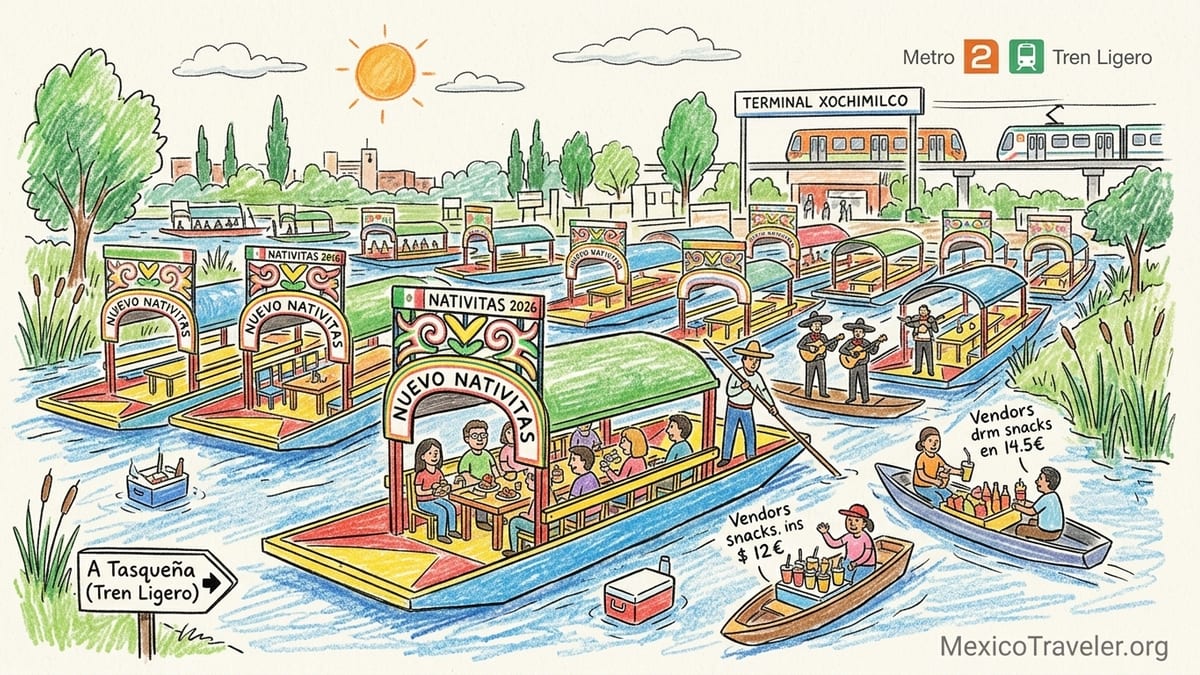
Where I Actually Went: Embarcadero Nuevo Nativitas (And Why)
I did my ride from Embarcadero Nuevo Nativitas, the dock that’s become the easiest “first timer” choice because it’s organized, busy, and generally straightforward about the rules. It is also, frankly, the place where you feel the party energy immediately. I wasn’t chasing a silent nature float that day, I wanted the classic canals experience with enough structure that I wouldn’t spend my whole morning arguing over what I owed.
Nuevo Nativitas also has posted operating hours and is commonly listed as open daily from early morning into the evening, which matters if you’re trying to arrive before the peak crowds. I arrived late morning and the dock was already in full weekend mode: vendors calling out prices, families negotiating, and boats stacked up like taxis in a terminal.
One important 2026 reality check: the official rate repeatedly posted by local authorities and echoed across recent reporting is about MX$750 per hour per trajinera, meaning per boat, not per person, with a typical maximum capacity around 18 passengers. That number is your anchor in every conversation you have on the dock, even if someone tries to reframe it as a per-person charge.
How I Got There From Central Mexico City (And What I’d Do Differently)
I started in central Mexico City and took public transit to keep the logistics predictable: Metro Line 2 to Tasqueña, then transferred to the Tren Ligero (light rail) toward Xochimilco. The light rail ride is not glamorous, but it is the most direct “tourist-proof” way to reach the area without bargaining with a driver for the whole distance.
From the Terminal Xochimilco station, I took a short ride-hail to Nuevo Nativitas. You can also use a taxi from the terminal, but what mattered to me was avoiding a second round of negotiating after a long transit ride. The last-mile hop is where time can disappear if you try to walk without being sure of the route, especially in heat or rain.
If I were doing it again with a tight schedule, I’d either go earlier or I’d split costs with friends for a direct car both ways. Traffic in and out of Xochimilco on weekends can be slow, and the return trip can feel longer than you expect when the afternoon crowds all leave at once.
Booking: I Went Independently, and This Is What Was Confusing
I did not pre-book online. I walked up and rented directly at the embarcadero, which is completely doable, but it comes with a learning curve. The confusion starts with how many people approach you as soon as you arrive: some are official-looking promoters, some are boatmen, some are selling add-ons, and some are simply intermediaries trying to steer you into a deal that benefits them.
The key negotiating moment is agreeing on the number of hours before you step onto the boat. The official pricing is set per hour per boat, but on a busy day you may hear “minimum two hours,” or you may be offered a “special route” that quietly stretches the clock. I had to ask three times, in different ways, to confirm: “How many hours are we paying for, and what is the total right now?” Once the total was said clearly, the conversation became easier.
Another practical point that’s easy to miss: “shared” isn’t always an official product at the dock. Some visitors share informally by teaming up with strangers and splitting the cost of a private boat. That can work, but it requires social effort and trust on the spot. If you are solo or a couple and you want to keep costs down without negotiating with strangers, a guided group tour booked in advance can be simpler.
On Board: How Our Trajinera Was Set Up (And What It Felt Like)
Our trajinera was arranged like a floating picnic platform: long benches running down both sides under a canopy, an open center aisle, and just enough space to pass snacks and bags without stepping on anyone’s feet. There were four of us, so we had the luxury of spreading out. The boat could have held far more people, and I understood immediately why groups love Xochimilco: the pricing model rewards filling the boat.
We paid by the hour for the boat and agreed to a two-hour ride so we wouldn’t spend the entire time checking our watches. Once we pushed off, the first ten minutes were the loudest because the dock area is basically a water intersection. Boats bump close enough to touch, music overlaps, and vendors drift up alongside with floating coolers and baskets.
Then the canal opened. The best part of my visit was the moment we were far enough away that the sound became layered instead of overwhelming. You still hear music, but it’s distant, like a radio playing from another room. The water slows everything down, and you start noticing details that don’t fit the “party boat” stereotype: the texture of the reeds along the edge, the way the boatman uses a long pole to nudge and steer, and the sudden pockets of shade when you pass under trees.
Emotionally, the ride felt like Mexico City’s version of exhaling. Not silent, not pristine, but undeniably different from the streets. It’s a break from traffic logic. You don’t “get somewhere” quickly, you drift through it.
Music, Food, Vendors, and the Real Noise Level
I didn’t hire a mariachi band. That choice alone changed the vibe. What I heard instead was a collage: a brass band passing close enough for a full song, a birthday group blasting a playlist from a speaker, and boatmen calling out to each other as they coordinated who was turning where. The music felt less like a curated performance and more like a neighborhood soundtrack that happens to be floating.
Food and drinks were the most constant interaction. Vendors pull alongside and pitch what they have, and you can buy without docking. In my two-hour ride, we were offered everything from micheladas and beer to snacks and full plates depending on who floated past at that moment. It’s convenient, but it’s also where travelers can overspend if they say yes to everything in the first 15 minutes. We waited until we were settled and then bought a couple of items, keeping it simple.
Noise level is not a single setting in Xochimilco. Near Nuevo Nativitas, it’s loud enough that you sometimes have to lean in to talk. Farther out, it’s more like city-park noise: distant voices, scattered music, and the sound of poles hitting the canal bottom. The difference is dramatic, and it’s why timing and route matter more than most first-timers realize.
If you want a calmer ride without giving up the canal experience entirely, the current guidance from local tourism materials and recent visitor reporting points to embarcaderos associated with the protected natural area, such as Cuemanco and Fernando Celada, which tend to emphasize ecological routes more than the central party corridor.
Best Xochimilco Tours in 2026: What’s Worth Booking (And For Whom)
The “best” tour is less about a single operator and more about matching your tolerance for crowds, your budget, and whether you want the Island of the Dolls. In 2026 marketplaces, you’ll see everything from short canal loops to longer themed routes. The most common options break down into three practical choices: private trajinera rental at the dock, shared cost with strangers, or a guided tour package that bundles transport and a set itinerary.
Private dock rental works best if you have a group and want control. You pay the posted hourly boat rate, bring your own food if you want, and decide whether to add music. This is the purest version of the experience I had: you’re not following a script, you’re just floating and reacting to what you see.
Guided tours make the most sense for travelers who don’t want to negotiate at all or who are short on time. The value is not that the canals are “better,” it’s that someone else handles transport, timing, and the awkward dock conversation. Many guided options also include stops that independent riders might skip, such as a chinampa visit, an axolotl-related exhibit or educational stop where available, or a specific food plan.
The Island of the Dolls is the biggest fork in the road. Recent guidance commonly describes it as a long ride from the main tourist docks, often requiring several hours round-trip depending on waterway access and route. If the Island of the Dolls is your primary goal, it’s smart to book specifically for it, confirm the hours on the water, and verify which embarcadero the tour departs from. In 2026, you’ll see Island of the Dolls routes commonly tied to areas like Cuemanco or Fernando Celada, not just the busiest central docks.
The Takeaway
My honest summary is that Xochimilco is not one experience, it’s many experiences stacked on top of each other. At Nuevo Nativitas, the first stretch is a loud, social, vendor-heavy corridor that can feel chaotic if you expected a peaceful canal. But if you give it time and let the boat push beyond the dock traffic, the place changes. The water gets wider, the sound thins out, and you start to understand why this landscape has held cultural weight for so long.
Was it confusing to book? Yes, in a very specific way: you have to arrive knowing the posted hourly price model and you have to confirm the total hours and total cost before you board. Once that’s settled, the ride itself is easy.
Next time, I’d make one change depending on my goal. If I was going with friends, I’d book a private boat again and arrive early to avoid the peak crush. If I was going as a couple or solo, I’d either book a guided tour with transport included or I’d choose a calmer, ecological-leaning embarcadero like Cuemanco or Fernando Celada to reduce the “party terminal” feeling at the start. And if the Island of the Dolls was the point, I’d book that route specifically and commit to the longer time on the water instead of trying to tack it onto a short visit.
FAQ
Q1. What is the official trajinera price in Xochimilco in 2026?
The posted official rate widely cited by local authorities and recent reporting is about MX$750 per hour per trajinera (per boat), not per person, typically with a maximum capacity around 18 passengers.
Q2. Which embarcadero did you use for your trip?
I rented directly at Embarcadero Nuevo Nativitas and did a two-hour ride.
Q3. How do you get to Xochimilco from central Mexico City by public transit?
A common route is Metro Line 2 to Tasqueña, then transfer to the Tren Ligero toward Terminal Xochimilco, then take a short taxi or ride-hail to your chosen embarcadero.
Q4. Should I book online or rent on arrival?
If you want the simplest logistics and minimal negotiation, book a guided tour. If you have a group and want flexibility, renting on arrival can be great, as long as you confirm the total hours and total cost before boarding.
Q5. Is Xochimilco loud?
Near the main docks like Nuevo Nativitas, it can be very loud with overlapping music and vendors. Farther from the dock, the sound usually spreads out and becomes more manageable.
Q6. Can you bring your own food and drinks on a trajinera?
In many cases, yes, and plenty of groups do. Vendors also sell food and drinks on the canals, which is convenient if you prefer to buy as you go.
Q7. Are shared trajineras a real option?
Sometimes, but it’s often informal. Travelers may team up with others on the spot and split the cost of a private boat. If you want a guaranteed shared experience, a guided group tour is usually more reliable.
Q8. How long does an Island of the Dolls trip take?
It’s commonly described as a multi-hour commitment, often around four hours total depending on the departure point and route. Confirm the duration and embarcadero before you book.
Q9. Which embarcaderos are better for a calmer, more ecological route?
Routes associated with the protected natural area, often linked to embarcaderos like Cuemanco and Fernando Celada, are commonly described as calmer than the main party corridor.
Q10. What’s the single most important tip to avoid overpaying?
Arrive knowing that the standard pricing model is per hour per boat, then agree on the exact number of hours and the total cost before you step onto the trajinera.