


Mexico City is the rare capital where “just wandering” can feel like a full itinerary, and that is exactly how you end up missing the places that reward limited time. On my last trip, I tried to do everything in too few days and learned a more useful lesson: CDMX is best experienced as a set of deliberate, high-impact blocks. A morning that belongs to Centro. A full afternoon that belongs to Chapultepec. One day where you commit to Teotihuacán and don’t pretend it’s a quick detour. And a food plan that treats markets and street snacks like the main event, not filler between museums.
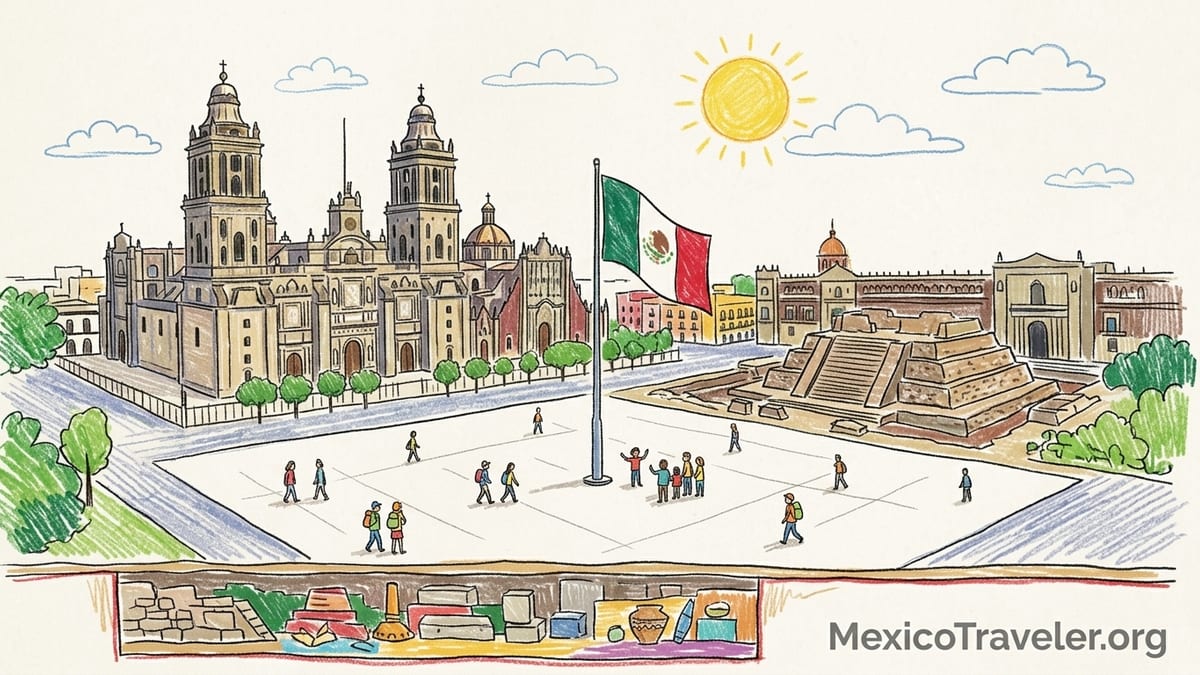
Start In Centro Histórico: Zócalo First, Then The Ruins Under Your Feet
I always begin in Centro Histórico because it calibrates the whole city. The first time I arrived at the Zócalo in the morning, I stepped out of the Metro and surfaced into an enormous plaza that felt like it was holding the city’s breath. On a weekday, the crowd was a mix of commuters cutting across the square, school groups clustering around flags, and travelers doing the same thing I was doing: turning in place, trying to take in the Cathedral, the scale of the space, and the sudden sense of altitude and sun. The light can be sharp here, and even when the weather is mild, the open plaza has very little shade, so I regretted not having sunglasses and water already in hand.
This is also where the city teaches you your first practical rule: Centro is a working district that changes by the hour. I’ve arrived on a bright, calm morning and had the square feel wide open, and I’ve arrived on another day and found portions restricted due to preparations for public events. Around major holidays and civic celebrations, the area can have traffic restrictions and tighter access control, so I now treat Centro like a “go early” neighborhood rather than a “swing by later” plan.
From the Zócalo, I walk straight to the Templo Mayor site and museum, because it is the most emotionally immediate history lesson in CDMX. The official schedule is Tuesday to Sunday, 9:00 a.m. to 5:00 p.m., and the general admission is listed at 100 pesos in the museum’s own visitor information. The walk from the Zócalo is short, but the approach matters: you move from grand colonial facades to exposed stone, and suddenly the city’s layers stop being a metaphor and become an actual view.
What stood out most to me inside the museum was how the exhibits clarify the dual dedication of the temple complex, and how that idea echoes in the museum’s layout. I expected the outdoor ruins to be the main draw and thought I’d spend most of my time outside. Instead, I stayed longer than planned in the galleries, reading labels slowly and circling back to a few objects because the story made more sense the second time. My disappointment was not the museum itself, but my timing: I arrived closer to midday once and felt the crowd tighten in the narrow indoor spaces. If I could do it again, I would go right at opening, do the museum first while it is cooler and quieter, then return outside for the ruins when the day has warmed up.