


I learned Mexico City by walking it first, then letting transit do the heavy lifting. I arrived at Aeropuerto Internacional Benito Juárez (AICM) expecting a quick hop into the center, and immediately met my first CDMX truth: this city is gigantic, and every plan needs a margin for traffic, lines, and sheer distance. I stayed in Roma Norte and used a mix of Metrobús, the Metro, and rideshares depending on time of day and what I was carrying. I also felt the altitude more than I expected in my first 24 hours, not dramatic, but enough that I slowed my pace, drank more water, and built my itinerary around neighborhoods rather than pinballing across the map.
Arrival, Getting Around, and the Reality of CDMX Distances
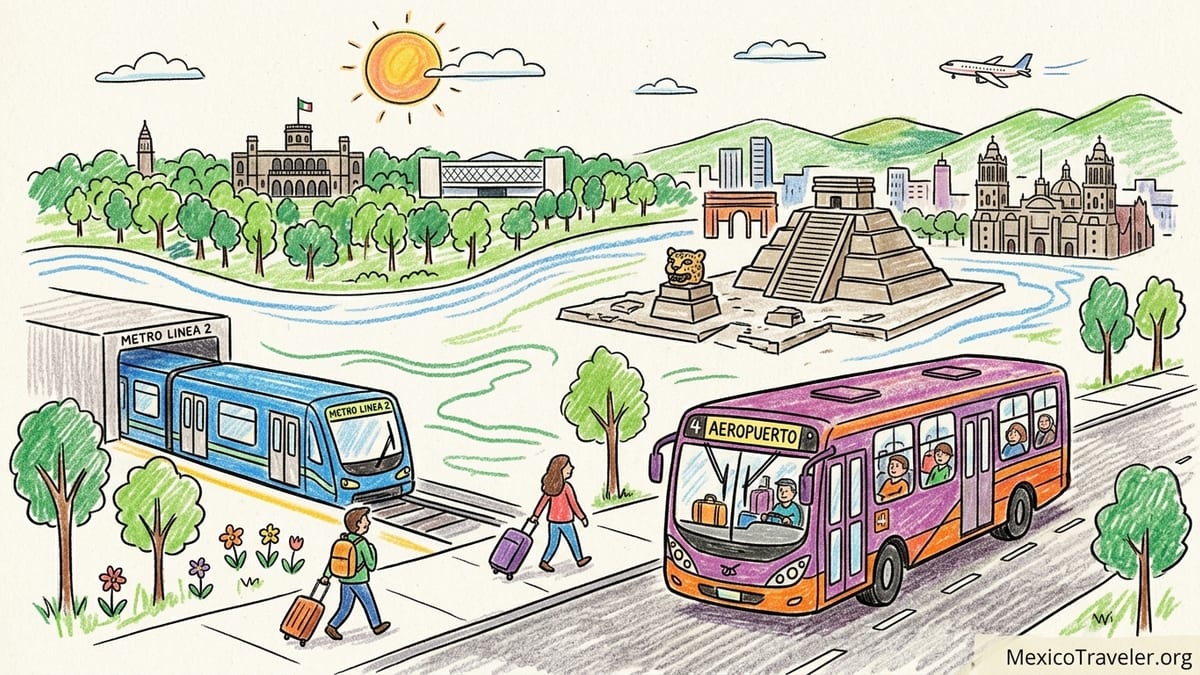
Landing at AICM, I had two practical options I was willing to use: public transit or a rideshare style pickup outside the terminal area. For a first-time visit with luggage, I chose Metrobús Line 4 from the airport because it is straightforward, cheap, and it runs long hours. The airport’s Metrobús stop at Terminal 1 is at Puerta 7, and the published operating hours are early morning through midnight, with slightly later starts on Sundays and holidays. The airport route is priced differently from the rest of the Metrobús system, with a $30 MXN fare for the airport service.
Once I was settled, I leaned on the Metro and the regular Metrobús network. The Metro’s published fare is $5 MXN per trip, regardless of distance or transfers within the system, and the official operating hours are roughly 5:00 a.m. to midnight on weekdays, 6:00 a.m. to midnight Saturdays, and 7:00 a.m. to midnight Sundays and holidays. For Metrobús, the standard fare is $6 MXN per ride, with the airport exception staying at $30 MXN, and current city guidance also notes that access has been digitized so visitors can use the Movilidad Integrada card and, in many cases, tap-in with a contactless bank card or phone at Metrobús.
Even with good transit, cross-city journeys still felt like a commitment. A ride that looked short on a map often turned into a full hour when you factor in station walks, transfers, and the last mile. That reality changed how I planned my days. Instead of doing one museum in Chapultepec, then dinner in Coyoacán, then drinks in Condesa, I started batching: one day mostly for Centro Histórico, another day built around Chapultepec and Polanco, another for Coyoacán and then only a short hop back toward Roma.
My most repeated routes weren’t glamorous: I kept returning to the Roma Norte and Condesa corridors because it was easy to walk, easy to find coffee and a simple breakfast, and it gave me a predictable base when the city’s scale started to feel overwhelming. When I used rideshare, it was usually at night, or when I was moving between neighborhoods that would have required multiple transfers. The tradeoff was clear: rideshares bought me simplicity, but traffic could erase the time savings.
Centro Histórico: Where CDMX Feels Loudest, Oldest, and Most Essential
My first long walk was in Centro Histórico, and it immediately clarified why people say CDMX is many cities at once. The streets around the Zócalo can feel ceremonial one minute and intensely commercial the next. I built this area around early starts, partly to beat crowds and partly because midday traffic and congestion made everything slower. The Metro is the cleanest way to get into the historic core without playing games with traffic, and even the Museo del Templo Mayor itself recommends arriving by Metro as the fastest option, pointing visitors to the Zócalo station on Line 2.
The Museo del Templo Mayor is one of those places that rewards you for arriving with energy. The museum and site list public hours Tuesday through Sunday, 9:00 a.m. to 5:00 p.m., which made it easy to pair with an early lunch and then a second stop nearby. What surprised me most is how quickly the modern city noise fades once you are looking at the excavations. It is not a long visit in terms of physical distance, but it is dense in meaning and detail, and I was glad I did it before museum fatigue set in later in the trip.
In the same zone, evenings were a different personality. Centro can be thrilling at night, but I kept my “late” plans closer to Roma and Condesa where I felt more comfortable walking between dinner and my lodging. That was not about fear so much as reducing friction: when you are tired, you want fewer variables. If you do stay for an evening performance, dinner, or a night stroll, I would plan your transport home in advance, especially if you are relying on an app pickup that may require walking to a designated point depending on rules and traffic patterns.
What felt a bit overrated to me in Centro was trying to see everything in one day. It is tempting because the landmarks are close together, but the crowds, the sensory intensity, and the stop-and-start pace can make it exhausting. Next time, I would allocate more time to the museums and less to zigzagging for checklist photos.
Roma Norte and Condesa: My Home Base for Walks, Coffee, and Easy Nights
Roma Norte was my anchor neighborhood, and it shaped my Mexico City experience as much as any major attraction. I liked that I could start the day on foot, stop wherever looked inviting, and still return to reset before heading out again. The neighborhood felt built for wandering: leafy blocks, storefronts that reward curiosity, and a constant stream of people out for coffee or dinner. Condesa, just next door, gave me longer park-adjacent walks and a calmer rhythm when I needed a break from the city’s louder zones.
This was also where I most felt the altitude in a subtle way. On my first day, I walked too fast out of pure excitement and had to slow down, especially on longer stretches without shade. I adjusted by carrying water, taking more sit-down breaks, and choosing one big activity per day rather than trying to conquer the entire city. If you are coming from sea level, it is worth planning your first 24 hours as an “easy day” that you can scale up or down.
Food wise, I kept things simple and repetitive in a good way: a light breakfast, a big lunch, and then a smaller dinner or late snack. I am not going to claim exact prices I cannot prove from memory, but I can say this: Roma and Condesa made it easy to control spending because you can choose between quick street-style bites, midrange sit-down meals, and higher-end dining on the same few blocks. The convenience is the point. When you are tired from transit and walking, an easy meal close to where you are staying is worth more than another cross-city trip.
What surprised me was how quickly these neighborhoods can become your entire trip if you let them. Roma and Condesa are comfortable, photogenic, and full of English-friendly services, which is useful, but it is also a trap. I had to deliberately schedule days in other parts of the city so I did not end up doing “CDMX lite.”
Polanco and Chapultepec: Big Museums, Big Park Days, and Ticket Details to Know
Chapultepec was my reset button: trees, space, and museums that can fill a full day without forcing you into traffic. I treated it like its own mini-city. My core stop was the Museo Nacional de Antropología, which currently lists public hours Tuesday through Sunday from 9:00 a.m. to 6:00 p.m. and, importantly for planning, it notes updated pricing: the general admission is listed at $210 MXN, with specific free and discounted categories posted by the museum and by INAH communications. The museum also posts practical rules and fees such as paid lockers, which is useful if you arrive with a day bag you do not want to carry through the galleries.
I also went up to the Castillo de Chapultepec, home to the Museo Nacional de Historia. INAH listings show the current general admission price at $210 MXN, and Chapultepec museum guides have also published the visiting window as Tuesday through Sunday with daytime hours and a last entry time that is earlier than many travelers assume. The hill climb is short but not nothing, and on a warm day at altitude it can feel steeper than it looks, so I recommend doing the castle earlier rather than after you have been walking for hours.
Polanco, for me, was best as a museum and architecture add-on rather than a place I had to “do” in depth on a first trip. The Museo Soumaya was the standout because it is highly accessible and known for free admission, and current cultural listings show hours around 10:30 a.m. to 6:30 p.m., with the Plaza Carso location open daily. It is an easy pairing with a Chapultepec day if you have the energy, but I would not force it if you are already museum-saturated.
What felt overrated here was trying to stack too many major museums in one day. The Anthropology Museum alone can take most of a day if you give it the attention it deserves. Next visit, I would allocate more time to Chapultepec as a whole, including slower park time between museum blocks, rather than turning the area into a sprint.
Coyoacán: A Slower Pace, A Mandatory Ticket Lesson, and What I’d Do Differently
Coyoacán was my “exhale” neighborhood. The pace shifts, the streets feel more intimate, and it is one of the few places where I naturally slowed down without needing to remind myself. It is also where planning matters most, because the area’s biggest draw has strict ticketing.
The Museo Frida Kahlo, also known as the Casa Azul, sells timed tickets through its official ticketing site and makes a point of directing visitors to official sales channels. That is the practical lesson: if you want to go, book ahead. I am not going to pretend I remember the exact ticket price from memory, and I will not invent it here, but I can say the friction is real if you leave it late. This was one of the moments where Mexico City taught me that spontaneity has limits in popular, small-footprint attractions.
Transport to Coyoacán is where CDMX’s scale hit me again. Even when the route was straightforward, it felt like a cross-city shift rather than a quick neighborhood hop. My best day in Coyoacán happened when I treated it as a full half-day: arrive late morning, eat, do one main cultural stop, then spend the rest of the time wandering and sitting, not rushing to the next landmark.
What I would do differently next time is allocate more time to the area beyond the Casa Azul itself. The neighborhood is the reward. If you go only for one museum and immediately leave, you miss the point. I would also avoid scheduling Coyoacán on a day when I already had major plans elsewhere, because the return trip can feel longer when you are tired.
Xochimilco: How I’d Plan It Now, Official Pricing Notes, and How to Avoid a Bad Deal
Xochimilco is one of those places that can be magical or chaotic depending on when you go and how you arrange it. I learned quickly that you should treat it like a set-piece outing rather than a casual add-on. It is far enough from the central neighborhoods that travel time becomes part of the cost, and the experience itself depends on the specific embarcadero, the day of week, and how crowded the canals are.
The most practical detail to know right now is the pricing structure. Local reporting and multiple visitor-facing sources in 2026 state the official rate as $750 MXN per hour per trajinera, meaning you are renting the whole boat, not paying per person. That difference matters because the most common tourist mistake is getting quoted a per-person price that inflates the real cost, especially if you are in a small group. If you split a boat among friends, it can be reasonable. If you are solo, you either need to join others or accept that you are paying for the full unit.
I also saw conflicting visitor guidance floating around online about lower hourly rates, which is exactly why I recommend verifying the current official rate before you go and confirming it at the dock. In practice, I would arrive with a clear sense of how many hours I want, what I am paying per hour, and what is included. If anything feels improvised in a way that raises the price or changes the terms, I would walk away and try a different operator at the same embarcadero.
If I were planning my own trip again, I would go earlier in the day, commit to at least two hours so it feels like an experience rather than a loop, and keep the rest of the day light. Xochimilco is fun, but it can be draining, and the return journey back to Roma, Condesa, or Centro can feel long when the day is already loud.
The Takeaway
Mexico City rewarded me every time I planned by neighborhood, not by headline attraction. The Metro and Metrobús let me travel cheaply and efficiently, but the city’s size still shaped everything: even good transit does not make distances disappear. My best days were the ones with one main goal and plenty of space around it.
If you are visiting for the first time, I would pick a walkable base like Roma Norte or Condesa, start your trip with Centro Histórico and the Templo Mayor, dedicate a full day to Chapultepec and the Anthropology Museum, and treat Coyoacán and Xochimilco as deliberate half-day or full-day outings. And I would book any timed, high-demand museum tickets early rather than assuming you can decide on the day.
What surprised me most was not one landmark but the rhythm: mornings belong to museums and big sights, afternoons belong to long lunches and recovery, and evenings belong to nearby neighborhoods unless you have the energy to travel again. Next time, I would allocate more time to Chapultepec and to slower neighborhood wandering, and less time to ambitious cross-city stacking that looks efficient only on a map.
FAQ
Q1. What is the cheapest, easiest way to get from AICM airport into the city?
Metrobús Line 4 is one of the simplest budget options; the airport service fare is $30 MXN and it runs from early morning to midnight.
Q2. How much does the Mexico City Metro cost, and what are the hours?
The Metro fare is $5 MXN per trip. Hours are typically 5:00 a.m. to midnight weekdays, 6:00 a.m. to midnight Saturdays, and 7:00 a.m. to midnight Sundays and holidays.
Q3. How much does the Metrobús cost?
The standard Metrobús fare is $6 MXN per ride, with the airport Line 4 service priced at $30 MXN.
Q4. Do I need to book the Frida Kahlo Museum in advance?
Yes. The Casa Azul uses timed tickets and directs visitors to buy through official ticketing channels, so booking ahead is the safest plan.
Q5. What are the current hours for the Museo Nacional de Antropología?
It lists hours Tuesday through Sunday from 9:00 a.m. to 6:00 p.m.
Q6. How much is the ticket for the Museo Nacional de Antropología?
The museum lists a general admission of $210 MXN, with free or discounted categories depending on eligibility.
Q7. What are the current hours and ticket price for Castillo de Chapultepec?
INAH listings show Tuesday through Sunday daytime hours, and a general admission price of $210 MXN for the Museo Nacional de Historia at Chapultepec Castle.
Q8. Is Museo Soumaya really free, and what are the hours?
Yes, it is widely published as free admission. Current cultural listings show daily hours around 10:30 a.m. to 6:30 p.m.
Q9. How much do Xochimilco trajineras cost in 2026?
Multiple 2026 sources describe an official rate of $750 MXN per hour per trajinera, meaning you pay for the whole boat, not per person.
Q10. What practical safety issues should I plan for in CDMX?
Plan for common big-city risks like pickpocketing in crowded areas, keep valuables secured on transit, and be extra cautious with late-night transport and airport pickups.