


I have a weakness for truly old hotels, not the “colonial-style” kind that arrive with distressed beams and imported tiles, but the ones where the building itself is the artifact. In Colonial Mexico, that means thick masonry that muffles street noise, uneven stone stairs polished by generations, courtyards designed for light and ventilation before air conditioning existed, and room layouts that make sense only when you remember they were never meant to be hotels. Over multiple trips through Guanajuato, Morelia, and San Miguel de Allende, I’ve learned to read the difference between authentic structure and decorative nostalgia, and I’ve also learned to accept the trade-offs: the occasional tiny bathroom carved out of a former alcove, the lack of elevators, and the reality that heritage protection often limits what can be modernized. Here are the historic properties where I most felt the past at night, when the doors closed, the courtyard went quiet, and the building did what it has done for centuries: sheltered people.
What I Mean by “Historic” (And How I Can Tell)
In Mexico’s colonial cities, “historic” can be a slippery label. I’ve stayed in hotels that market themselves as centuries old, but the only antique element was a carved headboard. For this story, I focused on properties where the bones of the place are verifiably old: documented as 1700s or earlier in some cases, and where the plan, walls, and courtyard structure are clearly inherited from another era rather than newly built to imitate one.
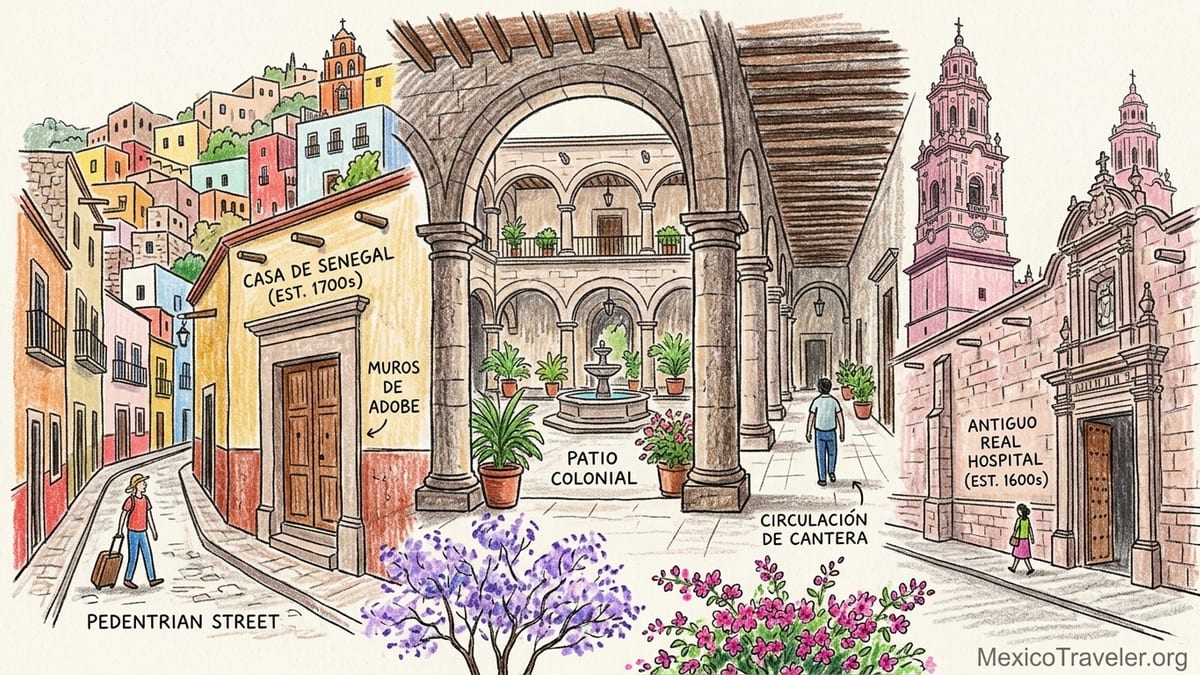
In practice, I look for telltale physical clues. The big one is wall thickness and temperature behavior. Adobe or stone walls that are truly structural tend to keep a room cool through the heat of the day and then release warmth slowly at night, which is very different from modern drywall dressed up with “rustic” finishes. I also pay attention to circulation: original houses and institutional buildings were designed around patios, with rooms opening inward. Hotels built from scratch often mimic the patio visually but rely on modern corridors and back-of-house systems that feel like any contemporary property.
The third clue is compromise. Real heritage buildings force compromises because there’s only so much you can change without erasing what makes them historic. If a hotel claims to be in an 18th-century mansion but has perfectly uniform room shapes, wide elevator cores, and identical bathroom layouts, I get suspicious. In the places below, the quirks are part of the proof.
Guanajuato: The 1700s House Where the Walls Do the Climate Control
Guanajuato is the city where I most feel the protective, insulating logic of old construction. My most memorable stay for that sensation was at Antigua Casa del Limón, a property described as a colonial building dating to the 1700s, built with thick adobe walls using original techniques. That detail mattered the moment I walked in. The street outside was lively, but inside, the air felt calmer and noticeably more stable, like the building was buffering the city rather than just separating me from it.
The experience here was about texture and weight: doors that felt heavier than modern interior doors, floors that were cool underfoot, and a layout that prioritized inward-facing privacy. Guanajuato’s center is famously walkable and often car-restricted, and staying in a pedestrian area adds to the historical immersion but also creates a modern inconvenience: arrival logistics. I planned for a short roll with luggage and accepted that the last stretch would be on foot, the way a resident would have approached a house long before valet parking existed.
What felt genuinely historic was the way the building handled light. In older houses, daylight tends to arrive from above and from the patio, not from giant street-facing windows. In the morning, the brightness changes as it falls into the courtyard and then filters into rooms indirectly, making the interior feel private and thick-walled rather than “open plan.” What did not feel historic was any overly curated “museum corner” styling, which is common in smaller properties: a few period-look objects arranged to suggest a colonial past. The structure did the convincing, not the décor.
Practical realities: older buildings in Guanajuato often mean stairs and uneven steps, and that affects accessibility. Bathroom design can also be a patchwork because modern plumbing has to be threaded through old fabric. When I’m choosing a truly old building here, I prioritize location and atmosphere, then I confirm whether my room is on an upper floor and whether there is any help offered for bags. I also check current rates before booking because pricing can swing widely by season. Around early September 2026, publicly listed rates for Antigua Casa del Limón showed a low end around the mid-double-digits in U.S. dollars on some dates, which is a reminder that “historic” does not always mean expensive, especially in smaller, independently run properties.
Morelia: Sleeping in a Former Hospital at Hotel Los Juaninos
Morelia is one of Mexico’s great cities for pink-stone architecture and formal historic urbanism, and it also has some of the most compelling conversions because the city center has long been filled with large institutional buildings. Hotel Los Juaninos is the stay that delivered the most literal sense of history to me. The building is tied to the Antiguo Real Hospital de San Juan de Dios, widely described as dating to the 17th century, and the hotel’s own account situates the structure in that period and notes its later transformation and modern hotel inauguration in the late 1990s.
Walking into Los Juaninos, I felt the difference between a mansion conversion and an institutional one. Former hospitals and religious complexes tend to have a seriousness in their proportions: larger courtyards, longer stone corridors, and stairs that prioritize durability over comfort. At night, the soundscape did the rest. Morelia’s cathedral is close, and the city’s center carries sound in a way that makes bells and footsteps feel part of the architecture. When the courtyard quieted down, the building did not feel like a theme, it felt like a structure that had simply been reoccupied.
Where the authenticity was strongest: the courtyards and the stone circulation. The patios feel like the building’s lungs, designed for light and air before modern HVAC. Stone stairs and thick masonry give you that tactile “this has been here a long time” reality. Where the modern hotel layer showed: in the finishing choices. Some decorative elements in properties like this can lean romantic, even theatrical, and that’s where I separate atmosphere from authenticity. If I can imagine removing the furniture and still believing the building is historic, then it passes my test.
Practical issues were real. Accessibility is the big one. A 17th-century footprint rarely accommodates elevators gracefully, and even when one exists, it may not reach every level or every wing. Bathrooms can be compact because you’re inserting showers and modern fixtures into spaces never intended for them. Parking is also the constant negotiation in historic centers: if you arrive with a car, you may rely on nearby lots or hotel assistance rather than expecting an on-site garage. Price-wise, I have seen Los Juaninos fluctuate like a true city-center boutique hotel; around September 2026, publicly listed rates showed nights around the low-to-mid hundreds in U.S. dollars on certain dates, with discounts sometimes advertised for specific stay windows. The key is to treat the nightly rate like a moving target and book when the value matches the experience you want.
Morelia Again: Hotel de la Soledad and the Courtyard You Feel After Dark
Hotel de la Soledad is the Morelia stay I recommend when travelers want “old-building romance” but also want the polish of a long-running hospitality operation. The hotel’s own history materials describe its earliest data points as dating to the early 18th century, and other documentation references the property’s long life under different names and renovations. Regardless of which specific year you anchor to, the impression is consistent: this is not a replica. It is a building with a long timeline that has been repeatedly adapted.
My strongest memory is the courtyard atmosphere at night. This is the classic colonial-hotel pleasure: you step out of your room into a central patio, and the stone seems to soften the sound. In a good courtyard hotel, the natural light story continues into evening: lantern glow, reflections in tile, and the way plants look against old masonry. The building’s old layout means you are constantly moving between open-air and enclosed spaces, which makes you feel the climate in a way modern sealed hotels do not.
What felt genuinely historic was the choreography of thresholds: wooden doors, heavy frames, the slight temperature shift when you pass from a sunlit patio into a shaded corridor. What felt modern was the inevitable overlay of comfort: updated bedding, curated art, and contemporary lighting solutions that have to be added because the original building was not designed for today’s expectations of brightness. This is not a criticism. It is the reality of conversion done responsibly, and the best heritage hotels are honest about it in how they integrate the new.
Practical realities: like many historic-center stays, parking is a consideration, and accessibility can be limited by stairs and uneven surfaces. Heating and cooling can also be variable. Thick walls help, but in shoulder seasons you might feel cooler interiors in the morning, and in the heat you may rely on room units rather than the kind of central system you’d find in a modern tower. Rate-wise, I’ve seen it listed around the high hundreds of U.S. dollars on some peak dates, but also much lower on deal windows and third-party promotions. If you’re sensitive to noise, I recommend requesting a room positioned away from any active social areas, because courtyards are beautiful but they can amplify conversations depending on the geometry.
San Miguel de Allende: Belmond Casa de Sierra Nevada, Six Casonas and Five Centuries of Layers
San Miguel de Allende is the city where the “historic mansion market” is so strong that it can blur into aesthetic performance. That’s exactly why I gravitate to a property with clear, specific claims about its structures, and then I sanity-check those claims. Belmond Casa de Sierra Nevada is spread across multiple heritage houses, and Belmond describes the complex as including a 16th-century Casa Principal (once home to an archbishop) and a 17th-century Casa Parque associated with a former fort, among other historic casonas. Other widely cited summaries also describe the hotel as composed of six colonial mansions with elements dating across centuries.
Staying here feels like inhabiting the city rather than visiting it. That is partly because the property is not one big sealed hotel building. You move between courtyards and different houses, and the shifts in texture and scale are the point. In one wing, I remember stone floors and a sense of coolness; in another, the light felt softer and more domestic. The best moment, for me, was early morning: doors open to a courtyard, natural light arriving from above, and the sound of San Miguel waking up in the distance.
What felt genuinely historic was the irregularity. Room-to-room, the architecture changes, and that’s what happens when you’re dealing with multiple old houses rather than a single planned build. The walls and courtyards are not just “design.” They are the framework. What can feel more modern is any layer that leans too perfectly “colonial,” such as brand-new-looking distressed finishes or overly coordinated decorative motifs. In San Miguel, especially, some properties can fall into a curated look that photographs beautifully but feels less convincing in person. At Casa de Sierra Nevada, I felt the difference most clearly when I focused on the structure: the thickness of openings, the sense of enclosure, and the way the building deals with sun and shade.
Practical issues: accessibility is difficult here, and not just because of the hotel. San Miguel’s historic center is famously cobbled and sloped, and the multi-building layout adds more steps and thresholds. If you need an elevator to reach every room, you should ask detailed questions before booking. Air conditioning can vary by room category, and the multi-casa layout means not every space behaves the same thermally. Pricing is also in a different tier than many boutique conversions. Around late summer 2026, publicly visible deal listings placed Casa de Sierra Nevada in the several-hundred-U.S.-dollars range for some nights, with averages higher on many dates. In other words: you are paying for a brand-level service layer on top of historic fabric, and whether that is worth it depends on how much you value quiet courtyards and architectural atmosphere over modern uniformity.
How I Compare Atmosphere vs. Convenience (And What I Book Depending on My Trip)
When I choose a historic hotel in Colonial Mexico, I decide first what kind of trip I’m on. If I’m traveling for pure atmosphere and walking-city immersion, I accept the compromises: stairs, small bathrooms, tricky parking, and occasional room temperature quirks. That’s when I pick the properties where the building itself is the main attraction, like a thick-walled house in Guanajuato’s center or an institutional conversion in Morelia that still reads as what it once was.
If I’m traveling with heavy luggage, limited mobility, or a need for consistent climate control, I get more selective. Historic fabric can fight you: narrow doors, steep stone stairs, and bathrooms that had to be inserted wherever space could be found. In a truly old building, even the best renovation may not produce a perfect “modern hotel” bathroom. You might get a beautiful tiled space with a shower that has a partial glass screen instead of a fully sealed enclosure, or a vanity tucked into an odd corner because plumbing routes were limited. That is part of the deal, and I would rather know it going in than feel disappointed at check-in.
I also compare how “historic” the experience feels after the novelty wears off. Some hotels impress in the lobby and then feel generic in the room. The stays I keep returning to are the ones where the nightly experience remains anchored in the architecture: a courtyard that changes with the sun, doors and stairs that remind you of the building’s age, and a layout that makes you adapt your habits slightly. That adaptation is exactly what makes the stay memorable.
Finally, I watch for the line between authenticity and performance. A few antique-looking pieces and a palette of terracotta and cobalt do not make a building historic. In the best heritage conversions, the decoration is secondary. The real signal is structural: thick walls, older proportions, inward courtyards, and the honest constraints of a building that has survived because it was reused, not replaced.
The Takeaway
Colonial Mexico has no shortage of hotels that photograph “old,” but the most rewarding stays are the ones where the building itself carries the history, even when that history complicates modern comfort. In Guanajuato, I loved the sensation of thick, climate-managing walls and pedestrian-center living. In Morelia, I felt the gravity of stone courtyards and institutional scale at Los Juaninos, and I felt the polished romance of a long-adapted historic property at Hotel de la Soledad. In San Miguel, Casa de Sierra Nevada delivered a multi-casa experience that made the city feel less like a destination and more like a lived-in place.
If you want perfect accessibility, uniform room layouts, and predictable bathroom design, you can find that in modern builds across Mexico. But if you want the deeper travel pleasure of sleeping inside real architecture that has watched centuries pass, these are the stays that made me slow down, listen to the bells, feel the light move across stone, and accept a few inconveniences as the price of authenticity.
FAQ
Q1. How can I tell if a “colonial” hotel is actually historic?
Look for verifiable building history and structural clues like thick masonry walls, inward courtyards, irregular layouts, and stairworn stone. If it feels too uniform, it may be a modern build with themed décor.
Q2. Which city is best for truly historic hotel stays: Guanajuato, Morelia, or San Miguel?
Morelia offers some of the most convincing large-scale historic conversions, Guanajuato delivers the strongest old-house feel, and San Miguel has the deepest market for mansion-style luxury in historic settings.
Q3. Are historic hotels in Colonial Mexico usually walkable to major sights?
Often, yes. Many are in historic centers near plazas, churches, and museums, but that can also mean limited car access, pedestrian-only streets, and complicated drop-offs.
Q4. Do these historic buildings usually have elevators?
Not reliably. Some may have limited elevator access, but many genuine heritage buildings rely on stairs, split levels, and narrow passageways. Always confirm if step-free access is essential.
Q5. What are the most common bathroom compromises in heritage conversions?
Smaller bathrooms, tight shower layouts, unusual sink placement, and limited counter space are common because modern plumbing must fit within older room shapes and protected structures.
Q6. Will I get air conditioning and heating in truly old buildings?
It varies by property and room. Thick walls help with temperature stability, but you may still rely on room units or partial systems rather than fully centralized climate control.
Q7. Is parking difficult at historic hotels in these cities?
Frequently. Historic centers may have narrow streets, restricted zones, or no on-site garage. Some hotels coordinate nearby lots or assisted parking, but it’s best to plan ahead.
Q8. Are historic hotels always expensive?
No. Some smaller historic properties can be surprisingly affordable on certain dates, while heritage-luxury brands in San Miguel can run several hundred dollars per night or more depending on season.
Q9. What should I request when booking a room in a historic building?
If you’re noise-sensitive, ask for a room away from social courtyards. If stairs are an issue, request the lowest floor available and confirm the exact number of steps from entrance to room.
Q10. What’s the biggest difference between “genuinely historic” and “colonial-style” hotels?
Genuinely historic hotels make you feel the past through structure and layout. Colonial-style hotels rely more on decorative signals like tiles, beams, and antiques, even when the building itself is modern.