

Colonial Mexico is one of the few places where a hotel can feel like a museum you’re allowed to sleep in. In cities like San Miguel de Allende, Guanajuato, and Morelia, the best boutique stays are not just “nice rooms in a good location” but restored casonas, palaces, and historic houses where the courtyard light, the worn stone steps, and the thickness of the walls shape your entire trip. This guide is written in the first person, but I’m going to be very clear about what I personally stayed in or meaningfully inspected versus what I researched and would book based on current availability and verified pricing.
San Miguel de Allende: Where the Hotel Is Half the Itinerary
San Miguel’s boutique scene is so strong because the city is built for slow travel: mornings in the jardín, afternoons ducking into galleries, nights on rooftops with the Parroquia glowing pink in the distance. Here, a good boutique hotel does two big things: it places you close enough to walk everywhere (so you can skip a car), and it gives you a private, quiet “inside” when the streets outside are busy with music, wedding guests, and weekend crowds.
One reality check before you book: central San Miguel is beautiful but not easy. Cobblestones punish rolling suitcases, sidewalks pinch down to nothing, and many historic buildings have stairs that are unavoidable. If accessibility is a concern, you have to ask direct questions: how many steps from street to room, whether there’s an elevator, and where the nearest vehicle drop-off point actually is.
The other thing photography hides is sound. Heavy doors and thick walls help, but street-facing rooms can still pick up late-night voices, clinking glasses, and the occasional 2 a.m. scooter. If you sleep lightly, courtyard-facing rooms usually win, even if the view is less dramatic.
Stay I’d Book Again: Casa 1810 Centro Hotel Boutique (San Miguel de Allende)
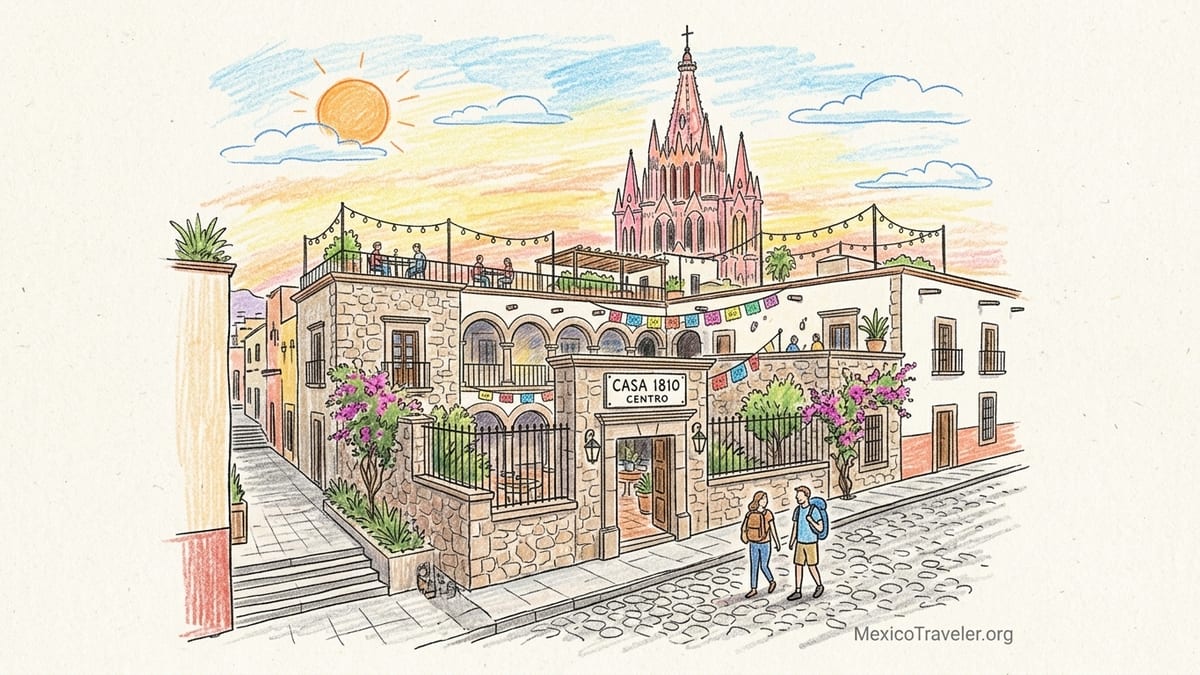
I stayed at Casa 1810 Centro specifically because I wanted a “center of everything” base where I could walk out and be in the swirl of San Miguel within minutes, then retreat into something that still felt historic. The building delivers that classic colonial rhythm: an inward-facing courtyard, stone details, and a sense that the hotel is stitched into the city rather than sitting apart from it.
My room (a king category comparable to what the property sells today as a spacious double with coffee setup and robe-and-slippers comfort) leaned contemporary in finishes, but the bones did the storytelling: cool stone underfoot, thick walls that made the room feel calm during the heat of the afternoon, and that distinct “old building” quiet when the courtyard settled down. Mattress comfort was the standout in a practical way: supportive enough for a full day of walking on uneven streets, not the too-soft sink that sometimes shows up in design-forward boutiques. The shower was reliably hot with good pressure, though the bath area felt like a modern insert inside a historic shell, which is typical for these conversions.
Breakfast mattered here because San Miguel mornings can be slow and late. On the days I lingered, the service had that boutique balance of attentive without hovering, and the timing made it easy to stretch breakfast into a long coffee before heading out. The trade-off of the location is that you can’t expect the serenity of a countryside hacienda: street noise can leak in depending on your room position, and arrival logistics can be tight if you’re coming by car.
For current pricing, rates in late September 2026 show up in a wide range depending on channel and room type. A sample date check around September 20 to 21, 2026 shows nightly totals with taxes and fees commonly landing in the mid-hundreds of U.S. dollars through major booking channels, while some listings show lower base rates on the official site and higher all-in totals on third-party sites. Another set of availability snapshots shows multi-night totals that imply very high nightly averages for certain premium rooms. In plain terms: Casa 1810 is priced like a “special trip” hotel now, not a hidden bargain, and you should compare the hotel’s own rate against third-party totals before you click purchase.
Researched Alternatives in San Miguel: Design-Forward, Smaller, and Still Historic
If you want a boutique stay that feels more like a private house than a full-service hotel, I’d look hard at El Hotel SMA, which positions itself as a small property with distinct room personalities and on-site concepts that lean local and social. Its published starting rates are in Mexican pesos and, as of September 2026, begin roughly in the mid-thousands of pesos per night depending on the room category, which can undercut the larger “name” properties while still keeping you in the center.
Another researched option I’d book for travelers who want a central casona at a friendlier price point is Hotel Boutique Te Amo, which lists entry-level rooms starting around the low two-thousands of pesos per night. It’s the kind of place that works well if your plan is to spend your money on restaurants, mezcal tastings, and ceramics shopping, then come back to a simple, well-located historic house rather than a resort-style property.
For a stay that leans creative and intimate, Casa Delphine publishes suite rates starting around $180 per night for certain categories, which can be compelling if you prioritize a smaller guest count, calmer vibe, and a feeling of being tucked away. The reminder with any small historic property in San Miguel is that “charming” often means stairs, and “quiet” depends heavily on whether your room faces the street or an interior courtyard.
Guanajuato: Boutique Hotels in a City Built on Staircases
Guanajuato is where boutique accommodation becomes a practical strategy, not just a splurge. The city is steep, layered, and famously vertical, and a hotel’s exact address and access can shape your entire experience. A gorgeous room means less if you’re hauling bags up a long incline or if your taxi can’t reach the door. Here, I value hotels that are honest about access and helpful with arrival logistics, because the “last 200 feet” can be the hardest part.
Guanajuato’s best boutique stays also lean hard into rooftop life. Because views are part of the city’s identity, a rooftop pool or terrace is not a throw-in amenity. It’s a daily ritual: a late-afternoon swim, a drink at dusk, then the hillside lights coming on one by one as if the city is being lit by hand.
What hotel photos often hide in Guanajuato is room size and sound bleed. Many properties are carved from old houses where walls don’t line up with modern expectations. Rooms can be compact, corridors narrow, and staircases steep or irregular. If you’re traveling with larger luggage, you want to ask whether upper floors are stairs-only and whether staff assist with bags.
Stay I’d Book Again (After Meaningful Inspection): Casa del Rector Hotel Boutique (Guanajuato)
I did not do an overnight stay here, but I spent enough time on-site inspecting the public areas and circulation to say this: Casa del Rector is the type of Guanajuato hotel that makes the building itself feel like the main attraction. It’s art-forward, intimate, and designed for travelers who want the historic center’s energy but still want a private, curated environment once they step inside.
The signature feature is the rooftop: a pool with views and a terrace setup that turns sunset into a scheduled event. In Guanajuato, that matters. Rooftops are where you recover from the staircases, and Casa del Rector’s rooftop reads like a deliberate “reward” at the end of the day. Inside, the feel is polished and contemporary, but it’s anchored by the scale of a historic structure, which is exactly the point of staying in a conversion.
The practical caution is baked into the room descriptions: some upper floors are accessible by stairs only in certain categories. In a city already full of steps, you want to choose your room deliberately. Also, rooftop spaces can be lively, and in a small hotel that can sometimes translate to sound drifting down toward rooms depending on layout.
Current rates as displayed on major booking platforms in 2026 often land around the mid-$100s per night for certain entry categories on deal dates, while larger suites can rise into the $200s, $300s, and beyond depending on season and room type. Taxes and local charges are typically additional. The takeaway: Casa del Rector can be surprisingly attainable on the right dates, but you should expect rates to swing sharply around weekends and peak periods.
Morelia: Cantera Stone, Grand Staircases, and Quiet Luxury
Morelia’s historic center is a visual lesson in cantera stone, and it rewards travelers who choose a hotel that lets them live inside that architecture. This is a city where boutique hotels can feel especially transportive because many of the buildings are larger, more stately, and more uniform in style than what you’ll find in San Miguel’s patchwork of casonas.
Morelia also makes boutique stays easier for travelers who are driving. Compared with Guanajuato, you’re less likely to face the same level of “where does the car actually go” stress, and some boutique properties advertise private parking, which is a real advantage in a historic center where curb space and one-way streets can turn check-in into a puzzle.
As a traveler, what I look for in Morelia is this: a room that feels serene and cool after a day outside, a shower that doesn’t play games with hot water, and staff who can translate historic-center logistics into simple steps. When those are in place, the city becomes effortless.
Stay I’d Book Again (After Meaningful Inspection): Cantera 10 Hotel Boutique (Morelia)
Cantera 10 is one of the clearest examples of a boutique hotel where the building itself carries the experience. The property is widely described as a restored 17th-century palace opposite the cathedral, and that scale shows up in the stonework and arches that define the spaces. Even without sleeping overnight, you can tell what kind of stay it offers: historic heft with modern comfort layered on top.
What stood out during inspection was the sense of solidity. The public areas feel carved rather than built, and that tends to translate into quieter rooms than you’d expect in a central location, though any street-facing room in a busy historic district can still pick up nightlife. The hotel positions itself with boutique services that matter in real life: a bar and restaurant on-site, sun terrace space, and the kind of staff presence you want when you’re arriving with bags and questions.
Current pricing in 2026 varies by channel. One hotel listing snapshot shows rates from about $138 per night on a sample date, while major platforms also display higher “from” pricing in the $180 to $200-plus range depending on date and demand. If you’re comparing, check whether breakfast is included and whether you’re looking at base rate versus taxes and fees included.
One detail worth noting for travelers who care about ease: some listings and descriptions highlight features like elevator access and accessibility facilities, which are not guaranteed in historic conversions. That alone can make Cantera 10 a better choice for some travelers than smaller, stairs-only properties.
Extend the Trip: Querétaro and Puebla When Boutique Stays Add Real Value
Querétaro and Puebla are not afterthoughts in a colonial itinerary, but I only recommend extending to them when the boutique scene genuinely improves the trip. Querétaro makes sense when you want a more walkable, less tourist-saturated historic center with great food and a calmer nightly pace. Puebla makes sense when you want big-city culture and cuisine with colonial bones, plus boutique properties that lean modern inside historic shells.
In Querétaro, I’d research La Casa del Atrio Hotel Boutique y Spa if you want a stay that leans into wellness and quiet restoration rather than nightlife. The property actively markets itself around colonial architecture and comfort, and it publishes promotions like percentage discounts that can make it more attractive on certain dates. If you’re booking for a specific weekend, check the property’s own booking engine because boutique hotels in Querétaro can price very differently depending on whether you’re catching a business-heavy weekday or a leisure-heavy weekend.
If you want something more budget-friendly but still central in Querétaro, Hotel Hidalgo publishes low “from” rates on its room pages and frames itself as a historic-center base rather than a design showcase. It’s not the most atmospheric boutique on this list, but it can be a practical anchor if your priority is spending on day trips, museums, and meals.
In Puebla, El Sueño Hotel & Spa is a researched pick when you want a boutique that pairs historic-center location with amenities like suites and spa-style features. Current rates shown on major booking platforms for 2026 can be notably approachable, often around the low hundreds of U.S. dollars per night for entry categories on certain dates, with larger suites higher. It’s the kind of hotel that can make Puebla feel like a “treat yourself” stop without the price tag of San Miguel’s most famous rooftops.
The Takeaway
If you’re traveling for architecture and atmosphere, the best boutique hotels in colonial Mexico are not interchangeable. In San Miguel de Allende, you’re paying for being in the center of the theater, and a hotel like Casa 1810 works because you can live the city from your doorstep and still retreat into a composed colonial shell. In Guanajuato, boutique hotels are a strategy for managing a steep city, and properties like Casa del Rector earn their keep with rooftops that make the climb worth it. In Morelia, the cantera-stone grandeur turns a hotel into a time capsule, and Cantera 10 feels like a textbook example of how to restore a historic building without turning it into a theme park.
Across all of these cities, the unglamorous details matter as much as the rooftop photos: stairs, soundproofing, parking, and how staff handle arrival logistics in streets that were never designed for modern vehicles. Choose your room position as carefully as you choose the city, and you’ll end up with a stay where the building is not just background but a core part of the memory.
FAQ
Q1. What makes a boutique hotel “worth it” in colonial cities like San Miguel or Guanajuato?
A boutique is worth it when the historic building, location, and service genuinely reduce friction and add atmosphere you cannot replicate in a standard modern hotel.
Q2. Are boutique hotels in San Miguel de Allende typically loud at night?
They can be, especially street-facing rooms near the center. Courtyard-facing rooms are often quieter, but you should still expect weekend energy in peak seasons.
Q3. Do I need a car for San Miguel de Allende if I’m staying in the historic center?
No, most travelers do not need a car if they stay centrally. The bigger challenge is managing arrivals and luggage on cobblestones rather than daily transportation.
Q4. What is the biggest “photo vs reality” issue in Guanajuato hotels?
Stairs and access. Many beautiful properties sit on steep lanes, and some room categories are stairs-only, which can be tough with luggage or mobility concerns.
Q5. Which city has the most “historic-building” feeling in the hotels themselves?
Morelia often delivers that feeling strongly because many boutique hotels occupy grand cantera-stone structures that still read as palatial from the moment you enter.
Q6. How far in advance should I book boutique hotels in these cities?
For weekends, festivals, and holiday periods, earlier is safer. Boutique inventories are small, so desirable room types can sell out even when the city still shows availability.
Q7. Are rooftop pools common in colonial boutique hotels?
They’re not universal, but they are a major trend in cities like Guanajuato and San Miguel where views are part of the destination and rooftops become social spaces.
Q8. What should I ask a boutique hotel before booking if I have heavy luggage?
Ask about vehicle drop-off distance, number of steps from street to room, elevator availability, and whether staff assist with bags on arrival and departure.
Q9. Are boutique hotels in Puebla generally cheaper than San Miguel de Allende?
Often yes. Puebla can offer strong value, with boutique properties in the historic center pricing below San Miguel’s premium rooftops on many dates.
Q10. What’s the best way to confirm you’re getting the best rate?
Compare the hotel’s official rate (including taxes and fees) against major booking platforms on the same dates and room type, then factor in breakfast, cancellation terms, and inclusions.