


I’ve crossed from Playa del Carmen to Cozumel more than once, but this particular trip sticks with me because it was the one where I did everything “like a normal traveler” instead of overplanning. I walked to the pier with a small roller bag, bought my ticket at the window, watched two ferry companies leapfrog departures, and learned exactly where the pain points are: the timing, the boarding funnel, the wind on the top deck, and the moment you step off in Cozumel and realize you still have to solve transportation. Here’s how my journey played out in real-world detail and what I’d do differently next time, along with the latest published fares, rules, and ticket conditions you should know before you go.
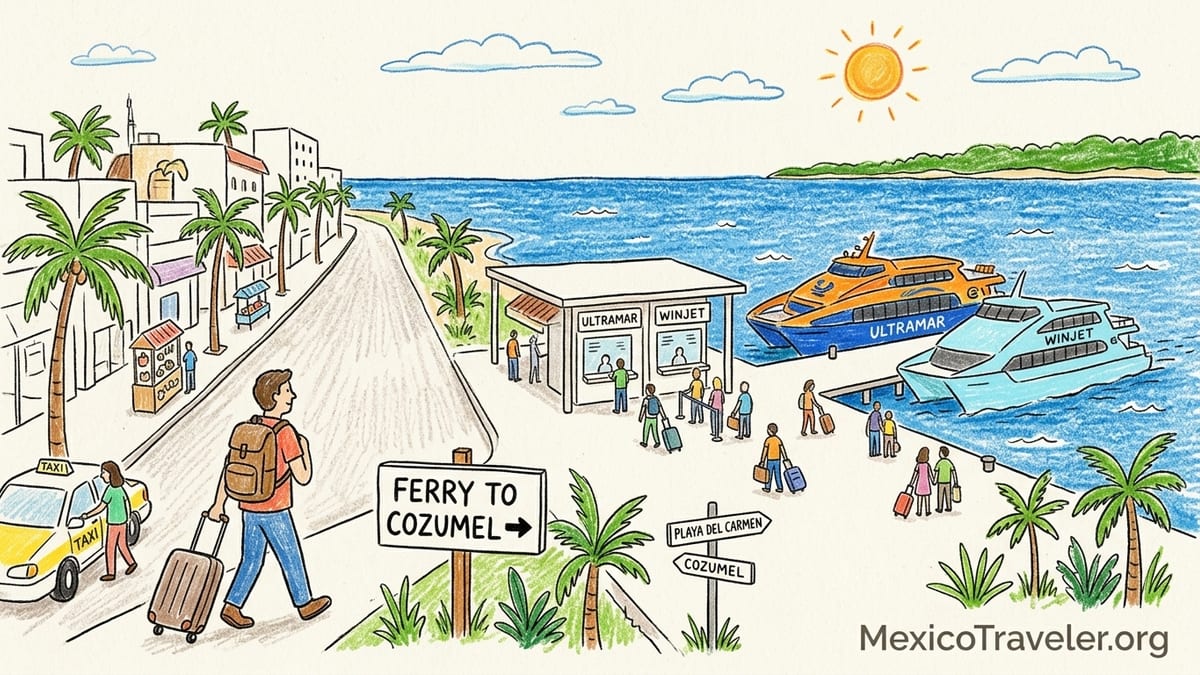
Getting to the Pier in Playa del Carmen: The Walk, the Taxi Drop-Off, and the One Turn That Matters
I started in central Playa del Carmen, the kind of location most travelers end up in: a small hotel a few blocks inland from Fifth Avenue. The ferry piers sit at the end of Avenida Benito Juárez, where the street runs straight to the water. That last stretch is the whole story. If you’re on foot, you’re moving through a busy tourist corridor with souvenir shops, beach clubs, and people funneling toward the shoreline.
I walked, but I watched plenty of travelers arrive by taxi. The easiest instruction to give a driver is simply “el muelle a Cozumel, Benito Juárez,” and you want to be dropped near the pier entrance, not somewhere random on Fifth Avenue where you’ll be dragging luggage through crowds. If you’re carrying a roller bag, the sidewalks are doable but uneven in spots, and you’ll feel every curb cut. If I had a heavier suitcase next time, I’d take a short taxi ride even from nearby just to avoid arriving sweaty, rushed, and annoyed.
The moment that matters is when you get close enough to see the ferry signage and the entrance flow. The area can look chaotic at first: multiple ticket counters, multiple lines, security-style checks, and travelers trying to decide which departure is “the next one.” My first tip is mental, not logistical: don’t join the first line you see until you confirm which company it belongs to and what time it’s actually boarding.
Ticket Purchase in Real Time: What I Bought, What the Fine Print Means, and What It Cost
I bought my ticket at the terminal window rather than online. It’s fast when there isn’t a big surge of day-trippers, and it’s reassuring to have a staff member point to the next departure time on the board. On this route, the big name most visitors recognize is Ultramar, which publishes Playa del Carmen to Cozumel fares online. As of the latest published fare table, Ultramar lists a Premium Plus adult ticket at 320 MXN one-way and 640 MXN round-trip, with child pricing lower. Ultramar also publishes resident and local plans with lower prices for qualifying travelers with identification, but most tourists pay the regular adult fare.
One detail people miss: your ferry ticket and your “I’m actually getting on a boat right now” access aren’t always the same thing. You still have to make the departure time, get through the boarding funnel, and comply with whatever local terminal procedures are in place. Ultramar’s own conditions emphasize three points that affect real trips: passengers should arrive about 30 minutes before departure, tickets are non-refundable, and tickets are valid for six months from the purchase date on any available departure for the route. That combination is convenient if your plans change, but it also means you should treat the ticket like a flexible voucher, not a reservation that guarantees you a specific seat.
Because I was traveling with a small roller bag, I paid attention to baggage rules. Ultramar publishes a baggage allowance of one piece up to 25 kg, with a maximum combined dimension limit. That matters if you’re trying to do an airport-style suitcase plus an oversized beach tote plus a snorkel bag. I was fine, but if I were doing a longer stay with heavier gear, I’d pack so everything clearly looks like “one main bag plus a personal item” instead of multiple awkward pieces that invite questions at the gate.
Two Companies, Competing Departures: How I Chose the Next Boat Instead of the “Best” Boat
At the Playa del Carmen pier area, what you feel first is not romance, it’s options. Depending on the day, you’ll see more than one operator selling tickets for the same crossing. That can be confusing if you assume “there is one ferry.” In my case, I walked up expecting to buy the most recognizable brand, then realized another company was advertising departures as well. The practical reality is that travelers often pick the next departure that fits their day, not necessarily the brand they read about in advance.
Winjet, for example, publishes its own rates online and notes an additional sanitation fee that applies to departures from Playa del Carmen. Its published regular adult fare shows different pricing depending on the direction of travel, with Playa del Carmen departures priced higher in MXN than Cozumel departures and a round-trip price also listed. That sanitation note is the kind of small print you want to notice before you’re at the counter doing mental math with a line behind you.
Here’s what I did in the moment: I looked at the posted departure times at the counters, asked which boat was boarding soonest, and bought the ticket that matched the departure that would get me to Cozumel in time for my plans. I wasn’t trying to win the “best seat on the best boat” contest. I was trying to protect my day. If I were doing this again, I’d still choose based on timing, but I’d factor in comfort more deliberately if the sea looked rough, because where you sit matters on choppy crossings.
Boarding, Seating, and Luggage: The Funnel, the Photo Moment, and Where I Sat (and Why)
Boarding is a process, not a single event. In Playa del Carmen, I experienced it as a series of small chokepoints: show the ticket, move into a waiting area, watch the crowd compress as boarding is called, then walk down toward the vessel. This is why the “arrive 30 minutes early” rule matters in practice. It’s not just about being polite. It’s about giving yourself enough buffer to find the right line, buy the right ticket, and still be in position when boarding starts.
With my roller bag, I kept it close and learned quickly that wheels don’t love every surface in the terminal area. Once on board, the luggage part was straightforward. I didn’t have to check it like airline baggage, but I also didn’t want to be the person blocking the aisle while trying to wedge a suitcase in a tight space. I chose a seat where I could keep the bag in front of me without turning the row into an obstacle course.
Seating came down to a simple tradeoff: indoor air-conditioning versus outdoor breeze. I started indoors because it was hot and I wanted the stable feeling of being centered in the boat. But once we were underway, I stepped outside for the view and immediately felt the wind and spray. Outside is where the crossing looks like a postcard. Outside is also where you discover how strong the breeze can be and how quickly a calm-looking sea can translate into a rocking deck. If you’re even mildly prone to motion sickness, I’d pick an indoor seat near the middle of the vessel and commit to short outdoor visits rather than camping on the top deck the whole way.
The Crossing Itself: Rough Water, Seasickness Strategy, and What 40 Minutes Actually Feels Like
The crossing is often described as “about 40 to 45 minutes,” and that’s a helpful baseline, but it’s not the whole story. The real time cost includes walking to the pier, buying tickets, waiting for boarding, the actual voyage, and then disembarking into Cozumel’s terminal flow. On my trip, the sailing time felt fast once we were moving, but the overall experience from “I leave my hotel” to “I’m outside the Cozumel terminal” was a much bigger block than most people budget for mentally.
On the water, conditions can change quickly. I had a crossing that wasn’t scary but definitely bouncy enough to make me glad I hadn’t started with a huge breakfast. The best real-world seasickness strategy I used was simple: stay hydrated, avoid heavy greasy food right before boarding, and keep my eyes on the horizon when I was outside. If you know you get motion-sick, pack what works for you before you reach the pier, because you don’t want your plan to hinge on whether a terminal snack bar has the brand you like.
It’s also worth knowing what “comfort” means on a ferry. You’re not getting a silent, smooth glide like a train. You’re getting engine vibration, announcements, people moving around, and the occasional kid doing laps. The upside is the atmosphere. The moment the mainland recedes and Cozumel becomes a green strip on the horizon is genuinely exciting, especially if you’ve been on the Riviera Maya for days and you’re craving a different pace.
Arriving in Cozumel: Terminal Reality, Getting Into Town, and What I Did Next
The arrival point in Cozumel is close to the island’s main town area, San Miguel de Cozumel, and you feel the shift immediately: the light looks sharper, the air feels saltier, and there’s a different rhythm on the streets. Ultramar lists its Cozumel arrival as the Terminal Marítima San Miguel on Avenida Rafael Melgar, which is essentially the waterfront strip where you’ll see taxis, shops, and travelers reorganizing their plans on the curb.
My first move was not a tour. It was logistics. I stepped out, took a breath, and decided whether I was walking, taking a taxi, or renting something. For a first-time visitor, taxis are the simplest bridge between “I got here” and “I’m actually doing something fun.” The waterfront area is walkable if you’re staying nearby, but if you’re going to a beach club on the far side or heading to a specific snorkeling operator, you’ll want a clear plan and enough time buffer that you’re not negotiating transportation under pressure.
On this trip, I stayed overnight. That was intentional, and it changed everything. A day trip can be fantastic, but it’s ruled by the last return ferry. Staying overnight meant I could arrive, check into a small hotel in town, eat without watching the clock, and plan a morning activity the next day without the “ferry countdown” anxiety. If you’re trying to do Cozumel in one day, the ferry timing dictates your island experience more than any guidebook does, because you’ll constantly be doing the math of: “If I go to the other side of the island now, will I make it back in time?”
What I’d Do Differently Next Time: Timing, Comfort, and Planning Around Ferry Rules
First, I would build my entire day around the reality of the terminal rule: arrive about 30 minutes before departure. That single guideline is the difference between a calm coffee and a sprint with a bag. It also protects you if the terminal is unusually busy, if you need to clarify which company’s next boat is boarding, or if you want time to choose seating instead of taking whatever’s left.
Second, I would treat ticket conditions as strategy. Ultramar’s published terms say tickets are non-refundable and valid for six months on available departures, which is helpful if you want flexibility. But it also means you should choose one-way versus round-trip deliberately. If you’re unsure when you’ll return, a one-way gives you more mental freedom, and the six-month validity gives you some cushion if plans change. If you are certain about your return, a round-trip can simplify the “end of day” decision-making when you’re tired, sunburned, and ready to get back to Playa del Carmen.
Third, I would pack for the crossing, not just the destination. That means: a light layer for the air-conditioned cabin, something to secure loose hair and hats on the outdoor deck, and motion-sickness protection if you need it. And if I were traveling with more luggage, I’d taxi to the pier even from close range, because the walk is easy only when you’re unencumbered and unhurried.
Finally, I would be more honest about whether I’m doing a day trip or an overnight. On paper, a day trip looks efficient. In practice, it can feel like you’re racing the return sailing. If you want a relaxed Cozumel experience with snorkeling, a long lunch, and time in town, the overnight is the move. If you’re doing a day trip, pick a morning departure and a return ferry that still leaves you breathing room for disembarkation, taxi time, and the inevitable “wait, where’s the line?” moment at the terminal.
The Takeaway
The Playa del Carmen to Cozumel ferry is straightforward once you accept what it is: a high-demand commuter-style crossing where timing and process matter as much as the boat ride. My journey worked because I chose the departure that protected my day, arrived early enough to move through the boarding funnel calmly, and stayed flexible about where I sat depending on the sea.
If you remember only three things, make them these: arrive about 30 minutes before departure, assume you’ll choose between competing operators based on the next sailing time, and plan your Cozumel transportation in advance so the trip doesn’t end at the terminal curb. Do that, and the ferry stops being a stress point and starts being part of the fun.
FAQ
Q1. How much is the Ultramar ferry from Playa del Carmen to Cozumel right now?
Ultramar’s published Premium Plus adult fare is 320 MXN one-way and 640 MXN round-trip, with lower child fares and separate resident and local plans for qualifying IDs.
Q2. How early should I arrive at the ferry terminal before departure?
Ultramar states passengers should reach the terminal about 30 minutes before departure time to allow for ticket checks and boarding procedures.
Q3. Are Ultramar tickets refundable if my plans change?
No. Ultramar’s published conditions state tickets are non-refundable.
Q4. How long is an Ultramar ticket valid if I don’t use it immediately?
Ultramar states the ticket is valid for six months from the purchase date on any available day and time for the route, subject to availability.
Q5. How much luggage can I bring on Ultramar?
Ultramar publishes an allowance of one piece of luggage up to 25 kg, with a maximum combined dimension limit for that bag.
Q6. Is Winjet usually cheaper than Ultramar?
It depends on the direction and the fare type. Winjet publishes different regular fares depending on whether you depart from Playa del Carmen or from Cozumel, and it notes an added sanitation fee that applies only to Playa del Carmen departures.
Q7. Can I buy tickets at the pier, or do I need to book online?
Many travelers buy at the pier, and operators maintain ticket windows at the terminal, but buying ahead can reduce time in line on busy days.
Q8. Should I sit inside or outside on the ferry?
If the sea looks choppy or you’re prone to motion sickness, sit indoors near the middle of the boat. If conditions are calm, the outdoor deck is great for views, but wind and spray can be strong.
Q9. Is Cozumel doable as a day trip from Playa del Carmen?
Yes, but your itinerary will be ruled by ferry timing. To avoid a rushed day, take a morning departure and plan your return with enough buffer for transport back to the terminal.
Q10. What happens when I arrive in Cozumel, and how do I continue my trip?
Arrivals are near San Miguel de Cozumel along the waterfront area, where taxis are readily available. Decide in advance whether you’re walking to lodging, taking a taxi, or connecting to a tour pickup.