


I’ve done this Caribbean-triangle the way most travelers actually do it: I flew into Cancún, I tried a classic Riviera Maya resort corridor stay, and I finished with a few days in Tulum because everyone I met said, “You have to see it.” What surprised me is how quickly my priorities shifted once I had sand in my shoes and a transfer receipt in my pocket. The differences aren’t abstract. They show up in the first 30 minutes after landing, in whether you can grab tacos without negotiating a ride, in how often you smell sargassum before you see the sea, and in the moment you realize you are either free to explore or effectively committed to your resort.
The Transfer Reality Check: What Happened the Moment I Landed
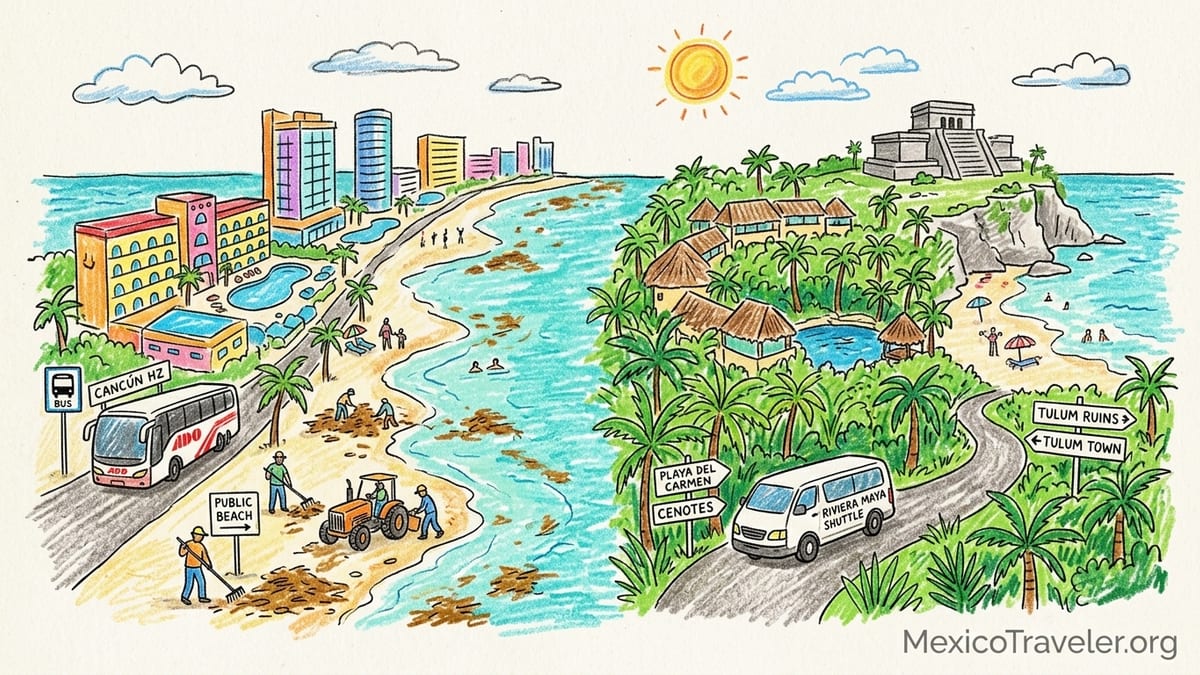
Cancún felt like the easiest win the second I cleared arrivals. Even when the airport is hectic, the logistics are mature: multiple terminals, constant transport options, and a hotel zone that’s basically designed to absorb travelers at scale. On my first trip, I used ADO because I wanted to avoid the transfer upsell circus. Buying the ticket at the airport was straightforward, and the big takeaway was this: the bus isn’t romantic, but it is predictable. When I rolled into the Hotel Zone stop near Punta Cancún, I was already among resorts, pharmacies, mini-marts, and people walking around with wristbands on.
Riviera Maya was the first time I understood that “close to Cancún” doesn’t always mean “easy.” The corridor is long, and resorts are scattered behind jungle buffers, gated driveways, and frontage roads off Highway 307. My transfer time was not just about distance; it was about the last-mile problem. A bus can get you to Playa del Carmen or the highway, but then you still need a taxi, hotel shuttle, or prearranged ride into a property that may be set back in the trees. That extra step changed the feel of the whole trip because it made me plan everything around moving in and out.
Tulum was the biggest fork-in-the-road decision. If you land at Cancún (still the common choice because flight inventory is broader), you’re staring at a longer ride south. If you land at the newer Tulum airport, the transfer to town is shorter, but the ground-transport rhythm is still evolving. The moment that altered my preference happened on a late arrival: I realized how much I value “arrival comfort.” Cancún gave me immediate structure. Tulum gave me a sense that I needed to have my plan locked before I touched down.
Beaches and Sargassum: The Days the Water Smelled Different
I used to treat sargassum talk like travel forum noise, and then I hit a morning when the shoreline was brown enough that the sea stopped looking like the photos. What I noticed across my stays is that the experience isn’t just “is there seaweed.” It’s also how quickly it gets cleared and whether you have an alternative beach day that doesn’t require a full relocation.
In Cancún, the high-density model actually helped me. There are more crews, more visible beach management, and more places where you can simply walk 10 minutes and see different conditions. On one visit, my resort beach wasn’t great early in the day, so I took a quick ride to Playa Delfines for a reset. The sand felt wider, the public beach infrastructure was better than I expected, and the simple ability to pivot without losing a whole day made Cancún feel safer as a booking choice.
Riviera Maya was the most variable. One morning near Playa del Carmen, the beach looked fine at breakfast and felt fully changed by lunch. The corridor geography means you can have a resort that looks “beachfront” on a map, but still feel stuck if sargassum is heavy because leaving takes planning. The best day I had here was the day I didn’t insist on the ocean at all. I booked a cenote day and came back late, salty and tired from swimming in fresh water instead of staring at a compromised shoreline.
Tulum was the most emotional about it, because the contrast is sharper: when it’s pristine, it’s the Caribbean postcard. When it’s not, it’s impossible to ignore because so much of the town’s identity is tied to the beach strip. The specific moment that changed my preference was a beach-club afternoon where the vibe was perfect but I kept catching that seaweed smell under the perfume and sunscreen. That’s when I decided Tulum is a place I’d book when I can accept beach variability, not when I’m chasing my first “perfect water” trip.
Hotel Style and All-Inclusive Choices: What I’d Actually Book Again
Cancún is the easiest place to book when you want your resort to be the vacation. The hotel zone is dense for a reason: it’s an assembly line of options, and that means you can match your priorities with less risk. If I wanted an all-inclusive where I don’t leave the property much, Cancún is where I’d do it because you can find everything from massive family resorts to adults-only towers, plus the supporting services are right there.
Riviera Maya is where I go when I want the resort to feel like it has space. The properties tend to sprawl. You get jungle paths, separate restaurant clusters, and that sense that you’re inside a self-contained world. The trade-off is that leaving the hotel takes more effort, so you should be honest about your intentions. If you love the idea of staying put, this is a strength. If you think you’ll explore nightly, it can become a friction point fast.
Tulum’s hotel style is the most polarizing in practice. I’ve stayed both in town and closer to the beach zone, and the split matters more than people admit. In town, I felt independent: coffee in the morning, tacos at night, and quick access to transport. In the beach zone, I felt like I had paid for proximity but surrendered flexibility. The moment that made it click was realizing that two properties with the word “Tulum” in the listing can create completely different trips: one feels like a walkable small city, the other feels like a curated coastal bubble with a price tag attached.
Walkability, Restaurants, Nightlife: The Nights That Decided It for Me
If you measure a destination by how easily you can leave your hotel and still feel safe, fed, and entertained, Cancún surprised me. The hotel zone is linear, and that’s useful. I had evenings where I left after dinner for a quick walk, grabbed a late snack, and didn’t feel like I was breaking the rules of the resort. It isn’t “old town charm,” but it is functional. The nightlife is also concentrated, which is either a perk or a pass depending on your tolerance for crowds.
In Riviera Maya, I ate well, but the spontaneity was limited by geography. My best meal wasn’t inside a resort restaurant lineup; it was in Playa del Carmen on an evening when I committed to going in early and staying late. That night was fun, but it was also a reminder that the corridor is not a single place. You have nodes. Playa del Carmen is one node. Puerto Morelos is another. If you stay deep in the resort zone, you need to choose your node and make a plan.
Tulum was the most satisfying for “food as an activity,” but also the most expensive-feeling per day once I started moving around. The night that shifted my opinion was a simple one: I had dinner in town, walked to a dessert stop, then ended the night with a drink without ever needing a cab. That’s the Tulum I’d go back for. The beach-zone version of nightlife can be memorable, but it’s the least forgiving if you don’t want to rely on rides and minimum spends to have a good evening.
Cenotes, Ruins, and Excursions: Where the Calendar Filled Itself
Riviera Maya is the easiest place for a balanced itinerary because it sits between the big day-trip magnets. I found it simplest to book a cenote morning and still be back for a late lunch at the resort. The corridor location also meant I could decide late. One day I woke up and chose a shorter excursion because I didn’t want to commit to a full-day coach ride. That flexibility is underrated, especially for travelers who think they want to “do it all” but still crave downtime.
Tulum is the most efficient base for archaeology and cenotes when those are your priority, and the current attraction setup makes planning more important than it used to be. The Tulum archaeological zone now sits within the broader Jaguar Park area, with integrated access rules and mobility inside the park changing how you enter and move around. On my visit, what mattered wasn’t just the ruins themselves, but the operational reality: arriving earlier felt essential, and I treated it more like a protected-site experience than a quick selfie stop.
Cancún can absolutely deliver on excursions, but the best ones often involve longer days. When I did a major ruins day from Cancún, it was a commitment: early pickup, long transit, and a very “tour day” pace. The reason it still works is that Cancún’s tour infrastructure is enormous. If you want someone else to handle logistics, Cancún is the place where that machine runs the smoothest. If you want to move independently between cenotes and smaller sites, I found the south corridor and Tulum more intuitive.
Traffic, Costs, and the “Can I Leave the Hotel?” Test
The simplest way I can explain the cost difference is this: Cancún can be expensive, but it’s easier to control your spending because so much is packaged. You can choose an all-inclusive, use predictable transport options, and keep your daily decisions limited. My biggest “save” day in Cancún was also my most ordinary: a public-beach morning, a quick local lunch outside the resort strip, and a return to the hotel without needing to book anything special.
Riviera Maya costs crept up when I underestimated how often I’d need a ride. The corridor layout makes taxis and transfers feel like part of the baseline, not an occasional treat. I also noticed that traffic can change your mood quickly on Highway 307, especially around peak arrival windows and popular excursion routes. The moment that altered my behavior was sitting in a slow-moving line of vehicles and realizing I was watching my “free afternoon” disappear. After that, I stopped booking anything that required crossing too many choke points at rush times.
Tulum was the hardest place for me to keep friction low. I loved it when everything aligned, but the costs felt more fragmented. Small rides add up. Beach access often involves a decision, and sometimes a spend. And because the destination is still in a rapid growth phase, the experience can vary sharply even within the same week. That said, if you stay in town and build your plan around walkable meals, early ruins visits, and cenote days, Tulum can feel surprisingly doable. The key is choosing the version of Tulum you’re actually booking.
The Takeaway: Which One I’d Choose for Your Trip Type
For a first Caribbean trip, I would personally choose Cancún because it removes the most uncertainty at the start and gives you immediate options if your beach or weather day doesn’t match expectations. The airport-to-bed timeline is simply more forgiving, and the density means you can adjust without turning every change into a logistics project.
For an all-inclusive stay, I’d pick Riviera Maya if the goal is to stay on-property in a resort that feels expansive, with multiple pools, restaurants, and that “you could disappear here” layout. If the goal is an all-inclusive with easy off-property moments, I’d go back to Cancún because leaving the hotel can be as simple as a quick bus or short ride to a different beach or dinner.
For families, I’d lean Cancún first, Riviera Maya second, and Tulum last, purely based on predictability, transfer simplicity, and the ease of finding calm, serviced beach time. For couples, it depends on the couple: Riviera Maya for resort romance and privacy, Tulum for couples who want food, design-forward stays, and independent day plans, and Cancún for couples who want nightlife with minimal effort.
For nightlife, I’d choose Cancún if you want a concentrated scene that’s easy to access, and Tulum if you want nights that feel like curated events and you don’t mind planning transport and spending. For independent exploring, I’d choose Tulum town or Playa del Carmen-style nodes over deep-corridor resorts, because walking to meals and casually changing plans is the whole point of traveling without a wristband.
For a cenote and archaeology-heavy trip, I’d stay closer to Tulum or in the Riviera Maya corridor where you can split your days between ruins, cenotes, and shorter drives. Cancún can still work, but I found it better as the “easy base” when you want tours to handle the work, not when you want to string together multiple stops on your own schedule.
FAQ
Q1. Which is easiest after landing for a stress-free first day?
For most travelers, Cancún is the easiest because transfers are abundant and the hotel zone is designed for quick arrivals.
Q2. Where would you personally stay for the best chance of a classic turquoise-water beach day?
I’d start with Cancún because it’s easier to pivot between beaches and conditions without turning it into a full-day relocation.
Q3. Which area is best if I want a true all-inclusive resort bubble?
Riviera Maya is my pick for that “resort world” feeling, where the property itself is the main activity.
Q4. Is Tulum still worth it if I care a lot about beaches?
Yes, but I’d book with flexibility in mind and choose a stay that makes it easy to do cenotes and ruins on days the beach is affected.
Q5. Which place is most walkable if I don’t want to rely on taxis?
Tulum town can be the most walkable for daily life, while Cancún’s hotel zone is walkable in a linear, resort-strip way.
Q6. Where did you find it easiest to leave the hotel for casual dinners?
Cancún made it easy because the strip has constant options, but my most enjoyable “wander and eat” nights were in Tulum town.
Q7. Which destination is best for families?
Cancún is the safest booking choice for families because logistics are simpler and services are more consistent.
Q8. Which is best for couples who want romance without constant planning?
Riviera Maya works best for couples who want privacy and a resort-forward trip without needing nightly decisions.
Q9. What’s the best base for cenotes and archaeological sites?
Tulum and the southern Riviera Maya corridor are best if those are your priority, because you can reach more sites with shorter day plans.
Q10. If you could only pick one for a week, which would it be?
I’d choose Cancún for a first-time, one-and-done week because it’s the most forgiving mix of beach time, access, and backup options.