


I love Central Mexico most when I don’t try to “collect” it. The region is dense with cities, pueblos mágicos, and mountain roads that look short on a map but eat half a day once you add traffic, toll plazas, topes, and the slow crawl through historic centers. On my last trip, I stopped pretending I could do one perfect loop and instead drove three realistic mini-routes I’d happily repeat: Mexico City to Puebla and Cholula, a Querétaro base with Bernal and Tequisquiapan, and a quick reset in Tepoztlán before bending west toward Valle de Bravo. Here’s what I actually drove, what it felt like behind the wheel, what it cost in 2026 tolls, and where I’d take a bus or hire a driver next time.
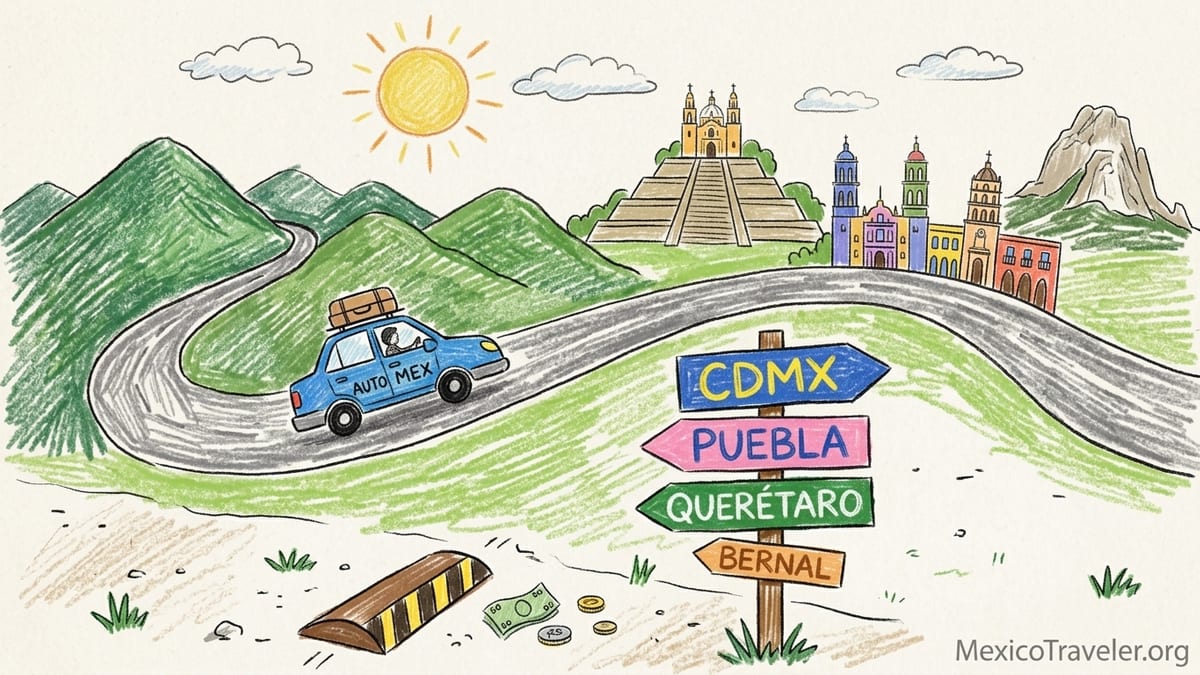
The Car I Rented, Pickup Reality, and the Insurance Conversation
I picked up a compact automatic sedan from a major-brand counter at Mexico City International Airport (MEX). I specifically asked for something small enough to thread through colonial streets and fit in tight parking garages, but stable enough for the high-speed cuota roads and the mountain grades around Estado de México and Morelos. The category mattered more than the badge: good tires, functioning AC, and a spare or repair kit were my non-negotiables.
The part I’d warn anyone about is the insurance conversation at the counter. Even if you book ahead, you can still be offered add-ons on arrival, especially liability and damage coverage. I was asked to confirm liability coverage and decide whether to add collision damage coverage and supplemental liability coverage. The deposit size also depends on what you accept or decline, and it can be substantial if you decline damage protection. I kept it simple: I chose coverage that reduced my financial exposure and made the hold on my card predictable rather than “potentially huge if something happens.”
If you’re used to renting in the U.S., the Mexico process feels more contractual and less casual. Next time, I’d arrive with two things printed or saved offline: the exact coverage included in my reservation and the exact terms for deposit and deductibles, because cell service at airport counters can be unreliable when you’re stressed and tired.
Leaving Mexico City: The Day I Learned to Respect Timing
The hardest part of driving in Central Mexico is not the mountain roads or the topes. It’s the first 45 minutes after you start the engine in Mexico City. I left at what I thought was a reasonable morning hour and immediately got folded into the capital’s reality: slow-moving lanes, aggressive merges, and a sense that every on-ramp is a negotiation. The biggest sightseeing killer of my whole trip was not a museum line, it was underestimating Mexico City departure traffic.
My rule after that morning became strict: I only planned “out-of-city” drives either early or after the main rush. When I did it right, the city fell away quickly and the cuota roads felt smooth and controlled. When I did it wrong, I arrived at my destination already tired, which is the worst possible state to navigate a historic center, find parking, and still have patience for a long lunch.
One more practical note: if you’re new to Mexico’s road culture, topes will humble you. They appear everywhere, from town entries to random stretches near schools and markets. The signage can be inconsistent, and hitting one too fast is the easiest way to ruin your suspension and your mood. I learned to watch for brake lights ahead and for painted warnings on the road surface more than I relied on signs.
Route 1: Mexico City to Puebla and Cholula (The Drive I’d Repeat)
If you want a “first win” road trip from Mexico City, this is it. The cuota route toward Puebla is straightforward, and Puebla is built for travelers who want big-city food and culture without Mexico City’s intensity. In 2026, the Mexico–Puebla toll for a standard car is posted at 226 MXN on the federal toll schedule, and that number is useful because it anchors your budget for the day. I paid at the toll plazas in pesos and kept small bills handy to avoid fumbling with change when the line was moving.
What surprised me is how much the driving still cut into my day even on a clean route. Between the departure traffic, toll stops, and the mental load of staying alert, I had to choose: either Puebla’s Centro Histórico properly, or a quick hop to Cholula plus a long dinner back in Puebla. Trying to do both at full speed made everything feel rushed.
Parking in Puebla is a whole topic on its own, and it’s where I made my first avoidable mistake: I assumed I’d “just find a spot.” In the central areas, the city has run a curbside parking program that allows up to three hours free and then charges 10 MXN per hour after the fourth hour, with posted operating hours by zone. That’s great if your timing matches, but it’s terrible if you lose track of time while you’re in a museum or lingering over coffee. I switched to paid parking garages in the historic core so I could stop watching the clock every 20 minutes.
Cholula was the easy add-on. The key detail for drivers is that San Pedro Cholula has operated metered curbside parking with a published rate of 6 MXN per hour in authorized zones. It’s not expensive, but you do need to budget a minute to understand where you’re allowed to park and how payment works, because nothing kills the mood faster than circling a photogenic neighborhood while your passenger says, “Just stop anywhere.”
Route 2: Querétaro Base, Then Bernal and Tequisquiapan (The “Small Town” Sweet Spot)
I treated Querétaro as a base rather than a one-night stop, and it changed the whole trip. The city is comfortable for drivers: modern roads leading in, plenty of services, and a historic center that feels energetic without being overwhelming. It also sets you up for day trips that are short enough to be fun but not so short that you’re constantly packing and unpacking.
Toll costs are part of why this base works. The Mexico City to Querétaro cuota route is commonly priced around 226 MXN for a car in 2026 on the federal schedule, and once you’re in Querétaro you can keep your daily driving to manageable chunks. That matters because the real cost of driving is not just pesos, it’s attention. Shorter drives meant I arrived with the patience to enjoy where I was.
Bernal was the day-trip that felt like a reward. The approach roads are easy, but the last stretch into town tightens quickly. On weekends, the stress is parking and crowds rather than the drive itself. I parked in a paid lot instead of trying to shave off a few pesos at the curb. Next time, I’d go earlier, because the “easy” part of the hike or walk becomes hotter and more crowded as the morning slides into midday.
Tequisquiapan was my “slow afternoon” stop, and it made me realize something: driving is optional here. If you’re not planning to hop between wineries or rural stops, you could absolutely do this region with buses and a taxi for the last mile. The roads are simple, but historic centers are where driving steals time. Next time, I’d still rent a car for flexibility, but I’d plan at least one day where I do not move the car at all and just walk.
Route 3: Mexico City to Tepoztlán, Then West Toward Valle de Bravo (Where I’d Change My Plan)
Tepoztlán is the kind of place that makes you want to drive because it feels so close. The problem is that “close” can be an illusion when you factor in Mexico City’s southbound traffic patterns. The cuota route uses the Mexico–Cuernavaca toll corridor, and the posted 2026 toll for a standard car on Mexico–Cuernavaca is 156 MXN. The road itself is efficient, but the experience is heavily dependent on timing, because everyone has the same idea on weekends.
I made a classic mistake: I tried to combine “arrive, park, hike, lunch” into one smooth flow, and it didn’t flow. Tepoztlán’s streets tighten near the center, parking can be competitive, and the popular trail plans can become queue plans. I still loved the day, but next time I’d either (a) go as an overnight and start early before the biggest crowds or (b) skip driving entirely and go by bus from Mexico City, then use local taxis. The drive is not hard, but it can be stressful, and stress is the opposite of why you go to Tepoztlán.
From there, heading west to Valle de Bravo sounded simple in my head and took longer in the real world. The roads turn mountain-curvy, and even when they’re paved and fine, they demand concentration. This was the part of the trip where I most felt the tradeoff: every extra hour behind the wheel was an hour I wasn’t on the lake, wasn’t browsing galleries, and wasn’t sitting down for a slow meal. Valle de Bravo is worth the effort, but I’d do it as a dedicated segment, not as a “swing by” on the way somewhere else.
If you’re choosing only one “mountain driving” destination, I’d pick the one that matches your tolerance for curves and your desire to actually relax. Valle de Bravo is a reset button, but only if you arrive with energy. If you arrive fried from traffic, you’ll spend the first evening recovering instead of enjoying the town.
Road Notes That Actually Mattered: Toll Roads, Cash, Fuel, and the Stress Points
Cuota roads were the backbone of this trip. They cost more than libres, but the consistency is what made my itinerary possible. The most useful habit I had was carrying a dedicated toll wallet with small bills. I also kept my receipts, not because anyone asked, but because it helped me track what the road was actually costing me day to day rather than guessing later.
Fuel was straightforward along the main corridors, but I stopped treating “half a tank” as comfortable once I was doing mountain segments. I fueled earlier than I needed to and avoided the anxiety of hunting for a station when daylight was fading. That was also a safety choice. I kept my driving to daylight whenever possible and avoided the temptation to push into the night just to “make it.” Multiple official advisories emphasize extra caution at night outside tourist areas, and my own experience matched that guidance: driving after dark raised my stress without adding any real joy to the trip.
Parking was the stealth time thief. In Puebla, curbside parking policies can be traveler-friendly but require attention to hours and limits, while garages buy you mental freedom. In smaller towns, the issue was less “cost” and more “space” and traffic flow. I wasted time trying to park too close to the center because my brain wanted a short walk. Once I accepted a slightly longer walk, everything got easier.
The stressful sections were predictable: leaving Mexico City at the wrong time, entering small-town centers at peak weekend hours, and mountain roads when I was already tired. Next time, I’d build in fewer “same-day doubles” and I’d schedule intentional non-driving afternoons. Central Mexico is not a place you win by speed.
The Takeaway
If I could bottle one lesson from this trip, it’s that Central Mexico rewards segmentation. Instead of one ambitious loop, I’d drive three compact routes again: Mexico City to Puebla and Cholula for an easy culture hit, a Querétaro base with Bernal and Tequisquiapan for small-town charm, and a separate escape to Tepoztlán with a deliberate decision about whether the car is worth the stress. The roads are workable, the toll system is predictable, and the destinations are outstanding, but driving has a real opportunity cost.
What I’d change is not the places, it’s the pacing. I’d treat Mexico City departure timing as a major planning variable, I’d pick parking strategies in advance in the busiest historic centers, and I’d stop assuming that a two-hour drive equals a half-day activity. In practice, a two-hour drive often becomes the day.
Do it with intention, keep your driving in daylight, and give each destination enough breathing room to feel like more than a checkbox. That’s the Central Mexico road trip I’d drive again, and the one I’d recommend to anyone who wants the magic without the burnout.
FAQ
Q1. What’s a realistic Central Mexico road trip length without feeling rushed?
Six to nine days works well if you split it into two or three mini-routes and avoid trying to connect every destination in a single loop.
Q2. How much are the main tolls on these routes in 2026?
Mexico–Puebla is 226 MXN for a car, Mexico–Cuernavaca is 156 MXN, and Mexico City to Querétaro is commonly priced around 226 MXN on the federal toll schedule.
Q3. Should I drive from Mexico City to Puebla or take a bus?
Driving is straightforward and flexible, but a bus can be less stressful. If you want to explore Cholula and nearby stops on your own schedule, the car is worth it.
Q4. Is it hard to park in Puebla and Cholula?
It can be, especially near the historic center on busy days. Puebla has a curbside parking program in central areas, while Cholula has metered curbside zones with published hourly rates.
Q5. What’s the single most stressful part of driving in Central Mexico?
Leaving Mexico City at the wrong time. Traffic and aggressive merging can drain your energy before the trip even begins.
Q6. Are topes really that big of a deal?
Yes. They’re common and sometimes poorly marked. Hitting one too fast is an easy way to damage the car and spike your stress level.
Q7. Would you rent a car again for the Querétaro, Bernal, and Tequisquiapan area?
Yes, but I’d use Querétaro as a base and keep daily drives short. For a purely town-focused visit, buses and taxis can also work well.
Q8. When would you skip driving and hire a driver or take public transport instead?
For high-traffic weekend escapes like Tepoztlán, or whenever you expect heavy congestion and difficult parking in tight historic centers.
Q9. Is it better to use toll roads (cuotas) or free roads (libres)?
For this itinerary, cuotas are more predictable and generally faster. Libres can be scenic, but they can add time and complexity you may not want on a short trip.
Q10. What’s one planning change that makes the biggest difference?
Build fewer same-day doubles. A drive that looks short on a map can still cut deeply into sightseeing once you add traffic, toll stops, and parking.