

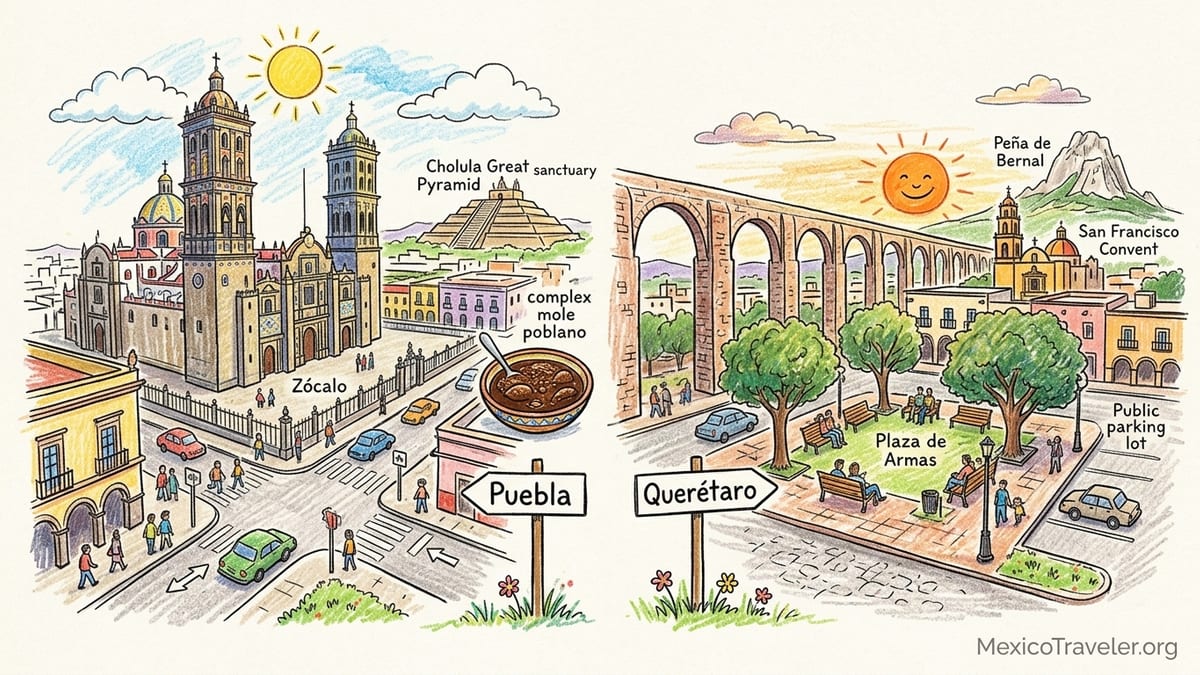
I’ve landed in Puebla and Querétaro on different trips with the same goal: a Central Mexico city break that feels easy, beautiful, and full of memorable meals between long walks in a historic center. Both delivered, but they delivered in different ways. Puebla felt like a city you taste first and photograph second, all tiled courtyards, busy markets, and dishes that demand a second stop. Querétaro felt like a city you stroll, linger, and decompress in, with a historic center designed for unhurried evenings and spontaneous plaza time. After visiting both, I know which one I’d pick depending on what kind of weekend I wanted, and which I’d recommend if it’s your first time choosing a “one city” Central Mexico escape.
Arrival Day: First Impressions, Getting In, and Where I’d Stay
Puebla greeted me with scale. The arrival felt big city, not in a chaotic way, but in the way that immediately suggests you could spend days here without repeating yourself. I remember pulling into the Centro Histórico and seeing how quickly the streets start to frame grand architecture: the cathedral presence near the Zócalo, the rhythm of portals and cafés, and that signature Puebla palette of stone, talavera, and warm paint colors that look even richer in late afternoon light.
Querétaro, by contrast, felt instantly compact and managed. The first time I arrived, I noticed how “contained” the historic center feels, like a walkable rectangle of plazas and colonial streets that invites you to drop your bags and start wandering. Even before doing anything touristy, the city’s center gave me that rare travel feeling of not needing to plan the first hour. You can simply follow the foot traffic toward Plaza de Armas or Jardín Zenea and be where you need to be.
If I’m choosing a hotel location based on convenience alone, I prefer staying right inside Querétaro’s Centro Histórico, a few minutes from Jardín Zenea (on 16 de Septiembre) because it makes evenings effortless and mornings calm. Puebla is also highly walkable once you’re in the center, but I find hotel choice matters more there. In Puebla I’d stay close to the Zócalo and the museum cluster so I’m not repeatedly negotiating traffic patterns and one way streets just to grab coffee or duck into a gallery.
Driving and parking is where the difference becomes practical. Puebla has a formal street parking program called “Estaciónate Aquí” that, as of its latest city update dated September 20, 2026, is designed around short stays: up to three hours free, then a per hour charge after that, with operating hours that vary by zone and day. It can be genuinely useful, but it’s not the same as “I’ll just wing it.” In Querétaro, parking tends to be about choosing a public lot and moving on with your day. The city has even coordinated extended operating hours for 20 downtown parking facilities during holiday periods like Semana Santa, which tells you how central parking management is to the visitor experience.
Walking the Historic Center: What It Feels Like at Street Level
Puebla’s historic center feels like it’s constantly offering you a decision. Turn left for another church façade, right for a little street of crafts, straight for a busy corridor where you can feel commerce pulsing under the heritage. My most vivid “Puebla walking” memory is how quickly you move between grandeur and the everyday: one block you’re looking up at carved stone and tiled domes, the next you’re stepping around a vendor setting up for the day. Puebla rewards curiosity and energy.
Querétaro feels more like a continuous promenade. Its UNESCO listed historic center has a polish that translates into an easy walking rhythm: plazas spaced just right, benches that invite you to sit, and streets that seem designed for evening loops. Jardín Zenea is a perfect example of why I like walking here. It’s not just a photo stop. It’s a living room for the city, a place people use to meet, listen to music, and pause under mature trees.
The emotional difference for me is this: Puebla is a city where I’m always tempted to add “one more stop,” which can turn a simple afternoon walk into a full day. Querétaro is where I naturally slow down. If I’m traveling with someone who doesn’t want to be “on” all day, Querétaro feels gentler on the feet and the brain.
That doesn’t mean Puebla is difficult. It means Puebla’s center is denser with “pull.” I’d still choose Puebla if your joy comes from moving through layered streets, dipping into courtyards, and letting the city steer your itinerary. Querétaro is the city I choose when I want the itinerary to feel like an option, not a requirement.
Museums and Culture: Puebla’s Depth vs Querétaro’s Ease
Puebla’s museum experience feels like it has range built in. My go to anchor is Museo Amparo, which is not only in a beautiful building but also one of those museums where you can spend an hour and feel satisfied or spend half a day and still want more. The visit planning details are clear and current on the museum’s official “Plan your visit” information, and it’s the kind of institution that makes Puebla feel like a major cultural city rather than a quick weekend destination.
For a different texture, Puebla also makes it easy to pivot into more specific collections. The INAH listed Museo de Arte Religioso, Ex Convento de Santa Mónica, is the kind of place that changes the tone of your trip in the best way: quiet courtyards, sacred art, and a feeling of stepping into the layered history of convent life in the city. And if you’re willing to go a bit beyond the tightest downtown loop, INAH’s Museo Regional de Puebla at Los Fuertes gives you a broader historic sweep and ties directly into the city’s identity around the Battle of 1862 and the civic park area.
Querétaro’s strongest museum day for me starts with the Museo Regional de Querétaro, inside the former Convent of San Francisco. INAH’s official museum listing is the one I trust for basics like hours (it lists Tuesday to Sunday, 9 a.m. to 6 p.m.), and that reliability matters when you’re fitting culture into a weekend. The experience here is less about “big city museum hopping” and more about creating one solid cultural block and then returning to plaza life.
If your trip is primarily museums, Puebla is the easier winner. If your trip is “museums plus long, relaxed plaza time,” Querétaro fits the rhythm better. Personally, I enjoyed Puebla’s cultural depth more, but I enjoyed Querétaro’s cultural pacing more.
Food Moments: What I Actually Ate, and Which City Tasted Better
Puebla is the city where I ate with purpose. Even when I tried to keep things casual, the food scene kept turning into the headline of my day. My most “Puebla” moment was sitting down for something that sounded simple and realizing it came with layers: a plate that involved a sauce with real complexity, a side that wasn’t an afterthought, and a setting that made me linger. Puebla has that effect. You can intend to grab a quick bite and end up planning the rest of the afternoon around where to eat next.
And Puebla’s street food and market energy made the city feel edible in the best way. If you’re the kind of traveler who likes to try things in small increments, Puebla is built for it. You can sample something savory, detour for something sweet, and still have a full dinner later without feeling like you “wasted” a meal. It’s also the city where I found myself repeatedly buying small items to bring back to the hotel: a pastry for later, a snack for the evening, or something I couldn’t pronounce but wanted to learn by tasting.
Querétaro’s best meals for me were about atmosphere. I remember the feeling more than the specifics: sitting near the center, ordering something comforting, and watching the city shift from daytime strolling into evening light. Querétaro is excellent for a couples style weekend where dinner is part of the walk, not a separate event you drive to. Its historic center makes it easy to do the classic “one drink here, one dessert there” without feeling like you’re commuting across town.
If you’re booking a trip mainly to eat, Puebla is the one I’d choose first. Querétaro still has great food and a strong dining scene, but Puebla is the city that turned meals into memories more consistently for me. Querétaro turned evenings into memories more consistently.
Evening Atmosphere: Where I Wanted to Stay Out Later
Querétaro wins my “most enjoyable nights” category. The reason is simple: the center feels like it belongs to pedestrians after dark. You can loop from Plaza de Armas to Jardín Zenea and back, and the evening activity feels social rather than frenetic. Even if you don’t have a reservation, you don’t feel stuck. You can sit, listen, people watch, and decide what happens next.
Puebla’s evenings were more mixed, but in a way that depends on what you want. When I wanted a lively night with plenty of options, Puebla delivered. When I wanted a slower, romantic “walk and linger” vibe, I found myself having to choose my streets more intentionally. Puebla is bigger, and that size can make the nighttime vibe feel more neighborhood dependent.
For couples, Querétaro is the city I’d pick for a weekend where you want low friction romance: a hotel in the center, an early dinner, a long walk, a nightcap, and the feeling that you don’t have to monitor the clock. For a friends trip where the goal is variety and a city that stays animated, Puebla is the better bet.
One practical note: both cities have the kind of historic center where you should keep an eye on the usual travel basics at night, but in my experience Querétaro felt calmer and easier to navigate after dark. Puebla felt more dynamic and therefore required a bit more situational awareness when moving between areas.
Traffic, Parking, and Prices: The Unsexy Stuff That Shapes a Weekend
Puebla is where logistics can either be a perk or a drag. If you’re driving, the city’s “Estaciónate Aquí” street parking program can be useful if you understand its structure. The city has stated that the program supports short visits, including up to three hours free and then a per hour charge after that, and it has published operating hours by zone. That can be a real money saver for quick stops, but it also nudges you to plan your day in chunks rather than leaving your car indefinitely.
In Querétaro, I found it easier to default to a public parking lot and then forget about the car. The municipality publishes maximum tariffs for public parking services through official channels, and it has shown that it coordinates downtown parking operations during high demand periods like Semana Santa by aligning hours across multiple facilities. In real life, that translated into less circling and fewer “should we just give up and go somewhere else?” moments for me.
Prices are tricky to compare without turning the whole trip into spreadsheet travel, and I’m careful not to claim a city is “cheaper” in a universal way. In both Puebla and Querétaro, you can do budget street food and casual cafés, or you can climb quickly into higher end dining and boutique hotel pricing. What I can say from experience is that Puebla tempted me to spend more on food and museum time, while Querétaro tempted me to spend more on lingering: extra coffees, a second drink, a dessert you didn’t plan, because the center makes that kind of slow spending feel worthwhile.
If you’re road tripping, Querétaro feels more forgiving for drivers. If you’re arriving without a car and plan to walk, Puebla’s density becomes an advantage because you can pack your days full without needing to hop neighborhoods.
Day Trips and Nearby Escapes: Which City Is the Better Base
Puebla’s biggest advantage as a base is how quickly you can pivot to iconic nearby experiences. Cholula is the classic day trip, and it feels close enough to be spontaneous. The Great Pyramid of Cholula and its tunnels, plus the views by the sanctuary above, make for a half day that still feels substantial. Admission pricing can change year to year, and in 2026 local reporting has pointed to ticket adjustments for the archaeological zone, so I recommend checking official channels close to your visit date. From a traveler standpoint, the key point is that Puebla makes “big history day trip” very easy.
Another Puebla side trip that fits a weekend is a quick modern attraction break like the Estrella de Puebla, a large observation wheel with published official operating hours and ticket purchase steps through the state’s online service portal. I like that kind of option in a city break because it gives you a different vantage point and a lighter activity if you’ve spent the morning in churches and museums.
Querétaro, meanwhile, is the better base for a string of small town day trips, especially if you’re leaning into Pueblos Mágicos style travel. Tequisquiapan is an easy example, with clearly posted visitor information about its artisan markets and typical operating hours on official local tourism channels. It’s the kind of place where you can buy crafts, snack, wander, and be back in the city for dinner without feeling like you dedicated your entire day to transit.
And then there’s Bernal, anchored by Peña de Bernal. Rules and fees for access can shift, and local reporting in 2026 has discussed a modest access charge and trail hours, along with management measures that can affect how and where visitors can climb. Even with that variability, Querétaro is the smoother base for “one day, one town, one big natural landmark.” For me, Puebla is the better base for history and culinary side quests; Querétaro is the better base for charming towns and an easy road trip arc.
The Takeaway
If I had to choose just one for a first Central Mexico city break, I’d choose Querétaro. It’s easier to arrive, easier to park, easier to walk without thinking, and easier to turn a weekend into a genuinely restful escape. The historic center’s plazas make the trip feel complete even if you do less. For a couples weekend, Querétaro is also my pick because the city naturally creates romantic pacing: long walks, plaza time, and dinner without friction.
For a food focused trip, I’d choose Puebla. Puebla is where meals became the most vivid memories, and where culture and cuisine felt intertwined at every turn. If your ideal itinerary is museums plus purposeful eating plus a day trip to a headline site like Cholula, Puebla is the stronger choice.
For a road trip, I’d lean Querétaro as the home base, especially if your plan includes Tequisquiapan, Bernal, or other nearby towns where you’ll appreciate a city that makes driving logistics simpler. For a base specifically aimed at nearby Pueblos Mágicos experiences, Querétaro again has the edge because it feels designed for day trip loops and returning to a calm, walkable center at night.
If you can swing it, the real answer is to do both and let the contrast sharpen your experience of Central Mexico. But if you’re standing at the fork in the road, choose Puebla when you want the trip to be driven by food and cultural depth, and choose Querétaro when you want the trip to be driven by ease, plazas, and the pleasure of unplanned evenings.
FAQ
Q1. Which city is better for a first time Central Mexico weekend?
Querétaro, because the Centro Histórico is compact, plaza centered, and easy to enjoy without planning every hour.
Q2. Which city would you pick for a food focused trip?
Puebla. It’s the city where meals most consistently felt like the main event, from casual bites to more formal dining.
Q3. Which is more walkable: Puebla or Querétaro?
Both are walkable in their historic centers, but Querétaro feels more continuously walkable and relaxed block to block.
Q4. Which city has the stronger museum lineup?
Puebla, especially if you want variety in a tight area, with major institutions like Museo Amparo plus multiple historic and INAH listed museums.
Q5. Is it easy to drive and park in Puebla’s historic center?
It can be, but you’ll want to understand local parking rules. Puebla’s “Estaciónate Aquí” program is designed around short stays, not all day street parking.
Q6. Is Querétaro easier than Puebla for a road trip base?
Yes. Querétaro felt more forgiving for drivers, and it’s a convenient base for day trips to towns like Tequisquiapan and Bernal.
Q7. Which city is better for a couples weekend?
Querétaro, because the evening atmosphere in the plazas supports slow, romantic pacing without needing a packed itinerary.
Q8. Which city is better for a day trip to a major archaeological site?
Puebla, because Cholula is close and makes an easy half day or full day trip paired with downtown museums and food.
Q9. How long do you need in each city to enjoy it?
Two full days works well in either city. Puebla rewards three days if you want deeper museum time and more meals.
Q10. If you could only choose one, which would you return to first?
I’d return to Puebla first when I’m traveling for food and culture, but I’d return to Querétaro first when I want a low friction weekend reset.