


I left Mexico City in the dark, half-excited and half-suspicious that the internet had oversold Grutas Tolantongo the way it sometimes does with “hidden gems.” By the time I was back in the city that night, hair still smelling faintly like minerals and my bag stuffed with wet clothes, I understood why people obsess over this place and why so many day-trippers look slightly shell-shocked on the way home. This is my full, observational account of a very long Tolantongo day trip from CDMX, with the practical details that make or break it: the road descent into the canyon, the changing and locker situation, where you will need cash, how slippery the walkways feel, what the water actually feels like on your skin, and what I would do differently next time.
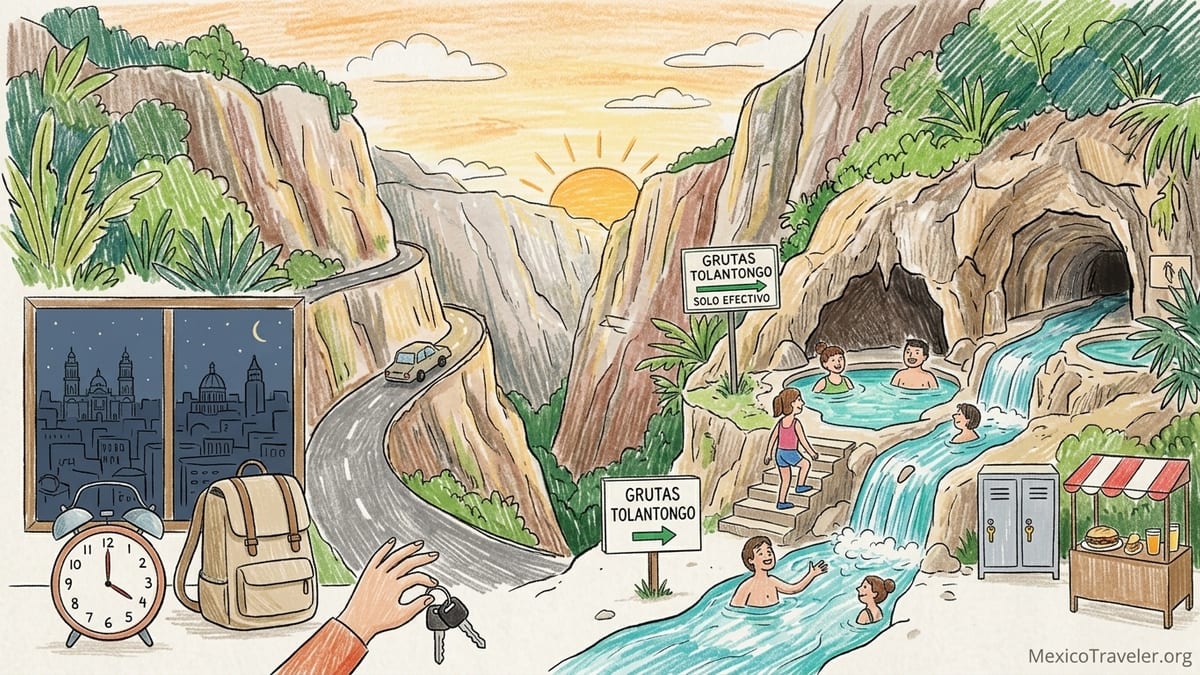
04:30 a.m. in Mexico City: The Early Start That Sets the Tone
My alarm went off at 4:30 a.m., the kind of hour where Mexico City feels paused, like someone hit mute on the usual soundtrack of engines and street vendors. I was out the door before 5:15 a.m. with a small backpack that looked innocent but was strategically packed: a swimsuit under my clothes, quick-dry towel, water shoes, a light hoodie for the morning chill, and a plastic bag I knew I’d need later for wet gear.
The big mental shift before Tolantongo is accepting that it is not “near” Mexico City in any practical sense if you’re day-tripping. You are choosing a marathon. Even if everything goes smoothly, the day is built around transport: leaving early enough to beat some traffic, arriving early enough to get a good spot, and leaving early enough to avoid driving the canyon roads while exhausted.
One important thing I handled before I left the city was cash. The official Grutas Tolantongo site states that all payments in the park are in cash, and their 2026 costs page repeats that clearly. That includes your entrance ticket, parking, lockers, food, and anything extra you decide to do inside. I treated it like traveling to a place with no banking infrastructure, because in practice that is how it functions once you’re down in the canyon.
The Drive North: Highways, Towns, Then the Canyon Descent
Once I was on the road, the first stretch felt deceptively easy: typical highway driving out of CDMX, then longer, open segments where the city gives way to hills and wide skies. The last portion is where Tolantongo starts to feel real, because you’re no longer just “going somewhere,” you’re committing to a descent into a steep valley that looks, from certain angles, like it was cut open.
The canyon descent is the part that made my palms sweaty. The road narrows, the curves tighten, and you start seeing vehicles coming up the other way with that cautious, slightly hesitant pace that says everyone is doing their best to share a small ribbon of pavement. If you get carsick, this is where it can hit. I watched people in other vehicles staring straight ahead, jaw set, like they were trying not to think about the drop-offs.
By the time the road bottoms out, the air feels different: warmer, more humid, and faintly mineral. You also start noticing the infrastructure of a place that has been handling crowds for years, not a secret hideaway: parking areas, entry control points, and the visible flow of people in swimsuits and sandals moving with purpose.
Arrival, Tickets, and the Cash Reality Check
At arrival, the procedure is straightforward but not fast. You are entering a complex with two main areas, and the official pricing clarifies that your daily entrance covers attractions across both areas, including the cave and tunnel, the river, pools, thermal pools, and more, with the ticket valid from 7:00 a.m. to 8:00 p.m. It is a day ticket, not a 24-hour pass, which matters if you are tempted to squeeze in a late-night soak on a day visit.
Here are the official costs I verified on the 2026 “Costos” page from the official Grutas Tolantongo site: general entrance is 230 MXN per person per day, and parking is 50 MXN per vehicle per day. The same official page also notes that children aged 5 and up pay full entrance, and children ages 0 to 4 do not pay. The same page is blunt about payments: everything in the park is cash only.
I felt that cash-only rule immediately. You are tired from the early start, you are excited to get to the water, and now you are mentally counting bills in your hand like you’re buying concert tickets. It is not complicated, but it is easy to underestimate how many little costs stack up once you add lockers, food, and internal transport if you choose to use it.
A small but important detail: I kept my cash split. Some in a zipped compartment, some in a different pocket, and a small amount loose for quick payments. The reason is simple: when you are wet, moving between areas, and constantly changing what you’re carrying, it is too easy to fumble your wallet or set something down for “just a second.”
Changing Rooms, Lockers, and the Wet-Clothes Problem No One Mentions
My first practical stop after getting in was to sort my stuff. Tolantongo is not a place where you can casually wander with everything you own. You will be in and out of water, and you will be walking on wet concrete, stone, and uneven paths. You need to simplify what you carry.
I rented a locker, and this is one of those details that people gloss over until they are standing there in a swimsuit holding a phone, a towel, and shoes they do not want to lose. On the official 2026 costs page, locker service is listed at 150 MXN, with the note that when you return the key you get back only 50 MXN as a deposit return. The same line gives hours for lockers as 8:00 a.m. to 5:00 p.m., which is a crucial detail if you planned to stay late and assumed you could access your stuff indefinitely.
Now for the wet-clothes issue: once you change into swimwear, your regular clothes become an awkward, heavy problem later. I was glad I brought a plastic bag and an extra thin bag for my shoes. At the end of the day, that wet bundle turns cold and a little sour, and the bag keeps it from soaking your other items on the ride back.
Footwear mattered more than I expected. Water shoes with grip were the difference between walking confidently and doing that careful shuffle people do when every step might slide. There are slick spots, especially where water runs across walkways, and some stair sections feel steep even when dry. Add wet surfaces and tired legs, and you start appreciating any extra traction you can get.
First Soak: Thermal Pools, The River, and the Way the Water Really Feels
The first time I got into the thermal water, my body did that involuntary exhale like it finally understood why we woke up before dawn. The water in the popular soaking zones feels hot-warm rather than “boiling,” the kind of temperature your shoulders melt into after a few minutes. I did not measure it with a thermometer, but against the morning air it felt comfortably warm, like a heated bath that is not trying to scald you.
Then I moved between different water experiences, which is one of Tolantongo’s superpowers. The river is a different sensation: you can find stretches where the current cools you down and the temperature feels more mixed, a balance of warm mineral water and fresh flow. Sitting at the edge with water moving past your calves felt like hitting a reset button. It is also where you start noticing families settling in with towels, snacks, and that long-stay mindset that day-trippers rarely achieve.
The surfaces near the water are not forgiving. Rocks are smooth in places, steps are uneven in others, and you are always negotiating where to put your feet. I saw people trying to do it in flat sandals and regretting it, especially when they had to climb stairs with wet soles. This is one of the few places where a very practical purchase, like proper water shoes, genuinely improves your day.
If I had to name the area I enjoyed most, it was the calmer river time, not the “must-do” photo moments. The river sections gave me room to breathe, and I could adjust my pace without feeling like I was in someone else’s frame. The thermal soaking is amazing, but the river is where I felt the canyon atmosphere most strongly.
The Gruta and Tunnel: Beautiful, Slippery, and Surprisingly Intense
Eventually, I went for the cave and tunnel experience, because it is part of the identity of the place. The cave area has that dramatic contrast: bright canyon outside, then a darker, echoing interior where the air feels cooler and damp. The sound changes immediately. Voices bounce off rock. Water noise becomes louder. Your steps get more careful.
This is where slippery surfaces become a real factor. The combination of mineral water, smooth stone, and foot traffic creates patches that feel like natural polished tile. I moved slowly, not because I am overly cautious, but because watching one person nearly lose footing was enough to convince me that no photo is worth a twisted ankle.
Crowds fluctuate, but the cave and tunnel can compress people into tight spaces. If you’re claustrophobic or simply don’t like being jostled, go early or accept that you may need to wait for a moment when the flow eases. It is not a solitary nature walk. It is a popular natural attraction with a constant stream of visitors, and the vibe can shift from serene to chaotic depending on timing.
What surprised me was how energy-draining it felt. Not physically in a cardio sense, but mentally. You are constantly adjusting, stepping carefully, minding your balance, and negotiating space with others. When I walked back into sunlight afterward, it felt like my brain unclenched.
Food, Crowds, and the Midday Wall (Plus the Costs That Add Up)
By midday, Tolantongo felt like it had fully “turned on.” More people arrived. More families staked out spots. Lines became more obvious. You start noticing how the day-trip schedule is similar for many visitors: arrive, change, hit the headline attractions, then search for food around the same time.
The official site lists common fast-food style options inside the park, and the reality matches that: you can find basics like burgers, fries, tortas, sandwiches, hot dogs, juices, fruit water, and snacks. I did not treat it like a culinary destination. I treated it like fuel. Cash again matters, because you are paying as you go, and a couple of meals plus drinks can quietly become a meaningful part of your total spend.
In the afternoon, I felt the famous Tolantongo “midday wall,” where your body is sun-warmed, slightly dehydrated, and simultaneously relaxed and exhausted from moving between water and stairs. This is when day-trippers make mistakes: skipping water, staying too long in the hot soak without breaks, and pushing their return departure later because leaving feels emotionally hard even when your body is already tired.
My overall day-trip cost depended on choices, but the baseline official fees are clear: 230 MXN entrance per person and 50 MXN parking per vehicle per day, with cash-only payments inside. Add a locker (150 MXN with a partial deposit return according to the official price note), plus food and drinks, and you can see how a “cheap” day becomes a moderate one quickly, especially for couples or families.
Would I Do a Day Trip Again, or Sleep in the Canyon Next Time?
The honest answer is that a day trip is enough to see Tolantongo, but not enough to feel like you lived it. The day ticket’s validity window, the long transport time, and the simple fact that you are managing fatigue from early morning all push you toward a fast, greatest-hits version of the park.
Next time, I would seriously consider staying overnight, and I would do it inside the complex rather than trusting “nearby” third-party lodging claims. The official lodging information warns travelers not to be misled by “hotels de paso” that claim to be close to the park, noting that many are farther than promised and cost you extra time and resources. The official lodging page also states clearly that all payments in the hotel and inside the park are in cash, which is consistent with the rest of the official guidance.
The same official lodging page also makes an important point for planning: your room cost does not include daily park entrances. If you stay multiple days, you pay entrance each day. In other words, staying overnight is not a hack to avoid day tickets. It is a way to slow down your experience and trade a punishing return schedule for more time in the water.
As for what I would do differently on a repeat day trip: I would arrive even earlier than most people aim for, prioritize the cave and tunnel before peak crowding, spend the middle hours in the river area I liked most, and leave with a firm cutoff time to avoid driving back to Mexico City completely drained.
The Takeaway
Grutas Tolantongo from Mexico City is not a casual day outing. It is an all-day commitment built around early departure, a curving canyon descent, and hours of moving between hot water, slippery walkways, and steep-feeling stairs. When it hits right, it feels like a genuine oasis: warm mineral water in a dramatic canyon, a river that lets you float between calm and awe, and a sense of reward that lasts even after you’re tired.
If you do it as a day trip, be honest about what you are buying: a compressed version of Tolantongo with a long return ride where the exhaustion sneaks up on you. If you can swing an overnight stay, you will likely get the experience day-trippers chase but rarely catch: early and late moments when the canyon is quieter and the water feels like it belongs to you, not to a crowd.
Either way, the practical rules are not optional. The official information is clear that payments are cash only, the entrance is a daily ticket with set hours, and key extras like parking and lockers have their own official costs. Prepare like a grown-up, not like an influencer, and Tolantongo rewards you.
FAQ
Q1. What are the official 2026 entrance and parking costs at Grutas Tolantongo?
Entrance is 230 MXN per person per day, and parking is 50 MXN per vehicle per day, according to the official 2026 costs page.
Q2. Are payments inside Grutas Tolantongo cash-only?
Yes. The official site states that all payments in the park are in cash, and official lodging information also states hotel payments are cash only.
Q3. What are the official hours for the park ticket?
The official 2026 costs information states the entrance ticket is valid from 7:00 a.m. to 8:00 p.m., and it is not a 24-hour ticket.
Q4. Do children pay full price at Tolantongo?
According to the official 2026 costs page, children aged 5 and up pay full entrance, and children ages 0 to 4 do not pay.
Q5. How much are lockers, and what are the locker hours?
The official 2026 costs page lists lockers at 150 MXN and notes locker service hours as 8:00 a.m. to 5:00 p.m., with a partial deposit return when you hand back the key.
Q6. Is Grutas Tolantongo doable as a day trip from Mexico City?
It is doable, but it is a very long day. You should plan for an early departure, a tiring return, and less time in the water than the photos suggest.
Q7. Is it better to stay overnight in Tolantongo?
If you want a slower experience and less pressure to rush, an overnight stay can be better. The official lodging information warns against misleading third-party “nearby” hotel offers and notes that park entrances are still paid daily.
Q8. Does the entrance ticket include access to both main areas?
Yes. The official 2026 costs page states the ticket includes access to attractions across both areas, including Paraíso Escondido and La Gruta.
Q9. What footwear is best for Tolantongo?
Grippy water shoes are ideal because many surfaces are wet and can be slippery, especially near the cave and along walkways.
Q10. What is the single biggest mistake day-trippers make?
Leaving too late. The day is already long, and the canyon road and highway drive back to Mexico City can feel much harder when you are sun-tired and carrying wet gear.