


I’ve done Mexico beach trips three ways: the Caribbean resort corridor in Cancún, the Pacific city-beach rhythm in Puerto Vallarta, and the desert-meets-sea drama of Los Cabos. All three can deliver sunshine and a cold drink with your toes in the sand. But after real stays and a few moments that genuinely changed what I prioritize, I now treat these destinations as materially different vacation choices, especially when you factor in beach conditions, sargassum risk on the Caribbean side, and how much you actually end up leaving your hotel.
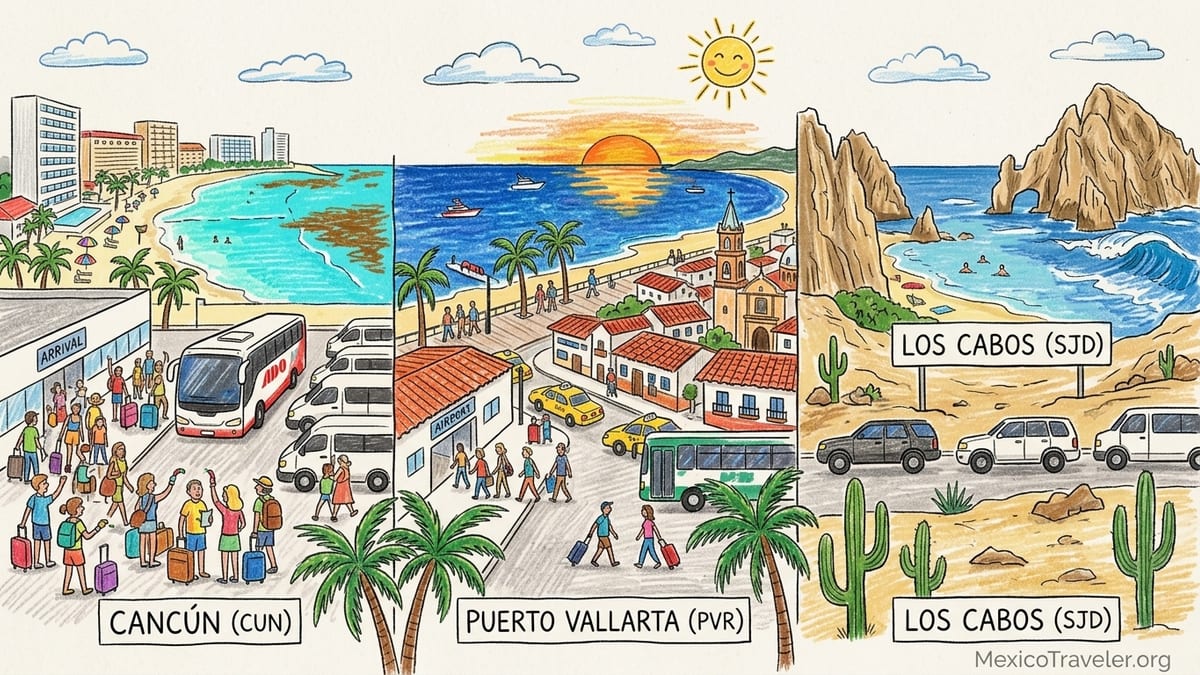
Arrivals That Set the Tone: CUN vs PVR vs SJD
Cancún felt like stepping into a high-volume machine designed to move tourists quickly. On my first arrival at CUN, the sensation was speed and scale: bright terminals, a constant stream of families in matching resort wristbands, and a parking-lot ecosystem of transfer reps. That first hour pushed me toward convenience decisions, not curiosity decisions. I remember thinking, “This is built for the Hotel Zone and all-inclusives first, and everything else second,” and that ended up shaping how much I explored beyond the resort.
Puerto Vallarta was the opposite vibe for me. Landing at PVR felt more like arriving to a real coastal city that also happens to be a vacation hub. Even with crowds, the energy outside the airport wasn’t “resort corridor,” it was “neighborhoods.” That difference hit me the moment I realized how quickly you can be in the Marina area or downtown, and how normal it feels to grab a taco somewhere that isn’t attached to your room rate.
Los Cabos at SJD felt the most geographically dramatic: desert hills, bright light, and that distinct Baja dryness you notice the second you step outside. It also felt the most “transfer-dependent.” The airport is not in Cabo San Lucas, and the first decision you make is how you’ll cover that distance, whether you’re headed to San José del Cabo, the Tourist Corridor, or Cabo San Lucas itself.
Important transparency before we go deeper: I have personally stayed in Cancún and Puerto Vallarta. For Los Cabos, I’m relying more heavily on current 2026 research and widely reported on-the-ground realities (especially around swimmable beaches and airport transfers) rather than pretending I had the exact same kind of stay there.
Airport-to-Hotel Transfer: The First Cost Trap (Or Convenience Win)
Cancún is the easiest place of the three to “go budget” without feeling like you’re roughing it, and that’s because you have real public transport options tied to tourism. The ADO airport bus has a direct route to a fixed stop in the Hotel Zone (Punta Cancún) with fares starting around MXN 170 per person, which I’ve used as my “I don’t want to negotiate anything today” solution when I wasn’t arriving with a group. From there, I either walked with a carry-on or hopped a short taxi or local bus to the hotel depending on how far down Boulevard Kukulcán I was staying.
Puerto Vallarta’s airport transfer experience is more about knowing the system than finding the cheapest theoretical option. The practical detail that changed my own routine is that the official airport taxi setup can be more expensive than what you can get if you walk out toward the highway side and catch alternatives, and ride-hailing rules around airport pickups can be a moving target. When I’m tired after a flight, “certainty” beats “saving a few dollars,” so I usually pre-decide: either I’m paying the official voucher and moving on, or I’m committing to the walk-and-wait strategy. Current 2026 travel guidance commonly puts official airport taxi vouchers to the Hotel Zone roughly in the MXN 300 to 450 range depending on exact hotel location, which aligns with the idea that zones matter.
Los Cabos is where transfer planning matters most, simply because distances are longer and the region is spread out. In current 2026 pricing examples, private SUVs are commonly quoted roughly around $79 to San José del Cabo and about $85 to $130 to Cabo San Lucas, with shared shuttles taking longer because of multiple stops. That’s not a minor detail. If you’re the type of traveler who already hates “one more queue,” Los Cabos can feel like it begins with one more queue unless you pre-book.
One small but real-world thing I learned from Cancún that I apply anywhere: I pack my first-hour patience like it’s a toiletry. If I’m arriving late, I’d rather spend a bit more on a direct transfer than start the trip stressed. If I’m arriving midday, I’ll happily take the bus and keep that money for a better dinner later.
Beach and Water Reality: Caribbean Shine vs Pacific Power vs Baja Swimmability
Cancún’s water, on a good day, is the kind of color that makes you stay outside longer than you planned. But what changed my preference wasn’t the “wow” moment. It was the “can I actually use the beach every day I’m here?” question. In the Mexican Caribbean, sargassum is not a trivia fact, it is a trip-shaping variable. In late summer 2026, sargassum forecasting and monitoring has become mainstream enough that you can check a 4-day Riviera Maya arrival outlook and other regularly updated forecasts that refresh frequently, rather than relying on anecdotes.
When I’ve hit Cancún during cleaner stretches, I spent hours in the water and felt like the beach was the trip. When I’ve hit it during heavier seaweed periods, the trip turned inward: pool time, spa time, long lunches, and a bigger reliance on excursions to places less impacted. That change in behavior is the important part. Even if your resort works hard with cleaning crews, the experience can become “I’m here for the resort” rather than “I’m here for the sea.”
Puerto Vallarta’s beach experience is less about a single iconic stretch of sand and more about how you use the bay and surrounding coast. The water is Pacific, the sunsets are the show, and the swimming conditions can vary by beach and season. What I personally liked is that even when the beach itself wasn’t my “all-day lounger” spot, I found myself outside the hotel more. Vallarta’s appeal, to me, is that you can do beach time and city time in the same day without feeling like you’re abandoning the point of the trip.
Los Cabos is the destination where you need to understand one headline fact: beauty and swimmability aren’t the same thing. Current 2026 guidance on Cabo beaches emphasizes that many Pacific-facing beaches have strong surf, steep drop-offs, and rip currents that make swimming genuinely dangerous. The swimmable areas are concentrated, and Médano Beach is consistently cited as the main calm, swimmable stretch in Cabo San Lucas thanks to its more protected waters. That distinction is exactly why Los Cabos can be perfect for some travelers and frustrating for others.
Resort Quality and the “How Much Did I Leave the Property?” Test
Cancún is the easiest place for me to go full resort mode, and that’s not a compliment or a criticism, it’s just what happens. The resort infrastructure is dense, the all-inclusive model is deeply refined, and after a long travel day it’s incredibly easy to decide you don’t need to leave. On my last stay there, I realized I’d spent less time outside the property than I planned, not because I was bored, but because everything I needed was frictionless. That’s the Cancún strength: it’s a vacation that can run itself.
Puerto Vallarta pulled me out of my hotel more than any other Mexico beach destination I’ve visited, and that is the single biggest reason it keeps rising on my personal list. Even if you stay at a nice resort in the Marina or Hotel Zone, you’re close enough to neighborhoods and the Malecón energy that “let’s go out” feels easy. I found myself doing short outings that didn’t require planning like grabbing a sunset drink downtown, or walking a few blocks for a meal that wasn’t attached to a buffet schedule.
Los Cabos, based on how the region is structured, seems like it can go either way depending on where you stay. If you’re on the Tourist Corridor or at a property designed as a self-contained luxury bubble, the gravitational pull is strong. If you’re near the marina or in San José del Cabo and you like pairing resort time with dining out, you can build a trip that feels more outward-facing. The key difference is that distances can turn “let’s just pop out” into a car decision.
My personal takeaway from these patterns is simple: if I want to truly unplug, Cancún is the easiest. If I want a beach trip that still feels like a city trip, Vallarta wins. If I want dramatic scenery, a grown-up vibe, and I’m fine being deliberate about where I swim, Los Cabos becomes the contender.
Food, Restaurants, and Nightlife: What I Actually Craved After Day Two
Cancún has great food inside top-tier resorts, and the best nights I’ve had there were honestly the nights I didn’t over-plan. The “changed my preference” moment came when I realized my favorite meals in Cancún were often the simplest: a late ceviche at the resort beach bar, a breakfast that turned into a long coffee, and then an early night because tomorrow was another water day. Cancún nightlife exists in a big way, but on my stays, I usually didn’t build the trip around it because the resort schedule already felt full.
Puerto Vallarta is where I ate with the most spontaneity. I wasn’t trying to “win dinner.” I just kept finding myself in real situations like walking along the Malecón and deciding to sit down because the vibe was right, not because I’d booked something. Vallarta’s nightlife also feels more integrated into the city itself. You can do a low-key bar, a lively night, or just people-watch with a drink, and then get back to your hotel without making it a production.
Los Cabos is famous for high-energy nightlife and a more upscale dining scene in certain pockets, and the way it’s described in current traveler reporting lines up with its identity: part beach escape, part party destination, part luxury playground. If I were going there, I would likely plan at least one “yes, we’re going out” night and then protect the rest of the trip for daytime activities and calmer evenings, simply because Cabo’s rhythm can run hot if you let it.
If you’re choosing purely on where you’ll actually leave your resort to eat, Puerto Vallarta is my personal leader. Cancún is the destination where I’m most tempted to say, “The resort’s restaurant is good enough, and I’m already in paradise.”
Excursions, Weather, and Seasonal Tradeoffs (Including Sargassum)
Cancún’s best “I’m glad I left the hotel” days have often been water-based and nature-based, especially when the shoreline itself is compromised by seaweed. This is where sargassum becomes more than a beach annoyance. It changes what you book. In 2026, there are multiple regularly updated forecasting tools and monitoring systems used by travelers to gauge likely conditions over the next few days, and Mexico also has official and scientific monitoring efforts that explain why these influxes happen and track them over time. Practically, that means I treat the Caribbean side as a destination where I check conditions close to departure and stay flexible about beach days versus outing days.
Puerto Vallarta excursions felt more like “choose your own intensity.” I’ve done days that were mostly about strolling, shopping, and quick beach breaks, and days that were more active. Vallarta also has a way of making a simple sunset feel like an event, which sounds corny until you’re actually there watching the bay shift colors while the city hums behind you.
Los Cabos excursions are often described as iconic and photo-forward: the arch at Land’s End, boat rides, and desert-meets-ocean landscapes. The tradeoff is that you plan around distances and around where the water is safe. If you go expecting to swim anywhere you see sand, you can be disappointed. If you go expecting to admire the coastline and pick your swimming beach deliberately, you’re aligned with what Cabo does best.
Weather-wise, these places don’t behave the same. The Caribbean side and the Pacific/Baja side have different seasonal patterns and different “problem days.” In the Mexican Caribbean, sargassum season is a reality travelers actively monitor, and late summer into early fall is when many people pay closer attention to forecasts and live beach cams. On the Baja side, the ocean’s power and exposure on certain beaches is a year-round safety reality, not a seasonal quirk. Those are two very different types of risk.
Traffic, Crowds, and Costs: The Stuff That Quietly Decides Your Mood
Cancún feels the most crowded to me in the most specific way: it has a constant churn of arrivals and departures, and the Hotel Zone can feel like a single long strip of vacation decisions. Traffic can turn short distances into long rides, and crowds can cluster in predictable places. The upside is that the logistics are extremely tourism-friendly. You can use public buses and fixed-stop systems, and there’s always another option if Plan A doesn’t work.
Puerto Vallarta’s crowds feel more “city-normal” and less “corridor-stacked.” Yes, there are high seasons and busy cruise ship days, but because the destination is also a living city, the energy reads differently. The traffic is real, but I found it easier to pivot, walk, and change plans without feeling like I was trapped in the flow of a single tourist highway.
Los Cabos costs can spike quickly because transport adds up and because the destination has a strong luxury market. Even before you talk about hotel rates, transfers are a meaningful line item. Current 2026 examples commonly show private transfers to Cabo San Lucas in a range that can land around the low hundreds roundtrip depending on provider, vehicle size, and whether you do shared or private service. If you’re traveling with a group, that can be fine. If you’re traveling solo, that can feel like a tax on spontaneity.
If I were traveling with kids and needed “easy beach access every day,” I would be extremely careful with Los Cabos resort location and beach swimmability. If I wanted maximum predictability inside one property, Cancún would be the easiest. If I wanted a trip where the family can do beach time but also take breaks from resort life with low-effort outings, Puerto Vallarta would be my personal pick.
The Takeaway
If I had to choose one for my next Mexico beach trip, I’d choose Puerto Vallarta most often because it matched how I actually travel: I like beach time, but I also like feeling the place. Vallarta is the only one of these three where I consistently spent meaningful time outside the hotel without it feeling like an “excursion day.” It’s the difference between visiting a resort destination and visiting a coastal city where resorts happen to be excellent.
I’d choose Cancún when my priority is maximum ease and maximum resort efficiency, and when I’m comfortable treating sargassum as a variable I’ll monitor and manage. If I’m going for a short trip and I want the highest chance I’ll never need to think too hard, Cancún still makes a strong case, especially if I book a property known for beach maintenance and I keep my plans flexible.
I’d choose Los Cabos when I want the Baja scenery, the upscale edge, and the dramatic coastline, and when I’m willing to be intentional about swimming. Los Cabos is not the place I’d pick if my non-negotiable is “walk out and swim anywhere, every day.” But if my non-negotiable is “I want a stunning setting and a more grown-up vacation feel,” it rises quickly.
In 2026, the most honest way to frame this is simple: Cancún is a Caribbean resort corridor trip where sargassum can determine your beach hours; Puerto Vallarta is a Pacific city-beach trip where you’ll likely explore more; Los Cabos is a Baja trip where you choose your swimming beaches carefully and pay closer attention to transfers and distances. I can love all three and still admit they’re not interchangeable.
FAQ
Q1. Which destination has the easiest airport-to-hotel transfer?
Cancún is the easiest for a straightforward budget transfer because the ADO airport bus runs to a fixed stop inside the Hotel Zone, with fares starting around MXN 170 per person.
Q2. Where is sargassum most likely to affect my beach days?
Cancún and the wider Mexican Caribbean are the most exposed, and in 2026 many travelers actively check sargassum forecasts and monitoring tools close to departure and during the trip.
Q3. Which destination is best if swimming in the ocean is my top priority?
Cancún often delivers the most “easy swimming” conditions when the shoreline is clear, while Los Cabos requires you to choose swimmable beaches deliberately because many Pacific-facing beaches can be unsafe.
Q4. Is Los Cabos good for beach lovers if many beaches aren’t swimmable?
Yes, if you love dramatic scenery, beach walking, and choosing specific swimmable areas like Médano Beach, but it’s not ideal if you expect to swim anywhere you see sand.
Q5. Which destination made me leave the hotel the most?
Puerto Vallarta. Its city layout and dining scene made quick outings feel easy, so I spent more time off-property without needing to plan “big” excursions.
Q6. Which is best for an all-inclusive, stay-on-property vacation?
Cancún. The Hotel Zone is built around resort efficiency, and it’s the easiest place to let the resort schedule run the trip.
Q7. Which destination is best for nightlife?
All three have nightlife, but they’re different: Cancún can be big and club-forward, Puerto Vallarta feels integrated into a real city scene, and Los Cabos is often described as high-energy with an upscale edge.
Q8. Which destination is most family-friendly?
Cancún is the simplest for families who want predictable resort beaches and contained logistics, while Puerto Vallarta is great if your family likes mixing beach time with easy city outings.
Q9. Where are transfers most expensive or most important to plan?
Los Cabos. The airport-to-resort distances are longer, and current 2026 pricing examples show private transfers that can add a meaningful cost line item, especially for small groups.
Q10. If I can only pick one for 2026, what would I choose?
For my own travel style, Puerto Vallarta, because it delivers a satisfying beach trip while still feeling like I visited a place, not just a resort.