


I’ve learned the hard way that “best beaches in Mexico” is not a single list. The Caribbean can be bathtub-warm and shockingly clear one day, then smell like a compost pile of sargassum the next. The Pacific can give you a sunset that feels cinematic, then punish casual swimmers with rip currents and a shorebreak that slaps. Baja can look like a screensaver from the highway, then greet you with water so cold you last five minutes unless you brought a wetsuit. The through-line is this: Mexico’s beach quality is real, but it is not static. In 2026, COFEPRIS again published nationwide recreational water monitoring using enterococci thresholds, and the point of those reports is not to scare you. It’s to remind you to verify conditions now, not nostalgically. Below are the beaches I’ve actually swum at or spent meaningful time on, the ones that felt better than the photos, and the ones that photographed like paradise but didn’t feel that way under my feet.
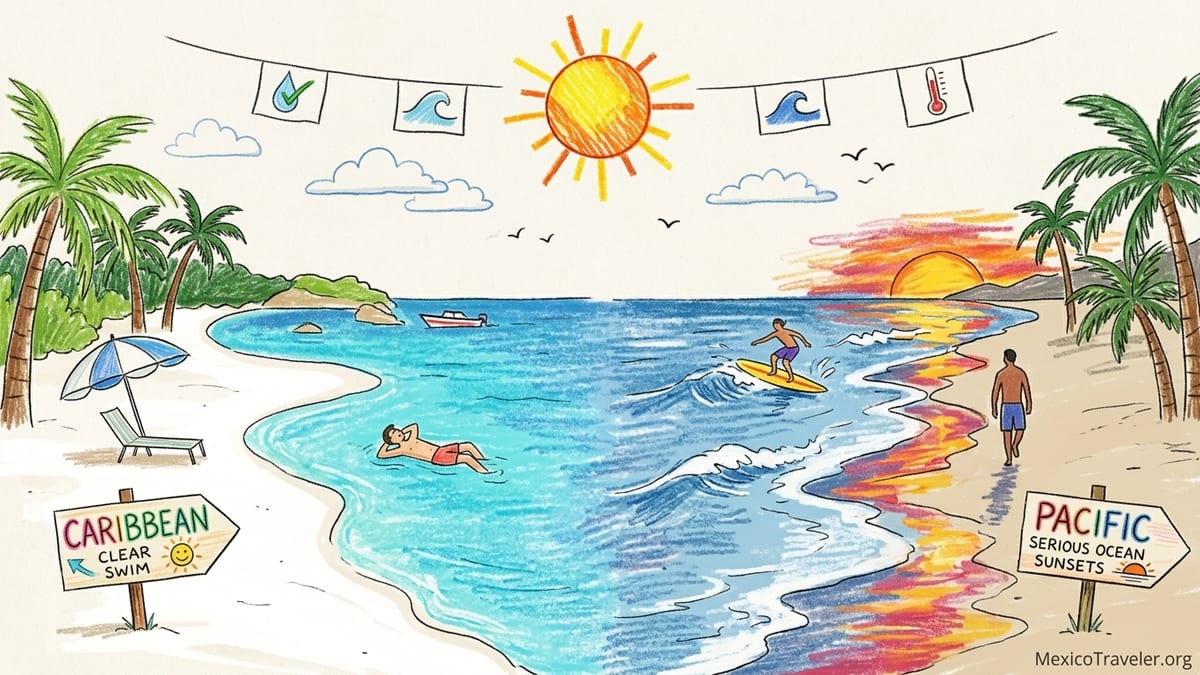
How I judge a beach (and why 2026 monitoring matters)
I’m picky in a very practical way: I want to know what my feet feel when I walk in (powder, grit, or sharp shell), how quickly the depth drops (ankle-to-waist in three steps or a long sandy shelf), whether the water is clear enough to see my toes, and whether I can relax without scanning the horizon for a set wave that will dump me. Shade matters too. So do bathrooms. So does whether I’m being upsold a “VIP bed” every 30 seconds.
Before I even think about recommending a swim, I also check current water-quality and local advisories. Mexico’s federal recreational monitoring uses enterococci as an indicator, with a commonly cited risk threshold of 200 NMP per 100 mL for recreational contact. COFEPRIS’ Verano 2026 monitoring sampled hundreds of beaches and reported that most were suitable, but a small number exceeded the criteria and were flagged as not suitable during that period. The important part is the logic: a beach that was “fine last year” can be different after rains, runoff, or infrastructure problems, especially near river mouths and outfalls.
On the Caribbean side, I treat sargassum as its own moving weather system. In September 2026, day-by-day sargassum reporting for the Riviera Maya showed that even when a majority of monitored beaches were clean or minimal, a meaningful share still had visible seaweed, and conditions could change within the same day with wind and current shifts. That is why I never promise a “guaranteed” seaweed-free beach day in Quintana Roo without a same-day check.
Caribbean and Yucatán: warm, clear, and sometimes seaweed-chaotic
When the Caribbean cooperates, it spoils you. I’ve had mornings in Cancún’s calmer coves where the water felt like a warm pool and stayed chest-deep far enough out that I could actually swim rather than bob. In protected spots like Playa Langosta, the entry is easy, the bottom is sandy and forgiving, and the water can stay clear enough that you’re watching your shadow move over ripples on the seafloor. It’s one of those rare “non-athletic swim” beaches where you can bring a nervous swimmer and everyone still has a good day.
But the Caribbean can also be the most misleading in photos. I’ve stayed near stretches that looked impossibly turquoise at 9 a.m., then by lunchtime the breeze shifted and sargassum rolled in, turning the shoreline into a brown line of seaweed and that unmistakable smell. What I dislike most is not the seaweed itself, but the whiplash: you can plan a full beach day and end up pivoting to a pool day or ferrying to an island for cleaner water.
My best strategy in the Mexican Caribbean is to be mobile. If one Hotel Zone stretch in Cancún is messy, I’ll switch to a more sheltered cove, or I’ll plan a day trip where the shoreline faces differently. I also mentally separate “walk-and-lounge beaches” from “swim beaches.” Some days, the seaweed makes the shoreline gross but the water beyond the first few meters is workable. Other days, it’s not worth forcing it.
Beaches I loved in the Caribbean: Isla Mujeres, Cozumel, and quiet coves
Isla Mujeres is my Caribbean reset button. When I want the classic white-sand, clear-water experience that feels like the brochure, I take the short hop over and spend the day actually in the water, not just staring at it. The sand is typically softer underfoot than many mainland stretches, and the water color can be that milky-aqua that makes you stop mid-sentence. I like it because the swim feels friendly: less drama in the surf than open-ocean beaches, and enough shallow shelfing that you can float and talk without fighting waves.
Cozumel, on the right day, is the clearest water I’ve personally swum in around the region. When I’ve snorkeled here, the standouts weren’t “lots of fish,” but specific sightings: parrotfish grinding at coral, schools of blue tang, sergeant majors flashing their striped uniforms, and the occasional barracuda holding still like it’s been paused. Cozumel’s downside is that it’s not a lazy, everywhere-is-swimmable island. Some areas have ironshore and ladders rather than a sandy entry, which is great for confident swimmers and awkward for families with small kids.
On the mainland, I gravitate toward calmer, protected beach pockets for a real swim. Playa Langosta in Cancún is a recurring favorite because it stays more reliably swimmable when other stretches are rougher, and it’s the kind of place where I can do long, relaxed laps without feeling like the ocean is trying to outsmart me. If I’m traveling with friends who want a simple day, it’s the beach I pick when I don’t want to gamble.
The Caribbean beaches I’d skip (or only do for photos)
Tulum is where my love of the Caribbean gets complicated. I’ve had gorgeous swims there, but I’ve also had the most “this looked better on Instagram” moments of my Mexico beach life. The sand can be beautiful, the water can be clear, and then the combination of sargassum, crowds, and the constant sell can drain the joy out of it. I dislike how quickly a mellow beach day turns into an obstacle course of reservations, minimum spends, and searching for a square meter of unclaimed shade.
If you want a concrete example of what I mean by “photo beach” versus “feel beach,” Tulum is the place. The camera loves the color contrast of white sand and teal water, plus the palm-leaning aesthetic. But in person, if the seaweed is up and the wind is wrong, the shoreline can feel messy and smelly, and the swim can be less pleasant than a less famous beach a few miles away. In those moments, I’d rather spend my money on a good lunch and save the swim for another day.
My other Caribbean “skip” isn’t a single named beach, but a habit: I avoid long, fully exposed stretches on high-wind days if the seaweed reports look mixed. In September 2026, daily Riviera Maya reporting showed that even when many beaches are clean or minimal, a substantial minority can still have visible sargassum, and a beach that is fine in the morning can change by afternoon. That variability is exactly why I plan a backup: cenotes, a lagoon-side afternoon, or a different-facing beach.
Pacific Mexico: the sunsets are real, but the ocean can be serious
The Pacific side is where Mexico’s beach personality changes completely. The water often feels cooler than the Caribbean, the waves have more muscle, and the drop-off can be steeper. The payoff is the sunset. On the Pacific, I’ve watched the sky go copper, then pink, then purple, with the last light reflecting off wet sand like a mirror. It’s the kind of beauty that doesn’t need a filter.
Puerto Vallarta is a good example of “city beach convenience” with a few caveats. You can walk from tacos to sand in minutes, and the vibe is social, but you also have to think like a local about runoff, river mouths, and post-rain water. COFEPRIS’ Verano 2026 monitoring flagged Playa del Cuale in Puerto Vallarta as not suitable during that sampling period because it exceeded criteria. That makes intuitive sense when you see where it sits: near a river mouth and urban flows. It’s a reminder that on any coast, the prettiest promenade isn’t always the cleanest swim.
Oaxaca’s coast is where I’ve felt the Pacific’s power most directly. Puerto Escondido can be a surf dream and a casual-swimmer trap in the same afternoon. COFEPRIS-linked local reporting in Oaxaca in summer 2026 noted an observation for Playa Principal of Puerto Escondido with elevated enterococci during that period, while other nearby beaches were reported suitable. My takeaway is not “don’t go.” It’s “choose your specific cove, and keep an eye on what’s happening right now.”
Pacific beaches I loved: Puerto Escondido coves and the “swimability factor”
In Puerto Escondido, I don’t treat all beaches equally. Zicatela is iconic, but it’s not my go-to for a casual swim. I go there to watch surfers and feel the energy, then I move to smaller bays when I want to get in the water. The coves like Carrizalillo and Puerto Angelito have been my personal “yes, I can actually swim” spots because the geography softens the ocean’s punch. The water still feels like the Pacific, but it’s less of a wrestling match.
When I snorkeled off the calmer Oaxacan coves on clear mornings, the life I remember wasn’t exotic-rare, but vivid: damselfish hovering close to rocks, wrasses darting, sea urchins wedged into crevices, and the occasional stingray gliding through the sand like a moving shadow. Visibility varies a lot with swell. I’ve had days when it was clear enough to track fish patterns, and other days when the surge made it feel like looking through shaken glass.
What I like most about these smaller Pacific bays is the rhythm of the day. You can swim early, eat something simple nearby, then come back for golden hour. The vendors exist, but the pressure feels lower than in the most heavily packaged resort strips. And the sunsets, especially when thin clouds catch the light, are the kind that make you stay on the beach longer than you planned.
Baja California and Baja California Sur: dramatic beauty, colder water, and different expectations
Baja beaches are where I adjust my idea of a “good beach day.” In parts of Baja California Sur, the visuals are astonishing: pale sand, desert mountains, and water that can shift from deep blue to turquoise depending on the cove. But the water temperature can be noticeably cooler than the Caribbean, and the ocean exposure can be more variable. I’ve had swims where I loved the clarity and hated how quickly I went numb.
In Baja, I also pay more attention to access and safety warnings, because some of the best-looking beaches are remote, and conditions can change without the infrastructure you’d find in a major resort zone. A beach that feels empty and pristine can also mean no lifeguards, no shade, and a longer wait if something goes wrong. When Baja is calm, it can be magical. When it’s windy or the surf is up, it becomes a beach for walking, photos, and short dips rather than long swims.
My favorite Baja moments are simple: a quiet cove where the water is clear enough to see rocks and small fish near shore, a long beach walk with no one around, and then a casual meal in town where the seafood tastes like it came from the same horizon I just stared at. Baja rarely gives me the “tropical float all day” vibe. It gives me contrast, scale, and a kind of rugged calm that feels different from the Caribbean’s lushness.
The Takeaway
If you want the most reliably easy swimming, start with calmer Caribbean coves and island days, and treat sargassum like weather. If you want drama and sunsets, the Pacific delivers, but it asks you to respect currents, shorebreak, and post-rain water quality. If you want raw beauty and fewer crowds, Baja can feel like the edge of the continent, but bring different expectations about water temperature, shade, and services.
The unglamorous truth is that beach quality needs current verification. COFEPRIS’ 2026 federal monitoring, with a clear enterococci threshold for recreational contact, is a reminder that conditions can change by location and season, and that a “best beaches” list is only responsible if it encourages you to check current advisories. On the Caribbean coast, sargassum can vary sharply by beach and by day, even within the same destination. The best Mexico beach trip is the one planned like a flexible itinerary, not a single, fixed postcard.
FAQ
Q1. What does COFEPRIS actually measure for beach water quality?
COFEPRIS recreational monitoring commonly uses enterococci levels as an indicator of contamination risk for primary contact recreation, and compares results to a threshold used for public health guidance.
Q2. What was the key message of the COFEPRIS Verano 2026 beach monitoring?
The monitoring reported that most sampled beaches were suitable during that period, but a small number exceeded the criteria and were flagged, reinforcing that conditions vary by location and time.
Q3. Which beach was flagged in Puerto Vallarta during Verano 2026 monitoring?
COFEPRIS’ Verano 2026 report flagged Playa del Cuale in Puerto Vallarta as not suitable during the sampling period, a reminder to be cautious near river mouths and urban runoff.
Q4. Why can a beach look perfect in photos but feel disappointing in person?
Crowds, noise, aggressive vendor pressure, limited shade, or seaweed buildup can change the experience even when the water color still photographs beautifully.
Q5. How unpredictable is sargassum in Quintana Roo?
It can change sharply by beach and by day, and even within the same day as wind shifts. That’s why same-day checks and backup plans matter on the Caribbean coast.
Q6. Which Cancun-area beach tends to be better for relaxed swimming when conditions are mixed?
Protected coves like Playa Langosta are often favored for calmer entry and easier swimming, though you should still check same-day seaweed conditions.
Q7. Is the Pacific coast good for swimming if I’m not a strong swimmer?
It depends on the specific beach and the day. Many open Pacific beaches have stronger surf and rip currents, while smaller bays and coves can be far more swimmable.
Q8. What snorkeling marine life might I realistically see around Cozumel on a good day?
Common sightings for many snorkelers include parrotfish, blue tang, sergeant majors, and sometimes barracuda, with visibility often better than many mainland spots.
Q9. Why does Baja feel so different from the Caribbean?
Baja often has cooler water, more wind exposure, and more rugged access, trading tropical softness for dramatic desert-meets-sea scenery and quieter stretches.
Q10. What is the simplest way to avoid a “wasted beach day” in Mexico?
Build flexibility into your plan: check current water-quality and local advisories, verify same-day seaweed conditions in the Caribbean, and keep a backup activity for wind or surf changes.